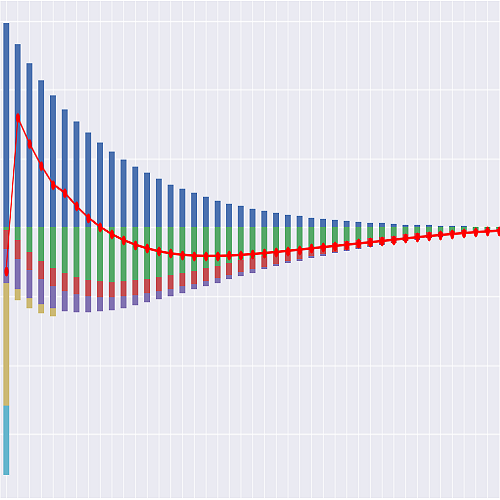
The IP_UK_S Model#
Reference liability cash flow model for UK individual income protection.
IP_UK_S is the executable counterpart of
products/income_protection/technical-notes.md in the lifelib-products library. It
projects gross best-estimate liability cash flows for a single-policy model point of
full-term guaranteed-premium own-occupation income protection: a monthly income benefit
payable in arrears after a deferred period, escalating in claim, ceasing at recovery,
death or the policy end date.
This is the only multiple-state model in the library. Every other model here runs a single in-force probability down through decrements; this one carries a three-state population — healthy and active (H), sick and in claim payment (S), dead (D) — with lapse as a further exit from H and recovery flowing back from S to H. That structure is not decoration: it is the structure the CMI’s own graduations use, and the reason IP has two experience bases rather than one, claim inception rates out of H and claim termination rates out of S.
The second structural feature is that the in-claim population is two-dimensional.
Termination rates depend on how long the claim has already run — 40% a year at duration
one, 5% from duration five in the shipped basis — so the model tracks l_S(t, z), the
population in claim at month t with claim duration z, cohort by cohort.
Collapsing that to a single bucket with a duration-independent termination rate
materially misstates claim run-off, and is the notes’ first-listed pitfall.
Spaces. The model contains two:
DataReads the five input CSVs and holds their filename References. It takes no parameters, so each file is read once per model.
ProjectionThe by-policy projection, parameterized by
point_id:Projection[1]is an ItemSpace projecting model point 1. It reaches the input tables through itsdataReference, which resolves to the singleDataSpace.
The split matters for more than tidiness. Because Projection is parameterized,
every Projection[N] is a separate ItemSpace with its own cells cache; readers
placed there would re-read every file for every policy. In Data they are evaluated
once, however many policies are projected.
Input data is external: CSVs in the model folder’s parent directory, read at run time rather than stored inside the model. The model folder itself holds no data, so the model and its inputs must travel together.
Projection basis. Monthly steps, matching the monthly-in-arrears benefit. Policy
month t is 0-based and runs 0, 1, …, proj_len() - 1, where
proj_len() = 12 x (expiry_age - entry_age) is the number of projected months;
t = 0 is the first month and the policy year is the contractual label
policy_year(t) = t // 12 + 1. Premiums fall at the beginning of the month and are
paid by lives in H only — premiums are waived from the start of benefit payment.
Transitions and benefit fall at the end of the month; a claim incepting at the end of
month t receives its first payment at the end of month t + 1. All cover and any
claim in payment terminate at the policy end date, the end of month
proj_len() - 1, with no value. The claim duration z is a separate 1-based
cohort clock, not a time index.
Model points come in two kinds. status = active cells start the whole population
in H; status = in_claim cells start it in S at a stated claim duration, and are the
disabled-life annuity the notes describe. An in-force portfolio needs both.
What is sourced and what is not. The contractual mechanics are sourced: the deferred period menu, the two-band maximum-benefit formula, escalation capped at 10% with a x1.5 premium multiplier continuing in claim, waiver of premium from benefit start, linked claims within 52 weeks, and expiry without value. Every rate is a standardization. The CMI IP11 Series — claim inception rates by sex, deferred period and occupation class, and termination rates split by recovery and death — is restricted to CMI Authorised Users, so the inception, recovery and in-claim mortality rates shipped here are [std] proxies shaped like IP11 and carry no CMI authority, and the premium is a placeholder. This model is a mechanics demonstration, not a pricing or reserving result. Replace the basis with licensed tables before drawing any conclusion from the output.
Verification. tests/test_income_protection_uk.py asserts the notes’ three-month
claims-in-payment worked example (t = 0, 1, 2) to the penny, including its present
values, and the first-month (t = 0) active-lives figures alongside it.
Example
>>> import modelx as mx
>>> model = mx.read_model("products/income_protection/IP_UK_S")
>>> model.Projection[1].result_cf()