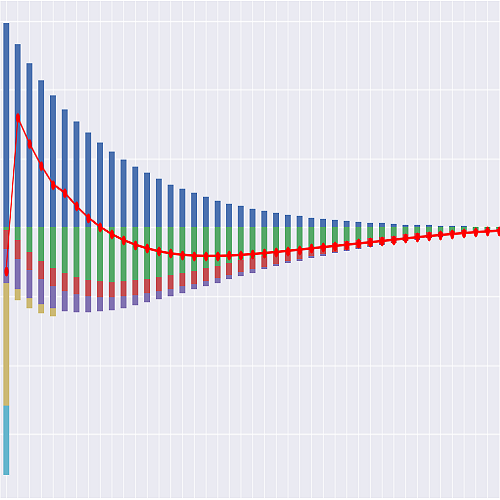
The BU_DE_S Model#
Reference liability cash flow model for the German selbstaendige Berufsunfaehigkeitsversicherung.
BU_DE_S is the executable counterpart of
products/berufsunfaehigkeit/technical-notes.md in the lifelib-products library. It
projects gross best-estimate liability cash flows, undiscounted, for a single-policy
model point of a German standalone occupational-disability contract — a monthly
BU-Rente while the insured is berufsunfaehig, a Beitragsbefreiung for the same
period, and nothing at all otherwise — on a monthly grid over t = 0 ...
proj_len() - 1.
Three things make this the German BU model rather than a translated disability rider.
It is a four-ledger multi-state chain with a return arc. aktiv (paying premium,
exposed to inception, active-lives mortality and lapse) becomes leistungspflichtig
(receiving the BU-Rente, premium-free, exposed to reactivation and to disabled-lives
mortality), which on a Nachpruefung termination becomes a three-month run-off in
which the annuity is still paid, and only then returns to aktiv. Death and lapse are
the only absorbing exits, so inception, recovery and reactivation are internal transfers
and must not appear in the closure identity. The run-off is § 174 VVG in arithmetic: the
insurer stays liable to the end of the third month after the notice reaches the
policyholder, so a recovery does not release the liability in the month it happens.
check_runoff_roll_fwd() and
check_dis_roll_fwd() assert both ledgers close.
The premium is quoted as two numbers. The Bruttobeitrag is the contractually
guaranteed maximum, struck on Rechnungsgrundlagen erster Ordnung; the Zahlbeitrag
actually charged is beitragsverrechnung times it, the anticipated Ueberschuss
credited in advance under § 153 VVG through § 176. Both are published —
premiums() is the gross stream and
surplus_credit() the credit returned out of it — because a
model carrying only one of them either assumes the credit is permanent or overstates
collected premium by 1 / 0.70 - 1. No German BU rate card exists in this library’s
source corpus, so the Bruttobeitrag is derived by an equivalence on a stated
first-order basis rather than read from a table.
The premium is weighted by the premium-paying count, not by the in-force count.
pols_prem(t) is pols_actv(t) plus the disabled cohorts still inside the
Karenzzeit: charging premium to lives in claim silently deletes the
Beitragsbefreiung, which is core cover and not an option.
Spaces. The model contains two:
DataReads the seven input CSVs and holds their filename References. It takes no parameters, so each file is read once per model.
ProjectionThe by-policy projection, parameterized by
point_id:Projection[1]is an ItemSpace projecting model point 1, the worked example’s anchor cell. It reaches the input tables through itsdataReference, which resolves to the singleDataSpace.
The split matters for more than tidiness. Because Projection is parameterized,
every Projection[N] is a separate ItemSpace with its own cells cache; readers placed
there would re-read every file for every policy. In Data they are evaluated once,
however many policies are projected.
Input data is external: plain CSVs in the model folder’s parent directory, read at
run time rather than stored inside the model. The model folder holds nothing but
formulas — no _data/, no IOSpec, no embedded values — so the model and its inputs
must travel together, and a diff of the model shows logic changes only.
Projection basis. Monthly steps, matching the BU-Rente paid monthly in advance and
the retail monthly premium. t is the policy month, 0-based: t = 0 is the
first projected month — the month of inception for a new-business point, the valuation
month for an in-force one — and proj_len() is the number of projected months, the
exclusive end of the frame, so result_cf() runs t = 0 ... proj_len() - 1 and ends
there — 444 rows on the anchor cell. Premium, the surplus
credit, administration expense, the BU-Rente and the claim-maintenance cost fall at
the start of the month; every state transition and the claim-assessment cost at the
end of it.
What is sourced and what is not. The mechanics are the established German ones and
each carries the instrument it must be checked against: the Berufsunfaehigkeit
definition and its 50 % / six-month concretisation, the Anerkenntnis and Nachpruefung
frame with its three-month run-off, the Beitragsbefreiung, the Brutto / Zahlbeitrag
pair, the unisex rule, and the absence of any death, maturity or surrender benefit.
Every level is a standardization. The DAV 1997 family (inception, reactivation and
disabled-lives mortality) and DAV 2008 T are the property of the Deutsche
Aktuarvereinigung, are not public and are not redistributed here — they are cited by
name and the model ships anchored [std] proxies instead. No German insurer publishes
a BU charge structure, lapse rate or rate card, and a pure risk contract carries no
Effektivkosten disclosure, so the charges and the premium are [std] too.
This model is a mechanics demonstration, not a pricing or reserving result. Replace
the decrement, charge and premium bases with company data before drawing any conclusion
from the output.
Model points. Thirteen, covering both premium forms, all four payment frequencies, an in-force active policy, an in-force policy already in claim, a Karenzzeit, an Endalter of 60, a Leistungsendalter below the Versicherungsdauer, the AU-Klausel switched on, a Risikozuschlag, a point with both escalation options off, and a premium override. Model point 1 is the anchor cell of the worked example in the technical notes, and model points 2 and 3 are one-attribute neighbours of it so that the unisex invariance and the occupational loading can be measured against it rather than inferred.
Verification. tests/test_berufsunfaehigkeit_de.py asserts the notes’ worked
example to the cent and pols_if to six decimals, the derived annual Bruttobeitrag,
and one test per listed modeling pitfall. tests/test_model_conventions_de.py asserts
the house style, including delib’s two rulings: every model publishes
check_net_cf(), and every input CSV but the model point table
carries a populated provenance column.
Example
>>> import modelx as mx
>>> model = mx.read_model("products/berufsunfaehigkeit/BU_DE_S")
>>> model.Projection[1].result_cf()