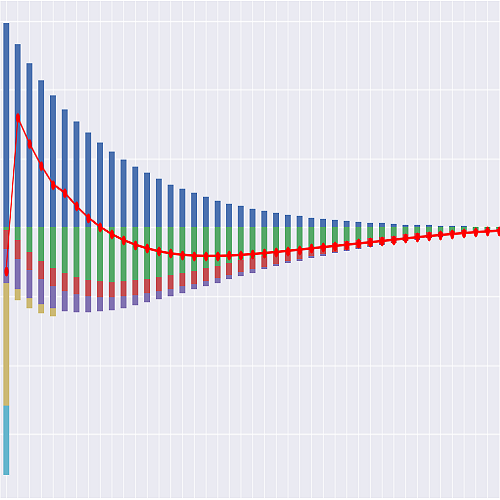
The FRV_DE_S Model#
Reference liability cash flow model for the German fondsgebundene Rentenversicherung.
FRV_DE_S is the executable counterpart of
products/fondsgebundene_rentenversicherung/technical-notes.md in the lifelib-products
library. It projects gross best-estimate liability cash flows for a single-policy model
point of a German unit-linked deferred private annuity — Schicht 3, single life,
one fund, no Beitragsgarantie — over the *Aufschubzeit* only, on a monthly
grid. At the end of month proj_len() - 1, the frame’s last, the units are cancelled,
the Fondsguthaben is converted at the Rentenfaktor, and the contract leaves this
model: the payout phase belongs to products/sofortrente/.
Three things make this the unit-linked model rather than a translated general-account one.
The insurer guarantees the number of units, not their value. There is no
Rechnungszins in the accumulation phase, no Deckungskapital, no Zinsüberschuss and
— because the Anlagestock holds the covering assets in the very units the liability is
denominated in — no investment-mismatch term anywhere in the model. The state
variable is units_pp(); euro are derived from it and a unit
price. Every charge is either withheld from the Beitrag before units are bought or
levied by cancelling units that already exist, and which of the two it is decides what
happens when premiums stop.
``net_cf`` is the non-unit stream, and that is the model’s single most important
convention. Every benefit paid before Rentenbeginn — the death benefit up to the
fund, the Rückkaufswert, the Teilentnahme, the capital released at Rentenbeginn —
is funded by cancelling the policyholder’s own units, so a gross presentation would
count the same money twice. net_cf(t) is therefore charges collected, less insurer
expenses, less the death strain. The gross flows are published beside it —
premiums, prem_to_av, claims_death, claims_lapse, claims_maturity,
withdrawals, av_releases are all result_cf() columns — and
check_benefit_funding() asserts that they net exactly, so the exclusion is visible in
the frame rather than merely asserted in prose.
Two mortality bases at once. The Risikobeitrag the tariff charges is priced on a
death table (DAV 2008 T, first order); the projection decrements on the
second-order best estimate. The wedge between them is the Risikoergebnis, and with
the shipped flat mort_be_factor = 0.75 it is exactly 25 % of the Risikobeitrag
collected. A model that uses one basis for both makes the risk result identically zero
and deletes the mechanic. The Rentenfaktor rests on a third basis again — an annuity
table, DAV 2004 R — which is why no cells reads both tables.
Spaces. The model contains two:
DataReads the six input CSVs and holds their filename References. It takes no parameters, so each file is read once per model.
ProjectionThe by-policy projection, parameterized by
point_id:Projection[1]is an ItemSpace projecting model point 1. It reaches the input tables through itsdataReference, which resolves to the singleDataSpace.
The split matters for more than tidiness. Because Projection is parameterized, every
Projection[N] is a separate ItemSpace with its own cells cache; readers placed there
would re-read every file for every policy. In Data they are evaluated once, however
many policies are projected.
Input data is external: CSVs in the model folder’s parent directory, read at run time rather than stored inside the model. The model folder itself holds no data, so the model and its inputs must travel together.
Projection basis. Monthly steps, which the contract forces rather than the modeller
choosing: the dominant premium frequency is monthly, the kapitalbezogenen
Verwaltungskosten and the Risikobeitrag are levied monthly by unit cancellation, and
the Abschluss- und Vertriebskosten instalment runs for exactly 60 months. An
annual grid cannot place the month-60 cliff, and that cliff is the characteristic shape
of a German unit-linked contract’s early values. t is the 0-based policy month
counted from the contract’s own inception — t = 0 is the inception month — so
t = 60 means the same thing on every model point. The frame is
range(proj_start(), proj_len()) with proj_start() = duration_init_m and
proj_len() = 12 x (annuity_age - entry_age), the number of policy months and so
the frame’s exclusive end; an in-force model point simply opens partway through it. The
contractual policy year is the 1-based label t // 12 + 1.
What is sourced and what is not. The mechanics are common ground in German practice:
the Beitragsverrechnung order, the five-year spreading of the acquisition charge, the
Beitragsrückgewähr death benefit and its net amount at risk, the Zeitwert
Rückkaufswert, the max(guaranteed, current) Rentenfaktor rule, and the survival
of the fund-based charges into a beitragsfrei contract. The levels are almost
entirely standardizations: no charge rate, no *Rentenfaktor*, no lapse rate and no
expense loading was established at any carrier, and no document cited in this library
was retrieved. The one anchor in the whole charge stack is the Höchstzillmersatz of
25 ‰ of the Beitragssumme, and the shipped tariff takes the cap rather than a guessed
interior point. The DAV tables — DAV 2008 T for the risk charge, DAV 2004 R behind the
Rentenfaktor — are the property of the Deutsche Aktuarvereinigung, are not public and
are not redistributed here: they are cited by name and stood in for by anchored
[std] proxies. This model is a mechanics demonstration, not a pricing, reserving
or disclosure result. Nothing it produces may be quoted as an Effektivkostenquote or
compared with a PRIIPs performance scenario, and its charge levels must be replaced with
a real tariff before any quantitative use.
Model points. Thirteen, covering both premium forms, all four payment frequencies,
an in-force cell opening at duration 96, a beitragsfrei cell on a zero-return fund, a
Zuzahlung and a Teilentnahme, a Beitragsdynamik, a Nettotarif on an ETF, a
two-year premium term inside a twelve-year deferment on a stress path, a cell with a
non-zero Stornoabzug, and a Rentenbeginn at 70 where the current Rentenfaktor
exceeds the guaranteed one so the max() bites. Model point 1 is the anchor cell of
the worked example in the technical notes.
Verification. tests/test_fondsgebundene_rentenversicherung_de.py asserts the
notes’ worked example to the cent and pols_if to six decimals, and one test per
listed modeling pitfall. Seven check_*() cells travel with the model itself.
Example
>>> import modelx as mx
>>> model = mx.read_model("products/fondsgebundene_rentenversicherung/FRV_DE_S")
>>> model.Projection[1].result_cf()