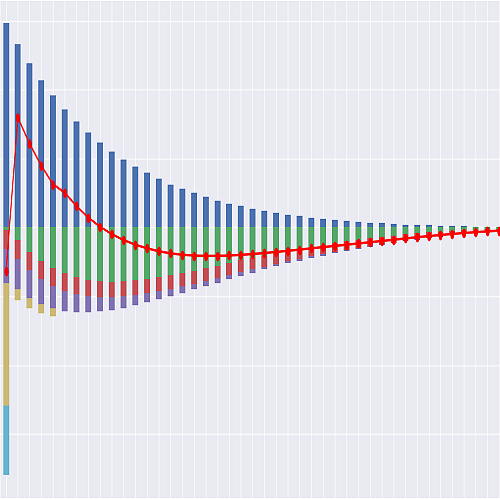
In-Force Implementation Notes#
Status: Draft, 2026-11-10. IUL_US_SEC is IUL_US_S taught to project
from a valuation date. Besides policies issued at that date, it takes policies already in
force there, in any month of their policy year and with up to twelve index segments live,
and policies to be written in the ten years after it, as lifelib’s basiclife/BasicTerm_SE
extends basiclife/BasicTerm_S. The product is the one
product-spec.md specifies and
technical-notes.md models; this page says what running in force
changes, and how the model compiles. The suffix adds lifelib’s letters to S: E for in
force, as in BasicTerm_SE, and C for the compiled form, as in basiclife/BasicTerm_SC:
the same formulas compile under modelx-cython, from sample_sec.py and spec_sec.py
beside the model.
This is a mechanics demonstration, not a pricing or reserving result. The model is
IUL_US_Son another time axis, and it readsIUL_US_S’s assumption tables in place, every assumption unchanged. The contractual elements are sourced: the 10.00% current and 2.00% guaranteed caps, the 100% participation and the 0% floor of the Benchmark Index Account [S2] R1, the 4.50% current and 1.00% guaranteed fixed-account rates [S2], the monthly ladder of 1-year S&P 500 point-to-point segments, up to twelve live at once [S2] [S3] [S4], the $10 policy fee [S3] [S5], the $25 withdrawal fee [S3], the cumulative-MNLP no-lapse test [S3] [S4], the 10-year surrender charge period [S1] [S5] [S7] and the IRC 7702(d) corridor factors R4. Every behavioural and expense assumption, the whole COI scale, the surrender charge dollars, the per-unit charge and the 6.40% level index return are std standardizations introduced for the reference implementation. Replace them with company data before drawing any conclusion from the numbers.
Run it#
python products/indexed_ul/run_sec.py            # point 1: S point 1, issued now
python products/indexed_ul/run_sec.py 7          # point 7: S point 4 in force 65 months
python products/indexed_ul/run_sec.py --block    # every model point, summed row by row
python products/indexed_ul/run_sec.py 7 --cython # point 7 on the compiled model
--cython runs the compiled model and prints the same lines. The runner builds it beside
the model with the repository’s tools/build_sec_cy.py the first time, in about three
minutes, and again whenever the model, sample_sec.py, spec_sec.py or the tool is newer
than the build, and says so on stderr. --build DIR runs a build made elsewhere instead
(The compiled model, below). Nothing a build leaves is committed, and .gitignore
covers it.
The first prints, as rows t = 0 … 11, the cash flows, the account value roll-forward,
the segment ladder and the counts behind them for point 1, IUL_US_S’s baseline cell
issued at the valuation date: its cash flows, its account values and its segment ladder
are the numbers run.py prints for IUL_US_S’s point 1 in the same months. The second
prints point 7, IUL_US_S’s monthly payer restated 65 months after its issue. It brings
in all twelve of its live segments, and one of them matures in each of its first twelve
rows: the one in slot 12 at t = 0, credited 233.73 a policy, 6.40% of its 3,652.04.
Three lines to the same thing:
import modelx as mx
model = mx.read_model("products/indexed_ul/IUL_US_SEC")
model.Projection[6].result_seg()     # point 7, the table's seventh row
Projection takes idx, the position of a point in the table, as basiclife/BasicTerm_SC
does: Projection[6] is point 7, and its point_id() says so. Its four result tables are
indexed by t, with one row per month from the valuation date, t = 0 … proj_len() − 1:
Cells |
What it shows |
|---|---|
|
|
|
|
|
|
|
The counts behind |
IUL_US_S’s four self-checks, check_av_components(), check_av_roll_fwd(),
check_seg_ladder() and check_margin(), run over the same frame and hold on every
committed point, IUL_US_S’s point 5 and the three rows restated from it included, where
IUL_US_S’s own check_margin() fails from policy month 383 (Departures, below).
--block asks every point for its frame before it projects any, then projects each and
releases its ItemSpace once its frame is read, so the run holds the cells of one point at
a time. Deleting it, del model.Projection[idx], is not enough: an ItemSpace sits in
reference cycles, which only Python’s cyclic collector frees, so the runner collects after
each release. It freezes everything alive (gc.freeze()) once the model and its table are
read, and again once it has asked every point for its frame, so that each collection scans
only what the block has made since. It prints where each point stands at the valuation
date — its months in force, policy year, attained age and count; its account value and
the three parts of it, the fixed account, the live segments and the loan collateral; its
loan, face in force, premiums paid, no-lapse accumulator and MEC status — then the block’s
first twelve rows and the block summed into projection years, pols_if the count
entering each. It keeps the block’s sum as it goes, compensated as pandas sums a
groupby, so that wherever every frame is finite the block is, bit for bit, the frames
concatenated and summed by t, as below. The committed block opens with 7.67 policies,
44,514.67 of premiums and a net cash flow of 41,034.86. A label not in the table, or not a
number, stops the runner with the table’s labels and no traceback.
Two clocks#
The model runs on two clocks, and each formula reads the one its quantity belongs to.
t, the valuation clock, counts months from the valuation date.t = 0is the valuation month for every model point, however old the policy, and the frame runst = 0 … proj_len() − 1, whereproj_len()is the number of months from the valuation date to the end of the projection, the first month at attained age 121.duration_mth(t), the policy clock, counts the months the policy has been in force at timet:duration_mth(t) = duration_mth_init() + t, withduration_mth_init()read from the model point. It is the technical notes’ own month index from issue, and the contract runs on it:duration(t) = duration_mth(t) // 12,policy_year(t) = duration(t) + 1andage(t) = age_at_entry() + duration(t), as inIUL_US_S.BasicTerm_SEreaches the same numbers by adding one a month, a recursion as long as the frame; the closed form needs no such chain of calls.
IUL_US_S already counts its months from the start of its own projection, and opens a
point whose duration_mth is above 0 there, from its account value and its loan. But it
ships no such point, and its entry loses what a policy’s past has left it: it puts the
whole account value less the loan in the fixed account, opens the loan collateral at the
loan, the face at issue and both premium accumulators at 0, and has no index segment
before its first month. Re-opened that way at its month 60, IUL_US_S’s point 4 closes
its month 71, eleven months on, with 50,921.66 of account value where its own projection
holds 53,730.24, about 5% short, and reads its no-lapse guarantee as failed where its own
projection holds it in effect. What the valuation clock adds is that t = 0 is one instant
for every point, that a point may be issued after it, and that a point in force brings in
its whole state, its live index segments among it (The opening state, below).
Point 7 is IUL_US_S’s point 4, the monthly payer, restated at its month 65. At t = 0
it is five months into policy year 6, at attained age 50, with all twelve segments live,
and its frame has 847 rows, t = 0 … 846. Its anniversaries fall at t = 7, 19, …, where
the attained age steps to 51 and the premium persistency from 0.98⁵ to 0.98⁶. Point 12 is
IUL_US_S’s point 4 to be issued 25 months after the valuation date:
duration_mth(0) = −25, it is on the books from t_entry() = 25, rows 0 to 24 are zeros,
its first monthly premium, $833.33, falls at t = 25, and its frame has 937 rows.
Read on the policy clock |
Read on the valuation clock |
|---|---|
the anniversary premium, |
the index path, |
The index path. IUL_US_S grows the index at its level return along its own months,
index_level(t) = index_level_init × (1 + index_return_ann)^(duration_mth(t) / 12): a
path of each point’s own from its issue, which is one path for every point it ships, all
issued at its t = 0. Here the path runs on the valuation clock,
index_level_init × (1 + index_return_ann)^(t / 12), one path for every point of a block,
as a historical or simulated path would be: index_level_init, 4,500.00 as shipped, is its
level at the valuation date. A segment’s credit is a ratio of two levels, its level at
maturity over its level at its creation, so the path’s clock moves no credit as long as
both levels are on the same path. A segment created in the frame, at month t − 12,
starts from index_level(t − 12); one created before the valuation date carries its start
level in its ladder row, on this model’s path: IUL_US_S’s level at the segment’s
creation, times index_level_init over IUL_US_S’s level at the valuation date. On
point 7 the segment maturing at t = 0 started from 4,229.32, where IUL_US_S’s started
from 5,918.41 and matures at 6,297.18: its return is 6.40% either way. What moves is the
level itself: on a point in force d months, index_level(t) is IUL_US_S’s level at its
month t + d divided by (1 + index_return_ann)^(d / 12), 1.399374 on point 7, and so is
the index_level column of result_seg(). Each credit agrees with IUL_US_S’s on a
restated row to the rounding of a ratio of two other levels, a few parts in 10¹⁵, and
every other value of the four reports to within 4e-12 relative on the committed rows, but
the credit of a segment drawn to a rounding about zero (The segment ladder, below).
index_level is the single point of substitution: override it with a path keyed by the
months from the valuation date, and every segment created in the frame follows it, while
one created before the valuation date reads its start level from its ladder row, which
must then be on the same path.
The cap in force and the fixed-account rate are economic inputs too, read at t: a
re-declared rate applies to every point from the month it is declared, and a re-declared
cap to every segment created from that month on, since a segment keeps the cap declared at
its creation (seg_index_cap(t), the ladder’s seg_index_cap_init for a segment created
before the valuation date). As shipped both are level, 10.00% and 4.50%, so their clock
shows in no number. Expense inflation keeps IUL_US_S’s step by year and moves it onto
t, so that the maintenance expense would be in valuation-date dollars, for every point
alike; it ships at 0, as in IUL_US_S, and moves no number either. Switched on, a point in
force bears IUL_US_S’s maintenance expense times
(1 + inflation_rate)^(t // 12 − (y − 1)), y its policy year in the month, both models
stepping on their own anniversaries. Acquisition, $150 a policy in the issue month, is
charged per policy issued and not inflated, as in basiclife/BasicTerm_SE: IUL_US_S
charges it on the policies in force in the issue month, which are the policies issued.
Because row t is the same month for every point, the frames of a block line up and sum
row by row, which is what run_sec.py --block prints:
import pandas as pd
frames = [model.Projection[i].result_cf() for i in range(len(model.Data.point_id()))]
block = pd.concat(frames).groupby(level="t").sum()
On a point issued at t = 0 the two clocks coincide, and the model computes what
IUL_US_S computes, whatever the point’s count. On IUL_US_S’s five points, all new
business, every cash flow and every count agrees, and so does every other cell the two
models share, at every argument IUL_US_S’s own sweep evaluates, bit for bit, but four
whose meaning changed: pols_if_init(), now the count already in force at the valuation
date, 0 for new business; model_point(), a row of another table; result_pols(), which
gains pols_new_biz; and check_margin(), whose identity this model states with the debt
a surrender recovers (Departures, below), and which holds on point 5, where
IUL_US_S’s fails.
The in-force interface#
The model point table is model_point_table_sec.csv. It carries IUL_US_S’s columns,
pols_if_init renamed policy_count, and ten of its columns are the in-force interface:
basiclife/BasicTerm_SE’s two, and eight that open an in-force policy’s state, two of
them IUL_US_S’s own. The live index segments are a companion table,
inforce_segments_sec.csv, one row a segment (below). Every amount is per policy.
Column |
Unit |
Measured at |
Meaning |
|---|---|---|---|
|
policies, not necessarily whole |
for a point in force, the start of month 0, before any month-0 event; for any other, its issue month |
the policies in force at the valuation date, for a point already in force; the policies issued, for one issued at or after it |
|
whole months |
the valuation date |
the policy’s age in months: positive in force, in any month of its policy year, 0 for a policy issued at the valuation date, |
|
dollars, of either sign |
the start of month 0, before any month-0 event: the close of policy month |
the account value: the fixed account, the live segments and the loan collateral |
|
dollars, 0 or more |
the start of month 0 |
the policy loan outstanding, the interest accrued to then included |
|
dollars, of either sign |
the start of month 0 |
the fixed (holding) account, which an exhausted policy runs below 0 |
|
dollars, 0 or more, above 0 exactly where the loan is |
the start of month 0 |
the loan collateral account, part of the account value, as the debt is not |
|
dollars of face, 0 to |
the start of month 0: after policy month |
the face in force, after every Option A withdrawal cut to date |
|
dollars, of either sign |
the start of month 0 |
the gross premiums paid from issue to policy month |
|
dollars, of either sign, at most |
the start of month 0 |
the same less every loan drawn: the no-lapse guarantee’s accumulator |
|
an int code: 0, not a MEC; 1, a MEC |
the start of month 0: the latch after policy month |
whether the policy has failed the 7-pay test, and so is a modified endowment contract for good |
The eight state columns are 0 on a point issued at or after the valuation date: it is
issued at the face sum_assured, with no account value, no loan, nothing paid and no MEC
status, and with no segment. av_pp_init and loan_bal_init are IUL_US_S’s own columns:
they already measure the account value and the loan entering IUL_US_S’s first month, so
they keep their names. Each new column is named for the cell it opens, with _init added:
fa_pp_init for fa_pp_at, lca_pp_init for lca_pp_at, sum_assured_init for
sum_assured_at, cum_prem_init for cum_prem_pp, as in UL_US_SEC,
cum_prem_net_init for cum_prem_net_pp and is_mec_init for is_mec. No quantity of
the product is read at the last anniversary, so none needs a column at a second instant:
at a mid-year valuation the year’s anniversary premium and loan draw are already inside the
two accumulators and the loan.
The segment ladder. inforce_segments_sec.csv holds, for each point in force, one row
for each of its last min(12, duration_mth) policy months, a month whose sweep made a
segment of nothing, or whose segment has since been drawn to nothing, included:
Column |
Unit |
Measured at |
Meaning |
|---|---|---|---|
|
a label, a point of the table |
— |
the point the segment belongs to; nothing else in the file names one |
|
whole months, 1 to 12 |
the valuation date |
the months since the segment’s creation: slot |
|
dollars, |
the start of month 0 |
the segment’s balance |
|
dollars, |
the start of month 0 |
the monthly deductions charged to it since its creation |
|
dollars, |
the start of month 0 |
the withdrawals and loan transfers drawn from it since its creation |
|
index points, above 0 |
the segment’s creation |
the index level it started from, on this model’s path, whose level at the valuation date is |
|
a rate, 0 or more |
the segment’s creation |
the cap declared then, at which its credit at maturity is capped |
A point not yet in force holds no row. A segment’s balance, deductions and draws are its
credit base, and its creation balance takes no column: nothing may enter or leave a
segment but a deduction, a withdrawal or a loan transfer, since segments earn no interim
interest, so it is the three summed, the closure IUL_US_S’s own ladder check asserts
(The segment ladder, below). The ladder is long, a row a segment, rather than sixty
columns of the model point table, and it is read by a Data reader of its own,
inforce_segments(), which no reader of IUL_US_S’s could serve.
|
|
Why |
|---|---|---|
|
|
The count, under BasicTerm_SE’s name. |
|
|
The same column, now at the valuation date, and negative for a policy to be issued after it |
|
the same |
|
— |
|
|
— |
|
|
— |
|
|
— |
|
|
— |
|
|
— |
|
No segment of |
On the twins the six new columns take what IUL_US_S itself assumes on new business, 0,
and IUL_US_S’s two are as its table has them, 0 on every shipped point, so each twin
opens as its S row does, and holds no ladder row.
The columns carried over are read as IUL_US_S reads them. For a policy in force, the
facts they record are still those at issue, the plans for premiums, withdrawals and loans
and the allocation excepted, which hold over the frame:
Column |
Unit |
Measured at |
|---|---|---|
|
labels |
— |
|
years, age nearest birthday |
issue, not the valuation date: |
|
codes, as in |
issue |
|
dollars of face |
issue: the face a policy is issued at, and the surrender charge’s base, whatever withdrawals cut the face to |
|
|
the option in force over the frame |
|
|
issue |
|
|
the pattern over the frame; a single premium falls in the issue month alone |
|
|
the mode over the frame; an annual premium falls on the policy anniversary |
|
dollars a year, the planned premium, or the single premium on |
the plan over the frame, before the premium persistency |
|
a fraction of each premium |
the current load over the frame |
|
a fraction of the fixed account |
the share each month’s sweep moves into a new segment |
|
dollars a month; a policy year |
the withdrawal taken in every month from that policy year on, gross of its $25 fee; 0 on every shipped point but 5 |
|
dollars a year; a policy year |
the standard loan drawn at each anniversary from that policy year on; 0 on every shipped point but 5 |
|
a flag and a schedule ID, a row of |
issue |
|
dollars a year per $1,000 of face |
issue: the minimum no-lapse premium rate |
|
dollars, the compliance inputs |
issue |
Three more columns, row_kind, source_policy_id and source_mth, record where the
generator took each shipped row from (below). No formula reads them, and an in-force
extract need not carry them: without them the model projects the same numbers, and
run_sec.py runs.
Data.model_point_table() checks the table as it reads it, over all rows at once, by
twenty rules in turn. The first that fails raises ValueError, naming the missing column
or every point that fails it:
the in-force columns are present, and so is every column of
IUL_US_S’s own that the projection reads as a number or a flag:age_at_entry,wd_first_year,loan_first_year,sum_assured,premium_pp_ann,wd_pp,loan_new_pp_ann,mnlp_rate,gsp,glp,seven_pay_prem,load_prem_rate,index_alloc_rateandhas_surr_charge;no
point_idappears twice;policy_countis a number, zero or more, so not blank, text or infinite;duration_mthis a whole number of months, and −120 or more: “model_point_table_sec.csv: duration_mth must be -120 or more, a policy issued at most 120 months after the valuation date; it is not at point_id [12]”. Future new business is written over a horizon,Data.future_horizon_mth, 120 months as shipped, so that no frame runs longer than the projection from issue plus ten years: 1,572 months at issue age 0, the youngest the product issues, and 1,032 at 45, the only issue age the shipped COI scale carries. Set to 0, the Reference refuses future new business altogether, and a negative horizon is itself refused;age_at_entryis a whole number of years, 0 or more, andwd_first_yearandloan_first_yeareach a whole number of policy years, 1 or more:IUL_US_Stakes theint()of each, so a fraction would move an age or a first year without a word;sum_assured, the face at issue, is a number above 0, andpremium_pp_ann,wd_pp,loan_new_pp_ann,mnlp_rate,gsp,glpandseven_pay_premare each a number, zero or more: the guideline limit’smaxand the single premium’sminreadgspandglp, and would lose a blank one;load_prem_rateandindex_alloc_rate, the share of each premium the load takes and the share of the fixed account each month’s sweep moves into a segment, are numbers from 0 to 1;has_surr_chargeisTrueorFalse, as pandas reads those words, in any case. A blank, a number or any other text is refused: one such value turns the whole column into text, where"False"is a true string, so that every point would read as carrying a surrender charge;av_pp_initandfa_pp_initare each a number, of either sign (The opening state, below);lca_pp_init,loan_bal_initandsum_assured_initeach a number, zero or more, a face of 0 in force among them; andcum_prem_initandcum_prem_net_initeach a number, of either sign: each is a tax or guarantee measure, not a balance, and withdrawals and loans can exceed the premiums paid;is_mec_initis 0 or 1, an int code; written as 1.0 it reads asTrue;a policy not yet in force,
duration_mth0 or less, has an opening state of zeros: “model_point_table_sec.csv: cum_prem_init must be 0 on a policy not yet in force, duration_mth 0 or less; it is not at point_id [12]”;sum_assured_initis at mostsum_assuredon a policy in force, since face increases are not modelled. A face below it is accepted, whether withdrawals cut it or an elective decrease the model does not implement, and it is projected from the value given;lca_pp_initis above 0 exactly whereloan_bal_initis: a standard loan moves value into the collateral account on the day it is taken, and the model takes no repayment, so the two are held together from the loan’s first day, each at its own rate;cum_prem_net_initis at mostcum_prem_init, to a cent and a half, half a cent for each of the two and half a cent more, since loans only lower it;is_mec_initis 1 wherever the 7-pay test has already failed in the month before the valuation date:cum_prem_initaboveseven_pay_premtimes the policy years to then, in the first seven. A failure the premiums to date no longer show, after withdrawals, or one on a policy valued after its seventh year, where the test no longer applies, is the column’s to record, and either value is accepted.
Data.inforce_segments() checks the ladder as it reads it, by nine rules in turn, each
naming the lines or the points it fails on:
the seven columns are present;
point_idandslotare each a whole number, read by value, below2**53in size;each
point_idis a point of the table: “inforce_segments_sec.csv: point_id [99] on line [68] is no point of model_point_table_sec.csv”;no
point_idandslotappear together twice;slotis from 1 to its point’sduration_mth: no segment predates issue, and a point not yet in force holds none;each balance, deductions and draws are a number,
−1e-8or more: a draw or a deduction that took a segment’s whole balance can leave a rounding about zero of either sign, whichIUL_US_Scloses on (The segment ladder, below) and an extract carried to the cent writes as 0;check_seg_ladder()holds every live balance to the same−1e-8,IUL_US_S’s tolerance, so a balanceDataadmits is one the check passes;each start level is a number above 0, the level the segment’s return divides by;
each cap is a number, zero or more: the credited rate’s
minreads the cap first, and would read a blank cap as a credit at the floor, without a word;each point’s
av_pp_initis itsfa_pp_initplus itslca_pp_initplus the balances of its segments, to half a cent an amount and half a cent more: “model_point_table_sec.csv: av_pp_init must be fa_pp_init plus lca_pp_init plus the point’s segments in inforce_segments_sec.csv, to half a cent an amount and half a cent more; it is not at point_id [7]”.check_av_components()holds that identity in every month, and the opening state is the close of the month before. The projection opens the account value from its parts, the fixed account, the collateral and the ladder’s balances, summed slot by slot asseg_bal_active_pp()sums, not from this column, so an extract carried to the cent, whose rounded parts need not sum to its rounded account value, opens one account, and the check holds on it, as it does on every committed point carried to the cent. The cent slack also covers an exhausted account: at its worst, on S point 5’s month 906, the account value is −9.81e9 and its parts differ from it by 3.8e-6.
Six kinds of point read, but proj_len() refuses each, naming the point, because each is
a rule of the product, read from Projection’s References, not the table’s. It checks them
in this order:
a point to be issued at or past attained age 121,
maturity_age, which would never be in cover: “point_id 12: age_at_entry 121 is at or past maturity_age, 121: a policy issued there would never be in cover”. The age is checked first, so that such a point is refused by its age whenever it is to be issued: one to be issued later would otherwise have a frame of months, every one of them before its issue. A point to be issued at attained age 120 is a policy, with a year of cover;a point at or past the end of the projection at the valuation date,
duration_mth ≥ 12 × (121 − age_at_entry): “point_id 11: duration_mth 912 is at or past the end of the projection, policy month 912, attained age 121”;a point whose planned withdrawal is above 0 and below the withdrawal fee,
0 < wd_pp < wd_fee: “point_id 5: wd_pp 24.99 is above 0 and below wd_fee, 25.0: a withdrawal pays its fee out of itself, so it must be at least the fee”. Such a withdrawal would debit the account less than the fee the insurer books and pay the policyholder nothing:IUL_US_Sprojects it, and its own account value roll-forward and margin identity fail on it, as they do on its point 5 withdrawing $20 a month;a point in force whose ladder does not hold exactly one row for each of its last
min(seg_term_mth, duration_mth)months, slots 1 to that: “point_id 6: inforce_segments_sec.csv holds 11 segments, its last in slot 12, where a policy in force 60 months holds one a month for its last 12, slots 1 to 12”. The count isseg_term_mth’s, a Reference ofProjection, whichDatadoes not read.Data’s slot rule accepts twelve rows on the wrong slots, 2 to 13 at month 60, and so this rule refuses them, naming the last slot. Each of the five readers of the ladder,seg_bal_pp_init()toseg_index_cap_init(), asksproj_len()before it reads a row, so that a ladder missing a slot is refused by name, never read as pandas’KeyError;a point issued below
issue_age_min, 0, or aboveissue_age_max, 85, the issue agesproduct-spec.mdadmits: “point_id 4: issue age 86 is above issue_age_max, 85”.IUL_US_Sprojects any age its tables serve, but the compiled model’s caches are sized from the youngest issue age (The compiled model, below), so a younger point, whose frame and policy years run longer, would read past them.Datarefuses a negative age first, so at the shipped 0 the lower rule binds only once the Reference is raised. The two rules come after the four above, which running in force set, so that every message those gave a point they still give.
So a loop over the block meets such a row only when it reaches it, after projecting the
points before it. run_sec.py --block asks every point for its frame before it projects
any, and stops before it prints anything.
The assumption tables are checked too, each once, in the Data cell its reader in
Projection takes its extent or its count from. The tables read at an attained age or a
policy year take their extents from corridor_age_first() and corridor_age_last(),
mort_age_first() and mort_age_last(), lapse_last_year() and coi_rate_last_years(),
the last policy year of each scale of coi_rates.csv, one for each sex, class and issue
age, beyond which each reads its nearest row. The key column is read by value, so a year
written 5.0 is 5, and a key that is blank, text or not a whole number is refused, naming
the file, the column and the lines it is on. So are keys that do not run one row an age or a
year, without a gap or a repeat, policy years from 1, the message naming each key that
repeats, with its lines, and each that is missing. So is a blank sex or class in the COI
scale, and a value that is blank, text or infinite. A lapse or mortality rate is a
probability, held to 0 to 1, since past 1 the monthly rate 1 − (1 − q)^(1/12) has no real
value. A class factor, a guaranteed COI rate and a surrender charge are held to 0 or more,
since below it each projects, with every check passing, negative deaths, a credit for the
insurance or a surrender charge that rises once its schedule has run off. A COI rate is a
charge per $1,000 of net amount at risk a month, not a decrement: the current rate passes 1
from attained age 69, as it should, and nothing caps it. A corridor factor is held to 0 or
more too. IUL_US_S’s death benefit is the max of the face and the corridor factor times
the account value, with no floor on the account value, so on an exhausted account a factor
below 0 would pay far above the face: at −0.5 from attained age 95, IUL_US_S’s point 5
pays 58,155,653.50 on a face of 92,200 at its month 800, every account check passing.
class_count() and surr_charge_count() check the class factors and the surrender-charge
schedules, for the per-point joins that read them, the same way, and surr_charge_count()
also refuses a run-off that is not a whole number of years, 1 or more, which the projection
divides the charge by, where IUL_US_S divides by zero at 0. A class, or on a point with a
charge a schedule, the table has no row for is refused when Data joins it to the points,
naming every such point, and a COI cell when the point’s first COI rate is read, naming it,
where IUL_US_S raises pandas’ KeyError.
Each reader asks for its extent or its count before it reads a value, so a projection meets
the checks first. IUL_US_S takes each extent from the key column as pandas reads it, where
a blank key is a missing value the extent skips: the table is cut short, and every later
year or age reads the last good row, without a word. A blank value is a missing value to it
too, which shows in its flows or is lost in a min or a max: a blank lapse rate reaches
the lapse cap’s min, whose bound is written first, and is read as the cap, 1.0, so that
every policy lapses; a blank corridor factor reads as no corridor at all, and a blank
surrender charge as none. Here the cap on the mortality rate, min(q, 1.0), keeps a blank
base rate or class factor missing, as IUL_US_S’s own does, and each of them is refused
before any rate is read.
The model points#
No row of model_point_table_sec.csv or of inforce_segments_sec.csv is typed by hand.
Every one is generated from IUL_US_S and its table by tests/sec_support.py, from the
IUL_US_SEC entry in its SEC_SPECS, and the tests regenerate both files and compare, so
an edit to an IUL_US_S row reaches them or fails the suite. In the source repository,
python tools/gen_sec_points.py IUL_US_SEC writes them.
Point |
Kind |
From |
At the valuation date |
|---|---|---|---|
1–5 |
twin |
S points 1–5 |
issued at |
6 |
derived |
S point 1 at S month 60 |
on its fifth anniversary, at attained age 50, with 48,039.60 of premiums paid: its 43,877.35 of account value is all in the segment created at its fourth anniversary, which matures at |
7 |
derived |
S point 4 at S month 65 |
five months into policy year 6, paying monthly, all twelve segments live, 47,950.61 in all, one maturing each month from |
8 |
derived |
S point 5 at S month 6 |
six months into its first year: its ladder six months deep, the one segment swept at issue holding 4,998.62 and maturing at |
9 |
derived |
S point 5 at S month 384 |
in policy year 33, at attained age 77: its fixed account −112.50 entering the month, its segments empty, and its loan of 87,706.74 above its account value of 87,594.24, so above its cash value; its face cut to 175,600 by its withdrawals |
10 |
derived |
S point 5 at S month 605 |
in policy year 51, at attained age 95: its account value −241.18, the fixed account −303,975.15 against a collateral of 303,733.97; its face at 131,400 |
11 |
derived |
S point 1 at S month 888 |
two years before the end of its projection, at attained age 119, where the mortality rate is 1.0, with 1.042e-10 of a policy: every survivor dies at |
12 |
future |
S point 4, 25 months on |
to be issued at |
A derived row’s policy_count is the count IUL_US_S carries into that month, its
pols_if(d), and its opening state is what IUL_US_S carries into it, each column read
as IUL_US_S’s own formulas read it: the account value, the fixed account and the
collateral as their BEF_PREM timings at d; the loan, the face and the two
accumulators as the close of month d − 1, loan_bal_pp(d − 1), sum_assured_at(d − 1),
cum_prem_pp(d − 1) and cum_prem_net_pp(d − 1); and the MEC latch as whether
IUL_US_S’s 7-pay test failed in any month before d, since its flag does not latch. Its
ladder row in slot k is the segment IUL_US_S created at its month d − k: its balance,
deductions and draws at the close of month d − 1, seg_bal_pp(d − 1, d − k) and the two
running totals beside it; the cap index_cap_at(d − k); and the start level
index_level(d − k) rebased onto this model’s path, times index_level_init over
index_level(d). So the row continues the S projection from there, per policy: point 9
opens with 0.175064 policies, and point 11 with 1.042e-10. A derived row’s policy_id is
the S row’s with the month appended, IUL-000005-M384, and a future row’s carries the
months to issue, IUL-000004-F25. Row t of a generated point is month t + source_mth
of its S point. All twelve are on the notes’ anchor configuration, M45 / NT / $250,000 /
GPT, because the illustrative COI scale covers that cell alone, so a point on any other
issue age, sex or class needs coi_rates.csv extended first.
Counts and timings#
pols_if_init() is the count in force at the valuation date: policy_count for a point
already in force, 0 for any other. pols_new_biz(t) is policy_count in the issue month,
the month with duration_mth(t) = 0, and 0 in every other. pols_if_at(t, timing) has the
three timings that IUL_US_S already names:
BEF_NB, the count carried in from montht − 1, before montht’s new business:pols_if_init()att_entry(), the first month on the books, and the survivors of montht − 1after it;BEF_DECR, that count pluspols_new_biz(t), before montht’s decrements;BEF_MAT, the count before any maturity,IUL_US_S’s meaning: theBEF_DECRcount, since nothing matures in the frame and no event of the month separates the two.
Any other timing raises. IUL_US_S’s cell of the name returns pols_if(t) for every
timing, and nothing calls it. BEF_NB is the one timing this model gives a meaning of
its own, basiclife/BasicTerm_SE’s, and the two models differ in it alone, in the issue
month: there IUL_US_S counts the issued policies, and this model counts them as new
business, not yet in. As in UL_US_SEC, VUL_US_SEC and ULSG_US_SEC,
basiclife/BasicTerm_SE’s BEF_MAT, the count at the start of the month before its new
business, is not adopted: the name keeps its S model’s meaning.
The month’s decrements are IUL_US_S’s, in its order, both at the end of the month:
deaths, then surrenders out of the survivors. No policy is terminated for insufficiency, as
in IUL_US_S, whose notes leave the account value in grace and the cash flow of a cure
undetermined: a policy whose account value is exhausted goes on being charged (The opening
state, below).
Every chain of calls from month t back to t_entry() is one cell a month. BEF_NB
forms the survivors of month t − 1 itself, as its own value at t − 1 plus that month’s
new business, less that month’s deaths and lapses, death applied first, as pols_death
and pols_lapse take them. Each account’s opening balance forms the previous month’s close
the same way, the same operations in the same order as the closing cell IUL_US_S calls
for: av_pp_at(t, BEF_PREM) from its own value at t − 1 and month t − 1’s net
premium, index credit, withdrawal, deduction and interest, where IUL_US_S’s account
value ran through five cells a month; fa_pp_at(t, BEF_PREM) from its own and month
t − 1’s net premium, matured segment, draw, deduction, sweep and interest, where
IUL_US_S’s fixed account ran through six; and lca_pp_at(t, BEF_PREM) from its own,
month t − 1’s new loan and the collateral’s interest, where IUL_US_S’s collateral ran
through two. The loan, the face, the two premium accumulators, the MEC latch, and each
segment’s balance and its two running totals call themselves at t − 1.
On a model just read, a cold net_cf in the last month of point 1’s 912-month frame runs
930 cells deep, against 3,974 for IUL_US_S’s point 1: 19 cells above the chain back to
t_entry(). The other committed points run 17 to 19 above theirs, point 12 19 above its
chain of 911 months from its issue. Each chain’s head called alone, on a read of its own
with every chain cold, on the twin of point 4, which pays monthly and keeps twelve segments
live, runs at most 14 cells above its chain: the account value’s 8, the fixed account’s 12,
the collateral’s 3, the loan’s 4, the face’s 5, each accumulator’s 4, the latch’s 5 and the
count’s 14. At the longest cover the contract allows, issue age 0 and 1,452 months, a cold
net_cf in the last month runs 1,470 deep, 19 above its chain, both issued at the valuation
date and issued 120 months after it, since every chain stops at the issue month: compiled
with gcc, it runs on 352 KiB of C stack and not on 320 (The compiled model, below). Each
report evaluates its columns in ascending t, and on a model just read the committed
points’ four reports and four checks run that way under a recursion limit of 18 to 28, and
IUL_US_S’s points 1 to 4 under 24 to 26. Two rows are the exception, twin 5 and point 8,
the rows of IUL_US_S’s point 5 on the books before its no-lapse guarantee expires: each
needs 217. Their guarantee fails for good at policy month 49, from which the count reads the
account value in no month until the expiry’s shock, at policy month 240, reads the cash
value and runs the account value’s chain cold back to month 49, 192 months, one cell a
month. IUL_US_S’s point 5, whose chain is five cells a month, does not run that way under
400.
The model exported by modelx 0.33 runs as plain Python, each cell a function call, and
needs more: Python’s recursion limit, set after the import, must be at least 1,886 for a
cold net_cf in the last month on twin 1 and on point 12, issued 25 months on, 1,756 on
point 7 and 1,114 on point 9, and 2,966 at the longest cover, issue age 0, issued now or
120 months on; the ascending sweep of the four reports and four checks needs 64 on twin 1,
on point 7 and at the longest cover, 60 on point 9 and 438 on twin 5, the expiry’s read
after a lapsed guarantee. So the export, and the sample and the runner, need a limit above
2,966, and sample_sec.py sets 12,000 (The compiled model, below).
pols_if(t) is pols_if_at(t, BEF_DECR), the count that weights row t, and on a point
issued at t = 0 it is exactly IUL_US_S’s pols_if. It is not BasicTerm_SE’s
pols_if, the count before maturity. The roll-forward closes as
pols_if(t) − pols_if_at(t + 1, BEF_NB) = pols_death(t) + pols_lapse(t) + pols_maturity(t)
at every t of every frame, the last month included, and pols_if(t + 1) adds
pols_new_biz(t + 1) to the count on the left.
Cover is is_active(t), 0 ≤ duration_mth(t) < maturity_mth(), where
maturity_mth() = 12 × (maturity_age − age_at_entry) is IUL_US_S’s frame from issue, the
first month at attained age 121. Outside it, before issue and from t = proj_len() on,
every count, balance, segment, premium, withdrawal, loan draw, charge, credit, decrement
rate, decrement, claim and cash flow is zero and every flag false, seg_count the int 0;
only the two clocks, the inputs read on the valuation clock, the level policy fee and the
neutral 1.0 of the two lapse multipliers hold values there, and the month after the frame
holds two exceptions more, below. No count evaluates a decrement rate there, and no table
is read at a policy year or an attained age the policy does not have: prem_persistency,
premium_pp, wd_pp, loan_new_pp, face_reduction_pp, sum_assured_at,
corridor_factor, db_pp, coi_rate_guar, coi_pp, expense_unit_mth_at,
maint_fee_pp, loan_credit_rate_ann, surr_charge_rate, the segment cells, the
opening timings of the three accounts, loan_bal_pp, cum_prem_pp, cum_prem_net_pp,
cum_mnlp_pp, gpt_limit, seven_pay_limit, cred_rate_ann, mort_rate,
lapse_rate_base, lapse_rate, pols_death, pols_lapse and expenses are zero, and
nlg_test_ok, nlg_in_effect, nlg_expiry_shock, is_shortfall, gpt_ok and is_mec
false, before any table or rate is read, and every other value is zero through them.
lapse_rate_sc_mult and lapse_rate_dyn_mult are 1.0 there. The first is 1.0 before it
compares the policy year with the shock year: a point with no surrender charge has the
shock year 0, and before issue the valuation clock reaches policy year 0. Each table read at
a policy year or an attained age has one reader keyed by it, called inside cover only, so
on point 12, whose policy year is −2 at t = 0, no reader is asked for a policy year below
1 or an attained age below 45.
The end of the projection. The frame ends at maturity_mth(), the first month at
attained age 121, the notes’ unverified maturity inference (spec F5), and not at an event
of the contract, which is described as continuing in force there with no further charges.
Premiums, withdrawals and charges cease at charges_cease_age, a Reference of its own, 121
too as shipped; set below maturity_age, the projection runs on past the cessation, the
account value earning its interest and the segments their credits with nothing deducted.
Lives can survive the last month, and IUL_US_S’s roll-forwards read them:
check_av_roll_fwd() and av_change() read the account value in force entering month
t + 1, which in the last month is t = proj_len(). So the two opening values read there,
the count carried in (pols_if_at(t, BEF_NB), and through it pols_if(t)) and the
account value carried in (av_pp_at(t, BEF_PREM)), are defined for
0 ≤ duration_mth(t) ≤ maturity_mth(): in the month after the frame they are the survivors
of the last month and the account value they carry, IUL_US_S’s own values there.
Everything else is zero or false there, the expenses included, which would otherwise fall
on the carried count, and nothing reads past it: av_change() and the checks’ residual
cells, which read t + 1 or are read beside cells that do, are zero outside cover before
they read it. At the shipped assumptions the survivors at proj_len() are exactly 0.0 on
every committed point: the mortality table reaches 1.0 at attained age 119, and on the
anchor class, whose factor is 1.0, at an A/E of 1.0, every life has died by the end of the
first month at that age, as point 11 shows. At an A/E of 0.56, which leaves the rate below
1, they are 3.276e-6 of a policy on the twins of points 1 to 3, 3.414e-6 on point 4’s and
3.485e-6 on point 5’s, IUL_US_S’s own counts there, and every check closes.
Rates stay rates. The annual mortality rate is capped at 1.0, as in IUL_US_S,
min(q, 1.0) with its bound second, so that a missing input stays missing. On no committed
point does the product pass 1, since all are on NT, whose factor is 1.0: the cap binds on
the classes whose factor is above 1, first on Tob at attained age 113, 1.75 × 0.625687, and
on PTob at 115, at an A/E of 1.0. The annual lapse rate keeps IUL_US_S’s cap,
min(lapse_rate_cap, rate), its bound written first. The cap is 1.0, inert as shipped:
these notes give none, and on the committed points the rate before it is at most 8%, the
4% of policy year 11 doubled by the surrender charge’s expiry. The no-lapse guarantee’s
expiry shock, nlg_shock_lapse, 25%, is returned before the cap, as in IUL_US_S: set
past 1 it is a rate past 1, whose monthly rate has no real value, and the account value’s
and the margin’s checks then raise through their residuals, as IUL_US_S’s
math.isclose raises. It falls only on a policy with no net cash value in the year after
its no-lapse period, and no committed point takes it. The dynamic lapse multiplier is 1 in
every month, comp_rate_ann being cred_rate_ann, so neither its floor of 0.5 nor its
cap of 2.0 binds on a committed point.
The opening state#
IUL_US_S opens a point whose duration_mth is above 0 from two columns, the account
value and the loan entering its first month, and takes the rest from them or as they stand
at issue: the fixed account as the account value less the loan, the collateral as the
loan, no live segment, the face at issue, both premium accumulators at 0, and a MEC flag
from the month’s own 7-pay test alone. A policy valued in any month of its life needs all
eight columns and its ladder, each what IUL_US_S carries into that month. The committed
points show what most of them change, each compared with the same row read with the column
as IUL_US_S would open it:
The ladder and
fa_pp_init. Point 7 holds its 47,950.61 in twelve live segments and nothing in its fixed account, and one segment matures each month, its credit 233.73 att = 0and 286.48 att = 11. Read asIUL_US_Swould open it, all of it in the fixed account and no segment live, it would earn no credit untilt = 12, when the segment its first month’s sweep makes of the whole account value matures: it would close month 6 with 52,091.99 of account value whereIUL_US_S’s own projection, and this model’s, hold 53,730.24, and month 11 with 54,965.36 where they hold 58,038.13. Point 6 holds its 43,877.35 in the segment created at its fourth anniversary, which matures att = 0with a credit of 2,808.15; read with it in the fixed account, the credit would be lost and the account value would close month 0 at 52,341.01 in place of 55,149.71.sum_assured_init. Point 9 has withdrawn $200 a month for 31 years under Option A, each withdrawal cutting the face, which stands at 175,600.00 entering month 0, so its death benefit att = 0is 175,400.00, after the month’s cut. Read at the face at issue, asIUL_US_Swould open it, the death benefit would be 249,800.00, the net amount at risk 159,212.58 in place of 84,874.24 and the cost of insurance 331.71 a policy in place of 176.83. The surrender charge is quoted on the face at issue either way, and has run off.cum_prem_net_init. Point 8, six months after its issue, has paid one annual premium of $6,000.00, which keeps its no-lapse test, premiums less withdrawals and loans against the minimum no-lapse premium counted from issue, 3,033.33 through month 0, passing: its guarantee is in effect, and with no cash value its lapse rate is 0. Read at 0, asIUL_US_Sopens the accumulator, the test would fail at once: the guarantee would be off, the lapse rate 6%, and 0.993983 policies would be in force att = 1in place of 0.999121.loan_bal_initandlca_pp_init. On the committed points the two are equal:IUL_US_S’s point 5 borrows only from policy year 21, when the collateral’s credited rate has stepped up to the loan’s 3.00%, so that points 9 and 10 carry 87,706.74 and 303,733.97 of each. They part on a loan taken in the first ten policy years, when the collateral is credited 2.00% against the loan’s 3.00%: on a variant ofIUL_US_S’s point 5 borrowing from policy year 6, restated at its month 83, the collateral is 12,342.02 where the loan is 12,514.54, two balances that have accrued apart since the first loan, and thatIUL_US_S’s entry would merge into one.
The other two columns show nothing on the committed points: none fails the 7-pay test, and none pays a TARGET premium. Each shows on a variant of an S point, in a copy of S’s table that is never committed, read with the column as above:
cum_prem_init.IUL_US_S’s point 1 paying a TARGET premium of $30,000 a year, restated on its third anniversary, at its month 36, has paid 88,212.00, which leaves 6,788.00 of room under the guideline premium limit, its guideline single premium of 95,000: it collects 6,788.00 att = 0and nothing after. With the column at 0 it would collect its whole premium for the year, 28,235.76, at once.is_mec_init.IUL_US_S’s point 4 paying $36,000 a year, monthly, fails the 7-pay test at its policy month 7. Restated at its month 85, in policy year 8, where the in-year test no longer applies,is_mec(0)is true from the latch alone; with the column at 0 it would be false, asIUL_US_S’s own flag is there, which turns itself off in policy year 8, exactly when the failure becomes permanent.
The in-year test runs before the latch looks back, in the valuation month as in every
other, so a policy that fails the test at t = 0 is a MEC from then on, whatever
is_mec_init says: the same variant restated at its month 7 has paid 21,000.00, inside the
first year’s limit of 21,000.00, so its is_mec_init is 0, and month 0’s premium of
3,000.00 takes it to 24,000.00: is_mec(0) is true. With cum_prem_init at 0 it would be
false.
An exhausted account, in force. IUL_US_S lapses no policy for insufficiency: a
policy whose account value is exhausted goes on being charged, its fixed account carrying
every deduction and draw the segments cannot, and the cost of insurance then compounds,
since the net amount at risk rises as the account value falls. Its point 5’s fixed account
closes below 0 from policy month 383 and its account value from month 604, by design, and
its own tests pin both months; by the end of its frame the account value is about
−1.3 × 10¹⁰. So this model accepts such an opening state: fa_pp_init and av_pp_init
may be of either sign, held to each other by the account value’s identity with the
collateral and the segments. Points 9 and 10 are those states, at 384 and 605, and each
continues IUL_US_S’s projection from there, its four checks holding. A face of 0 in force
is accepted too: Option A withdrawals cut the face dollar for dollar, never below 0, while
the policy stays in force. This is where the model departs from UL_US_SEC and
ULSG_US_SEC, which refuse an account value below 0 and ask for a point to be restated no
later than its last month at 0 or more: IUL_US_S carries an exhausted account on by
design, on a shipped point, and a row restated past it is a state its projection
continues. The cash flows stay finite and bounded there, the death claim being the
face less the loan, floored at 0, and the surrender value floored at 0; the account value
is not a meaningful number, as IUL_US_S’s implementation notes say.
The segment ladder#
A segment is created at every monthiversary by the sweep, and matures twelve policy months
later, so up to twelve are live at once [S4]. IUL_US_S keys each segment by the month of
its creation on its own clock, seg_bal_pp(t, m). This model keys a segment in month t
by its slot, its months since creation, k = duration_mth(t) − m, where m is the
policy month of its creation, duration_mth of the month whose sweep made it: 0 in its
creation month and 11 in the last month it is live. The six cells of a segment in a month,
seg_share, seg_wd_pp, seg_ded_pp, seg_bal_pp, seg_ded_cum_pp and
seg_wd_cum_pp, take (t, k), and each reads its own value of the month before at
(t − 1, k − 1), the same segment a month younger. Keyed by (t, m), a compiled cache
would hold every creation month of the frame in every month, 1,452 of them at the longest
cover, where twelve slots hold the live ones (The compiled model, below). A segment’s
creation balance, seg_new_pp(m), keeps its creation month, one value a segment, which
seg_bal_pp reads in slot 0 and the credit reads at maturity. A parameter that holds a
policy month is named m, never t, so that what moves with the valuation clock is t
alone. The twin comparison maps IUL_US_S’s (t, m) to (t, t − m) on its points, all
issued at its t = 0, where the policy month is its month. The ladder’s slot is the slot
of month 0, k = duration_mth_init() − m, which is what an extract of a policy’s live
segments knows: slot k at the valuation date is the segment born in policy month
duration_mth_init() − k, and slot 12 the one maturing at t = 0.
Each segment cell opens a segment born before the valuation date from its ladder row, at
t_entry(): seg_bal_pp, seg_ded_cum_pp and seg_wd_cum_pp from the slot’s balance,
deductions and draws, seg_share and the pool, seg_bal_active_pp, from its balance, and
index_credit_pp, seg_roll_pp and the closure’s residual, at t = 0, from slot 12’s.
Its creation balance, seg_new_pp(m), is its row’s three amounts summed, so the closure
check_seg_ladder() asserts holds by construction on the segment maturing at t = 0, and
the credit, under either credit base convention, depends on the three amounts alone. A
segment born in the frame is the sweep of its month, as in IUL_US_S.
The start level and the cap of the segment maturing in month t, seg_index_start(t) and
seg_index_cap(t), are index_level(t − 12) and index_cap_at(t − 12) for a segment born
in the frame, and its ladder row’s seg_index_start_init and seg_index_cap_init for one
born before the valuation date. IUL_US_S credits a segment through its crediting engine,
five cells of float arguments, index_change, index_credit_rate, seg_credit_base,
index_credit and seg_matured_value. Here the projection computes the same credit in
cells keyed by the month, seg_return(t), the segment’s return, seg_credit_rate(t), its
credited rate at the cap declared at its creation, and index_credit_pp(t), the rate times
the credit base under seg_credit_base_conv, each in IUL_US_S’s order of operations and
of bounds, the cap first and then the floor. The five engine cells are kept as IUL_US_S
has them, None defaults included, for its worked example and for the comparison with
IUL_US_S, and no projection cell calls them. Every month the ladder runs reads a start
level and a cap, a month whose segment holds nothing included: the trailing credited rate,
cred_rate_ann(t), which drives the dynamic lapse multiplier, is the credited rate of the
segment maturing in the month whether or not it holds a balance, from policy month 12 on.
So every one of the last twelve months holds a ladder row, empty or not, and proj_len()
refuses a point in force that lacks one.
Rounding about zero. A draw or a deduction that takes a segment’s whole balance can
leave it a rounding about zero, a balance of the order of 10⁻¹⁶ of either sign, and
IUL_US_S closes on such states. seg_share reads the pool by IUL_US_S’s test,
pool <= 0, and seg_count counts a segment where its balance is above 0, so that on
such a state the two models branch alike; Data accepts a segment’s balance, deductions
and draws down to −1e-8 for the same reason, the tolerance check_seg_ladder() holds
each live balance to. The credit of a segment drawn to a
rounding about zero is a rounding itself: point 9’s slot 12 holds nothing, and its credit
at t = 0 is −1.455e-14 a policy, as IUL_US_S’s is at its month 384, well inside
check_seg_ladder()’s tolerance of 1e-8. On a row restated earlier, every return is a
ratio of two levels on another path, which differs from IUL_US_S’s in its last bits, and
so can such a rounding: on point 8 the same credit, at its t = 378, is −2.910e-14.
The pool, seg_bal_active_pp(t), and the total, seg_bal_tot_pp(t), sum the segments in
an explicit loop that compensates as Python’s sum() of floats does from Python 3.12,
Neumaier’s improvement of Kahan’s summation, so that each is IUL_US_S’s sum() bit for
bit there, a pool of 10⁻¹⁶ included. IUL_US_S sums a generator, which a rewritten cell
does not hold, so that it compiles; seg_count counts in a loop for the same reason. Python
3.11’s sum() is a plain fold, which can put such a pool on the other side of zero, so the
states IUL_US_S closes on a rounding about zero depend on the interpreter it runs on.
Departures from IUL_US_S#
Each formula that opened at t = 0 now opens at t_entry(), from the opening state and the
ladder on a point in force, and each cell that turns t into a policy year or an attained
age answers for the months outside cover. Of IUL_US_S’s 156 cells in Projection, 58 are
unchanged, 32 have a new docstring only, most of them to say what t now counts, and 66 are
rewritten. None is removed or renamed, and 42 cells are new, 198 in all. Compiling then
changed how each cell reads its inputs and spells its codes, and no number: it replaced one
cell, coi_rate_scale, by a schedule number, coi_schedule, and added four more,
point_id, claims_death, claims_lapse and seg_credit_rate, 202 in all (The compiled
model, below). Of IUL_US_S’s cells it changed the signature of one, claims, and the
second parameter of the six segment cells, a slot for a creation month. The twin identity
exempts coi_rate_scale, with its reason, compares IUL_US_S’s claims(t, None) with the
total claims(t), and reads a segment cell’s (t, m) at the slot (t, t − m): a cell of
IUL_US_S’s that this model lacked, or took other arguments, would fail it otherwise.
IUL_US_S’s Reference math, which only its checks’ math.isclose read, is dropped.
Running in force added none, and every other Reference of Projection is IUL_US_S’s,
value for value, but two that compiling turned into codes: basis and
seg_credit_base_conv, which hold CURRENT and REMAINING, 0, where IUL_US_S holds the
text. Compiling replaced point_id by idx and added the 18 codes and the contract’s two
issue ages, issue_age_min and issue_age_max. Of Data’s eight cells, running in force
rewrote model_point_table to check the table as it reads it, and added eleven, nineteen in
all: the ladder’s reader, inforce_segments, and its two summaries, inforce_segment_count
and inforce_segment_last; the six extents of the four tables read at a policy year or an
attained age, each of which checks its table’s keys and values; and class_count and
surr_charge_count, which check the class factors and the surrender-charge schedules.
Data gains two References, inforce_segments_file and future_horizon_mth, 120, and
model_point_file names model_point_table_sec.csv. Compiling added 49 cells to Data, 68
in all, and its Reference np, and widened the checks of the model point table and of the
two age tables. Some departures come from compiling rather than from the clock: proj_len’s
two issue-age refusals and the last three rows below. The cap on mortality, min(q, 1.0),
is IUL_US_S’s own and no departure, and so are the lapse rate’s cap in IUL_US_S’s order,
its bound written first, and the shock lapse returned before it.
Cells |
|
|
Why |
|---|---|---|---|
|
|
|
|
|
a recursion from |
|
Policies in force at the valuation date open the count; new business joins it in its issue month; the chain is one cell a month |
|
|
at |
The fixed account and the collateral are not the account value less the loan and the loan once a policy has segments or interest has accrued; every chain one cell a month, since a compiled model runs it on the C stack |
|
keyed by the month of creation on |
the six cells of a segment in a month keyed by its slot, |
A policy in force holds live segments; twelve slots a month make a compiled cache of 12 where creation months would make one of 1,452; the loops are |
|
the index at |
the index at |
One index path for every point, on the valuation clock; each credit stays |
|
opened at |
opened at |
A policy in force brings in its face, its premiums and its no-lapse accumulator |
|
the 7-pay test of the month alone, |
the same test, then the latch: month |
A contract that fails the test is a modified endowment contract for good R5; |
|
branches on the text of |
branches on eight decodes, each read from a 0/1 vector |
No monthly cell compares text, and no projection cell calls a label accessor. The label accessors stay, for reporting, and a value no decode knows still raises |
|
joined on the label accessors, the surrender-charge schedule’s row read in each |
the same joins, made in |
A blank factor, a missing value to |
|
the table read in the monthly cell, at |
one reader keyed by the age or the year — |
No table is read at an age or a year the policy does not have, each is read once an age or a year, and a malformed key or value is refused by name, where |
|
unguarded: no |
zero or false outside cover, |
A future point’s months before issue have |
|
|
zero outside cover |
At |
|
|
|
Unit costs in valuation-date dollars; 0 as shipped |
|
the model point’s |
read once a point, by |
A monthly cell on the accounts’ chains reads no model point column in its own formula |
|
|
the same conditions on residual cells, one a month: |
A residual a compiled model can type, and a failure that can be found by month |
|
the loan term |
|
The surrender claim is the net cash value floored at 0, so once a loan exceeds the cash value |
|
|
|
The counts behind |
|
the return written 0 where |
the return |
The ladder runs from the policy’s own twelfth month |
|
|
|
A compiled cell takes C numbers, and |
|
the point’s scale, a Series, sliced from the table by its sex, class and issue age, and its last policy year read from it |
|
No compiled cell returns a Series. |
|
a malformed value or key met, if at all, only when a projection reaches it, a missing class or schedule as |
refused by name at the first read of the array, over the whole table: an issue age, a |
A compiled model holds numbers, not text, and holds each age table from age 0 (What it refuses, below) |
The other new cells are policy_count, t_entry, is_active, pols_new_biz, the six
new opening-state accessors, fa_pp_init, lca_pp_init, sum_assured_init,
cum_prem_init, cum_prem_net_init and is_mec_init, the ladder’s five slot accessors,
seg_bal_pp_init(k), seg_ded_cum_pp_init(k), seg_wd_cum_pp_init(k),
seg_index_start_init(k) and seg_index_cap_init(k), and coi_rate_last_year, the extent
of a point’s COI scale, all of running in force; those of compiling are listed under What
compiling changed, and why, below.
Of the cash flows, the change of clock moves none at the shipped assumptions: inflation
ships at 0, and the index path’s clock moves the level and no credit. On a point restated
in force, every cash flow, count and per-policy value is IUL_US_S’s from its month on, to
rounding, and so is every column of result_seg() but the index level. On point 12, every
one is IUL_US_S’s point 4’s, 25 months on.
The compiled model#
The model compiles under modelx-cython into C-typed code, as basiclife/BasicTerm_SC does,
and modelx reads and runs the same formulas as before. Compiling changed how each cell
reads its inputs and spells its codes, and no number: what the model computed on each
committed point was frozen before the change, and it still computes it (Tests, below).
Cell by cell, at every argument a full modelx sweep evaluates, the compiled model computes
what modelx computes, bit for bit, on the committed points, on the points of the splice
grid, which take the branches they do not, on the guaranteed basis and the adjusted
beginning credit base, and where a NaN index return reaches the credited rate’s bounds.
The compile tests hold it so on x86-64, and to 1e-12 relative elsewhere, where no run has
shown it yet.
Building it#
In the source repository:
python tools/build_sec_cy.py indexed_ul                   # in place, beside the model
python tools/build_sec_cy.py indexed_ul --out /tmp/iul    # elsewhere, with the CSVs
The tool exports the model to IUL_US_SEC_nomx/, the Python package modelx’s export
writes, which runs without modelx. It copies the CSVs beside the export when it builds
anywhere but here, because the package reads the CSVs of the directory that holds it. It
then runs mx2cy, modelx-cython’s compiler, on the export, with sample_sec.py and
spec_sec.py (below). The result is IUL_US_SEC_nomx_cy/, whose spaces are C extension
types, and it is imported as the export is:
import sys
sys.path.insert(0, "products/indexed_ul")  # the directory holding the build
from IUL_US_SEC_nomx_cy import mx_model as model
model.Projection[6].result_seg()           # point 7, compiled
Compiled, no cache is ever cleared. An ItemSpace takes the References when it is made,
and keeps the values it computes until it is deleted; the base Projection and Data
keep theirs for good. So Projection.idx = 6 after Projection.result_cf() leaves point
1’s 912-row frame cached, while point_id(), not yet computed, reads point 7’s label, and
Projection.inflation_rate set to 0.025 once Projection[6] has computed point 7’s
expenses(12) leaves it at 4.3259, where modelx recomputes 4.4340, as an
ItemSpace made after it does. Set every Reference on a model just imported, before
anything is computed, where modelx would recompute.
A build takes about three minutes with gcc, 197 s here under load, and needs a C
compiler, which is why requirements.txt leaves modelx-cython out:
pip install -r requirements-cython.txt. run_sec.py --cython builds in place when it
finds no build, or one older than the model, the sample, the spec or the tool, and
--build DIR runs a build made with --out DIR. Nothing a build writes is committed. All
of it derives from committed files, and an extension module is built for one operating
system, processor and Python (_mx_classes.cpython-313-x86_64-linux-gnu.so here); in
place, .gitignore covers all of it. A lifelib.create() copy of the library carries no
tools/, so it cannot build, and run_sec.py --cython says so.
What compiling changed, and why#
A compiled cell is fast when its body is C, and types alone do not make it so. Compiled by
the same tool, with a sample of its own, as it stood after running in force, the model
compiled 171 of its 198 Projection cells to C throughout, but 13 kept a dictionary for a
cache: the eight that took a timing or a kind as text, or claims’s None, and the five
cells of the crediting engine, keyed by floats. The six segment cells, keyed by the month
of a segment’s creation, cached a C array of every month of the frame by every creation
month, which made a Projection ItemSpace a struct of 62.7 MB; and it ran only 1.4 times
its own export, 0.94 to 0.98 s against 1.31 to 1.36 s for net_cf over every frame of the
committed points. The bodies of the typed cells still called pandas and Python: a
model_point() lookup for each attribute a formula read, a .loc on a table for each
policy year’s lapse and COI rate, each attained age’s corridor factor and mortality, each
point’s class factor and surrender-charge schedule, and each segment of the ladder, the
point’s COI scale sliced into a Series by its sex, class and issue age, text compared in
every formula that branched on the death benefit option, the qualification test, the
premium pattern or mode, the basis or the credit base convention, and generators summed
in claims. So each input now reaches a cell as a number:
idx.Projectionis parameterized by the position of a point in the table, from 0, asBasicTerm_SCis:Projection[6]is point 7, andpoint_id()returns the label, which every refusal names. The position is what indexes the vectors below.Data’s vectors. Each model point attribute a formula uses is aDatavector of int64 or float64, one element a point, and a cell reads its point’s element:age_at_entry()isint(data.age_at_entry()[idx]). Compiled, the vector is a typed memoryview, and the read is a load from memory.Text, decoded once. A C cell holds no text, so
Datadecodes each text column a formula branches on into 0/1 flags, for every point at once: the death benefit option intois_db_option_aandis_db_option_b, the qualification test intois_gpt, the premium pattern intois_level_premium,is_single_premiumandis_target_premium, the premium mode intois_annual_premiumandis_monthly_premium, andhas_surr_chargeinto a flag of its own. Each decodes asIUL_US_Scompares the column, exactly, so a value none of the flags names,"level"or"GPT "among them, is no flag, and the cell that branches on it raisesIUL_US_S’s message, asIUL_US_Sdoes.Tables indexed by integers. The lapse table is held by policy year, and the corridor and mortality tables by attained age, padded from 0 so that the year or the age is the index. The COI scales, keyed by sex, class and issue age, are numbered from 1 in the order of those keys, each point carrying the number of its own,
coi_schedule(), and held by schedule and policy year incoi_rate_array, with the last policy year of each schedule beside it,coi_rate_last_years. That departs from the plan’s R7 asUL_US_SECdoes: there is no first-key vector, since the table’s check requires every scale to start at policy year 1. The padding holds NaN, and nothing reads it: each table’s one reader refuses a policy year below 1, naming the point, and reads an age outside the table at its nearest row, asIUL_US_Sdoes. The class factor and the surrender-charge schedule are one number a point, and each is joined to the points inData. Every point reads its class factor in its first month in cover, and a point with a charge its schedule in every month of it, soDatarefuses a class or, on a point with a charge, a schedule the table lacks, naming every such point, whereIUL_US_SraisedKeyErroras the point projected. A point without a charge is never refused a projection for its schedule, whichIUL_US_Snever reads; it reads its schedule’s two columns where the table holds its id, as at stage E, and where the table does not,has_surr_charge_schedule()is 0 and both accessors raiseValueError, naming the point, as at stage E. A point whose COI scale the table lacks reads the scale only while charges run, and a point valued or issued at or pastcharges_cease_agenever does, soIUL_US_Sprojects it: it is schedule 0, with a last year of 0, andcoi_rate_last_yearrefuses it, naming it and its issue age, where a rate is read.The ladder by slot.
Dataholds the segment ladder as five tables by the point’s position and the slot,seg_bal_pp_init()toseg_index_cap_init(), as wide as the most rows one point holds, plus one, so that the slot is the column; a point’s count and last slot are vectors,inforce_segment_count()andinforce_segment_last(), whichproj_len()holds to the slots a policy in force holds. Each of the five readers of the ladder refuses a slot below 1 or past the point’s last, naming the point and the slot, where stage E’s.locraised pandas’KeyError, so no read meets the padding, and a row in a far slot, whichproj_len()refuses, widens nothing.Segments by slot.
IUL_US_S’s six cells of a segment in a month take(t, m),mthe policy month of the segment’s creation, and a compiled cache of them would hold every creation month of the frame in every month: 1,452 at the longest cover, issue age 0. Here they take(t, k),k = duration_mth(t) − mthe segment’s slot, 0 to 11, and read the same segment a month younger at(t − 1, k − 1)(The segment ladder, above), so that each caches twelve values a month.seg_new_pp(m), one value a segment, keeps its creation month. The loops that read the segments, the pool, the total, the count and the least balance, run over the creation months inIUL_US_S’s order and read each at its slot, so that each sums, counts or compares in the orderIUL_US_Sdoes.The crediting engine, inlined.
IUL_US_Scredits a maturing segment through five cells of float arguments,index_change,index_credit_rate,seg_credit_base,index_creditandseg_matured_value, three of them withNonedefaults. A compiled cell keyed by floats keeps a dictionary for a cache, and aNonedefault is a Python object. So the projection computes the credit in cells keyed by the month:seg_return(t), the return of the segment maturing in montht;seg_credit_rate(t), new, its credited rate,max(index_floor, min(cap, index_par × r))at the cap declared at its creation, the bounds inIUL_US_S’s order, the cap first and then the floor; andindex_credit_pp(t), the rate times the credit base underseg_credit_base_conv, the rate first, then the base, asindex_creditmultiplies them. Each computes what the engine computes, in its order, so the credit isIUL_US_S’s bit for bit. The five engine cells are kept as they are, forIUL_US_S’s worked example, which prices one segment’s credit at the current and the guaranteed cap through them, and for the comparison withIUL_US_S; no projection cell calls them, andtests/us_registry.pyadmits them by name,"engine", as Python cells with a dictionary for a cache.Codes. A timing, a kind, the basis or the credit base convention, which
IUL_US_Sspells as text, is an int Reference named as the text: the count’s timingsBEF_NB = 0,BEF_DECR = 1andBEF_MAT = 2, the accounts’BEF_PREM = 3,BEF_CREDIT = 4,BEF_WD = 5,BEF_FEE = 6,BEF_SWEEP = 7,BEF_INV = 8andEOM = 9; the kindsDEATH = 0,LAPSE = 1,MATURITY = 2andWITHDRAWAL = 3; the basesCURRENT = 0andGUARANTEED = 1; and the conventionsREMAINING = 0andADJ_BEGIN = 1. A call reads as before, less the quotes:pols_if_at(t, BEF_DECR),av_pp_at(t, BEF_FEE),claim_pp(t, DEATH), and a run on the guaranteed basis setsbasis = GUARANTEED. A string argument or a string value would give the cell a dictionary for a cache, where a code indexes a C array, so codes are numbered from 0 without a gap. The model has two families of timing, the count’s and the accounts’, passed to different cells, and they are numbered as one,BEF_NBandBEF_DECRfirst, as in every SEC model, then the count’s third, then the accounts’ in the order of their instants within the month,EOMlast. So no two timings share a code, and a code of one family passed to the other’s cell,av_pp_at(t, BEF_NB), is refused asinvalid timingin both engines, where two families numbered from 0 would read it asBEF_PREMwithout a word. Each cell compares its code with==alone, so a text set onbasisorseg_credit_base_convmeets the cell’s own refusal in modelx,invalid basisorinvalid credit base, and is refused at assignment compiled (What it refuses, below). TheProjectiondocstring’s Codes lists all 18.The claims, split.
IUL_US_S’sclaims(t, kind=None)is one kind’s claims or, withNone, the two summed by a generator: neither a C parameter nor a C loop. Here the kinds are two cells,claims_deathandclaims_lapse, theresult_cfcolumns, andclaims(t)is their total,0.0 + death + lapse(Departures from IUL_US_S, above). With two kinds the sum is rounded once, so no compensation is needed, whereULSG_US_SEC’s three kinds needsum’s loop written out.Three compensated loops. The pool,
seg_bal_active_pp, the total,seg_bal_tot_pp, and the account value a point in force opens with,av_pp_atatt_entry(), its parts summed, sum floats as Python’ssum()does from Python 3.12, Neumaier’s way: each addition’s rounding error carried in a variable of its own and added back once at the end, where it is finite and not zero,abs(c) <= 1.7976931348623157e308, the largest double, a test no compiler folds away, asULSG_US_SECwrites it. Each is a C loop on doubles, and isIUL_US_S’ssum()bit for bit, a pool of 10⁻¹⁶ included, where no compiler reassociates the additions or folds(s − u) + xaway (Two compiler directives, below).No Python call kept. No formula outside the reporting and engine cells calls a Python builtin outside its refusals but
int,float,bool,abs,min,maxandrange, which Cython turns into C, all but oneint:lapse_shock_year’sintof the run-off, a float, is a Python int converted to a Clong long, exact below2**63, andDataholds a charged point’s run-off below2**53years. Sotests/us_registry.pyadmits none, as it admitsWholeLife_US_SEC’s andULSG_US_SEC’sround.Reporting cells stay Python.
model_point(), the label accessorssex(),rate_class(),db_option(),qual_test(),premium_type(),premium_mode()andsurr_charge_id(), and the four reports return a table row, text and DataFrames, for a reader, forrun_sec.pyand for the comparison withIUL_US_S. No other cell calls them, so they cost the projection nothing. A label accessor returns its column as read, andDataaccepts a label that is not text: a blanksurr_charge_idon a point without a charge, which reads as NaN and projects, and any other blank or numeric label, which the point’s first projection refuses. So each accessor compiles to a Python object, as the sample traces it (below), and returns what modelx returns. The four checks are reporting cells too, but they return a verdict, which compiles to a Cbint.
The Data docstring lists its vectors and arrays, each with the column or file it comes
from: 20 vectors of int64, among them the point labels, the decodes, the COI schedule of
each point, the last year of each schedule and the ladder’s count and last slot by point;
21 vectors of float64 by point, among them the three joins, and three by policy year or
attained age; six tables of float64, the COI scales by schedule and policy year and the
ladder’s five columns by point and slot; and nine int counts and extents, each a table’s
check, coi_schedules, the COI table’s, and inforce_segment_max, the ladder’s, among
them. The nine readers stay Python, returning DataFrames and a path, and no Projection
cell but model_point() reads them. Every other cell of Projection but the five engine
cells, 185 of its 202, returns a C bint, long long or double, and caches a single
value, or a C array the spec sizes from the contract:
Compiled to |
Cells |
|---|---|
a C array of 1,574 by |
the 116 cells of |
a C array of 1,574 by 12 |
|
a C array of 14 by |
the five readers of the ladder, by its slot at the valuation date |
a C array of 1,453 by |
|
a C array of 123 by |
|
a C array of 122 by |
|
one |
the 46 cells without a parameter but the reporting ones: the point’s label, numbers, decodes and opening state, its class factor, COI schedule and the scale’s last year, its surrender charge, run-off and shock year, the ends of its frame, the basis, the monthly guaranteed and loan rates and the NAAR factor, the no-lapse period and premium, and the four checks |
a Python object |
|
a Python dictionary, by its float arguments |
the five engine cells |
The declarations the build generates, _mx_classes.pxd in the compiled package, are the
record of it, and none of Projection’s caches there is a dictionary but the engine
cells’.
The sample and the spec#
mx2cy types each cell from the values the sample run passes it and gets back, and a cell
the run never calls compiles as a Python object. So sample_sec.py runs the four reports
and the four checks on every committed point, which reach 176 of the 202 cells, and
then the 26 they do not and the codes no report passes: model_point() and the
seven label accessors, which only a reader asks for; point_id(), which only a refusal
names; is_target_premium(), which a level premium never asks for; the guideline premium
and 7-pay tests, the MEC latch and the shortfall trigger, which no report reads, with what
only they read, the three tax inputs, the two limits, the premiums to date and their two
opening-state columns; the five engine cells; and, in cells the reports reach, pols_if_at
at BEF_MAT, av_at at every timing but BEF_PREM, and claims_from_av at MATURITY.
It calls the monthly ones in every month of the frame and the month after it. Each engine
cell it calls with every defaulted parameter both at its None default and at a value:
traced at a value alone, mx2cy types the parameter as a C double or long long and keeps
its None default, which Cython refuses, and the build fails; traced both ways, it types
as a Python object, as the cell’s dictionary keeps it. It projects the committed points
alone: the export it runs reads the CSVs of the directory the build is made in, and the
trace it needs is the committed points’, which are what the tests project. The seven
label accessors it calls once more, on a copy of the table’s first point with every label
blank, which it writes to a temporary directory and reads by a second instance of the
export, given the file’s absolute path as model_point_file. That types them as Python
objects, so that a blank or numeric label returns what modelx returns rather than raising
TypeError. The committed points leave branches untaken: a TARGET or SINGLE premium,
Option B’s corridor on an exhausted account, the guaranteed basis, the adjusted beginning
credit base, a point without a surrender charge and a lapse shock year in frame. That
still types every cell, because every branch of a cell returns the one type its others
return, a rate a float in every branch, and on points that take those branches the
compiled model computes modelx’s numbers (above). The sample also raises the recursion
limit, which modelx raises and its export does not (What a compiled run needs, below).
spec_sec.py sizes each C-array cache, by the names of the cells’ parameters, and a
compiled cache raises IndexError for an argument outside it. So each size covers the
largest argument a cell is called with on a point the contract allows, in its frame and
in the month after it, t = proj_len(), which the roll-forwards read and the compile
tests’ full sweep evaluates every monthly cell at; plus one because the index starts at
0, and one of headroom:
Parameters |
Size |
The largest argument |
|---|---|---|
|
1,574 |
1,572. The longest frame is a policy issued at the youngest issue age, 0, to the end of the projection at attained age 121, 121 policy years, and issued 120 months after the valuation date, the furthest ahead |
|
1,574 by 12 |
|
|
1,574 by 12 |
|
|
1,574 by 12 |
|
|
14 |
13: the ladder’s slots at the valuation date, 1 to |
|
1,453 |
1,451, the last covered policy month at issue age 0, the latest a segment is created in |
|
123 |
121, the policy year of the last covered month at issue age 0, read by the two readers by policy year inside cover alone |
|
122 |
120, the last attained age in cover, read by the two readers by age inside cover alone, from the youngest issue age, 0 |
proj_len() refuses a point issued below issue_age_min, 0, and Data one below 0, and
the projection ends at attained age 121, maturity_age, so no report on a point the model
projects runs past these caches. issue_age_min, maturity_age, seg_term_mth and
Data.future_horizon_mth are the contract the sizes are derived from; issue_age_max,
85, is the contract’s too, and sizes nothing. Lower the minimum, or raise maturity_age
or the horizon, and a report runs past the caches in the compiled model alone: a frame of
more than 1,573 months, a creation month past 1,452, a policy year past 122 or an age past
121 raises IndexError, naming nothing, where modelx projects. Raise seg_term_mth past
12 and a slot from 12 does the same. Each needs the sizes derived again, as spec_sec.py
derives them, and a rebuild: t raised to 12 × (maturity_age − issue_age_min) + the
horizon + 2, m to 12 × (maturity_age − issue_age_min) + 1, y to maturity_age −
issue_age_min + 2, a to maturity_age + 1, the width to seg_term_mth, and k to
seg_term_mth + 2. The tests’ splice that moves the segment term to 24 months runs in
modelx alone for that reason. The shipped COI scale carries the anchor cell alone, issue
age 45, so a point at any other is refused by its first COI rate, naming it; an issue
age of 0 is the contract’s, which an extended scale reaches.
Two compiler directives#
tools/build_sec_cy.py marks the module mx2cy translates # cython: infer_types=True, cpow=True, and compiles it with -ffp-contract=off on every platform but Windows, as
Term_US_SEC’s Two compiler directives sets out, with what each costs and what it was
measured to change there. Here cpow reaches nine powers: the monthly rates of both
decrements, 1 − (1 − q)^(1/12) in mort_rate_mth and lapse_rate_mth, the monthly
fixed-account, guaranteed, loan and collateral rates, (1 + i)^(1/12) − 1 in
inv_return_mth, guar_rate_mth, loan_rate_mth and loan_credit_rate_mth, the index
path, (1 + r)^(t / 12) in index_level, the premium persistency, 0.98^(y − 1) in
prem_persistency, and expense inflation, (1 + r)^(t // 12) in inflation_factor.
Without cpow a compiler with C99’s complex numbers, gcc among them, computes a power of
two doubles as a complex power, which can differ from Python’s float power in its last
bits. -ffp-contract=off keeps gcc from fusing a multiplication and an addition into one
instruction rounded once, which would move the last bit of a product summed, and the
compensated loops rest on more: on the additions being done as written, which no
optimization level reassociates without -ffast-math, which nothing sets. With both
directives and the flag every compiled value agrees with modelx’s bit for bit, and the
compile tests hold each, by the module’s first line, by the compiler’s command lines and,
on x86-64, by the comparison itself. On the same platforms the tool adds
-Werror=incompatible-pointer-types, so that gcc before 14, which only warns of a pointer
of the wrong type, fails the build as gcc 14 does: the error two cache widths give (The
sample and the spec, above).
What a compiled run needs#
Memory, and the release. A compiled Projection ItemSpace is a C struct of
4,986,976 bytes, about 5.0 MB, the type’s basic size, which holds every cell’s cache: 116
arrays of 1,574 months and 13 of 1,574 by 12, each beside a flag array of its shape that
marks what is computed, make nearly all of it, the 13 2-D caches’ values 1.96 MB of it.
That is 1.8 times ULSG_US_SEC’s, for frames of 1,574 months against 1,358, and 2-D
caches 12 wide against 10, 13 of them against seven. As it stood after running in force,
with the segment cells keyed by creation month, the struct was 62.7 MB, and the slots
alone, not the codes, take it from that to this. Deleting it, del model.Projection[idx],
frees nothing by itself: an ItemSpace sits in reference cycles, and only Python’s cyclic
collector frees it. That is why run_sec.py --block collects after each release, in its
frame pass and in its projections (Run it, above), and a compile test holds a compiled
block run to one point’s ItemSpace at a time. Allocating and zeroing the struct is paid
once a point: the frame pass, which makes each point’s ItemSpace, asks its proj_len()
and releases it, took about 0.2 ms a point (Speed, below).
Stack, not recursion limit. A compiled chain of cells calls C to C, on the C stack,
which the interpreter’s recursion limit does not count, so the compiled model needs no
limit raised. What it needs is stack. The deepest call the contract allows, a cold
net_cf in the last month of the longest cover, issue age 0, issued now or 120 months on,
runs the account value’s chain back to t_entry(), 1,470 cells deep in modelx (Counts
and timings, above), and compiled with gcc it runs on a thread of 352 KiB of
stack and not of 320, 223 to 245 bytes a level. A test runs it in a thread of
1 MiB, the stack Windows gives a program’s main thread unless the program is linked for
more, and again on the main thread, which is where run_sec.py --cython runs. MSVC’s
frames may be larger than gcc’s, and the cython CI job, which runs the test on Windows
too, is the check on them: the test first runs the call at seven stacks, from 256 KiB to
2 MiB, and reports the smallest it ran on, so a first run there measures MSVC’s need. Until
then it is an estimate: at WholeLife_US_SEC’s 325 to 433 bytes a level it would be about
466 to 621 KiB, inside 1 MiB by more than 1.6 times, and VUL_US_SEC’s 1,484 levels,
as deep, ran on the 1 MiB main thread on the Windows leg. A stack below the need kills its
child on an overflow, by design (with gcc, 320 KiB does); on Windows the child
ends with STATUS_STACK_OVERFLOW, and should Windows Error Reporting hold it instead, the
test waits a bounded time for each child rather than the job’s hour. The export recurses
in Python instead: the same call needs a recursion limit of 2,966 there, and the four
reports and the four checks, which run in ascending t, need 438 on the twin of
IUL_US_S’s point 5 and on point 8, where the expiry’s shock reads the account value
cold back to policy month 49, and 60 to 64 on the other committed points once the package
is imported. So sample_sec.py sets 12,000, four times the first rounded up to the
thousand, and a test holds it to that derivation.
On Windows, which no run here has reached, the cython CI job’s Windows leg is the
check, and five things are particular to it. The stack, above, is MSVC’s to measure. The
three compensated loops are exact only where the compiler neither reassociates their
additions nor folds (s − u) + x away nor fuses an addition with a multiplication: MSVC’s
default, /fp:precise, keeps all three, on x86-64, whose SSE2 arithmetic has no fused
multiply-add, and nothing sets /arch:AVX2; the exact comparison on the Windows leg’s
core grid, which holds every pool and every segment share that reads it, is the check.
The powers call the C runtime’s pow, which modelx’s float power calls too, on the same
platform, so the compile tests’ exact comparison holds there too, and a difference would
be a finding. MSVC accepts the unpickle code’s mismatched 2-D cache shapes that gcc 14
refuses, so the one inner width is held by the Linux leg and by the test of the spec’s
sizes. And the cost of allocating and zeroing the 5.0 MB struct a point has been measured
on Linux alone.
What it refuses#
The compiled model refuses what modelx refuses, with the same message. modelx raises its
FormulaError, which quotes the error; compiled, the error itself propagates.
What
Datacannot decode, join or hold, when the array is first read, naming every point at fault, or the table and its lines: apoint_idthat is not a whole number, when the labels are first read, bypoint_id()or a refusal; arate_classthe class factors lack; and, on a point thathas_surr_charge, asurr_charge_idthe schedules lack.IUL_US_Sfails every projection of a point of the first kind with aKeyError, and of the second its cash flows, which read the schedule in every month; compiled, that refusal is the table’s, so every point is refused with it, asTerm_US_SEC’s refusals at the first read are. No projection of a point without a charge reads its schedule, so none is refused for it; on such a point whose id the table lackssurr_charge_rate_max()andsurr_charge_runoff_years()raiseValueError,point_id 1: surr_charge_table.csv has no row for its surr_charge_id, compiled as in modelx. Every decode and join compares the text exactly, asIUL_US_Sdoes, so"NT ", with a space, is no class,"m"no sex of the COI scale and"iul10"no schedule, each refused in both engines. And, before it is cast to int64, a number of2**53or more in size, which numpy would cast to the least int64 without a word: apoint_id, an issue age, aduration_mth, the first year of the withdrawal or the loan, and, on a point with a charge, a run-off, whichIUL_US_Sprojects as a charge that never runs off.A negative age in
corridor_factors.csvormort_table.csv, by the table’s check, which every reader of the table asks first: each is held from age 0, so that the age is the index. A refusalIUL_US_Slacks.A key beyond a table, by the one cell that reads it, naming the point, where
IUL_US_S’s lookup raisedKeyError: a policy year below 1,point_id 1: lapse_table.csv has no rate for policy year 0, fromlapse_rate_base_py, and the same fromcoi_rate_guar_py, neither of which a projection calls outside cover; a point whose COI scale the table lacks, fromcoi_rate_last_year, when its first rate is read; and a slot of the ladder below 1 or past the point’s last,point_id 7: inforce_segments_sec.csv holds no segment in slot 13, from each of the five readers.By
proj_len(), the six kinds of point The in-force interface above lists, in that order.A timing or a kind a cell does not take,
ValueError("invalid timing")andValueError("invalid kind"), where the code is inside the cell’s cache: a code of the other family,av_pp_at(0, BEF_NB),pols_if_at(0, BEF_PREM),av_at(0, BEF_MAT), a timing of the family the cell lacks,av_pp_at(0, BEF_SWEEP),lca_pp_at(0, BEF_WD),fa_pp_at(0, EOM), a kind the cell lacks,claim_pp(0, MATURITY),claims_from_av(0, WITHDRAWAL), and a code up to 11,claims_from_av(0, 11).A basis or a credit base convention neither of its codes names,
ValueError("invalid basis")andValueError("invalid credit base"), set as an int; set as text, compiled refuses it at once, withTypeError, below.
An argument outside a cache raises IndexError in the compiled model alone, as above:
net_cf(1574), which modelx answers with 0, the month being outside cover;
pols_if_at(0, 12) and claim_pp(0, 12), which modelx refuses as invalid timing and
invalid kind; seg_bal_pp(0, 12) and seg_new_pp(1453), which modelx answers with 0;
seg_bal_pp_init(14), which modelx refuses, naming the point and the slot;
lapse_rate_base_py(123) and coi_rate_guar_py(123), which modelx reads at the table’s
last year, 0.04 and 83.333333; and corridor_factor_at(122) and corridor_factor_at(-1),
which modelx reads at the table’s nearest row, 1.0 and 2.5. An idx past the last row is
refused in both, with an IndexError at the first read of a vector, and Projection[-1]
reads every vector at its last element in both, so it is the table’s last point, under
that point’s own point_id().
A Reference is a C variable of its value’s type: issue_age_min, issue_age_max,
maturity_age, omega_age, charges_cease_age, seg_term_mth, the two step years, the
codes, basis, seg_credit_base_conv and idx a long long, as
Data.future_horizon_mth is, and the rates, amounts and index levels a double. Set past
that type, it is converted when it is set, where modelx keeps the value as given. A float
set on an int Reference is truncated toward zero without a word, maturity_age = 120.7
reading 120, where modelx computes with the float: maturity_mth() is then
908.4000000000001 there. A text, a NaN or an
int beyond 64 bits is refused at once, with TypeError, ValueError or OverflowError:
basis = "GUARANTEED", IUL_US_S’s spelling, is a TypeError compiled, where modelx
takes it and is_guaranteed_basis() then raises invalid basis. An int set on a
double Reference reads as a float compiled, where modelx returns the int:
lapse_shock_mult = 2 gives lapse_rate_sc_mult 2 in modelx and 2.0 compiled in the
shock year. Each shipped Reference is a value of its C type, so no shipped number differs.
And a Reference set past its domain computes as C computes, where modelx raises: an
inflation_rate of 1e300 makes inflation_factor(24) infinite compiled, where modelx’s
power raises OverflowError.
A rate past its domain is computed, not refused, as in IUL_US_S. The annual mortality rate
is capped at 1, min(q, 1.0), in both, so its monthly rate stays real. The lapse rate is
capped at lapse_rate_cap, and the no-lapse expiry’s shock, nlg_shock_lapse, is returned
before the cap: with either set past 1 the annual rate passes 1 and the monthly rate, 1 − (1 − w)^(1/12), has no real value. It is complex in modelx, whose account value and margin
checks then raise, a residual that is not real raising, and NaN compiled, whose same two
checks then fail, a residual that is not a number failing. On point 1 with the cap at 5 and
the spike at 30 times, the shock year’s rate is 1.2, and there check_av_roll_fwd() and
check_margin() raise in modelx and are false compiled, while check_av_components() and
check_seg_ladder() hold in both. A NaN stays NaN through the cap on mortality, in both,
and through each other bound the compiled model computes as a comparison that keeps the
value unless the bound is smaller, or larger. The credited rate keeps IUL_US_S’s order of
bounds, max(index_floor, min(cap, index_par × r)), so a return that is not a number is
lost to the cap, since min keeps its first argument unless a later one compares below it:
an index_return_ann of NaN credits every maturing segment at the cap, 10%, in both engines
alike, and a cap that is not a number credits the floor. Data’s refusals of a value
outside its range keep any NaN from reaching them through the inputs.
The index path and the competitor rate are inputs a user may want to replace: a
historical or simulated path in index_level, and a market rate in comp_rate_ann,
which switches dynamic lapse on. In modelx each is a formula override, made before the
model computes anything, as the docstrings say. Compiled, a formula is C, and there is no
override: a path is a formula edit and a rebuild, or a Reference the formula reads.
Speed#
python tools/bench_sec_cy.py indexed_ul builds the model into a temporary directory, or
takes a build with --build, and times one block run on three engines: modelx, the export
and the compiled model. Each engine runs the committed table repeated, in a process of its
own, as run_sec.py --block runs a block, each point projected and then released. The
table’s companion, the segment ladder, is repeated with it, each copy of a row naming the
copy of its point, as the tool repeats every companion keyed by point_id. net_cf is
net_cf(t) summed over the frame, the projection alone, as basiclife/BasicTerm_SC is
timed on its pv_net_cf(); result_cf is the report run_sec.py prints, which builds a
DataFrame for each point. Each time is the fastest of three runs, with their spread in
seconds:
Engine |
Points |
|
|
Peak memory |
|---|---|---|---|---|
compiled |
6,000 |
4.01 ms (24.06–24.42) |
4.75 ms (28.52–29.13) |
90 MB |
export |
600 |
69.4 ms (41.62–41.82) |
65.0 ms (39.02–41.54) |
90 MB |
modelx |
120 |
2,060 ms (247.7–256.2) |
2,140 ms (257.0–266.2) |
295 MB |
The blocks are the committed table repeated, 500 times compiled, 50 exported and ten in
modelx. On net_cf the compiled model runs 17.3 times its export, and on result_cf, where
building the DataFrame takes part of its time, 13.7 times; it runs 515 and 451 times modelx.
A second run of the compiled model and the export straight after, under a 1-minute load
between 3.0 and 3.2, gave the compiled model 4.12 and 4.63 ms and the export 69.2 and 64.7
ms, 16.8 and 14.0 times. That is more times its export than UL_US_SEC, 12.0, and
ULSG_US_SEC, 12.2, or WholeLife_US_SEC, 13.9, Term_US_SEC, 9.5, and BasicTerm_SC on
its own measure, 8.7. A point takes longer than ULSG_US_SEC’s, 1.42 ms, for 202 cells
against 165, frames of up to 937 months on the committed points, a ladder of twelve segments
a month, and a struct 1.8 times the size. As it stood after running in force, compiled the
same way, the model ran 1.4 times its export, the twelve committed points’ net_cf taking
0.94 to 0.98 s (What compiling changed, and why, above), where a copy of them takes about
0.05 s here, some 20 times less: the representation, not the compiler, is the gain. The
release keeps a block flat: the compiled model’s peak grew by less than 0.1 MB over its
6,000 points, and without the collection after each release (--no-collect), 504 compiled
points peaked at 2,326 MB, about 4.6 MB a point. Reading the eight files and building every
Data vector and array for those points took 0.155 s, and asking every point for its frame,
the runner’s first pass, which makes, reads and releases each point’s ItemSpace, 1.25 s,
about 0.2 ms a point, the struct’s allocation and zeroing among it.
Measured on 2026-11-13 on a machine shared with other work, under load: 4 CPUs (an Intel Xeon at 2.10 GHz), a 1-minute load average between 1.9 and 3.8 as the runs started; Linux, Python 3.13.18 and gcc 13.3.0, with modelx 0.33.0, modelx-cython 0.1.0, Cython 3.3.0, numpy 2.5.3 and pandas 3.0.5. Under load the spread is wide, and the fastest run is the one to compare.
Tests#
The twin identity, in
tests/test_model_conventions.py: on points 1 to 5, issued at the valuation date, every cell ofIUL_US_S’s agrees at every argumentIUL_US_Sevaluates in its own sweep, but forpols_if_init,model_point,result_polsandcheck_margin, whose meaning changed, andcoi_rate_scale, the point’s COI scale as a Series, which this model replaced by a schedule number, and whose rates the identity compares incoi_rate_guarin every month;IUL_US_S’sclaims(t, None)is compared with the totalclaims(t), its kinds through theresult_cfcolumnsclaims_deathandclaims_lapse, and a segment cell’s value at(t, m)with this model’s at the slot(t, t − m). A cell this model lacked would fail it. So the goldenstests/test_indexed_ul_us.pyasserts on those points — the worked example’s credits through the engine cells, the anchor’s account value rows and its month-0 trace, the ladder’s first segment and its eleven deductions, the pitfalls, point 5’s overloan from month 383 and its account value turning negative at month 604 — hold here, with no number restated. The identity holds on any count, sinceIUL_US_Salready charges acquisition on the policies issued. The same suite holds the model to the conventions every_SECmodel meets: every frame starts att = 0,pols_ifis theBEF_DECRcount, new business enters once at itspolicy_count, nothing happens before issue, and the in-force columns are present.The splice, in
tests/test_indexed_ul_us_sec.py: eachIUL_US_Spoint restated in force at a month either side of its events, opened withIUL_US_S’s own count, state and segments there, continues the S projection from there, in its four reports, column by column, and in every other cell the two share, to 1e-9 relative with no absolute floor, since its counts and its deepest ladder values fall far below 1e-7. A value both models give below 1e-9 a policy, a rounding about zero, is held to that floor instead, andseg_countandseg_shareare left out of a month where a live segment or the pool is such a rounding in either model: off the valuation date each such state is reached through other arithmetic thanIUL_US_S’s, the creation balance of a segment carried in summed from its row and each return a ratio of two levels on another path. The comparison leaves out those cells the twin identity skips,IUL_US_S’s own opening accessors and frame, the index level, whose path is on another clock, and the MEC flag, which latches here and which a test of its own compares withIUL_US_S’s flag accumulated. The months straddle the product’s events: a segment’s creation and its maturity, the first anniversaries, a full ladder of twelve segments carried in mid-year, the surrender charge’s last month, the lapse shock year, the no-lapse guarantee failing, passing again and expiring, with its lapse shock on a policy with no cash value, the 7-pay test’s seventh year and the latch it leaves, the guideline cap on a TARGET premium, a loan whose collateral is credited apart from it, charges ceasing in cover, a face withdrawn to nothing, a segment and the pool closing on a rounding about zero,IUL_US_S’s point 5’s fixed account and then its account value entering the month below 0, and the last covered month, whoset = 1is the month the survivors are carried into. So are variants of S’s points, in a copy of S’s table that is never committed, each changing S’s columns only and each with input rows of its own, for branches S’s own points do not reach: between them they carry every class and both sexes, both death benefit options, the single and the TARGET premium, each premium mode, a second surrender-charge schedule and none, issue ages 50 and 65, loans from policy year 6, a split allocation, a premium over the 7-pay limit, withdrawals that cut the face to nothing, withdrawals from the issue month (variant 19, on a row issued 13 months on), and underfunded payers whose accounts are exhausted. A row restated at a variant’s month 98 holds a loan its collateral would not fail the shortfall test on, where the loan does. The twin of each variant issued at the valuation date is compared with its S point cell by cell. The References are set in both models to reach what the shipped values leave unreached: the mortality A/E at 0.56, which leaves survivors at the end of every frame; charges ceasing at attained age 100, inside every frame; the lapse cap at 35% and the lapse spike at 10 times, so that the cap binds; and the per-unit charge after policy year 10, which ships at 0, switched on. Each also sets apart a Reference from another it ships equal to. A second fixture, on References of its own, binds the boundsIUL_US_Sships idle that one pair of models can bind, the guaranteed cap on the credits and the dynamic lapse multiplier’s floor, and a path of the index overridden alike in both models binds the index floor and the multiplier’s cap. Splices of their own move the segment term to 6 months, and to 24 on the full grid, so that every segment cell, the ladder’s count and the comparison’s cut-off readseg_term_mth, not the twelve it ships at; and set a premium persistency above 1, under which a variant fails the 7-pay test first in policy year 7, the window’s last, which its twin latches and its row restated there fails att = 0with no latch carried in. On a variant’s twin the tests of 0 thatseg_countandseg_sharekeep are asserted at a segment and a pool of 5.6e-17, which a threshold of1e-9would read otherwise;check_seg_bal_residis held to the least balance of the segments live in each month.The core grid and the full one. By default the splice and the future business run a core of 40 of their cases, which between them reach every line of the model the full grid reaches, every opening-state column, every kind of valuation month and every premium pattern and mode, and every floor and cap the grid binds, each checked by the raw value it bounds, and a test asserts that they do. The other cases carry the
sec_fullmarker and show as skipped, with the reason, unlessUSLIB_SEC_FULL=1is set, and so do the every-state test under the main splice’s References, the cold calls at the longest cover and the runner’s test on the committed table. One leg of the CI matrix sets it, so every CI run runs the full grid too. Even so the default run is long: 1,045 to 1,078 seconds over two runs under load without the compiled tests, as thesecCI job runs it, the longest of the product modules. Each splice’s S is swept one point at a time, as its cases ask, and its rows are generated one S point at a time, and every test that reads models of its own runs before the committed model andIUL_US_S, swept once for the module, are read, so that none adds its models to theirs: the default run, without the compiled tests, peaks at 4.36 GB, about 2.6 GB inside the 7 GB of the smallest CI runner, macOS’s. Run after the committed models were read, the compile step’s modelx tests took it to 5.19 GB.Future new business: issued 1, 6, 13 and 25 months after the valuation date, S’s points and variants are the S projection moved on, cell by cell, but the count before new business in the issue month, which
IUL_US_S’s cell counts as in force, the index level and the MEC flag, as on a restated row; with zeros before issue in every report and no decrement rate evaluated there. A point with no surrender charge, issued 6 months on, shows the guard on the lapse spike: before its issue its policy year is 0, the shock year such a point has.How it computes: on every row the splice and the future business compare, no cell has been called at a negative month, none evaluated from
t_entry()on has read a month before it, and none evaluated at monththas read a month later thant + 1. Every monthly cell holds its value outside cover and reads no table there, before issue and atproj_len(). On a fresh read of the committed model the policy clock is a closed form, every point’s reports run under a lowered recursion limit, raised by a stated allowance on the two rows whose expiry shock reads the account value cold, which a recursion backward over the frame would exceed, and no projection cell has read a label accessor. And every chain is called cold, each call on a read of its own,net_cfin the last month and each chain’s head, on the committed points and at the longest cover, issue age 0, issued now and 120 months on, modelx’s stack trace counting no more than one cell a month back tot_entry()and a fixed overhead, which a chain of two cells a month would exceed.Counts, validation and regeneration: the roll-forward closes, the last month included,
BEF_MATis theBEF_DECRcount, andpols_if_atrefuses a timing it does not have;result_pols()isIUL_US_S’s, column for column, withpols_new_bizbeside it; multiplyingpolicy_countby 2.5, with every assumption that ships at zero switched on, scales every counted cell and moves no per-policy value; each malformed row of the table and of the ladder is refused naming its point or its line, by its own rule, and so is a projection of it; each assumption table with a malformed key or value is refused naming its file, its column and its lines, a corridor factor below 0 among them, while the bounds of each range are read; adb_option,qual_test,premium_typeorpremium_modeno decode knows raisesIUL_US_S’s message, and a class, a COI cell or a schedule the tables lack is refused naming the point, each value a decode or a join knows written in another case or with a space among them; a key of the ladder of2**53or more in size is refused before numpy can cast it; the horizon is a Reference, which at 0 refuses any future business, saying so; a point to be issued at or past attained age 121, one at or past the end of the projection, one withdrawing below its fee and one whose ladder lacks a row or holds another are refused byproj_len(), in that order, each rule on its Reference, read at it, just past it and with it moved, and each pair of neighbouring rules broken together refused by the first; a ladder of twelve rows on the wrong slots is refused by name, and so is a projection that reads a sparse ladder before asking for its frame; every stateIUL_US_Sreaches, under the shipped References, the main splice’s and the second splice’s, each run of the test, restated in force by the generator and read throughDataandproj_len(), is accepted, the exhausted accounts, a face of 0 and the roundings about zero among them, and the test asserts that it met them; each flag reads the same in every spellingDataaccepts, and the edges of the interface are accepted, the tables’ keys written as floats among them; the committed table and ladder with every amount carried to the cent are read, and each point holds its four checks and projects within a cent a policy of its committed row; the committed table and ladder are whatIUL_US_Sgenerates; and each committed derived and future row opens withIUL_US_S’s own count and state at its month and continues its S point per policy, frame by frame, at the shipped assumptions.The opening state and the rest: each opening column, and the ladder, read as
IUL_US_Swould open it, gives the numbers above; the MEC flag latches whereIUL_US_S’s turns itself off; the index path runs on the valuation clock, overridden alike in both models; the cap and the fixed-account rate, overridden on this model alone by paths that step 30 months from the valuation date, sinceIUL_US_Sreads one cap for every segment, are read at montht, a segment keeping the cap of its creation month and one carried in its ladder row’s; and expense inflation, switched on, steps on the valuation anniversaries; a check whose residual is not a number fails, the NaN sent through a Reference before the model computes anything; a shock lapse past 1 makes the account value’s and the margin’s checks raise in both models; on point 5 the margin identity holds whereIUL_US_S’s fails; acquisition falls on new business alone; a tobacco point whose mortality passes 1 isIUL_US_S’s in every cell, the capped months included, the rate there the float 1.0 in both models; a NaN that reaches the cap stays NaN; each clamp of a table shorter than the cover binds with an effect; the engine cells give the worked example’s credits; the docstrings describe this model and notIUL_US_S, their tables read into the right cells, and they parse under docutils with nothing rendered wrongly; both models read the one copy of each assumption table, and every Reference ofProjectionisIUL_US_S’s, value for value, each pair that ships equal set apart somewhere; the points of a block sum row by row; an extract without the generator’s three columns, relabelled, projects the same numbers;run_sec.pyprints the model’s numbers; and the benchmark’s block,tools/bench_sec_cy.py’s, repeats the ladder with the table, each row naming its point’s copy, and refuses a row naming no point.The fingerprint (C2): before the compile step changed anything, what the model computed on each committed point was frozen in the module, each column of
result_cf()andresult_pols(), its sum, its largest value and its values at five months, and the model reproduces it to 1e-12.python tools/gen_sec_fingerprint.py IUL_US_SEC --checkmakes the same comparison. The tests above held through the compile step with their call syntax changed: a point’s position for its label, the codes for the text of a timing, a kind, a basis or a convention, the two claims cells forclaims(t, kind), and a segment’s slot for its creation month. Beyond call syntax, the test of a point issued at attained age 120 raisesissue_age_maxto 120, and the cases that refuse a point issued past attained age 121, and project it oncematurity_ageis moved past it, moveissue_age_maxwith it.No pandas in
Projection(C5), intests/test_compiled_conventions.py, which holds what every_SECmodel meets once it compiles. Read from the formulas, with no compiler: no cell but the reporting and engine ones refers to pandas, numpy or another module, reads a table with.locor the like, calls a reporting or engine cell, holds text but in its docstring and its refusals, or holds a generator, a comprehension or a nested function; none calls anything but a cell, aDatavector and the builtins of No Python call kept, and the registry admits no other for this model; everyDatavector a formula reads is an int64 or float64 array, read by element; no cell is uncached; each label accessor returns its point’s column of the same name; and only the five engine cells, named intests/us_registry.py, take a parameter no spec size names.Compiled, where modelx-cython and a C compiler are installed, after compiling the model once into a temporary directory, never into the tree. In the same conventions module: the generated declarations give every cell but the reporting and engine ones a C
bint,long longordoubleand a C-array cache of exactly the spec’s size, and every newDatacell but a reader a typed memoryview or a C scalar, and the generated C keeps no Python object among a projection cell’s locals, calls no Python builtin there, and builds no container, under both directives (C3); on the committed points, every cell at every argument a full modelx sweep caches is what modelx computes, bit for bit on x86-64, and so is every raise and everyDataarray (C4); andrun_sec.py --block, run compiled, holds one point’s ItemSpace at a time. Intests/test_indexed_ul_us_sec.py: the same comparison on the splice grid, the core by default and the full grid withUSLIB_SEC_FULL=1, variants included, a few rows at a time, with every slot, code and engine call no report asks for added; the account value a point in force opens with is its parts summed compensated, as stageEsummed them, bit for bit in both engines on inputsDataaccepts where a plain sum differs:1.0from−1e16,1.0and1e16, where a plain fold gives 0.0, and−0.0from three negative zeros, the loop starting at its first part; the compiled model refuses what modelx refuses, with modelx’s message, and an argument past a cache raisesIndexError; the deepest call the contract allows runs cold on a 1 MiB stack and on the main thread, and the test reports the smallest of seven stacks it ran on; andrun_sec.py --cythonprints whatrun_sec.pyprints. They are markedcython, and they skip without the toolchain, but in thecythonCI job, which installs it on Linux and on Windows, one leg a product, a skip fails, whatever made it.
python -m pytest tests/test_indexed_ul_us_sec.py -q
USLIB_SEC_FULL=1 python -m pytest tests/test_indexed_ul_us_sec.py -q     # the full grid
python -m pytest tests/test_model_conventions.py -q -k "[IUL_US_SEC]"
python -m pytest tests/test_compiled_conventions.py -q -k "[IUL_US_SEC]"
python -m pytest tests/test_indexed_ul_us_sec.py -q -m cython  # the compiled tests