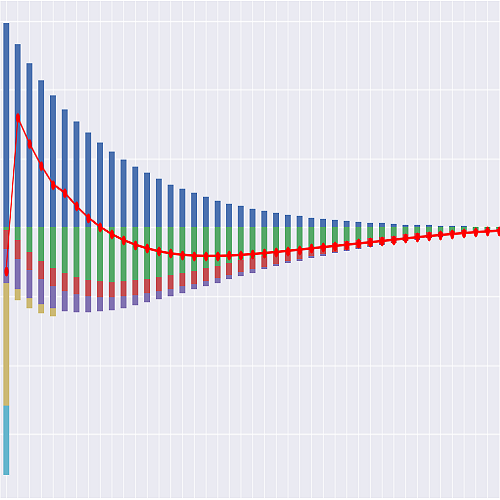
The Term_US_A Model#
Reference liability cash flow model for U.S. level premium term life insurance.
Term_US_A is the executable counterpart of
products/term_life/technical-notes.md in the lifelib-products library. It
projects gross liability cash flows for a single-life, fully underwritten level
premium term policy: level premiums for the level period, then Jump-to-ART renewal at
unchanged face amount to expiry at attained age 95, convertible to permanent cover
before min(end of level period, attained age 70), with no cash value.
Spaces. The model contains two:
DataReads the five input CSVs and holds their filename References. It takes no parameters, so each file is read once per model.
ProjectionThe by-policy projection, parameterized by
point_id:Projection[1]is an ItemSpace projecting model point 1. It reaches the input tables through itsdataReference, which resolves to the singleDataSpace.
The split matters for more than tidiness. Because Projection is parameterized,
every Projection[N] is a separate ItemSpace with its own cells cache; readers
placed there would re-read every file for every policy. In Data they are evaluated
once, however many policies are projected.
Input data is external: CSVs in the model folder’s parent directory, read at run time rather than stored inside the model. The model folder itself holds no data, so the model and its inputs must travel together.
Projection basis. Annual steps. Policy year t runs 1, 2, …, proj_len(),
where proj_len() = 95 - age_at_entry(). Premiums, commission, premium tax and
expenses fall at the beginning of the year; death claims and the conversion credit at
the end; lapses and conversions act on end-of-year survivors. Note the contrast with
lifelib’s BasicTerm_S, where t counts months — here it counts years,
because every decrement in this product is on an annual cycle and there is no account
value requiring monthiversary processing. The technical notes describe an optional
monthly mode; it is not implemented.
What is sourced and what is not. The contractual elements are taken from a specimen policy: the guaranteed premium schedule, the $65 policy fee inside it, and expiry at attained age 95. Everything behavioural and expense-related — mortality, lapse, the shock lapse, post-level-term mortality deterioration, conversion, commission, expenses and premium tax — is a standardization introduced for the reference implementation, because no public source carries it. This model is a mechanics demonstration, not a pricing or reserving result. Replace the assumption tables with company data before drawing any conclusion from the output.
Model points. Both points in model_point_table.csv use the anchor
configuration T10 / M / StdNT / band 1, because the specimen gives a guaranteed
premium scale for that cell alone. They differ only in the M(1) override, which is
what makes the divergence between the technical notes’ formula and its worked example
testable. A model point on any other plan, sex, class or band requires
premium_rates.csv to be extended first; a test asserts every model point in the
table actually projects.
Verification. Model point 1 is the anchor cell of the worked example in the
technical notes, and tests/test_term_life_us.py asserts all twelve of its rows —
money to the cent, in-force to six decimals.
Example
>>> import modelx as mx
>>> model = mx.read_model("products/term_life/Term_US_A")
>>> model.Projection[1].result_cf()