The WP_UK_A Model#
Reference liability cash flow model for UK with-profits business.
WP_UK_A is the executable counterpart of
products/with_profits/technical-notes.md in the lifelib-products library. It
projects gross best-estimate liability cash flows for single-policy model points on the
two composite chassis those notes specify — a unitised with-profits bond and a
conventional with-profits endowment — through the machinery that makes with-profits
what it is: a retrospective asset share, an annually declared bonus that hardens into a
guarantee, a smoothed payout inside a target corridor, a market value reduction on
non-guaranteed exits, and a 90:10 shareholder transfer.
The asset share is a state variable, not a cash flow. That sentence is the model. The policy’s cash flows are premiums, claims, withdrawals, expenses and shareholder transfers; the asset share is a shadow retrospective accumulation that nobody owns and nobody is paid, and it drives claim amounts only through the bonus, smoothing and MVR rules. The difference between what is paid and what the asset share says is absorbed by the estate.
That makes this the one product in the library with no account value in the library’s
sense. There is no av_pp_at here: the asset share is not a policyholder fund, and
the guaranteed benefit — a unit face value on the bond chassis, a sum assured plus
attaching reversionary bonuses on the endowment — is not a fund either. Both are
modelled, under their own names, and the gap between them is where the whole product
lives.
Spaces. The model contains two:
DataReads the three input CSVs and holds their filename References. It takes no parameters, so each file is read once per model.
ProjectionThe by-policy projection, parameterized by
point_id:Projection[1]is an ItemSpace projecting model point 1. It reaches the input tables through itsdataReference, which resolves to the singleDataSpace.
The split matters for more than tidiness. Because Projection is parameterized,
every Projection[N] is a separate ItemSpace with its own cells cache; readers
placed there would re-read every file for every policy. In Data they are evaluated
once, however many policies are projected.
Input data is external: CSVs in the model folder’s parent directory, read at run time rather than stored inside the model. The model folder itself holds no data, so the model and its inputs must travel together.
Projection basis. Annual steps, because the bonus declaration — the governing discretion — is annual. Premiums and partial withdrawals fall at the start of the year; the fund return accrues over it; charges, the bonus declaration, the shareholder transfer and the mortality charge fall at the end, in that order; claims and decrements follow. Age is age nearest birthday.
What is deterministic, and what that costs. This is a deterministic
single-scenario projection, and the notes are emphatic that a deterministic base run
materially understates the cost of guarantees, because guarantee cost is convex in
the fund return. The model produces exactly the per-scenario cash flows a
market-consistent stochastic valuation consumes; the stochastic layer is out of scope
and the c_g charge in the asset share recursion is a charging proxy, not a
valuation of anything.
What is sourced and what is not. The mechanics are sourced: the asset share item list and its regulatory codification, bonus hardening, the unit-price floor, the guarantee-date and death MVR exemptions, the MVR’s contractual bound, the target corridor, the smoothing cap, the lifetime guarantee-charge cap and the 90:10 split. Every rate is a standardization: bonus declarations are not published in the principles and practices documents, no MVR scale is public, the CMI’s tables are restricted to Authorised Users, and no UK with-profits lapse experience was retrieved. This model is a mechanics demonstration, not a pricing or reserving result.
Verification. tests/test_with_profits_uk.py asserts both scenarios of the
notes’ worked example step by step to the penny — the asset share recursion, the bonus
cost and shareholder transfer, the mortality charge, the smoothing cap and corridor,
the final bonus, the MVR and its regulatory bound, and all three payout bases.
Example
>>> import modelx as mx
>>> model = mx.read_model("products/with_profits/WP_UK_A")
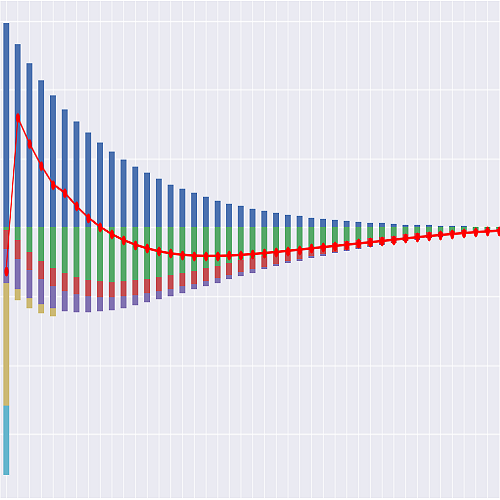
>>> model.Projection[1].result_cf()