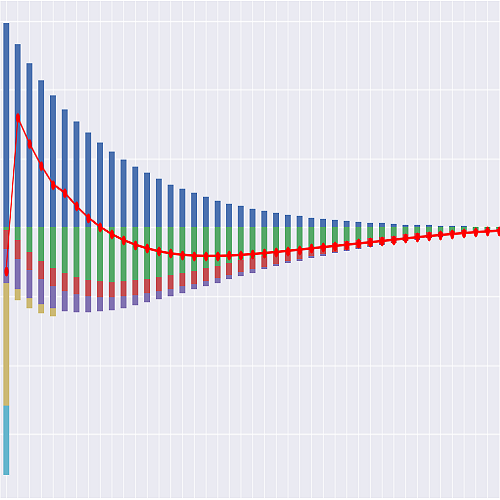
The Term_UK_A Model#
Reference liability cash flow model for UK guaranteed-premium term assurance.
Term_UK_A is the executable counterpart of
products/term_assurance/technical-notes.md in the lifelib-products library. It
projects gross best-estimate liability cash flows for a single-policy model point of
UK term assurance in the three benefit shapes the representative product offers —
level, decreasing at a client-selected schedule rate, and family income
benefit — with terminal illness inside the death decrement, an optional RPI
indexation option, and no tail states of any kind: cover ceases at the end of the
term with no maturity value, no renewal and no conversion.
That last point is the structural difference from Term_US_A, the U.S. model in
the same library. A U.S. level premium term policy jumps to ART rates at the end of
the level period and runs on to attained age 95; a UK policy simply stops. There is no
post-level-term phase, no shock lapse, no jump ratio and no mortality deterioration
factor here, and importing them would materially misstate UK term liabilities.
Spaces. The model contains two:
DataReads the four input CSVs and holds their filename References. It takes no parameters, so each file is read once per model.
ProjectionThe by-policy projection, parameterized by
point_id:Projection[1]is an ItemSpace projecting model point 1. It reaches the input tables through itsdataReference, which resolves to the singleDataSpace.
The split matters for more than tidiness. Because Projection is parameterized,
every Projection[N] is a separate ItemSpace with its own cells cache; readers
placed there would re-read every file for every policy. In Data they are evaluated
once, however many policies are projected.
Input data is external: CSVs in the model folder’s parent directory, read at run time rather than stored inside the model. The model folder itself holds no data, so the model and its inputs must travel together.
Projection basis. Annual steps, the notes’ base grid. Policy year t runs
1, 2, …, proj_len(), where proj_len() = policy_term(). Premiums, maintenance
expense and renewal commission fall at the start of the year; death and terminal
illness claims and their claim expense at the end; lapses act on the survivors of
mortality, death before lapse. Acquisition expense and initial commission fall at
issue. The notes describe a monthly grid as the arbiter of the two annual-grid
approximations — the mid-year benefit balance of the decreasing shape and the
annual-in-advance premium — and it is not implemented; premium_mode is inert.
What is sourced and what is not. The contractual mechanics are sourced: the decreasing-shape amortization, the family income benefit as an annuity-certain to the end of the term, terminal illness as a 100% acceleration rather than an extra benefit, the absence of any surrender value, and the indexation option’s cover and premium caps. Everything quantitative is a standardization introduced for the reference implementation. No UK insurer publishes premium rate tables — pricing is quote-driven, and only the £5/month minimum is public — and the current CMI “16” Series assured lives tables are subscriber-restricted, so both the premium and the mortality basis shipped here are constructed. This model is a mechanics demonstration, not a pricing or reserving result. Replace the assumption tables with company data, and the mortality basis with licensed tables, before drawing any conclusion from the output.
Model points. Eight, covering all three benefit shapes, both mortality bases, the indexation option, a joint first-death policy, waiver of premium, family income benefit commutation, and one policy already in force at duration 5. Model point 1 is the anchor cell of the worked example in the technical notes.
Verification. tests/test_term_assurance_uk.py asserts the notes’ three-row
worked example to the penny and the in-force column to six decimals, the
B(60) = £134,588 decreasing-schedule anchor, and the family income benefit ledger
against an independent rebuild.
Example
>>> import modelx as mx
>>> model = mx.read_model("products/term_assurance/Term_UK_A")
>>> model.Projection[1].result_cf()