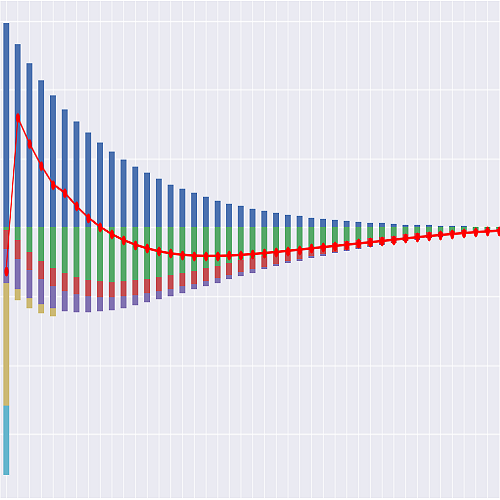
# modelx: pseudo-python
# This file is part of a modelx model.
# It can be imported as a Python module, but functions defined herein
# are model formulas and may not be executable as standard Python.
"""The by-policy projection of the :mod:`~.WholeLife_US_S` model.
The Space is parameterized by ``point_id``, so ``Projection[1]`` is an ItemSpace
projecting model point 1::
>>> Projection[1].result_cf() # the worked example's anchor cell
>>> Projection.point_id = 2 # or switch the default
.. rubric:: Input data
Inputs are **external files**: plain CSVs living in the model folder's parent
directory, ``products/whole_life/``, read at run time rather than stored inside the
model. The model folder therefore holds nothing but formulas — no ``_data/``, no
IOSpec, no embedded values — so a diff of the model shows logic changes only, and an
input can be edited or swapped without rewriting the model. This follows
``annuallife.TradLife_A``; contrast ``basiclife.BasicTerm_S``, which keeps its inputs
*inside* the model through modelx's IOSpec machinery.
The consequence worth knowing: **the model is not portable on its own.** Copying the
``WholeLife_US_S`` folder without its parent's CSVs produces a model that reads and then
fails on first evaluation.
Each table has a filename Reference and a reader Cells, both on the ``Data`` Space,
reached here through the ``data`` Reference:
====================== ============================== ==========================
Reference Cells File
====================== ============================== ==========================
model_point_file data.model_point_table() model_point_table.csv
cv_file data.cv_table() cv_table.csv
nsp_file data.nsp_table() nsp_table.csv
np_guar_file data.np_guar_table() np_guar_table.csv
mort_table_file data.mort_table() mort_table.csv
premium_rates_file data.premium_rates() premium_rates.csv
====================== ============================== ==========================
.. rubric:: The time index
``t`` counts **policy months** from issue, 0-based — lifelib's own clock
(``basiclife.BasicTerm_S``, ``savings.CashValue_SE``) and the one every other model in
this library runs on. ``t = 0`` is the issue month, period ``t`` runs from time ``t``
to time ``t + 1``, and ``proj_len() = 12 * (100 - x)`` is the **number** of policy
months projected, the exclusive end of the frame: the projection runs
``t = proj_start() .. proj_len() - 1``. ``proj_start()`` is 0 for new business and
``12 * duration_inforce()`` — the policy years already elapsed, in months — for an
in-force model point, so ``pols_if(proj_start())`` is ``pols_if_init()``.
Everything contractual about this product is on an **annual** cycle: the guaranteed
cash value schedule, the dividend declaration, the anniversary capitalization of loan
interest, the premium-paying period. The policy year is therefore derived and used as a
lookup key throughout — ``duration(t) = duration_mth(t) // 12`` is the completed policy
years at the start of month ``t``, ``policy_year(t) = duration(t) + 1`` is the
contractual 1-based label (the ``policy_year`` key of *cv_table.csv*), ``age(t) =
age_at_entry() + duration(t)`` is the attained age entering that policy year and
``age_anniv(t)`` the age at the anniversary that ends it. ``is_anniv(t)`` is true in the
**last month of a policy year**, which is where every annual event lands.
The **value** state variables are closing balances at the end of month ``t``:
``cv_pp(t)``, ``pua_face(t)``, ``pua_cv(t)``, ``div_accum(t)`` and ``loan_bal(t)``. The
value entering month ``t`` is the closing balance of month ``t - 1``, or, at the first
projected month, the model point's opening state (``puaf_inforce()``, ``loan_inforce()``,
zero accumulation, and a guaranteed cash value of zero at issue) — written inline as
``pua_face(t - 1) if t > proj_start() else puaf_inforce()`` wherever an opening balance
is read, so that nothing is ever indexed below the first projected month. Annual
quantities read the balance entering the **policy year** instead, twelve months back.
.. rubric:: What the monthly grid changes, and what it does not
Decrements run in two speeds, the library's convention: ``mort_rate(t)`` and
``lapse_rate(t)`` are the **annual** rates of the policy year containing month ``t`` —
the vectors the technical notes tabulate — and ``mort_rate_mth(t)`` and
``lapse_rate_mth(t)`` are the monthly rates actually applied, ``1 - (1 - q)^(1/12)``.
Twelve of those compound back to exactly the annual rate, so **the in-force at every
policy anniversary is what an annual-step model would carry**, to floating-point.
The annual events stay annual and land on ``is_anniv(t)``: the dividend is declared and
credited once a year, at the anniversary; loan interest capitalizes there; paid-up
additions are bought with the dividend there. What the finer grid buys is everything
that is *not* contractually annual — death claims settle at the end of the month of
death rather than the end of the policy year, maintenance expense accrues monthly, the
guaranteed cash value and the paid-up-additions cash value interpolate between
anniversaries so a mid-year surrender is valued where it happens, and a **modal premium
is collected when it is contractually due**. That last one is why the technical notes'
"premium mode modeled: annual" **[std]** is retired: the modal factors are sourced
([S1] for the participating design, [S7] for final expense) and the monthly grid is
what makes them expressible. ``result_cf_annual()`` sums the frame into policy years so
a monthly run can be laid beside an annual one.
Two interpolations are standardizations introduced here, both **[std]** and both exact
at the anniversary so that no anniversary quantity moves:
``cv_pp(t)``
Straight-line between the schedule's anniversary values, ``(k + 1) / 12`` of the
way from the value at the anniversary opening the policy year to the value at the
one closing it, ``k = duration_mth(t) % 12``. Contractual cash value tables are
printed at anniversaries only [S1] [S3]; pro-rating for elapsed time is the
ordinary policy-form convention and the Standard Nonforfeiture Law requires *some*
adjustment for it.
``nsp_mth(t)``
The same straight line applied to the net single premium between ``NSP_{x+dur}``
and ``NSP_{x+dur+1}``, so the paid-up-additions block is valued on the same clock
as the base cash value.
.. rubric:: Naming
Cells names follow lifelib's ``basiclife.BasicTerm_S`` and ``savings.CashValue_SE``
wherever those models have an analogue — ``pols_*`` for policy counts, plural nouns
for cash flows, ``*_rate`` for rates, ``*_pp`` for per-policy amounts,
``claim_pp(t, kind)`` and ``pols_if_at(t, timing)`` for the argument-keyed families.
The technical notes use compact actuarial symbols instead. The mapping is:
========================= ============================ ==========================
Notes symbol Cells Meaning
========================= ============================ ==========================
x age_at_entry Issue age (ANB)
x + dur age(t) Attained age entering the
policy year of month t
x + dur + 1 age_anniv(t) Attained age at the
anniversary ending it
T = 12(100 - x) proj_len Policy months projected
t0 duration_inforce Policy years already elapsed
12 t0 proj_start First projected month
(t // 12) duration(t) Completed policy years
(t) duration_mth(t) Completed policy months
dur(t) policy_year(t) Policy year, duration(t) + 1
(anniversary) is_anniv(t) Last month of a policy year
m policy_term Premium-paying period, years
F sum_assured Base face amount
G premium_pp_ann(t) Gross **annual** premium
(modal) premium_pp(t) Premium due in month t
(modal factor) modal_factor Fraction of G per instalment
(modal cycle) prem_cycle Months between instalments
(due month) prem_due(t) Whether an instalment is due
G^net_t premium_net_pp_ann(t) Annual premium after offset
(modal) premium_net_pp(t) The instalment actually collected
A_t rider_premium_pp_ann(t) PUA rider premium, annual
(modal) rider_premium_pp(t) The instalment due in month t
i_g int_rate_guar Guarantee interest, 4.00%
i_d int_rate_div Dividend interest rate, 6.00%
i_L int_rate_loan Policy loan rate, 6.00%
q^g_{x+t} mort_rate_guar(t) Guarantee mortality, annual
q^g_y mort_rate_guar_at(y) The same, keyed by age
q^sc_{x+t} mort_rate_scale(t) Dividend-scale mortality
q^e_{x+t} mort_rate(t) Best-estimate mortality, annual
(q^e monthly) mort_rate_mth(t) The monthly rate applied
w_t lapse_rate(t) Surrender rate, annual
(w monthly) lapse_rate_mth(t) The monthly rate applied
w^dyn multiplier dyn_lapse_factor(t) Interest-sensitive overlay
l_t pols_if(t) In force at BOM t (weight)
l_{t+1} pols_if_at(t, "AFT_DECR") In force at EOM t
l_t(1-q^e) pols_if_at(t, timing) In force inside month t
(none) pols_death(t) Deaths in month t
(none) pols_lapse(t) Surrenders at EOM t
(none) pols_maturity(t) Maturities at T - 1
CV_t cv_pp(t) Guaranteed cash value, EOM t
CV at anniversary cv_pp_anniv(y) The schedule's own values
F - CV_t net_amt_at_risk(t) Guarantee net amount at risk
NSP_y nsp(y) Net single premium, endow 100
(NSP monthly) nsp_mth(t) NSP interpolated to EOM t
NP_g np_guar() Nonforfeiture net level premium
D^int_t div_int(t) Interest margin
D^mort_t div_mort(t) Mortality margin
D^exp_t (e^m_t) div_exp(t) Expense margin
D_t div_base(t) Base-block dividend, floored
D^PUA_t div_pua(t) PUA-block dividend
D_t + D^PUA_t div_credited(t) Dividend credited at EOM t
D_{t-1} div_prev_anniv(t) Dividend at the anniversary
opening the policy year of t
D^cash_t div_cash(t) Cash dividend per policy
(none) div_to_pua(t) Dividend applied to PUAs
dPUAF_t pua_face_purch(t) PUA face bought by dividend
dPUAF^rider_t pua_face_rider(t) PUA face bought by the rider
(none) pua_face_offset(t) PUA face from the RPD excess
PUAF_t pua_face(t) PUA face in force at EOM t
PUACV_t pua_cv(t) PUA cash value at EOM t
DA_t div_accum(t) Dividend accumulation balance
L_t loan_bal(t) Loan balance at EOM t
(none) loan_int(t) Loan interest capitalized
(none) loan_draw(t) Net new borrowing per policy
TF term_blend_target Term-blend target face
OYT_t oyt_face(t) One-year-term face in the blend
(none) oyt_cost(t) Dividend absorbed by the OYT
DB_t claim_pp(t, "DEATH") Death benefit per policy
CSV_t claim_pp(t, "LAPSE") Surrender value per policy
MAT claim_pp(t, "MATURITY") Maturity benefit per policy
(none) prem_cum(t) Cumulative premiums paid
E_t expenses(t) Acquisition + maintenance
(none) premium_taxes(t) Premium tax outgo
(none) premiums(t) Premium income
(none) rider_premiums(t) PUA rider premium income
(none) claims(t, kind) Benefit outgo
(none) div_cash_paid(t) Cash dividend outgo
(none) loan_draws(t) Net loan advances
NetCF_t liability_cf(t) Net liability CF, outgo +
(none) net_cf(t) The same, income positive
(none) result_cf_annual() result_cf() summed into years
========================= ============================ ==========================
Seven names needed care.
``mort_rate`` is the **best-estimate** rate — the one that actually decrements the
block — while the guarantee and dividend-scale rates are ``mort_rate_guar`` and
``mort_rate_scale``. All three come off the same shipped table through the References
``ae_best_est`` and ``ae_scale``. The notes call this out as a consistency trap: the
same table feeds claim outgo and the dividend's mortality margin **with opposite
signs**, so raising best-estimate mortality raises claims *and*, if the scale factor
moves with it, cuts the dividend.
``policy_term`` is the **premium-paying** period ``m`` in years, not the coverage
period. Coverage runs to ``proj_len()`` in every variant; on the base pay-to-100 design
the two coincide, on ``PAY_10`` they do not. It stays in years because the contract
states it in years; ``premium_pp`` compares it against ``duration(t)``.
``pols_lapse`` counts **surrenders**. The notes say "surrenders", ``BasicTerm_S`` says
``pols_lapse``, and ``CashValue_SE``'s ``kind`` string is ``"LAPSE"``; the model keeps
the lifelib name so the ``kind`` vocabulary stays intact.
The notes' ``CSV_t`` is the cash surrender value, not a file. It is reached as
``claim_pp(t, "LAPSE")`` so that all three benefit amounts share one cells and one
``kind`` vocabulary with ``CashValue_SE``.
``age(t)`` and ``age_anniv(t)`` are both needed: the notes index mortality at the
attained age entering the policy year but price paid-up additions bought at the end of
it one year later. Getting them the wrong way round shifts every dividend purchase by
a year.
``pols_if(t)`` is the **start**-of-month count — the notes' ``l_t``, not their
``l_{t+1}``. That is the library-wide convention (``Term_US_S.pols_if(0)`` is
``pols_if_init()``, ``CashValue_SE.pols_if(t)`` is ``pols_if_at(t, "BEF_MAT")``), and it
is the number every cash flow on the same ``result_cf()`` row is weighted by. The
notes' end-of-period state variable is not lost — it is ``pols_if_at(t, "AFT_DECR")``,
and ``pols_if_at(t, "AFT_DECR") == pols_if(t + 1)`` by construction.
``liability_cf(t)`` and ``net_cf(t)`` are the same stream with opposite signs — see the
sign-convention rubric below.
.. rubric:: Timing and kind arguments
``pols_if_at(t, timing)`` takes ``"BEF_DECR"`` (start of month t, before any decrement
— the same number as ``pols_if(t)``), ``"BEF_SURR"`` (after deaths, before surrenders),
``"BEF_MAT"`` (after surrenders, before maturity) and ``"AFT_DECR"`` (after every
decrement, the notes' ``l_{t+1}``) — the notes' end-of-period processing order, deaths
then dividend then surrenders then maturity, now applied every month. ``"BEF_DECR"`` and
``"BEF_MAT"`` are ``CashValue_SE``'s names; ``"BEF_SURR"`` is added because this product
settles deaths and surrenders in one end-of-period step, and ``"AFT_DECR"`` because
``CashValue_SE`` has no string for the point past the last decrement, which is where the
notes' state variable lives. ``claim_pp(t, kind)`` and ``claims(t, kind)`` take
``"DEATH"``, ``"LAPSE"`` and ``"MATURITY"``. Both raise ``ValueError("invalid timing")``
/ ``ValueError("invalid kind")`` on anything else.
.. rubric:: The dividend is rounded to the cent
``div_round_digits = 2`` rounds the credited base dividend before it buys paid-up
additions. This is **[std]**, and it is not cosmetic: the notes' worked example adds the
*displayed* margins (216.00 + 85.25 + 25.00 = 326.25) and then divides 326.25 by the
net single premium. Carrying the unrounded 326.248 through instead moves the purchased
paid-up-additions face from 776.79 to 776.78 — a full displayed cent, because the exact
value sits just under the rounding boundary. Declared dividends are credited in whole
cents, so the model rounds; setting ``div_round_digits = None`` turns it off and a test
pins the size of the gap in both directions.
.. rubric:: The worked example sets the PUA-block dividend aside
The notes' worked-example table computes steps 11-15 from the base-block dividend
alone, saying so explicitly: "For clarity the PUA-block dividend ``D^PUA`` is
omitted from this table; in the model it adds ... to the amount in step 9." The
Reference ``pua_div_on`` ships **False** so the base deterministic run reproduces the
worked example exactly, the same way ``Term_US_S`` ships ``conv_rate_base = 0``. It is
a reproduction switch, not a claim that paid-up additions are excluded from the
dividend — they are dividend-eligible, and ``pua_div_on = True`` is the
product-faithful setting. ``div_pua(t)`` implements the notes' formula either way, and
a test asserts its value on the anchor cell against the notes' own parenthetical.
.. rubric:: The four guarantee-basis tables are not one construction
The notes' first "known modeling pitfall" is a mismatch between the cash value table and
the ``NSP``/annuity functions, and prescribes regenerating every guarantee-basis
quantity from one 2017 CSO / 4% source. **The shipped tables do not satisfy that**, and
no set of tables carrying the worked example's anchors could. On any single mortality
basis at interest ``i``, endowment insurance and the annuity-due satisfy
``A_{x:n} = 1 - d ae_{x:n}`` with ``d = i/(1+i)``, so the notes' own definition collapses
to ``NNLP = 1000 d NSP_45 / (1 - NSP_45)``; the worked example's ``NNLP = 13.00`` then
forces ``NSP_45 = 0.252616``. But ``NSP_y = v(NSP_{y+1} + q_y (1 - NSP_{y+1})) >= v NSP_{y+1}``
for any ``q_y >= 0``, so ``NSP_55 <= NSP_45 (1.04)^10 = 0.373933`` — below the worked
example's ``NSP_55 = 0.42``. Read the other way: ``NSP_55 = 0.42`` forces
``NSP_45 >= 0.283737`` and hence ``NNLP >= 15.236`` per $1,000, 17% above the notes'
13.00. The worked example's steps 3 and 10 are mutually unreachable, whatever mortality
table is used.
What the shipped tables do instead **[std]**: *mort_table.csv* is an illustrative Makeham
curve pinned to ``q^g_54 = 0.00320``; *nsp_table.csv* is a separate parametric curve
pinned to ``NSP_55 = 0.42`` and ``NSP_100 = 1``; *np_guar_table.csv* holds
``1000 NSP_x / ae_{x:(100-x)}`` with the annuity taken on the mortality table's own
survivorship, which is what makes ``NP_g = 13.00``; and *cv_table.csv* is a monotone
shape solved through its policy-year 9 and 10 rows — the worked example's 95.00 and
112.00 per $1,000, which are ``cv_pp_anniv(9)`` and ``cv_pp_anniv(10)`` — to ``1000.00``
at attained age 100. Reconciling the NSP curve with the mortality table needs a
guarantee interest rate that falls from 5.99% at age 45 to 0.02% at age 99, and
inverting the curve for the implied ``q`` at 4% gives a negative rate at every age up to
57 and a rate above 1 from age 89 on.
The two *consequences* the pitfall names are nevertheless absent, and are asserted by
tests: ``NSP_100 = 1`` exactly, so ``pua_cv(T - 1) == pua_face(T - 1)``, and the schedule
reaches exactly face in the final policy month, so ``cv_pp(T - 1) == sum_assured()``,
where ``T = proj_len()`` and ``T - 1`` is the last projected month. Neither block
leaks at maturity. What is missing is the *means* — one basis — not the endpoints. Swap
in a licensed 2017 CSO / 4% set and all four files must be replaced together; the worked
example will then no longer reproduce, which is the honest price of the notes' own
arithmetic.
.. rubric:: Sign convention — two names, one stream
The whole-life notes print ``NetCF_t`` with **outgo positive**, which is the opposite of
the sign the other eleven reference models in ``products/`` carry. Rather than pick one
and lose the other, the model publishes both and names them apart:
``liability_cf(t)``
The notes' ``NetCF_t``, verbatim: **outgo positive**. Premium and rider income enter
with a minus sign; expenses, premium tax, claims, cash dividends and net loan
advances enter with a plus. A positive ``liability_cf`` is money leaving the
insurer. This is the number to compare against the notes.
``net_cf(t)``
``-liability_cf(t)``: **income positive**, the sign convention every model in
``products/`` carries, so that ``result_cf()["net_cf"]`` can be summed or compared
across products. A positive ``net_cf`` is money arriving at the insurer.
Both are columns of ``result_cf()``. The pattern is ``SPIA_US_S`` and
``DIA_US_S``'s, which face the same clash. Nothing about the whole-life
notes' own convention is being denied — it is being kept under a name that does not
collide with the library-wide one, because a sign error in a 55-year liability
projection is invisible in a summary statistic.
"""
from modelx.serialize.jsonvalues import *
_formula = lambda point_id: None
_bases = []
_allow_none = None
_spaces = []
# ---------------------------------------------------------------------------
# Cells
[docs]
def model_point():
"""The selected model point as a Series."""
return data.model_point_table().loc[point_id] # noqa: F821
[docs]
def product():
"""The product code: WL_PAR, WL_FE_LEVEL or WL_FE_GRADED."""
return model_point()["product"]
[docs]
def is_par():
"""True for the participating design, which is the only one that pays dividends."""
return product() == "WL_PAR"
[docs]
def premium_period():
"""The premium period code: TO_100, PAY_10, PAY_20 or TO_65."""
return model_point()["premium_period"]
[docs]
def age_at_entry():
"""The issue age (ANB) of the selected model point."""
return int(model_point()["issue_age"])
[docs]
def sex():
"""The sex of the selected model point; rates are sex-distinct throughout."""
return model_point()["sex"]
[docs]
def risk_class():
"""The underwriting class of the selected model point (PREF_NT / STD_NT / TOB)."""
return model_point()["risk_class"]
[docs]
def sum_assured():
"""The base face amount F of the selected model point."""
return float(model_point()["face_amount"])
[docs]
def dividend_option():
"""The elected dividend option: PUA, CASH, ACCUM, REDUCE_PREM, or NONE for non-par."""
return model_point()["dividend_option"]
[docs]
def premium_mode():
"""The premium mode of the selected model point: A, SA, Q or M.
The technical notes' "premium mode modeled: annual" was a consequence of the annual
grid, not of the contract: every design in the spec is sold on all four modes
[S1] [S7]. On the monthly grid the mode is a model point attribute, and the shipped
table exercises both ends of it.
"""
return model_point()["premium_mode"]
[docs]
def pols_if_init():
"""Initial number of policies in force, l at proj_start()."""
return float(model_point()["pols_if_init"])
[docs]
def duration_inforce():
"""t0: policy **years** already elapsed at the valuation date; 0 for new business.
The contract states elapsed time in policy years and so does the model point table;
:func:`proj_start` turns it into the month the frame opens at.
"""
return int(model_point()["duration_inforce"])
[docs]
def puaf_inforce():
"""PUAF at t0: paid-up additions face already in force at the valuation date."""
return float(model_point()["puaf_inforce"])
[docs]
def loan_inforce():
"""L at t0: policy loan balance already outstanding at the valuation date."""
return float(model_point()["loan_inforce"])
[docs]
def loan_utilization():
"""Fraction of the guaranteed cash value held as a policy loan **[std]**.
0 in the base run; the notes' variant is 0.20, maintained by borrowing and
repaying as the cash value moves.
"""
return float(model_point()["loan_utilization"])
[docs]
def term_blend_target():
"""TF: the term-blend rider's target face amount; 0 switches the rider off."""
return float(model_point()["term_blend_target"])
[docs]
def is_blended():
"""True when the term-blend rider is active on this model point **[std]**.
The blend needs the dividend to pay the one-year-term cost, so it is modelled only
under the PUA dividend option and only on the participating design.
"""
return is_par() and dividend_option() == "PUA" and term_blend_target() > sum_assured()
[docs]
def proj_len():
"""T = 12 (maturity_age - x): the number of policy **months** projected from issue.
The **exclusive** end of the frame, counted from t = 0: the projection runs
``t = proj_start() .. proj_len() - 1``, so ``proj_len() - 1`` is the last projected
month, the one ending at attained age 100.
The contract itself matures at 121, but the guaranteed cash value equals face at
100 and the paid-up-additions cash value equals paid-up-additions face there, so
from 100 the policy is economically an endowment at face. Truncating at 100 is a
**[std]** simplification that moves the age 100-121 payments from death to
maturity without changing their amount per survivor.
"""
return 12 * (maturity_age - age_at_entry()) # noqa: F821
[docs]
def proj_start():
"""The first projected month, ``12 * duration_inforce()``.
New business starts at t = 0; an in-force model point starts at the month its
elapsed policy years end, so ``duration_inforce = 9`` opens the frame at
``t = 108``, the first month of the tenth policy year. Elapsed time is recorded in
whole policy years, so the frame always opens on an anniversary.
"""
return 12 * duration_inforce()
[docs]
def policy_term():
"""m: the premium-paying period in **years**, from the premium period code.
This is *not* the coverage period, which is proj_len() in every variant. It stays
in years because the contract states it in years; :func:`premium_pp_ann` compares
it against ``duration(t)``.
"""
p = premium_period()
if p == "TO_100":
return maturity_age - age_at_entry() # noqa: F821
elif p == "PAY_10":
return 10
elif p == "PAY_20":
return 20
elif p == "TO_65":
return max(65 - age_at_entry(), 1)
else:
raise ValueError("invalid premium_period")
[docs]
def duration_mth(t):
"""Completed policy months at the start of month t.
``t`` itself: every model point is projected on the policy's own clock, and an
in-force point opens the frame at ``proj_start()`` rather than re-basing ``t``.
The cells exists so the monthly vocabulary reads the same here as in the UL family
and ``savings.CashValue_SE``.
"""
return t
[docs]
def duration(t):
"""Completed policy years at the start of month t, ``duration_mth(t) // 12``.
0 throughout the first policy year. Every contractual schedule in this product is
annual, so this is what the attained age, the cash value schedule, the premium
period and the decrement vectors are all read at.
"""
return duration_mth(t) // 12
[docs]
def policy_year(t):
"""The contractual policy year containing month t, ``duration(t) + 1``.
A 1-based label derived from ``t``, never indexed by: it is the ``policy_year`` key
of *cv_table.csv*.
"""
return duration(t) + 1
[docs]
def is_anniv(t):
"""True in the **last month of a policy year**, where every annual event lands.
The dividend is declared and credited here, loan interest capitalizes here, and
paid-up additions are bought here. ``duration_mth(t) % 12 == 11``.
"""
return duration_mth(t) % 12 == 11
[docs]
def anniv_mth(t):
"""The month index of the anniversary that **ends** the policy year containing t.
``12 * duration(t) + 11``, which is ``t`` itself when :func:`is_anniv` is true.
Used by the term-blend layer, which is bought at that anniversary and is in force
for the whole of the policy year it closes.
"""
return 12 * duration(t) + 11
[docs]
def age(t):
"""The attained age x + duration(t) entering the policy year containing month t.
Mortality in that policy year is indexed here; paid-up additions bought at the
anniversary that ends it are priced at age_anniv(t).
"""
return age_at_entry() + duration(t)
[docs]
def age_anniv(t):
"""The attained age at the anniversary that ends the policy year containing month t."""
return age_at_entry() + duration(t) + 1
[docs]
def mec_flag():
"""True where the model point would need a Sect. 7702A test this model does not run.
The notes are explicit that the reference model does not police Sect. 7702 or
Sect. 7702A limits and should **flag** model points that would fail rather than
silently projecting them **[std]**. Limited-pay designs sit near the 7-pay limit
and paid-up-additions rider payments consume 7-pay room, so both raise the flag.
"""
return premium_period() != "TO_100" or float(model_point()["pua_rider_premium"]) > 0.0
[docs]
def premium_rate():
"""Final-expense annual premium per $1,000 of face, from *premium_rates.csv* [S7]."""
key = (product(), sex(), risk_class(), age_at_entry())
return float(data.premium_rates().loc[key, "rate_per_1000"]) # noqa: F821
[docs]
def modal_factor():
"""The fraction of the annual premium collected per instalment [S1] [S7].
The participating design takes the [S1] scale — semi-annual 0.515, quarterly
0.26265, monthly 0.085833 — and the final-expense variant the [S7] scale printed on
its own rate card — 0.52, 0.275, 0.089. Both are sourced, and both carry the modal
loading inside the factor, so twelve monthly instalments come to 1.03 of the annual
premium on the participating design and 1.068 on final expense. Each factor is its
own Reference, so a carrier's own scale drops in without a formula change.
"""
m = premium_mode()
if m == "A":
return 1.0
elif m == "SA":
return modal_factor_par_sa if is_par() else modal_factor_fe_sa # noqa: F821
elif m == "Q":
return modal_factor_par_q if is_par() else modal_factor_fe_q # noqa: F821
elif m == "M":
return modal_factor_par_m if is_par() else modal_factor_fe_m # noqa: F821
else:
raise ValueError("invalid premium mode")
[docs]
def prem_cycle():
"""Months between premium instalments: A 12, SA 6, Q 3, M 1.
Arithmetic of the mode rather than an assumption, so it is written here rather than
held in a Reference.
"""
return {"A": 12, "SA": 6, "Q": 3, "M": 1}[premium_mode()]
[docs]
def prem_due(t):
"""Whether a modal premium instalment falls due at the beginning of month t.
Instalments start on the policy anniversary and repeat on the mode's own cycle:
annual in the first month of each policy year, semi-annual every sixth month,
quarterly every third, monthly every month.
"""
return duration_mth(t) % prem_cycle() == 0
[docs]
def premium_pp_ann(t):
"""G: the gross **annual** premium per policy for the policy year containing month t.
Level and guaranteed through the policy_term() premium-paying years
``duration(t) = 0 .. policy_term() - 1``, zero after. The participating design
takes G from the model point (**[std illustrative]** — carrier rate books are not
public); the final-expense variant computes it from the sourced rate table as
``(F / 1000) * rate(x, sex, class) + 36`` [S7].
This is the notes' ``G`` and the base for the acquisition expense, the premium
offset and the paid-up-additions purchases, none of which should move with the
premium mode; :func:`premium_pp` is what is actually collected in month t.
"""
if t < 0 or duration(t) >= policy_term():
return 0.0
elif is_par():
return float(model_point()["annual_premium"])
else:
return sum_assured() / 1000.0 * premium_rate() + fe_policy_fee # noqa: F821
[docs]
def premium_net_pp_ann(t):
"""G^net_t: the **annual** premium actually charged for the policy year of month t.
Under REDUCE_PREM the dividend credited at the anniversary opening that policy year
offsets the premium, ``max(G - D, 0)``, and any excess buys paid-up additions
through pua_face_offset(). The dynamic premium-offset overlay (**[std]**, off by
default) applies a prem_offset_share fraction of the same offset once the dividend
has grown to cover the premium.
"""
g = premium_pp_ann(t)
if g == 0.0:
return 0.0
d = div_prev_anniv(t)
if dividend_option() == "REDUCE_PREM":
return max(g - d, 0.0)
elif prem_offset_on and d >= g: # noqa: F821
return g - prem_offset_share * min(d, g) # noqa: F821
else:
return g
[docs]
def premium_pp(t):
"""The **gross** premium instalment per policy due at the beginning of month t.
``modal_factor() * G`` in an instalment month, zero otherwise: what the policy is
billed before any dividend offset. :func:`premium_net_pp` is what is actually
collected, and the two differ only under REDUCE_PREM and the premium-offset overlay.
"""
return modal_factor() * premium_pp_ann(t) if prem_due(t) else 0.0
[docs]
def premium_net_pp(t):
"""The premium per policy actually collected at the beginning of month t.
``modal_factor() * G^net`` in an instalment month, zero otherwise. The dividend
offset is applied to the annual premium and the instalments then split what is
left **[std]**, so a mode change moves the timing of the collection and not the
amount the offset absorbs. This is what :func:`premiums` is weighted from.
"""
return modal_factor() * premium_net_pp_ann(t) if prem_due(t) else 0.0
[docs]
def rider_premium_pp_ann(t):
"""A_t: the **annual** paid-up-additions rider premium for the policy year of month t.
Level while base premiums are payable **[std]**; the notes set it within limits
fixed at issue and do not schedule it.
"""
if not is_par() or t < proj_start() or duration(t) >= policy_term():
return 0.0
return float(model_point()["pua_rider_premium"])
[docs]
def rider_premium_pp(t):
"""The paid-up-additions rider instalment paid at the beginning of month t.
The rider is billed with the base premium, so it follows the same modal cycle and
the same factor **[std]**.
"""
return modal_factor() * rider_premium_pp_ann(t) if prem_due(t) else 0.0
[docs]
def prem_cum(t):
"""Cumulative gross premium paid per policy through the beginning of month t.
Only the final-expense graded plan uses it, for the 110%-of-premiums-paid death
benefit in policy years 1-2 — and on the monthly grid it now grows with each
instalment rather than once a year, which is what the graded benefit actually
tracks [S6][S7]. That design is non-participating, so gross and net coincide there.
"""
if t <= 0:
return premium_pp(t)
return prem_cum(t - 1) + premium_pp(t)
[docs]
def cv_pp_anniv(y):
"""The guaranteed cash value per policy at the anniversary ending policy year y.
The schedule as it is printed: *cv_table.csv* per $1,000 of face, keyed by the
contractual 1-based ``policy_year``. Zero for ``y <= 0`` — there is no cash value
at issue — and zero past the projection.
The notes give the Standard Nonforfeiture Law adjusted-premium formula conceptually
but prescribe a table input in practice, because contractual cash value tables are
policy-form documents that are not public. The shipped schedule is **[std]**,
calibrated to the worked example's CV_107 and CV_119 — the policy-year 9 and 10 rows —
and reaching exactly face at attained age 100.
It is **sex-distinct**, as the notes require of every rate in this product: the male
pay-to-100 schedule carries the worked example's anchors, and the female schedule is
that schedule's funding-progress shape ``f = CV^M / (F NSP^M_{x+dur+1})`` applied
to the female paid-up value ``F NSP^F_{x+dur+1}`` **[std]**. The shape — how far along
the way to paid-up status the schedule has come — is a design choice that does not
depend on sex; the value it is progressing towards does, through NSP. See the
guarantee-basis rubric in the Space docstring for what this construction is *not*.
"""
if y <= 0 or y > proj_len() // 12:
return 0.0
key = (premium_period(), sex(), age_at_entry(), y)
return sum_assured() / 1000.0 * float(
data.cv_table().loc[key, "cv_per_1000"]) # noqa: F821
[docs]
def cv_pp(t):
"""CV_t: the guaranteed cash value per policy at the **end of month t**.
Straight-line between the schedule's anniversary values **[std]**: ``(k + 1) / 12``
of the way from ``cv_pp_anniv(duration(t))`` to ``cv_pp_anniv(duration(t) + 1)``,
where ``k = duration_mth(t) % 12``. Exact at the anniversary, where ``k = 11``, so
no anniversary quantity — the dividend's interest margin, the net amount at risk,
the anniversary surrender value — moves by a cent against the annual grid.
Contractual tables are printed at anniversaries only [S1] [S3]; pro-rating for
elapsed time is the ordinary policy-form convention, and it is what makes a mid-year
surrender value mean anything on this grid.
"""
if t < 0 or t >= proj_len():
return 0.0
lo = cv_pp_anniv(duration(t))
hi = cv_pp_anniv(duration(t) + 1)
return lo + (hi - lo) * (duration_mth(t) % 12 + 1) / 12
[docs]
def net_amt_at_risk(t):
"""F - CV_t: the guarantee-basis net amount at risk carried by the mortality margin."""
return sum_assured() - cv_pp(t)
[docs]
def nsp(y):
"""NSP_y: net single premium per 1 of paid-up endowment-at-100 face at attained age y.
The purchase basis for paid-up additions, unloaded, on the guarantee basis
**[std]**. NSP_100 = 1 by construction, which is what makes the paid-up-additions
cash value equal paid-up-additions face at maturity.
The shipped curve is *not* the endowment-at-100 net single premium implied by
*mort_table.csv* at 4%, and cannot be: see the guarantee-basis rubric in the Space
docstring, which shows that the worked example's own anchors rule out any single
mortality basis at 4%.
"""
return float(data.nsp_table().loc[(sex(), y), "nsp"]) # noqa: F821
[docs]
def nsp_mth(t):
"""The net single premium interpolated to the **end of month t** **[std]**.
The same straight line :func:`cv_pp` takes, between ``NSP_{age(t)}`` and
``NSP_{age_anniv(t)}``, so the paid-up-additions block is valued on the same clock
as the base cash value. Exact at the anniversary, where it is ``NSP_{age_anniv(t)}``
— which is what keeps ``pua_cv`` equal to ``pua_face`` in the final month, where
``NSP_100 = 1``.
"""
lo, hi = nsp(age(t)), nsp(age_anniv(t))
return lo + (hi - lo) * (duration_mth(t) % 12 + 1) / 12
[docs]
def np_guar():
"""NP_g: the nonforfeiture net level premium per policy, from *np_guar_table.csv*.
The dividend's interest margin is credited on the guaranteed fund *including* the
year's net premium, so this quantity sits inside div_int() **[std]**.
The notes define it over the **endowment** period, ``NNLP = F NSP_x / ae_{x:(100-x)}``,
and annotate the *other* nonforfeiture quantity — the adjusted premium P_adj — with
"(m = premium period)", so the (100 - x) subscript is deliberate: NNLP does not vary
with the premium period. The shipped table therefore carries one value per (sex,
issue age), repeated across the premium periods; the premium_period key is kept so a
carrier table that *does* vary by m can be dropped in without a formula change.
"""
key = (premium_period(), sex(), age_at_entry())
return sum_assured() / 1000.0 * float(
data.np_guar_table().loc[key, "np_guar_per_1000"]) # noqa: F821
[docs]
def mort_rate_guar_at(y):
"""q^g_y: the guaranteed **annual** mortality rate at attained age y, from *mort_table.csv*.
The shipped table is **[std]** illustrative and is *not* the 2017 CSO the notes
name; that table is licensed and cannot be shipped here.
"""
return float(data.mort_table().loc[(sex(), y), "mort_rate"]) # noqa: F821
[docs]
def mort_rate_guar(t):
"""q^g: the annual guarantee rate at the age entering the policy year of month t."""
return mort_rate_guar_at(age(t))
[docs]
def mort_rate_scale(t):
"""q^sc: the dividend scale's annual experience mortality, ae_scale x q^g **[std]**."""
return ae_scale * mort_rate_guar(t) # noqa: F821
[docs]
def mort_rate(t):
"""q^e: the **annual** best-estimate mortality rate of the policy year of month t **[std]**.
``ae_best_est`` x q^g. The notes' sensitivity list flags this as a consistency
trap: the same table drives claim outgo here and the dividend's mortality margin
through mort_rate_scale(), with opposite signs. :func:`mort_rate_mth` is the rate
actually applied in the month.
"""
return ae_best_est * mort_rate_guar(t) # noqa: F821
[docs]
def mort_rate_mth(t):
"""The monthly best-estimate mortality rate applied in month t **[std]**.
``1 - (1 - q^e)^(1/12)``, so twelve months of it compound back to exactly the
policy year's annual rate and the in-force at every anniversary is what the annual
grid carried.
"""
return 1.0 - (1.0 - mort_rate(t)) ** (1.0 / 12.0)
[docs]
def dyn_lapse_factor(t):
"""The interest-sensitive lapse multiplier **[std]**, for scenario runs.
``min(1 + 2.0 * max(0, r_cmp - i_d - 0.01), 3.0)``, where r_cmp is the competitor
or market rate in the scenario. Off unless dyn_lapse_on; the calibration is
judgmental and the research base records no dynamic-lapse study for whole life.
"""
return min(1.0 + 2.0 * max(0.0, competitor_rate - int_rate_div - 0.01), 3.0) # noqa: F821
[docs]
def lapse_rate(t):
"""w_t: the **annual** surrender rate of the policy year containing month t **[std]**.
Participating: 5.0% in policy year 1 grading linearly to 2.0% in policy year 10,
level 2.0% thereafter. Final expense (simplified issue, so heavier): 12% in year 1,
10% in year 2, grading linearly to 6% by year 5 and level after. Zero in the final
projected policy year — the notes' "0 through the final policy year" — so that its
survivors mature rather than surrender.
"""
y = duration(t)
if y >= proj_len() // 12 - 1:
return 0.0
elif is_par():
w = 0.05 - 0.03 * min(y, 9) / 9.0
elif y == 0:
w = 0.12
elif y == 1:
w = 0.10
else:
w = max(0.10 - (0.04 / 3.0) * (y - 1), 0.06)
return w * dyn_lapse_factor(t) if dyn_lapse_on else w # noqa: F821
[docs]
def lapse_rate_mth(t):
"""The monthly surrender rate applied at the end of month t **[std]**.
``1 - (1 - w)^(1/12)`` on the policy year's annual rate. Surrenders are now
settled where they happen, against an interpolated cash value, rather than being
collapsed onto the anniversary.
"""
return 1.0 - (1.0 - lapse_rate(t)) ** (1.0 / 12.0)
[docs]
def div_prev_anniv(t):
"""D_{t-1}: the dividend credited at the anniversary that **opened** the policy year
containing month t; zero when that anniversary is before the frame.
Every annual use of "last year's dividend" — the REDUCE_PREM offset, the
premium-offset overlay, the excess that buys paid-up additions — reads it here, so
those rules keep working whichever month of the policy year the premium falls in.
"""
prev = 12 * duration(t) - 1
return div_credited(prev) if prev >= proj_start() else 0.0
[docs]
def div_int(t):
"""D^int_t: the dividend's interest margin, with direct recognition **[std]**.
``(i_d - i_g)(CV_{t-12} + NP_g - L_{t-12}) + (i_L - i_g) L_{t-12}`` — the loaned
portion is credited at the loan rate rather than the portfolio dividend rate. With
the snapshot i_L = i_d = 6.00% the adjustment is zero, which is a coincidence of the
snapshot and not a model property.
``CV_{t-12}`` and ``L_{t-12}`` are the balances entering the **policy year** that this
anniversary closes — the closing balances of the month twelve back, the guaranteed
cash value being zero at issue and the loan the model point's loan_inforce at the
first projected period.
"""
fund = (cv_pp(t - 12) if t >= 12 else 0.0) + np_guar()
loan = loan_bal(t - 12) if t - 12 >= proj_start() else loan_inforce()
return ((int_rate_div - int_rate_guar) * (fund - loan) # noqa: F821
+ (int_rate_loan - int_rate_guar) * loan) # noqa: F821
[docs]
def div_mort(t):
"""D^mort_t: the dividend's mortality margin, (q^g - q^sc)(F - CV_t) **[std]**."""
return (mort_rate_guar(t) - mort_rate_scale(t)) * net_amt_at_risk(t)
[docs]
def div_exp(t):
"""D^exp_t: the dividend's expense margin, a flat per-policy amount **[std]**."""
return expense_margin # noqa: F821
[docs]
def div_base(t):
"""D_t: the base-block dividend credited at the anniversary ending month t.
``max(D^int + D^mort + D^exp, 0)``, rounded to div_round_digits, and zero in every
month that is not an anniversary — the declaration is annual [S1]. The floor is
**[std]**: dividends are non-negative distributions of surplus, so adverse
experience does not claw back. No dividend is credited before **policy year**
div_first_year — that is, for ``duration(t) < div_first_year - 1`` — a real
cross-carrier design split that the notes keep as a parameter, and none at all on
the non-participating final-expense design.
"""
if (not is_anniv(t) or not is_par()
or duration(t) < div_first_year - 1 # noqa: F821
or t < proj_start() or t >= proj_len()):
return 0.0
d = max(div_int(t) + div_mort(t) + div_exp(t), 0.0)
return d if div_round_digits is None else round(d, div_round_digits) # noqa: F821
[docs]
def div_pua(t):
"""D^PUA_t: the dividend earned by the paid-up-additions block **[std]**.
``(i_d - i_g) PUACV_{t-12} + (q^g - q^sc)(PUAF_{t-12} - PUACV_{t-12})``, on the block
entering the **policy year** this anniversary closes — the closing block of the
month twelve back, or the model point's puaf_inforce at the first projected period,
valued at ``NSP_{x+dur}``. Paid-up additions are dividend-eligible, and the
compounding this creates is the notes' first-ranked sensitivity. Switched **off** by
``pua_div_on`` in the shipped base run because the worked example's table omits it;
see the Space docstring.
"""
if (not pua_div_on or not is_anniv(t) or not is_par() # noqa: F821
or duration(t) < div_first_year - 1 # noqa: F821
or t < proj_start() or t >= proj_len()):
return 0.0
puaf = pua_face(t - 12) if t - 12 >= proj_start() else puaf_inforce()
puacv = puaf * nsp(age(t))
return ((int_rate_div - int_rate_guar) * puacv # noqa: F821
+ (mort_rate_guar(t) - mort_rate_scale(t)) * (puaf - puacv))
[docs]
def div_credited(t):
"""D_t + D^PUA_t: the whole dividend credited to survivors at the end of month t.
Non-zero only at an anniversary, which is where the declaration falls.
"""
if t < proj_start() or t >= proj_len():
return 0.0
return div_base(t) + div_pua(t)
[docs]
def oyt_face(t):
"""OYT_t: the one-year-term face the term-blend rider carries **through the policy
year containing month t**.
The layer is bought at the anniversary that closes that policy year, from that
year's dividend, and is a *one-year* term: it is level for the twelve months, which
is why this cells is constant within the policy year rather than only defined at the
anniversary. The amount is ``max(TF - F - PUAF_{prev}, 0)``, capped at what the
dividend can fund **[std]**. Two readings had to be settled here, and both are
standardizations:
The notes write the gap as ``TF - F - PUAF_t``, which is circular — the term cost
is deducted from the dividend that buys those very additions — so the model uses
the paid-up-additions face entering the policy year: the closing balance of the
month twelve before its anniversary, or puaf_inforce at the first projected period.
The notes are also silent on what happens when the dividend cannot pay for the
whole gap. Leaving the formula uncapped would report a term face the model never
charges for and would inflate the death benefit, so the layer is capped at
``D_t (1 + i_g) / q^sc_{x+dur+1}`` — as much term as the dividend actually buys.
Whether the cap binds is a property of how the blend is funded, not of the design.
On model point 8, where a $5,000 paid-up-additions rider premium funds the 2x
target, it binds only in policy year 1, where no dividend is payable at all under
div_first_year = 2, and the gap closes in policy year 8. On model point 14, the same
2x target with no rider premium, it binds in policy years 1-3 while the dividend is
small and again in every year from the thirtieth on as ``q^sc`` outruns it, and the
block never crosses over. Crossover, after which the rider is pure paid-up
additions, is where the gap itself reaches zero.
"""
if not is_blended() or t < proj_start() or t >= proj_len():
return 0.0
a = anniv_mth(t)
prev = a - 12
puaf = pua_face(prev) if prev >= proj_start() else puaf_inforce()
gap = max(term_blend_target() - sum_assured() - puaf, 0.0)
q = ae_scale * mort_rate_guar_at(age_anniv(t)) # noqa: F821
if gap == 0.0 or q <= 0.0:
return gap
return min(gap, div_credited(a) * (1.0 + int_rate_guar) / q) # noqa: F821
[docs]
def oyt_cost(t):
"""The dividend absorbed by the one-year-term layer at the anniversary **[std]**.
``q^sc_{x+dur+1} x OYT_t x v_g``, charged once a year against the dividend that
buys the layer, so it is zero in every month that is not an anniversary.
"""
if not is_anniv(t) or oyt_face(t) == 0.0:
return 0.0
return (ae_scale * mort_rate_guar_at(age_anniv(t)) # noqa: F821
* oyt_face(t) / (1.0 + int_rate_guar)) # noqa: F821
[docs]
def div_to_pua(t):
"""The part of the credited dividend that buys paid-up additions at the end of month t.
Under the PUA option, everything left after the term-blend cost. Under CASH it is
paid out, under ACCUM it goes to div_accum(), and under REDUCE_PREM it offsets the
next policy year's premium with the excess handled by pua_face_offset() — except at
the final anniversary, where there is no following policy year to offset. The notes
are silent on that last dividend; routing it anywhere else would drop it, so the
whole of it is treated as REDUCE_PREM excess and buys paid-up additions at
NSP_100 = 1 **[std]**, which is the same rule the option already applies in every
year whose premium the dividend has outgrown.
"""
if t < proj_start() or t >= proj_len():
return 0.0
elif dividend_option() == "PUA":
return max(div_credited(t) - oyt_cost(t), 0.0)
elif dividend_option() == "REDUCE_PREM" and t == proj_len() - 1:
return div_credited(t)
else:
return 0.0
[docs]
def div_cash(t):
"""D^cash_t: the cash dividend paid per surviving policy at the end of month t."""
return div_credited(t) if dividend_option() == "CASH" else 0.0
[docs]
def div_accum(t):
"""DA_t: the dividend accumulation balance at the end of month t.
``DA_{t-1}(1 + i_d)^(1/12) + D_t`` under the ACCUM option, zero otherwise, with the
opening balance zero at the first projected month — the notes' ``DA = 0``
initialization. The balance now accrues interest monthly, so twelve months of it
compound to exactly the annual credit the notes state, and the dividend lands on it
at the anniversary. The credit rate reuses the dividend interest rate **[std]**:
carriers declare an accumulation rate annually with the scale but publish no
separate figure. The balance adds to the death, surrender and maturity proceeds.
"""
if t < proj_start() or t >= proj_len() or dividend_option() != "ACCUM":
return 0.0
prev = div_accum(t - 1) if t > proj_start() else 0.0
return prev * (1 + int_rate_div) ** (1 / 12) + div_credited(t) # noqa: F821
[docs]
def pua_face_purch(t):
"""dPUAF_t: paid-up-additions face bought by the dividend, div / NSP_{x+dur+1}.
Non-zero only at an anniversary, where the dividend is credited, and priced at the
attained age reached there — the notes' ``NSP_{x+dur(t)+1}``.
"""
d = div_to_pua(t)
return d / nsp(age_anniv(t)) if d else 0.0
[docs]
def pua_face_rider(t):
"""dPUAF^rider_t: paid-up-additions face bought by the rider instalment paid in month t.
``A (1 - load) / NSP``, a 10% load **[std]** chosen from the observed 7.5%-10%
range on rider payments. Dividend purchases carry no load; only rider payments do.
Each instalment buys additions when it is paid, priced at ``nsp_mth(t - 1)`` — the
net single premium where the payment falls — so a monthly-mode rider buys twelve
small layers through the year rather than one at the anniversary.
"""
a = rider_premium_pp(t)
if not a:
return 0.0
price = nsp_mth(t - 1) if duration_mth(t) % 12 else nsp(age(t))
return a * (1 - pua_rider_load) / price # noqa: F821
[docs]
def pua_face_offset(t):
"""Paid-up-additions face bought by the REDUCE_PREM excess, when the premium falls.
Once the prior anniversary's dividend exceeds the annual premium it is offsetting,
the excess buys paid-up additions **[std]** rather than being paid out. It is
applied in the month the policy year's premium is first due, and priced at the
attained age entering that policy year. It carries the dividend of the anniversary
that opened the policy year, so it can never carry the final one; that last
dividend is routed through div_to_pua() instead — see its docstring.
"""
if (dividend_option() != "REDUCE_PREM" or t < proj_start()
or t >= proj_len() or duration_mth(t) % 12):
return 0.0
excess = max(div_prev_anniv(t) - premium_pp_ann(t), 0.0)
return excess / nsp(age(t)) if excess else 0.0
[docs]
def pua_face(t):
"""PUAF_t: paid-up-additions face in force at the end of month t.
``PUAF_{t-1}`` plus the dividend, rider and premium-offset purchases of month t.
The opening balance at the first projected month is the model point's
puaf_inforce, which is what makes the worked example's stipulated prior balance of
4,100 an input rather than a projection.
"""
if t < proj_start():
return puaf_inforce()
elif t >= proj_len():
return 0.0
prev = pua_face(t - 1) if t > proj_start() else puaf_inforce()
return (prev + pua_face_purch(t)
+ pua_face_rider(t) + pua_face_offset(t))
[docs]
def pua_cv(t):
"""PUACV_t: the cash value of the paid-up additions, PUAF_t x nsp_mth(t) **[std]**.
Valuing the whole block at the attained-age net single premium is exact at the
issue of each layer and again at age 100, and approximate in between; the monthly
interpolation of NSP puts it on the same clock as the base cash value.
"""
if t < 0 or t >= proj_len():
return 0.0
return pua_face(t) * nsp_mth(t)
[docs]
def loan_int(t):
"""Loan interest capitalized at the anniversary ending month t, L_{prev anniv} x i_L.
Capitalization is contractually annual [S1], so it lands on the anniversary and is
zero in every other month. The balance it is charged on is the one outstanding at
the previous anniversary: loan_inforce() at the first projected period, the closing
balance of the month twelve back after.
"""
if not is_anniv(t):
return 0.0
opening = loan_bal(t - 12) if t - 12 >= proj_start() else loan_inforce()
return opening * int_rate_loan # noqa: F821
[docs]
def loan_bal(t):
"""L_t: the policy loan balance at the end of month t **[std]**.
The notes' variant holds the loan at ``loan_utilization x CV_t``, maintained by
borrowing and repaying as the cash value moves; the base run sets loan_utilization
to zero. Because ``cv_pp`` now moves monthly, so does the balance. Loans reduce the
death, surrender and maturity proceeds.
"""
if t < proj_start():
return loan_inforce()
elif t >= proj_len():
return 0.0
return loan_utilization() * cv_pp(t)
[docs]
def loan_draw(t):
"""Net new borrowing per policy in month t; negative repays.
The balance change net of the interest that capitalized into it, so the cash the
insurer actually advances. Summed over a policy year it is exactly the annual
grid's single advance, because the interest term lands once, at the anniversary.
"""
opening = loan_bal(t - 1) if t > proj_start() else loan_inforce()
return loan_bal(t) - opening - loan_int(t)
[docs]
def claim_pp(t, kind):
"""The benefit amount per policy in month t, by kind.
``"DEATH"`` DB_t = F + PUAF_{t-1} + OYT_t + DA_{t-1} - L_{t-1}. Deaths fall at
the end of the month, and at an anniversary *before* the dividend is
credited, so the benefit carries the paid-up additions, accumulation
balance and loan entering the month **[std]** — the closing balances
of month t - 1, or the model point's opening state at the first
projected month. The one-year-term layer is the one in force through
the policy year, where ``F + PUAF + OYT`` is the notes' "target face
plus excess paid-up additions" written so that it still holds when
the dividend funds only part of the gap. On the final-expense
graded plan, natural-cause deaths in policy years 1-2 pay 110% of
cumulative premiums paid and accidental deaths pay the full face
from day one [S6][S7]; the two are blended by fe_accid_share
**[std]**, since the model carries one mortality decrement.
``"LAPSE"`` CSV_t = CV_t + PUACV_t + DA_t - L_t, the surrender value at the end
of month t, including any dividend just credited. Both cash value
components interpolate between anniversaries, so a mid-year
surrender is valued where it happens.
``"MATURITY"`` MAT = F + PUAF + DA - L at the end of the final projected month
t = proj_len() - 1, and zero in every other month. On the
non-participating design this is F - L.
"""
if kind == "DEATH":
if product() == "WL_FE_GRADED" and duration(t) < fe_graded_years: # noqa: F821
return ((1 - fe_accid_share) * fe_graded_factor * prem_cum(t) # noqa: F821
+ fe_accid_share * sum_assured()) # noqa: F821
puaf = pua_face(t - 1) if t > proj_start() else puaf_inforce()
accum = div_accum(t - 1) if t > proj_start() else 0.0
loan = loan_bal(t - 1) if t > proj_start() else loan_inforce()
face = sum_assured() + puaf + oyt_face(t)
return face + accum - loan
elif kind == "LAPSE":
return cv_pp(t) + pua_cv(t) + div_accum(t) - loan_bal(t)
elif kind == "MATURITY":
if t != proj_len() - 1:
return 0.0
return sum_assured() + pua_face(t) + div_accum(t) - loan_bal(t)
else:
raise ValueError("invalid kind")
[docs]
def pols_if_at(t, timing):
"""The number of policies in force at a point inside month t.
``"BEF_DECR"``
l_t, the start of month t, before any decrement; the same number
as pols_if(t), and the weight on that month's cash flows.
``"BEF_SURR"``
after deaths, before surrenders — the population the dividend is
credited to and the one surrenders are taken from.
``"BEF_MAT"``
after surrenders, before maturity; the survivors of the month.
``"AFT_DECR"``
l_{t+1}, the notes' end-of-period state variable: what is left once
the month's deaths, surrenders and — in the final projected month —
the maturities have all been taken, so it is zero from proj_len() - 1
on. Equals pols_if(t + 1). The string is added to CashValue_SE's set
because that model has no name for the point past the last decrement,
which is where these notes keep their in-force probability.
"""
if timing == "BEF_DECR":
return pols_if(t)
elif timing == "BEF_SURR":
return pols_if_at(t, "BEF_DECR") * (1 - mort_rate_mth(t))
elif timing == "BEF_MAT":
return pols_if_at(t, "BEF_SURR") * (1 - lapse_rate_mth(t))
elif timing == "AFT_DECR":
if t < proj_start():
return pols_if_init()
elif t >= proj_len() - 1:
return 0.0
return pols_if_at(t, "BEF_MAT")
else:
raise ValueError("invalid timing")
[docs]
def pols_if(t):
"""The number of policies in force at the **start** of month t.
The notes' l_t: the population that pays the month's premium, carries its
expenses and is exposed to its decrements, so it is the weight on every cash flow
of the same result_cf() row. Equal to pols_if_init() up to and including the first
projected month, and zero from proj_len() on, because everything still in force
in the final projected month matures there and the contract terminates.
The notes' end-of-period l_{t+1} is pols_if_at(t, "AFT_DECR"), which is this cells
one month on.
"""
if t <= proj_start():
return pols_if_init()
return pols_if_at(t - 1, "AFT_DECR")
[docs]
def pols_death(t):
"""Deaths in month t, the monthly rate applied to the policies in force at its start."""
return pols_if_at(t, "BEF_DECR") * mort_rate_mth(t)
[docs]
def pols_lapse(t):
"""Surrenders at the end of month t, the monthly rate applied to the month's survivors."""
return pols_if_at(t, "BEF_SURR") * lapse_rate_mth(t)
[docs]
def pols_maturity(t):
"""Policies maturing at attained age 100; non-zero only at t = proj_len() - 1.
Not a decrement — the modelled contract simply ends — but the in-force
roll-forward does not close without it.
"""
return pols_if_at(t, "BEF_MAT") if t == proj_len() - 1 else 0.0
[docs]
def inflation_factor(t):
"""The expense inflation factor in month t, ``(1 + inflation_rate) ** (t / 12)``.
Compounded on the monthly grid rather than stepped at anniversaries: on the annual
grid the factor could only move once a year, and the monthly refinement is one of
the things the finer grid buys. It is still exactly ``1.02^k`` at the anniversary
opening policy year ``k + 1``.
"""
return (1 + inflation_rate) ** (t / 12) # noqa: F821
[docs]
def premiums(t):
"""Premium income at the start of month t (an inflow), net of any dividend offset."""
return premium_net_pp(t) * pols_if_at(t, "BEF_DECR")
[docs]
def rider_premiums(t):
"""Paid-up-additions rider premium income at the start of month t (an inflow)."""
return rider_premium_pp(t) * pols_if_at(t, "BEF_DECR")
[docs]
def premium_taxes(t):
"""Premium tax at the start of month t **[std]**, on premium and rider income.
The notes' processing order collects it alongside the expenses; their one-line
NetCF formula omits it. The model follows the processing order and keeps it as its
own line, so it now falls with each instalment rather than once a year.
"""
return premium_tax_rate * (premiums(t) + rider_premiums(t)) # noqa: F821
[docs]
def expenses(t):
"""E_t: acquisition and inflating maintenance expense in month t **[std]**.
90% of the first year's **annual** premium plus $250 per policy at issue — the
t = 0 charge, which does not move with the premium mode — then $60 per policy per
year inflating at 2%, accruing at a twelfth a month. An in-force model point never
sees the acquisition charge, because its projection starts after the first policy
year.
"""
acq = (expense_acq_prem_rate * premium_pp_ann(t) + expense_acq # noqa: F821
if t == 0 else 0.0)
return ((acq + expense_maint / 12 * inflation_factor(t)) # noqa: F821
* pols_if_at(t, "BEF_DECR"))
[docs]
def claims(t, kind=None):
"""Benefit outgo in month t, by kind; the total when kind is omitted."""
if kind is None:
return sum(claims(t, k) for k in ("DEATH", "LAPSE", "MATURITY"))
elif kind == "DEATH":
return claim_pp(t, "DEATH") * pols_death(t)
elif kind == "LAPSE":
return claim_pp(t, "LAPSE") * pols_lapse(t)
elif kind == "MATURITY":
return claim_pp(t, "MATURITY") * pols_maturity(t)
else:
raise ValueError("invalid kind")
[docs]
def div_cash_paid(t):
"""Cash dividends paid out at the end of month t, to the survivors of the month."""
return div_cash(t) * pols_if_at(t, "BEF_SURR")
[docs]
def loan_draws(t):
"""Net policy loans advanced at the end of month t **[std]**, an outflow.
The notes report gross liability flows plus a separate loan account rather than
netting the loan into a net-amount-at-risk presentation. Advances go to the
policies still in force; the balance is recovered through the death, surrender and
maturity benefits, which are all net of the loan.
"""
return loan_draw(t) * pols_if_at(t, "BEF_MAT")
[docs]
def liability_cf(t):
"""NetCF_t: the net liability cash flow in month t, **outgo positive**.
The technical notes' formula verbatim, and the one to compare against them: premium
and rider income enter with a minus sign; expenses, premium tax, death, surrender
and maturity benefits, cash dividends and net loan advances enter with a plus, so a
positive value is money leaving the insurer. Internal dividend applications —
paid-up additions, accumulation, premium reduction — are not cash flows when
credited: they emerge later through the death benefit, the surrender value and the
maturity benefit.
These notes are the only ones in the library that print the outgo-positive sign, so
the stream is published twice: here under the notes' sign, and negated as net_cf(t)
under the library's. See the sign-convention rubric in the Space docstring.
"""
return (-premiums(t) - rider_premiums(t)
+ expenses(t) + premium_taxes(t)
+ claims(t) + div_cash_paid(t) + loan_draws(t))
[docs]
def net_cf(t):
"""The net cash flow in month t, **income positive**: -liability_cf(t).
Income less outgo, the sign every model in ``products/`` carries, so that a
``result_cf()["net_cf"]`` column can be summed or compared across products. A
positive value is money arriving at the insurer. liability_cf(t) is the same stream
under the technical notes' own outgo-positive sign; both are result_cf() columns
because neither reading may be lost.
"""
return -liability_cf(t)
[docs]
def result_cf():
"""Result table of cashflows, indexed by the 0-based **month** index t.
The frame runs ``t = proj_start() .. proj_len() - 1``: ``t = 0`` for new business,
``12 * duration_inforce()`` for an in-force point. ``pols_if`` is the
start-of-month count, which is the weight applied to every cash flow on the same
row. Both signs of the net flow are published: ``net_cf`` is income-positive, the
library-wide convention, and ``liability_cf`` is the technical notes'
outgo-positive ``NetCF_t``; the two are negatives of each other.
"""
ts = list(range(proj_start(), proj_len()))
return pd.DataFrame( # noqa: F821
{
"pols_if": [pols_if(t) for t in ts],
"premiums": [premiums(t) for t in ts],
"rider_premiums": [rider_premiums(t) for t in ts],
"expenses": [expenses(t) for t in ts],
"premium_taxes": [premium_taxes(t) for t in ts],
"claims_death": [claims(t, "DEATH") for t in ts],
"claims_lapse": [claims(t, "LAPSE") for t in ts],
"claims_maturity": [claims(t, "MATURITY") for t in ts],
"div_cash_paid": [div_cash_paid(t) for t in ts],
"loan_draws": [loan_draws(t) for t in ts],
"net_cf": [net_cf(t) for t in ts],
"liability_cf": [liability_cf(t) for t in ts],
},
index=pd.Index(ts, name="t"), # noqa: F821
)
[docs]
def result_cf_annual():
""":func:`result_cf` summed into policy years, indexed by ``policy_year``.
Every cash flow column is the total of its twelve months; ``pols_if`` is the count
at the **start** of the policy year, which is the number the annual-step model
carried on the same row. The two grids agree on that column exactly and on nothing
else, which is the point of the finer one — see the Space docstring.
"""
df = result_cf()
years = pd.Index([duration(t) + 1 for t in df.index], # noqa: F821
name="policy_year")
out = df.drop(columns="pols_if").groupby(years).sum()
out.insert(0, "pols_if", df["pols_if"].groupby(years).first())
return out
[docs]
def result_pols():
"""Result table of policy counts and decrement rates, indexed by t."""
ts = list(range(proj_start(), proj_len()))
return pd.DataFrame( # noqa: F821
{
"pols_if": [pols_if(t) for t in ts],
"pols_death": [pols_death(t) for t in ts],
"pols_lapse": [pols_lapse(t) for t in ts],
"pols_maturity": [pols_maturity(t) for t in ts],
"mort_rate": [mort_rate(t) for t in ts],
"mort_rate_mth": [mort_rate_mth(t) for t in ts],
"lapse_rate": [lapse_rate(t) for t in ts],
"lapse_rate_mth": [lapse_rate_mth(t) for t in ts],
},
index=pd.Index(ts, name="t"), # noqa: F821
)
[docs]
def result_cv():
"""Result table of the guaranteed and non-guaranteed values, indexed by t.
The account-value analogue for this product: the guaranteed cash value, the
paid-up-additions block, the accumulation balance and the loan, plus the dividend
that drives them and the two benefit amounts they feed. Every balance on row t is
the **closing** value of month t.
"""
ts = list(range(proj_start(), proj_len()))
return pd.DataFrame( # noqa: F821
{
"cv_pp": [cv_pp(t) for t in ts],
"div_base": [div_base(t) for t in ts],
"div_pua": [div_pua(t) for t in ts],
"pua_face": [pua_face(t) for t in ts],
"pua_cv": [pua_cv(t) for t in ts],
"div_accum": [div_accum(t) for t in ts],
"loan_bal": [loan_bal(t) for t in ts],
"db_pp": [claim_pp(t, "DEATH") for t in ts],
"surr_value_pp": [claim_pp(t, "LAPSE") for t in ts],
},
index=pd.Index(ts, name="t"), # noqa: F821
)
[docs]
def check_pols_roll_fwd_resid(t):
"""The in-force roll-forward residual in month t; zero everywhere.
``pols_if(t) - pols_if(t + 1) - deaths - surrenders - maturities``, the notes'
``l_t - l_{t+1} - ...``. Maturities are non-zero only in the final projected month,
where the survivors neither die nor surrender: their contract ends. Without that
term the last month appears to lose lives with no cause.
"""
return (pols_if(t) - pols_if(t + 1)
- pols_death(t) - pols_lapse(t) - pols_maturity(t))
[docs]
def check_pols_roll_fwd():
"""True when the in-force roll-forward closes in every projected month.
The library-wide form of a roll-forward check: no argument, one bool over all t, so
one test can call it across every model. check_pols_roll_fwd_resid(t) gives the
signed residual of the month that failed. The tolerance scales with pols_if_init(),
since the residual is an accumulation of rounding on that many policies.
"""
return all(abs(check_pols_roll_fwd_resid(t)) <= 1e-10 * max(pols_if_init(), 1.0)
for t in range(proj_start(), proj_len()))
[docs]
def check_pua_roll_fwd_resid(t):
"""The paid-up-additions roll-forward residual in month t; zero everywhere.
``PUAF_t - PUAF_{t-1} - dividend purchases - rider purchases - offset purchases``,
with ``PUAF_{t-1}`` the block entering the month — puaf_inforce() at the first
projected month. The analogue of ``CashValue_SE.check_av_roll_fwd`` for a product
whose accumulating state is a face amount rather than an account value.
"""
opening = pua_face(t - 1) if t > proj_start() else puaf_inforce()
return (pua_face(t) - opening - pua_face_purch(t)
- pua_face_rider(t) - pua_face_offset(t))
[docs]
def check_pua_roll_fwd():
"""True when the paid-up-additions roll-forward closes in every projected month.
No argument, one bool over all t, matching check_pols_roll_fwd();
check_pua_roll_fwd_resid(t) gives the signed residual. The tolerance is relative to
the block itself, which reaches six figures of face on a compounding projection.
"""
return all(abs(check_pua_roll_fwd_resid(t)) <= 1e-9 * max(pua_face(t), 1.0)
for t in range(proj_start(), proj_len()))
# ---------------------------------------------------------------------------
# References
data = ("Interface", ("..", "Data"), "auto")
point_id = 1
maturity_age = 100
modal_factor_par_sa = 0.515
modal_factor_par_q = 0.26265
modal_factor_par_m = 0.085833
modal_factor_fe_sa = 0.52
modal_factor_fe_q = 0.275
modal_factor_fe_m = 0.089
int_rate_guar = 0.04
int_rate_div = 0.06
int_rate_loan = 0.06
ae_scale = 0.7
ae_best_est = 0.7
expense_margin = 25.0
div_first_year = 2
div_round_digits = 2
pua_div_on = False
pua_rider_load = 0.1
expense_acq_prem_rate = 0.9
expense_acq = 250.0
expense_maint = 60.0
inflation_rate = 0.02
premium_tax_rate = 0.02
fe_policy_fee = 36.0
fe_graded_years = 2
fe_graded_factor = 1.1
fe_accid_share = 0.03
dyn_lapse_on = False
competitor_rate = 0.06
prem_offset_on = False
prem_offset_share = 0.5
pd = ("Module", "pandas")