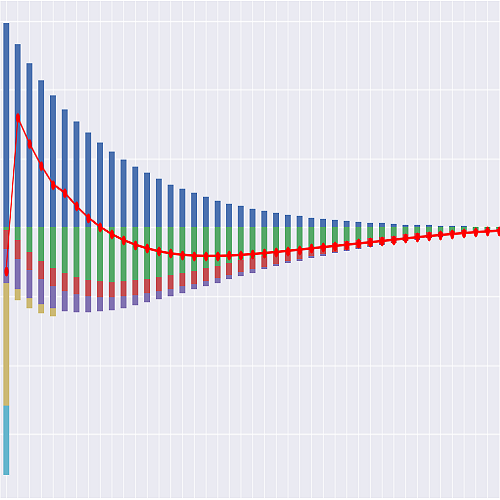
# modelx: pseudo-python
# This file is part of a modelx model.
# It can be imported as a Python module, but functions defined herein
# are model formulas and may not be executable as standard Python.
"""The by-policy projection of the :mod:`~.IP_UK_S` model.
The Space is parameterized by ``point_id``, so ``Projection[1]`` is an ItemSpace
projecting model point 1::
>>> Projection[1].result_cf() # the active-lives anchor cell
>>> Projection.point_id = 2 # the claims-in-payment worked example
``t`` counts **policy months**, 0-based: ``t = 0`` is the first projected month and
``t = proj_len() - 1``, with ``proj_len() = 12 (expiry_age - entry_age)``, the last, so
the frame is ``range(proj_len())``. Month ``t`` runs from time ``t`` to time ``t + 1``;
premiums fall at its start and transitions and the benefit at its end. The policy year
is the contractual 1-based label ``policy_year(t) = t // 12 + 1``. The notes index the
state probabilities ``l_H(t)`` and ``l_S(t, z)`` at the **start** of month ``t`` with
``l_H(0) = 1`` on an at-issue cell, and so does the library: ``pols_active(t)`` is the
notes' ``l_H(t)`` and ``pols_sick_dur(t, z)`` its ``l_S(t, z)``, so every cash flow on
a ``result_cf()`` row is weighted by a state count on the same row. ``z``, the claim
duration in months, is a separate 1-based cohort index and is not a time index.
.. rubric:: Input data
Inputs are **external files**: plain CSVs living in the model folder's parent
directory, ``products/income_protection/``, read at run time rather than stored inside
the model. The model folder therefore holds nothing but formulas — no ``_data/``, no
IOSpec, no embedded values — so a diff of the model shows logic changes only, and an
input can be edited or swapped without rewriting the model. This follows
``annuallife.TradLife_A``; contrast ``basiclife.BasicTerm_S``, which keeps its inputs
*inside* the model through modelx's IOSpec machinery.
The consequence worth knowing: **the model is not portable on its own.** Copying the
``IP_UK_S`` folder without its parent's CSVs produces a model that reads and then fails
on first evaluation.
Each table has a filename Reference and a reader Cells, both on :mod:`~.IP_UK_S.Data`,
reached here through the ``data`` Reference:
====================== ============================== ==========================
Reference Cells File
====================== ============================== ==========================
model_point_file data.model_point_table() model_point_table.csv
inception_file data.inception_table() inception_table.csv
termination_file data.termination_table() termination_table.csv
mort_table_file data.mort_table() mort_table.csv
lapse_table_file data.lapse_table() lapse_table.csv
====================== ============================== ==========================
.. rubric:: Naming
Cells names follow lifelib's ``basiclife.BasicTerm_S`` and ``savings.CashValue_SE``
wherever those models have an analogue — ``pols_*`` for population counts, plural nouns
for cash flows, ``*_rate`` for annual rates and ``*_rate_mth`` for monthly ones,
``*_pp`` for per-policy amounts, ``claims(t, kind)`` with an uppercase ``kind`` string.
The technical notes use compact actuarial symbols instead. The mapping is:
========================= ============================== ==========================
Notes symbol Cells Meaning
========================= ============================== ==========================
entry_age age_at_entry() Entry age (ANB)
a = entry_age + t // 12 age(t) Attained age (ANB) in month t
y = t // 12 + 1 policy_year(t) Policy year containing month t
(none) duration(t) Completed policy years, t // 12
(none) duration_mth(t) Months elapsed at start of month t
expiry_age expiry_age() Age all cover ceases
T = 12(expiry - entry) proj_len() Number of months; t = 0..T-1
d deferred_weeks() Deferred period in weeks
occ_class occ_class() CMI occupation class OC1-OC4
status status() active or in_claim cell
z (the duration argument) Claim duration in months
(none) claim_dur_year(z) Duration year containing z
(none) max_dur() Longest claim duration tracked
B(y) benefit_pp(t) Escalated monthly benefit
P(y) premium_pp(t) Escalated monthly premium
AP(y) amount_payable_pp(t) Amount payable per month
(max benefit formula) benefit_max_pp() Contractual maximum benefit
k claim_severity Severity factor, 1.0
AP/B ap_ratio Offset/guarantee effect, 1.0
j esc_rate() Escalation rate
M_esc(y) esc_lapse_factor(t) Premium-shock lapse multiplier
iota_a(a) inception_rate(t) Annual claim inception rate
iota_m(a) inception_rate_mth(t) The same, monthly
M_cycle cycle_factor Economic-cycle overlay, 1.0
q_H_a(a) mort_rate(t) Active-life annual mortality
q_H_m(a) mort_rate_mth(t) The same, monthly
w_a(y) lapse_rate(t) Annual lapse rate in month t
(table) lapse_rate_base(t) Table lapse rate before shock
w_m(y) lapse_rate_mth(t) Monthly lapse rate
rho_a(z) rec_rate(z) Annual recovery rate
rho_m(z) rec_rate_mth(z) Monthly recovery rate
q_S_a(z) mort_rate_sick(z) Annual in-claim mortality
q_S_m(z) mort_rate_sick_mth(z) Monthly in-claim mortality
s_S(z) claim_surv_step(z) Monthly in-claim survival
(the three vectors) claim_rate_vectors() rho_m, q_S_m and s_S as lists
l_H(t) pols_active(t) In state H at start of month t
l_S(t, z) pols_sick_dur(t, z) In claim at duration z
l_S(t) pols_sick(t) Total in claim payment
(the whole vector) sick_cohorts(t) l_S(t, .) as a list
(none) pols_if(t) H + S: policies in force
(none) pols_if_at(t, timing) BEF_DECR / AFT_DECR
n(t) pols_inception(t) New claim inceptions
rec(t) pols_recovery(t) Recoveries out of S
dth_S(t) pols_death_sick(t) Deaths in claim
dth_H(t) pols_death_active(t) Deaths in state H
lps(t) pols_lapse(t) Lapses out of H
(none) pols_exit(t) Recoveries leaving the model
(none) pols_maturity(t) In force at the policy end date
(none) pols_sick_surv(t) In claim at the end of month t
PREM(t) premiums(t) Premium income
BEN(t) claims(t, "BENEFIT") Income benefit outgo
0 claims(t, "DEATH") Death benefit; always zero
0 claims(t, "LAPSE") Surrender outgo; always zero
EXP(t) expenses(t) Maintenance + claim management
e_m(y), ec_m(y) expense_maint, expense_claim Expense levels p.a.
(none) inflation_factor(t) Expense inflation factor
CF(t) net_cf(t) Net cash flow, income positive
v(t) disc_factor(t) Discount factor to end of month t
(none) pv_benefits() PV of benefit outgo
a_dis(a0, z0) annuity_dis() Disabled-life annuity factor
========================= ============================== ==========================
Three names needed care.
The notes use ``q_H`` and ``q_S`` for the two mortality rates. :func:`mort_rate` is the
**active-life** one, because that is what ``mort_rate`` means in every other model in
this library — the rate applying to the population the projection starts with — and the
in-claim rate is :func:`mort_rate_sick`, keyed by claim duration rather than by month.
Reading a claimant mortality rate out of ``mort_rate`` is the kind of mistake the naming
is there to prevent.
``BEN(t)`` is an income stream, not a lump sum, but it is reached as
``claims(t, "BENEFIT")`` so that the library's one benefit-outgo cells covers it. The
other two kinds are zero and say so: this composite carries **no death benefit** — the
£5,000-£10,000 death benefits two sampled insurers offer are out of scope — and **no
surrender value** at any time.
``z`` is the claim duration in months and ``t`` the policy month. They are different
clocks and the model never mixes them: rates out of state S take ``z``, rates out of
state H take ``t``. ``z`` is 1-based by construction - cohort 1 is a claim that has just
started paying - and the 0-based time index ``t`` does not change that.
.. rubric:: Three states, and why the model needs all of them
Healthy and active (H), sick and in claim payment (S), dead (D), with lapse as a further
exit from H and **recovery flowing back from S to H**. That is the structure of the
CMI's own graduations, and it is why income protection has two experience bases rather
than one: claim *inception* rates out of H, and claim *termination* rates out of S, the
latter split into recovery and death.
The deferred period is embedded **in the inception basis**, not modelled as a fourth
state. ``iota`` is a claim *payment* inception rate specific to the policy's deferred
period — exactly the quantity the CMI publishes per deferred period — so a sickness
spell that recovers inside the deferred period never leaves H, and a life sick but not
yet in payment stays in H and keeps paying premiums, which is what the contract's
waiver-from-payment-start convention says. No separate "sick, not yet in payment" state
is needed and the lag between onset and payment is absorbed into the calibration of
``iota``. Dual deferred periods and sick-pay-linked deferreds would need spell-level
modelling and are out of scope.
.. rubric:: The in-claim population is two-dimensional
Termination rates depend on how long the claim has already run: 40% a year at duration
one falling to 5% from duration five in the shipped **[std]** basis. So the model tracks
``l_S(t, z)`` cohort by cohort. Collapsing that to a single bucket with a
duration-independent termination rate materially misstates claim run-off, and is the
notes' first-listed pitfall — the duration gradient *is* the defining feature of income
protection terminations.
:func:`sick_cohorts` holds the whole vector for one month and is the model's only
list-valued cells. The alternative — a two-argument ``pols_sick_dur(t, z)`` recursion —
would be ``proj_len() x max_dur()`` separate cells, 130,000 of them on the anchor cell,
each with its own cache entry. Keeping the vector in one cells per month makes it
``proj_len()`` cells with a loop inside, and :func:`pols_sick_dur` then reads an element
out of it so that the notes' two-dimensional object is still addressable by name. The
list is rebuilt rather than mutated on each step, so a caller cannot corrupt the cache
by holding one.
The shipped termination basis suppresses the **age** dimension **[std]**. IP11 is
two-dimensional in age and duration, with claimant mortality duration-dependent to five
years and age-only beyond, and it also has a "run-in" of *increasing* recovery rates
over the first weeks of claim for the shorter deferred periods, which annual duration-year
granularity smooths away. A licensee restoring both dimensions changes
``termination_table.csv`` and the two lookups, and nothing else.
.. rubric:: Where recoveries go, and the two kinds of model point
The notes give two calculations, and the model point's ``recovery_basis`` column says
which one a cell runs:
``recovery_basis = "return_to_h"``
The notes' processing order step 5: recovered lives re-enter H, resume paying
premiums and are again exposed to inception. This is the **active-lives** basis and
every ``active`` model point uses it.
``recovery_basis = "exit"``
Recovered lives leave the model. This is the **disabled-life annuity** the notes'
claims-in-payment section values — the expected present value of the benefit until
recovery, death or expiry — and it is the basis the worked example is computed on.
Both ``in_claim`` model points use it.
Keeping it a column rather than deriving it from ``status`` matters, because the choice
is a valuation question and not a property of the cell: a claims-in-payment reserve is
the disabled-life annuity, but a full contract-boundary best estimate for the same
policy would carry the post-recovery active phase as well. Running an ``in_claim`` cell
on ``return_to_h`` gives the second reading, and gives a materially different answer,
because recovered lives can and do claim again.
One limitation the notes name and this model inherits: contractually a same-cause
recurrence within 52 weeks restarts payment with **no new deferred period**, and
returning recovered lives to the standard inception basis ignores that. It understates
re-inception at short horizons. The refinement is a post-recovery flag carrying a loaded
inception rate for twelve months, and it is not implemented.
.. rubric:: Premiums come from H alone
Premiums are waived from the start of benefit payment, so :func:`premiums` is carried on
:func:`pols_active` and never on :func:`pols_if`. Projecting premium income from lives in
claim is the notes' second-listed pitfall and overstates income by the whole in-claim
population. Note the asymmetry it creates with escalation: the benefit escalates in
claim and the premium that would have paid for it does not, which is why the escalation
option is inflation-sensitive on exactly the claims that are longest.
.. rubric:: Benefit in arrears, and the month a claim starts
A claim incepting at the end of month ``t`` seeds cohort ``z = 1`` and receives its first
payment at the end of month ``t + 1``. So the benefit is paid on
:func:`pols_sick_surv` — the cohorts that were already in payment at the start of the
month and survived it — and not on :func:`pols_sick` plus new inceptions. Paying the new
inceptions would hand over a full month's benefit at the instant payment starts and
break the equivalence with the inception-annuity decomposition of the same projection.
The contractual daily pro-rating of partial claim months is replaced by whole-month
payment **[std]**: a life recovering mid-month receives nothing for that month here and
a pro-rated amount in reality.
.. rubric:: Expiry truncates everything
All cover and any claim in payment terminate at the policy end date with no value.
:func:`pols_maturity` is that termination, non-zero only in the last month, and it is
what makes the in-force roll-forward close. An untruncated disabled-life annuity
materially overstates the liability for claims incepting near expiry — model point 5 is
a claim at duration 30 months on a policy with 15 years to run, and its benefit stream
stops dead at ``proj_len()``.
.. rubric:: Amount payable is not the same thing as the chosen benefit
Offsets against other income, the minimum benefit guarantee and proportionate benefits
on a partial return to work all move the amount actually paid away from the benefit the
policyholder chose. The base run sets ``AP = B`` through ``ap_ratio`` and the
severity factor ``claim_severity`` to 1 **[std]**, which **overstates** outgo
wherever the maximum-benefit formula bites and understates nothing, since ``AP <= B``
always. A portfolio calibration sets one or both below 1 from claims experience.
:func:`benefit_max_pp` implements the contractual two-band maximum so that
:func:`check_benefit_max` can assert every shipped model point is inside it.
.. rubric:: Discounting, which the rest of the library does not do
Every other model in this library projects **undiscounted** gross liability cash flows
and leaves discounting to the layer that consumes them. This one carries
:func:`disc_factor`, :func:`pv_benefits` and :func:`annuity_dis` as well, because the
notes' worked example is a present value and because the disabled-life annuity is the
object a claims-in-payment reserve is quoted as. They are a **companion**, not part of
the cash flow projection: no line of :func:`result_cf` is discounted, and
``disc_rate`` is the worked example's flat 3% **[std]**, not a valuation basis. A
Solvency UK best estimate discounts these same cash flows on the PRA risk-free term
structure, and the claims-in-payment element is matching-adjustment eligible where it is
organised and managed separately.
"""
from modelx.serialize.jsonvalues import *
_formula = lambda point_id: None
_bases = []
_allow_none = None
_spaces = []
# ---------------------------------------------------------------------------
# Cells
[docs]
def model_point():
"""The selected model point as a Series."""
return data.model_point_table().loc[point_id] # noqa: F821
[docs]
def age_at_entry():
"""The entry age (ANB) of the selected model point.
On an ``in_claim`` cell this is the **attained age at the valuation date**, and the
policy-year clock restarts there **[std]**: the notes give no anniversary offset for
an in-force claim, so ``t = 0`` is the valuation month and escalation steps at
``t = 12, 24, ...`` from the valuation date rather than from the contractual
anniversary. The worked example is level cover, where the distinction does not
arise.
"""
return int(model_point()["entry_age"])
[docs]
def sex():
"""The sex (M / F) of the selected model point.
Not a smoker split: the IP11 rate structure is sex, deferred period and occupation
class, and any smoker differentiation sits in insurer pricing, which is not public.
"""
return model_point()["sex"]
[docs]
def occ_class():
"""The CMI occupation class, OC1 to OC4 [R1]; 1 is the lightest."""
v = int(model_point()["occ_class"])
if v not in (1, 2, 3, 4):
raise ValueError("invalid occ_class")
return v
[docs]
def deferred_weeks():
"""d: the deferred period in weeks, from the 4/8/13/26/52 menu [S6].
It is not a state in this model: the inception basis is deferred-period-specific, so
the deferred period enters through :func:`inception_rate` and nowhere else. See the
Space docstring.
"""
v = int(model_point()["deferred_weeks"])
if v not in (4, 8, 13, 26, 52):
raise ValueError("invalid deferred_weeks")
return v
[docs]
def benefit_mth():
"""B(1): the chosen monthly benefit in policy year 1 **[std]**, £2,000 on the base cell.
``B(y)`` is indexed by the contractual policy year ``y = policy_year(t)``, which is
1-based; this is its value at ``t = 0``.
"""
return float(model_point()["benefit_mth"])
[docs]
def earnings_annual():
"""The annual earnings on the underwriting record, which cap the benefit."""
return float(model_point()["earnings_annual"])
[docs]
def expiry_age():
"""The age at which all cover and any claim in payment cease, 50-70 [S1][S3][S5]."""
return int(model_point()["expiry_age"])
[docs]
def escalation():
"""``RPI`` or ``none``: whether the escalation option is elected [S1][S2]."""
v = model_point()["escalation"]
if v not in ("RPI", "none"):
raise ValueError("invalid escalation")
return v
[docs]
def premium_mth():
"""P(1): the monthly premium in policy year 1 **[std]**, a placeholder.
UK income protection premium rates are not public, so any reference premium is
constructed. It is guaranteed level apart from the escalation uplift
[S1][S3][S5][S7]. Its value at ``t = 0``; ``P(y)`` is indexed by the 1-based
contractual policy year.
"""
return float(model_point()["premium_mth"])
[docs]
def premium_basis():
"""``guaranteed``. Reviewable and age-costed premiums are out of scope.
A reviewable variation exists - fixed for five years, then reviewed with no
contractual cap - but the review formulas are insurer-discretionary and undisclosed,
so any reviewable model would need a **[std]** review rule that no source supports.
"""
v = model_point()["premium_basis"]
if v != "guaranteed":
raise ValueError("invalid premium_basis")
return v
[docs]
def status():
"""``active`` (the population starts in H) or ``in_claim`` (it starts in S).
An in-force portfolio needs both kinds of cell: active lives, and claims already in
payment carrying their claim duration as an attribute.
"""
v = model_point()["status"]
if v not in ("active", "in_claim"):
raise ValueError("invalid status")
return v
[docs]
def recovery_basis():
"""Where recovered lives go: back to H, or out of the model.
``return_to_h``
the notes' processing order step 5 - recovered lives re-enter H,
resume paying premiums and are again exposed to inception. The
**active-lives** basis.
``exit``
recovered lives leave the model, which is the **disabled-life
annuity** the claims-in-payment valuation uses, and the basis the
notes' worked example is computed on.
A column rather than something derived from :func:`status`, because it is a
valuation question: a claims-in-payment reserve is the disabled-life annuity, but a
full contract-boundary best estimate for the same policy carries the post-recovery
active phase too. See the Space docstring.
"""
v = model_point()["recovery_basis"]
if v not in ("return_to_h", "exit"):
raise ValueError("invalid recovery_basis")
return v
[docs]
def claim_duration_months():
"""z0: the claim duration already elapsed on an ``in_claim`` cell; 0 at inception.
An elapsed count on the claim-duration clock, not a point on the time axis. The
seeded population enters cohort ``z0 + 1`` at ``t = 0``, since cohort 1 is a claim
that has just started paying.
"""
return int(model_point()["claim_duration_months"])
[docs]
def pols_if_init():
"""Initial number of policies; 1.0 on a single-policy model point."""
return float(model_point()["pols_if_init"])
[docs]
def proj_len():
"""The number of projected months, ``12 (expiry_age - entry_age)``.
The frame is ``t = 0, 1, ..., proj_len() - 1``: ``proj_len()`` is the exclusive end
of the projection, and the last projected month is ``proj_len() - 1``. All cover
and any claim in payment terminate at the policy end date with no value
[S1][S3][S5][S7][S10], so there is nothing after it. This is what truncates the
disabled-life annuity, and an untruncated one materially overstates the liability
for claims incepting near expiry.
"""
return 12 * (expiry_age() - age_at_entry())
[docs]
def duration(t):
"""Completed policy years at the start of month t: ``t // 12``; 0 in the first year."""
return t // 12
[docs]
def duration_mth(t):
"""Months elapsed from the start of the projection at the start of month t; equal to t.
``t`` is 0-based, so the identity is trivial - the cells exists so the monthly
models in this library share one vocabulary.
"""
return t
[docs]
def policy_year(t):
"""y = t // 12 + 1: the contractual policy year containing month t; 1 for t = 0..11.
A 1-based label derived from the 0-based ``t``, used where a contractual schedule
is keyed by policy year: the lapse table and the escalation exponent.
"""
return duration(t) + 1
[docs]
def age(t):
"""a: the attained age (ANB) in the policy year containing month t."""
return age_at_entry() + duration(t)
[docs]
def max_dur():
"""The longest claim duration the cohort vector has to carry.
``proj_len() + z0 + 1``: a claim seeded at duration ``z0 + 1`` at ``t = 0`` reaches
``z0 + proj_len()`` in the last month, ``t = proj_len() - 1``, and a claim incepting
at the end of month 0 reaches ``proj_len() - 1`` there; the final ``+ 1`` is one
cohort of headroom. Cohorts beyond this are structurally zero. A length on the
claim-duration clock ``z``, which is 1-based and separate from ``t``.
"""
return proj_len() + claim_duration_months() + 1
[docs]
def claim_dur_year(z):
"""The claim duration year containing claim month z: ``(z - 1) // 12 + 1``.
``z`` is the 1-based claim-duration cohort index, not the time index ``t``, so the
``z - 1`` here is not a first-period idiom. Duration years beyond the termination
table take its last row, which is the shipped table's "5+" row.
"""
return (z - 1) // 12 + 1
[docs]
def inception_rate(t):
"""iota_a(a): the annual claim payment inception rate out of state H.
Read from ``inception_table.csv`` at the policy's sex, occupation class and deferred
period, **linearly** interpolated between pivot ages and linearly extrapolated
beyond them, then multiplied by the economic-cycle overlay ``cycle_factor``.
Floored at zero, since linear extrapolation below the first pivot can go negative.
The rate is a *claim payment* inception rate specific to the deferred period, which
is exactly what the CMI publishes per deferred period - so the deferred period needs
no state of its own. The shipped values are **[std]** proxies shaped like IP11 and
carry no CMI authority; IP11's own inception rates are additionally known to be
understated through exposure errors, and licensees must apply the CMI's indicative
adjustments.
"""
sub = data.inception_table().loc[ # noqa: F821
(sex(), occ_class(), deferred_weeks())]
ages = sorted(int(a) for a in sub.index)
x = age(t)
if x <= ages[0]:
lo, hi = ages[0], ages[1]
elif x >= ages[-1]:
lo, hi = ages[-2], ages[-1]
else:
lo = max(a for a in ages if a <= x)
hi = min(a for a in ages if a > x)
r_lo = float(sub.loc[lo, "inception_rate"])
r_hi = float(sub.loc[hi, "inception_rate"])
r = r_lo + (r_hi - r_lo) * (x - lo) / (hi - lo)
return max(0.0, r) * cycle_factor # noqa: F821
[docs]
def inception_rate_mth(t):
"""iota_m(a) = 1 - (1 - iota_a)^(1/12): the monthly inception rate **[std]**."""
return 1.0 - (1.0 - inception_rate(t)) ** (1.0 / 12.0)
[docs]
def mort_rate(t):
"""q_H_a(a): the **active-life** annual mortality rate.
A minor decrement in income protection, and a **[std]** proxy shaped like the ONS
national life tables scaled by ``mort_active_factor``. Claimant mortality is a
different rate on a different clock - see :func:`mort_rate_sick`.
"""
return float(data.mort_table().loc[ # noqa: F821
(sex(), age(t)), "mort_rate"]) * mort_active_factor # noqa: F821
[docs]
def mort_rate_mth(t):
"""q_H_m(a) = 1 - (1 - q_H_a)^(1/12): the monthly active-life mortality **[std]**."""
return 1.0 - (1.0 - mort_rate(t)) ** (1.0 / 12.0)
[docs]
def rec_rate(z):
"""rho_a(z): the annual recovery rate at claim duration z months.
From the duration year containing z, divided by the economic-cycle overlay - a
recession is believed to slow recoveries as well as raise inceptions, and the
overlay is a scenario axis rather than a calibrated assumption, held at 1 in the base
run. The declining gradient, 40% in year one to 5% from year five, is the defining
feature of income protection terminations; the values are **[std]** proxies.
"""
tbl = data.termination_table() # noqa: F821
y = min(claim_dur_year(z), int(tbl.index.max()))
return min(1.0, float(tbl.loc[y, "recovery_rate"]) / cycle_factor) # noqa: F821
[docs]
def rec_rate_mth(z):
"""rho_m(z) = 1 - (1 - rho_a)^(1/12): the monthly recovery rate **[std]**."""
return 1.0 - (1.0 - rec_rate(z)) ** (1.0 / 12.0)
[docs]
def mort_rate_sick(z):
"""q_S_a(z): the annual mortality of a life in claim at duration z months.
Flat across durations in the shipped **[std]** proxy. IP11 makes it
duration-dependent to five years and age-dependent beyond, so this is the crudest
part of the shipped basis; it is also the smaller of the two termination causes.
"""
tbl = data.termination_table() # noqa: F821
y = min(claim_dur_year(z), int(tbl.index.max()))
return float(tbl.loc[y, "mort_rate_sick"])
[docs]
def mort_rate_sick_mth(z):
"""q_S_m(z) = 1 - (1 - q_S_a)^(1/12): the monthly in-claim mortality **[std]**."""
return 1.0 - (1.0 - mort_rate_sick(z)) ** (1.0 / 12.0)
[docs]
def claim_surv_step(z):
"""s_S(z) = (1 - rho_m)(1 - q_S_m): monthly survival in claim at duration z.
Recovery first, then death among the non-recovered, as independent decrements
**[std]** - the notes' processing order for exits from state S.
"""
return (1.0 - rec_rate_mth(z)) * (1.0 - mort_rate_sick_mth(z))
[docs]
def claim_rate_vectors():
"""The three per-duration rate vectors, ``(rho_m, q_S_m, s_S)``, built once.
Element ``z - 1`` of each list is the value at claim duration ``z``, for
``z = 1 ... max_dur()``. Purely a performance shape: :func:`pols_recovery`,
:func:`pols_death_sick` and :func:`pols_sick_surv` each walk the whole cohort vector
in every projected month, and reading the rates out of a list rather than calling
:func:`rec_rate_mth` and friends per element turns ``proj_len() x max_dur()``
cells lookups into ``max_dur()`` of them - on the anchor cell, four hundred thousand
down to four hundred. The scalar cells stay, because they are what a reader looks
up and what a test asserts against; this is built *from* them, so there is still one
definition of each rate.
"""
zs = range(1, max_dur() + 1)
rec = [rec_rate_mth(z) for z in zs]
dth = [mort_rate_sick_mth(z) for z in zs]
return rec, dth, [(1.0 - r) * (1.0 - d) for r, d in zip(rec, dth)]
[docs]
def esc_rate():
"""j = min(max(RPI, 0), 10%): the escalation rate [S1][S2].
Zero when the option is not elected. A flat 3% RPI snapshot **[std]** - future RPI
is an economic input, not insurer discretion - so the benefit grows 3% a year and
the premium 4.5%, the x1.5 multiplier. The 10% cap is an embedded inflation option
the insurer has written.
"""
if escalation() != "RPI":
return 0.0
return min(max(rpi_rate, 0.0), esc_cap) # noqa: F821
[docs]
def benefit_pp(t):
"""B(y): the escalated monthly benefit in the policy year containing month t.
Escalates on policy anniversaries and **continues to escalate in claim** [S1][S2],
which is what makes the disabled-life annuity inflation-sensitive exactly when it is
longest. Some contracts instead escalate in-claim amounts on *claim* anniversaries
with index-lag rules; align the convention with the contract being modelled.
"""
return benefit_mth() * (1.0 + esc_rate()) ** (policy_year(t) - 1)
[docs]
def premium_pp(t):
"""P(y): the escalated monthly premium in the policy year containing month t.
Guaranteed level apart from the escalation uplift of ``1 + 1.5 j`` a year
[S1][S2][S3][S5][S7]. The premium side compensates for escalation only x1.5 on
active lives and not at all on lives in claim, where premiums are waived.
"""
step = 1.0 + esc_prem_mult * esc_rate() # noqa: F821
return premium_mth() * step ** (policy_year(t) - 1)
[docs]
def benefit_max_pp():
"""The contractual maximum monthly benefit from the two-band earnings formula.
65% of earnings to the £60,000 breakpoint and 50% above it, capped at £20,000 a
month and floored at the £1,500 guarantee [S1][S2][S5][S7]. Nothing in the
projection consumes it - the base run pays :func:`amount_payable_pp` - but
:func:`check_benefit_max` asserts every model point's chosen benefit is inside it,
which is the check the underwriting record exists to support.
"""
e = earnings_annual()
gross = (ben_band1_rate * min(e, ben_breakpoint) # noqa: F821
+ ben_band2_rate * max(0.0, e - ben_breakpoint)) # noqa: F821
m = min(gross / 12.0, ben_cap_mth) # noqa: F821
return max(m, ben_guarantee_mth) # noqa: F821
[docs]
def amount_payable_pp(t):
"""AP(y): the amount actually payable per month of full incapacity.
``ap_ratio x B(y)`` with ``ap_ratio`` at 1 **[std]**. Offsets against other
income, the minimum benefit guarantee and proportionate benefits on a partial return
to work all push the amount paid below the chosen benefit, so ``AP <= B`` always and
the base run **overstates** outgo wherever the maximum-benefit formula bites. A
portfolio calibration sets ``ap_ratio`` or ``claim_severity`` below 1 from claims
experience.
"""
return ap_ratio * benefit_pp(t) # noqa: F821
[docs]
def esc_lapse_factor(t):
"""M_esc(y): the premium-shock lapse multiplier **[std]**; 1 in the base run.
``1 + 2 max(0, 1.5 j - 0.05)`` once the escalation uplift has started - from policy
year 2, i.e. ``t >= 12`` - and 1 in policy year 1, so a 3% RPI
snapshot gives 4.5% premium growth and no shock, while the 10% cap would give 15%
growth and a multiplier of 1.2. Sampled insurers let policyholders decline
escalation increases, with the option lapsing after two or three consecutive
refusals; declines are a portfolio-level phenomenon that a single-cell model cannot
represent, so this multiplier is the aggregate proxy for them.
"""
if escalation() != "RPI" or policy_year(t) < 2:
return 1.0
return 1.0 + esc_lapse_slope * max( # noqa: F821
0.0, esc_prem_mult * esc_rate() - esc_lapse_threshold) # noqa: F821
[docs]
def lapse_rate_base(t):
"""The table annual lapse rate in month t **[std]**, before the escalation shock.
10 / 8 / 6 / 6 / 6 / 4 percent by policy year. No public UK income protection lapse
study was retrieved, so the table has no anchor at all and is a pure placeholder.
The table is keyed by the contractual 1-based ``policy_year``, reached through
:func:`policy_year`; policy years beyond the table take its last row.
"""
tbl = data.lapse_table() # noqa: F821
y = policy_year(t)
return float(tbl.loc[min(y, int(tbl.index.max())), "lapse_rate"])
[docs]
def lapse_rate(t):
"""w_a(y): the **annual** lapse rate out of state H in month t.
Applied to lives in H only. Lives in claim never lapse **[std]**: their premiums are
waived and the benefit in payment is the most valuable thing they own.
"""
return min(1.0, lapse_rate_base(t) * esc_lapse_factor(t))
[docs]
def lapse_rate_mth(t):
"""w_m(y) = 1 - (1 - w_a)^(1/12): the monthly lapse rate **[std]**."""
return 1.0 - (1.0 - lapse_rate(t)) ** (1.0 / 12.0)
[docs]
def sick_cohorts(t):
"""l_S(t, .): the in-claim population by claim duration, as a list.
Element ``z - 1`` is the population in claim payment at the start of month t with
claim duration ``z`` months, for ``z = 1 ... max_dur()`` (``z`` is 1-based; the
``z - 1`` is list position, not a time offset). The model's only list-valued
cells, and the reason is cost: a two-argument recursion would be
``proj_len() x max_dur()`` separate cells - 130,000 on the anchor cell - where this
is ``proj_len()`` cells with a loop inside. :func:`pols_sick_dur` reads an element
out of it, so the notes' two-dimensional object is still addressable by name.
At ``t = 0`` the vector is the seeded state: all zeros on an ``active`` cell, and
``pols_if_init()`` at cohort ``z0 + 1`` on an ``in_claim`` one. Thereafter cohort 1
is the previous month's inceptions and every other cohort is the previous cohort
survived one month. A new list is built on each step rather than the previous one
mutated, so holding a returned list cannot corrupt the cache.
From ``t = proj_len()`` on the vector is all zeros: every claim in payment
terminates at the policy end date, the end of month ``proj_len() - 1``, without
value, so there is no run-off tail for the roll-forward to reconcile against.
"""
n = max_dur()
if t < 0 or t >= proj_len():
return [0.0] * n
if t == 0:
seed = pols_if_init() if status() == "in_claim" else 0.0
z0 = claim_duration_months() + 1
return [seed if z == z0 else 0.0 for z in range(1, n + 1)]
prev = sick_cohorts(t - 1)
surv = claim_rate_vectors()[2]
out = [pols_inception(t - 1)]
for z in range(1, n):
out.append(prev[z - 1] * surv[z - 1])
return out
[docs]
def pols_sick_dur(t, z):
"""l_S(t, z): the population in claim at the start of month t at duration z.
``z`` is the 1-based claim-duration cohort index; ``z - 1`` is its list position.
"""
v = sick_cohorts(t)
return v[z - 1] if 1 <= z <= len(v) else 0.0
[docs]
def pols_sick(t):
"""l_S(t): the total population in claim payment at the start of month t."""
return sum(sick_cohorts(t))
[docs]
def pols_sick_surv(t):
"""The population still in claim at the **end** of month t, before new inceptions.
``sum over z of l_S(t, z) s_S(z)``, which is ``l_S(t + 1) - n(t)``. This is what
the benefit is paid on: the benefit is monthly in arrears, so a claim incepting at
the end of month t is not paid until the end of month ``t + 1``.
"""
v = sick_cohorts(t)
surv = claim_rate_vectors()[2]
return sum(a * b for a, b in zip(v, surv) if a != 0.0)
[docs]
def pols_recovery(t):
"""rec(t): recoveries out of state S at the end of month t.
``sum over z of l_S(t, z) rho_m(z)``. Where they go depends on
:func:`recovery_basis`.
"""
v = sick_cohorts(t)
rec = claim_rate_vectors()[0]
return sum(a * b for a, b in zip(v, rec) if a != 0.0)
[docs]
def pols_death_sick(t):
"""dth_S(t): deaths in claim at the end of month t.
``sum over z of l_S(t, z)(1 - rho_m(z)) q_S_m(z)`` - recovery first, then death
among the non-recovered.
"""
v = sick_cohorts(t)
rec, dth, _ = claim_rate_vectors()
return sum(a * (1.0 - r) * d
for a, r, d in zip(v, rec, dth) if a != 0.0)
[docs]
def pols_exit(t):
"""Recoveries that leave the model at the end of month t.
Equal to :func:`pols_recovery` on the ``exit`` recovery basis and zero on
``return_to_h``, where the same lives reappear in :func:`pols_active`. It exists so
that the population identity closes on both bases.
"""
return pols_recovery(t) if recovery_basis() == "exit" else 0.0
[docs]
def pols_active(t):
"""l_H(t): the population in state H at the start of month t.
``pols_if_init()`` at ``t = 0`` on an ``active`` cell and zero on an ``in_claim``
one, then the notes' state update from the previous month: survivors of mortality,
lapse and inception, plus that month's recoveries where the recovery basis returns
them. Zero from ``t = proj_len()`` on, once cover has ceased.
"""
if t < 0 or t >= proj_len():
return 0.0
if t == 0:
return pols_if_init() if status() == "active" else 0.0
prev = pols_active(t - 1)
stay = (prev * (1.0 - mort_rate_mth(t - 1)) * (1.0 - lapse_rate_mth(t - 1))
* (1.0 - inception_rate_mth(t - 1)))
back = 0.0 if recovery_basis() == "exit" else pols_recovery(t - 1)
return stay + back
[docs]
def pols_death_active(t):
"""dth_H(t): deaths out of state H at the end of month t.
The notes' processing order out of H is **death, then lapse, then inception among
the survivors** **[std]**.
"""
return pols_active(t) * mort_rate_mth(t)
[docs]
def pols_lapse(t):
"""lps(t): lapses out of state H at the end of month t.
Taken from the survivors of mortality. Pays nothing: the contract has no cash-in
value at any time [S4][S5][S7]. Lives in claim never lapse.
"""
return pols_active(t) * (1.0 - mort_rate_mth(t)) * lapse_rate_mth(t)
[docs]
def pols_inception(t):
"""n(t): new claim inceptions at the end of month t, seeding cohort z = 1.
Taken from the survivors of both mortality and lapse. Each inception starts a new
duration cohort, and is not paid until the end of the following month.
"""
return (pols_active(t) * (1.0 - mort_rate_mth(t))
* (1.0 - lapse_rate_mth(t)) * inception_rate_mth(t))
[docs]
def pols_if(t):
"""The number of policies in force at the start of month t: H plus S.
The weight on the maintenance expense, and the count a reader of ``result_cf()``
reconciles the rest of the row against. Note that it is **not** the weight on
premium income, which comes from :func:`pols_active` alone because premiums are
waived in claim.
"""
return pols_active(t) + pols_sick(t)
[docs]
def pols_if_at(t, timing):
"""The number of policies in force at a point inside month t.
``"BEF_DECR"``
the start of the month, before any transition; the same number as
:func:`pols_if`.
``"AFT_DECR"``
the end of the month, once deaths, lapses, recoveries leaving the
model and - in the last month - the expiry have been taken. Equal
to ``pols_if(t + 1)`` everywhere but the last month,
``t = proj_len() - 1``, where it is zero.
The intermediate points of the other models have no single-population meaning here,
because two states are moving at once; :func:`pols_active` and :func:`pols_sick`
expose them instead.
"""
if timing == "BEF_DECR":
return pols_if(t)
if timing == "AFT_DECR":
if t < 0 or t >= proj_len() - 1:
return 0.0
return pols_if(t + 1)
raise ValueError("invalid timing")
[docs]
def pols_maturity(t):
"""The population still in force when cover ceases at the policy end date.
Non-zero only in the last projected month, ``t = proj_len() - 1``, at whose end all
cover and any claim in payment terminate without value [S1][S3][S5][S7][S10]. Not
a decrement and not a benefit - but without it the last month appears to lose lives
with no cause, and :func:`check_pols_roll_fwd` would not close.
"""
if t != proj_len() - 1:
return 0.0
stay = (pols_active(t) * (1.0 - mort_rate_mth(t))
* (1.0 - lapse_rate_mth(t)) * (1.0 - inception_rate_mth(t)))
back = 0.0 if recovery_basis() == "exit" else pols_recovery(t)
return stay + back + pols_inception(t) + pols_sick_surv(t)
[docs]
def pols_dead_cum(t):
"""Cumulative deaths, from both states, before the start of month t; 0 at t = 0."""
if t <= 0:
return 0.0
return pols_dead_cum(t - 1) + pols_death_active(t - 1) + pols_death_sick(t - 1)
[docs]
def pols_lapse_cum(t):
"""Cumulative lapses out of state H before the start of month t; 0 at t = 0."""
if t <= 0:
return 0.0
return pols_lapse_cum(t - 1) + pols_lapse(t - 1)
[docs]
def pols_exit_cum(t):
"""Cumulative recoveries that left the model before the start of month t; 0 at t = 0.
Zero throughout on the ``return_to_h`` basis, where recoveries never leave.
"""
if t <= 0:
return 0.0
return pols_exit_cum(t - 1) + pols_exit(t - 1)
[docs]
def inflation_factor(t):
"""The expense inflation factor in month t: ``(1 + pi)^(y - 1)`` **[std]**.
Steps on policy anniversaries, not monthly, which is how the notes write it; ``y``
is the 1-based contractual policy year, so the exponent is ``t // 12``.
"""
return (1.0 + inflation_rate) ** (policy_year(t) - 1) # noqa: F821
[docs]
def premiums(t):
"""PREM(t): premium income at the beginning of month t, an inflow.
Carried on :func:`pols_active` and **never** on :func:`pols_if`. Premiums are
waived from the start of benefit payment [S5][S7][S10][S11], so projecting income
from lives in claim overstates it by the whole in-claim population - the notes'
second-listed pitfall. Lives sick but still inside the deferred period do pay, and
they are in H, so they are counted correctly without a state of their own.
"""
return premium_pp(t) * pols_active(t)
[docs]
def claims(t, kind=None):
"""Benefit outgo in month t, by kind; the total when kind is omitted.
``"BENEFIT"``
``k x AP(y) x`` :func:`pols_sick_surv`, the monthly income benefit,
paid in arrears at the end of the month to lives in claim throughout
it. New inceptions are excluded: a claim incepting at the end of
month t is not paid until the end of month ``t + 1``.
``"DEATH"``
zero. This composite carries no death benefit; the £5,000-£10,000
death benefits two sampled insurers offer are out of scope, and would
add a ``deaths x DB`` term here.
``"LAPSE"``
zero. There is no cash-in value at any time [S4][S5][S7].
The two zero kinds are published rather than omitted so that the product facts are
stated instead of inferred from a missing column.
"""
if kind is None:
return sum(claims(t, k) for k in ("BENEFIT", "DEATH", "LAPSE"))
if kind == "BENEFIT":
return claim_severity * amount_payable_pp(t) * pols_sick_surv(t) # noqa: F821
if kind in ("DEATH", "LAPSE"):
return 0.0
raise ValueError("invalid kind")
[docs]
def expenses(t):
"""EXP(t): maintenance and claim-management expense in month t **[std]**.
£60 per policy a year on every policy in force, plus £300 a year on every claim in
payment, both a twelfth at a time and both inflating at 3%. The claim-management
load is what makes a long claim expensive to administer as well as to pay.
"""
maint = expense_maint / 12.0 * inflation_factor(t) * pols_if(t) # noqa: F821
claim_mgmt = (expense_claim / 12.0 * inflation_factor(t) # noqa: F821
* pols_sick(t))
return maint + claim_mgmt
[docs]
def net_cf(t):
"""CF(t) = PREM(t) - BEN(t) - EXP(t): the net cash flow of month t, income positive.
The notes' own sign, and the library-wide one, so there is no outgo-positive
``liability_cf`` companion. Death and lapse generate no payment at all on this
product.
"""
return premiums(t) - claims(t) - expenses(t)
[docs]
def disc_factor(t):
"""v(t) = (1 + i)^(-(t + 1)/12): the worked example's flat discount factor **[std]**.
The discount factor to the **end** of month t, time ``t + 1``, which is when the
benefit of month t is paid; ``disc_factor(0)`` is one month's discount.
A **companion to** the cash flow projection, not part of it: no line of
:func:`result_cf` is discounted, and every other model in this library projects
undiscounted gross cash flows and leaves discounting to the layer that consumes them.
It exists because the notes' worked example is a present value and because the
disabled-life annuity is the object a claims-in-payment reserve is quoted as. A
Solvency UK best estimate discounts these same cash flows on the PRA risk-free term
structure instead of a flat 3%.
"""
return (1.0 + disc_rate) ** (-(t + 1) / 12.0) # noqa: F821
[docs]
def pv_benefits():
"""The present value of benefit outgo over the whole projection, at ``disc_rate``.
On an ``in_claim`` cell run on the ``exit`` recovery basis this is the
claims-in-payment liability the notes value. See :func:`disc_factor` for why
discounting appears in this model and nowhere else in the library.
"""
return sum(claims(t, "BENEFIT") * disc_factor(t)
for t in range(proj_len()))
[docs]
def annuity_dis():
"""a_dis: the disabled-life annuity factor per £1 a month of amount payable.
``pv_benefits() / AP(y = 1)`` - i.e. ``amount_payable_pp(0)``, the amount payable in
policy year 1, which contains month ``t = 0`` - which on
an ``in_claim`` cell run on the ``exit`` basis is
the notes' ``a_dis(a0, z0)`` exactly: the expected present value of the escalating
benefit until recovery, death or expiry, truncated at the policy end date. On an
``active`` cell the same expression is the inception-annuity decomposition of the
active-lives projection - the value of all *future* claims per unit of benefit - and
is a different object with the same units.
"""
return pv_benefits() / amount_payable_pp(0)
[docs]
def check_pols_roll_fwd_resid(t):
"""The in-force roll-forward residual in month t; zero everywhere.
``pols_if(t) - pols_if(t+1)`` less deaths from both states, lapses, recoveries
leaving the model and the expiry. Inceptions and returning recoveries are absent
because they move lives *between* states rather than out of the policy count - which
is the point of running the check on ``H + S`` rather than on either state alone.
"""
return (pols_if(t) - pols_if(t + 1)
- pols_death_active(t) - pols_death_sick(t) - pols_lapse(t)
- pols_exit(t) - pols_maturity(t))
[docs]
def check_pols_roll_fwd():
"""True when the in-force roll-forward closes in every projected month.
The library-wide form of a roll-forward check: no argument, one bool over all t, so
one test can call it across every model. :func:`check_pols_roll_fwd_resid` gives
the signed residual of the month that failed. The tolerance scales with
``pols_if_init()``, since the residual accumulates rounding on that many policies.
"""
return all(abs(check_pols_roll_fwd_resid(t)) <= 1e-10 * max(pols_if_init(), 1.0)
for t in range(proj_len()))
[docs]
def check_states_resid(t):
"""The three-state population identity residual at the start of month t; zero.
``H + S + cumulative deaths + cumulative lapses + cumulative exits`` must equal the
starting population in every month. This is the check that catches a leak in the
cohort machinery: a mis-indexed duration shift drops population out of S with no
corresponding exit, and nothing else in the model would notice.
"""
return (pols_active(t) + pols_sick(t) + pols_dead_cum(t)
+ pols_lapse_cum(t) + pols_exit_cum(t) - pols_if_init())
[docs]
def check_states():
"""True when the three-state population identity holds in every projected month.
No argument, one bool over all t, the library-wide shape of a ``check_*`` cells;
:func:`check_states_resid` gives the signed residual of the month that failed.
"""
return all(abs(check_states_resid(t)) <= 1e-10 * max(pols_if_init(), 1.0)
for t in range(proj_len()))
[docs]
def check_benefit_max():
"""True when the chosen benefit is inside the contractual maximum.
``B(1) <= benefit_max_pp() / tolerance``, the two-band earnings formula with the 90%
tolerance that stops a small fall in earnings cutting an in-force benefit
[S1][S2][S5][S7]. Unlike the other two checks this is a **validation of the model
point** rather than an identity of the projection: a benefit above the maximum is a
policy that could not have been written, and the underwriting record is on the model
point precisely so that it can be checked.
"""
return benefit_mth() <= benefit_max_pp() / ben_tolerance + 1e-9 # noqa: F821
[docs]
def result_cf():
"""Result table of cashflows, indexed by policy month ``t = 0 .. proj_len() - 1``.
``pols_if`` is H plus S at the start of the month. ``pols_active`` is published
beside it because it, and not ``pols_if``, is the weight on premium income - the
difference between the two columns is the population whose premiums are waived.
Nothing here is discounted; see :func:`disc_factor`.
"""
ts = list(range(proj_len()))
return pd.DataFrame( # noqa: F821
{
"pols_if": [pols_if(t) for t in ts],
"pols_active": [pols_active(t) for t in ts],
"pols_sick": [pols_sick(t) for t in ts],
"premiums": [premiums(t) for t in ts],
"claims_benefit": [claims(t, "BENEFIT") for t in ts],
"claims_death": [claims(t, "DEATH") for t in ts],
"claims_lapse": [claims(t, "LAPSE") for t in ts],
"expenses": [expenses(t) for t in ts],
"net_cf": [net_cf(t) for t in ts],
},
index=pd.Index(ts, name="t"), # noqa: F821
)
[docs]
def result_states():
"""Result table of state movements and rates, indexed by ``t = 0 .. proj_len() - 1``."""
ts = list(range(proj_len()))
return pd.DataFrame( # noqa: F821
{
"pols_active": [pols_active(t) for t in ts],
"pols_sick": [pols_sick(t) for t in ts],
"pols_inception": [pols_inception(t) for t in ts],
"pols_recovery": [pols_recovery(t) for t in ts],
"pols_death_active": [pols_death_active(t) for t in ts],
"pols_death_sick": [pols_death_sick(t) for t in ts],
"pols_lapse": [pols_lapse(t) for t in ts],
"inception_rate": [inception_rate(t) for t in ts],
"mort_rate": [mort_rate(t) for t in ts],
"lapse_rate": [lapse_rate(t) for t in ts],
},
index=pd.Index(ts, name="t"), # noqa: F821
)
# ---------------------------------------------------------------------------
# References
data = ("Interface", ("..", "Data"), "auto")
point_id = 1
cycle_factor = 1.0
mort_active_factor = 1.0
ap_ratio = 1.0
claim_severity = 1.0
rpi_rate = 0.03
esc_cap = 0.1
esc_prem_mult = 1.5
esc_lapse_slope = 2.0
esc_lapse_threshold = 0.05
ben_band1_rate = 0.65
ben_band2_rate = 0.5
ben_breakpoint = 60000.0
ben_cap_mth = 20000.0
ben_guarantee_mth = 1500.0
ben_tolerance = 0.9
expense_maint = 60.0
expense_claim = 300.0
inflation_rate = 0.03
disc_rate = 0.03
pd = ("Module", "pandas")