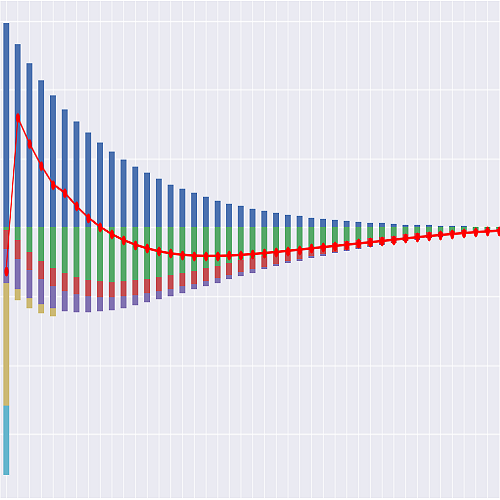
# modelx: pseudo-python
# This file is part of a modelx model.
# It can be imported as a Python module, but functions defined herein
# are model formulas and may not be executable as standard Python.
"""The by-policy projection of the :mod:`~.Term_JP_A` model.
The Space is parameterized by ``point_id``, so ``Projection[1]`` is an ItemSpace
projecting model point 1::
>>> Projection[1].result_cf() # the worked example's anchor cell
>>> Projection.point_id = 3 # or switch the default
``t`` counts **policy years**, 1-based: ``t = 1`` is the first policy year and
``t = proj_len()`` the last. There is nothing after it — no 満期保険金 (maturity
benefit), no 解約返戻金 (*kaiyaku-henreikin*, surrender value), no run-off and no tail
state of any kind [S1][S8][S10][S14].
Where the horizon ends is a product question rather than a convention. A 歳満了
(*sai manryō*) contract ends at its stated age and never renews [S1], so
``proj_len() = policy_term()``. A 年満了 (*nen manryō*) 更新型 contract renews
automatically at the end of every 保険期間 until it reaches the **renewal ceiling of
attained age 80** [S1][S2][S8], so ``proj_len() = renew_ceiling() - age_at_entry()``
and a ten-year term issued at 30 is projected for fifty years across five priced terms.
``contract_boundary = current_term`` truncates instead at the end of the term in force
at the valuation date.
.. rubric:: Input data
Inputs are **external files**: plain CSVs living in the model folder's parent directory,
``products/term_life/``, read at run time rather than stored inside the model. The model
folder therefore holds nothing but formulas — no ``_data/``, no IOSpec, no embedded
values — so a diff of the model shows logic changes only, and an input can be edited or
swapped without rewriting the model. This follows ``annuallife.TradLife_A``; contrast
``basiclife.BasicTerm_S``, which keeps its inputs *inside* the model through modelx's
IOSpec machinery.
The consequence worth knowing: **the model is not portable on its own.** Copying the
``Term_JP_A`` folder without its parent's CSVs produces a model that reads and then
fails on first evaluation.
Each table has a filename Reference and a reader Cells, both on
:mod:`~.Term_JP_A.Data`, reached here through the ``data`` Reference:
====================== ============================== ==========================
Reference Cells File
====================== ============================== ==========================
model_point_file data.model_point_table() model_point_table.csv
mort_table_file data.mort_table() mort_table.csv
lapse_table_file data.lapse_table() lapse_table.csv
prem_rate_file data.prem_rate_table() prem_rate_table.csv
====================== ============================== ==========================
.. rubric:: Naming
Cells names follow lifelib's ``basiclife.BasicTerm_S`` wherever that model has an
analogue — ``pols_*`` for policy counts, plural nouns for cash flows, ``*_rate`` for
rates, ``*_pp`` for per-policy amounts, ``claims(t, kind)`` with an uppercase ``kind``
string, ``pols_if_at(t, timing)`` for the within-year in-force reads. The technical
notes use compact actuarial symbols instead. The mapping is:
========================= ============================== ============================
Notes symbol Cells Meaning
========================= ============================== ============================
(row label) model_point() The selected model point row
t (the index of result_cf) Policy year, 1-based
x age_at_entry() 契約年齢, 満年齢
x + t - 1 age(t) Attained age in year t
(none) sex() Rating factor, M or F
(none) term_type() nen (renewable) or sai
n policy_term() 保険期間, in years
w_r renew_ceiling() Attained age renewal stops
N horizon_ceiling() Years from entry to w_r
t = 1..N proj_len() Last projected policy year
(none) contract_boundary() ceiling or current_term
k term_index(t) Term index, 1 in the first
x_k term_start_age(k) Attained age at term k start
m_k term_len(k) Length of term k, truncated
SA sum_assured() 保険金額, level
f policy_fee_m() Flat monthly element, 248
r(sex, x, m) prem_rate_m(t) Rate per 5,000,000 of cover
qbar(x, m) mort_table_mean(x, m) Mean table rate over m years
P_m(k) premium_mth_pp(t) Monthly premium, whole yen
P_a(k) prem_pp(t) Annualized premium
(table) mort_rate_at_age(x) Table rate at an age
(table) mort_rate_base(t) Table rate in year t
(margin removal) mort_be_factor Best-estimate factor, 0.80
lambda sel_lapse_lambda Selective-lapsation loading
l_ref sel_lapse_ref Selective-lapsation reference
(none) sel_lapse_factor(t) Mortality loading on stayers
q(t) mort_rate(t) Death and 高度障害 decrement
w(t) lapse_rate(t) Ordinary lapse rate
d(t) decline_rate(t) Renewal-decline rate
d_0 decline_base Flat decline rate, 15%
beta, d_max decline_beta, decline_max Decline elasticity module
l(t) pols_if(t) In force at start of year t
(within-year) pols_if_at(t, timing) BEF_DECR / BEF_LAPSE / ...
D(t) pols_death(t) Expected claims in year t
(none) pols_lapse(t) Ordinary lapses
(none) pols_decline(t) Renewal declines
lap(t) pols_lapse_pool(t) Reinstatable population
rho reinstate_rate Reinstatement rate
(window) reinstate_window 3 years [S1]
(none) pols_reinstate(t) Reinstatements into l(t+1)
(none) pols_lapse_expire(t) Pool leavers, window expired
(none) wop_waived_frac(t) Fraction with premiums waived
(none) pols_payer(t) Policies paying premium
A ln_amount() Accelerated amount
i_ln ln_interest_rate Six-month discount rate
a(t) ln_share(t) Acceleration take-up
(payout formula) ln_payout_pp(t) A - interest - premiums
P_a x l premiums(t) Premium income
SA x D(t) claims(t, kind) Benefit outgo by kind
ec expense_claim Claim expense per claim
ec x D(t) claim_expenses(t) Claim expense outgo
E0 expense_acq Acquisition expense, 15,000
e(t) expenses(t) Acquisition + maintenance
c0 comm_init_pp() Initial commission per policy
c_r comm_renewal_rate Renewal commission rate, 5%
(footnote 4) comm_new_term(t) Commission at a 更新
(none) commissions(t) Commission outgo
CF(t) net_cf(t) Net cash flow, income positive
========================= ============================== ============================
Four names needed care.
The notes write ``q(t)`` for the decrement and ``qbar(x, m)`` for a mean of **table**
rates used by the premium scale. Those are different quantities on different bases — one
is best-estimate and one is not — so they get different names: :func:`mort_rate` is the
decrement, and :func:`mort_table_mean` averages :func:`mort_rate_at_age`, which reads the
table unadjusted. Feeding the best-estimate rate into the premium extension would move a
premium scale by an assumption that has nothing to do with pricing.
``P_m(k)`` and ``P_a(k)`` are indexed by the *term* in the notes and by the policy year
here. :func:`premium_mth_pp` and :func:`prem_pp` take ``t`` and resolve the term through
:func:`term_index`, which is what keeps every cash flow line indexed the same way. The
premium is nonetheless level within a 保険期間, and :func:`check_prem_level` asserts it.
``d(t)`` is spelled :func:`decline_rate`, not any variant of ``lapse``. It is a
different event at a different time from a different population — see below — and the
name is the first line of defence against the two being merged.
``lap(t)`` is spelled :func:`pols_lapse_pool` because it is a **stock**, the lapsed
lives still inside the three-year 復活 window, whereas :func:`pols_lapse` is the
year's **flow** into it.
.. rubric:: 更新 reprices; it does not re-issue
This is the structural difference from this repository's UK term model and the notes'
second-listed pitfall. At a renewal boundary the premium is recomputed on attained age
and on the scale then in force [S1][S4][S8][S12], and **nothing else resets**:
- ``pols_if`` is continuous across the boundary. There is no reset to 1.
- No acquisition expense and, in the base run, no commission is paid at a renewal
(``comm_new_term_rate`` is 0). A 更新 is not new business: no new 保険証券 is issued
and no 告知 is taken [S1][S4].
- The suicide and contestability clocks run from the original 責任開始日 and **do not**
restart on 更新 [S1][S4][S7][S8]. Only 復活 restarts them [S1]. Neither clock is
monetized in the base run, so neither is a cells; both are stated here because
treating each renewed term as a fresh policy gets persistency, the strain pattern and
both clocks wrong at once.
Truncation at the ceiling shortens the **term**, not the horizon: a renewal that would
carry the policy past attained age 80 renews as an 80歳満了 term instead [S1][S2][S8],
so an issue age of 35 has a final term of five years and the projection still ends
exactly at 80. That is :func:`term_len`, and model point 4 exercises it. Three other
market rules exist — shorten to expiry age 90, shorten or lengthen to a 指定年齢,
auto-convert to another product [S4][S7][S12] — and importing one changes the horizon.
.. rubric:: Renewal decline is not lapse
:func:`decline_rate` is non-zero **only** in a boundary year, and the exits it produces
are taken **after** mortality and after ordinary lapse — the notes' processing order,
steps 3, 4 and 5. It is also the larger decrement where it applies: in year 10 of the
anchor cell it removes 0.08235591 of the 0.11175249 lives that leave that year, 74% of
all exits. Folding it into :func:`lapse_rate` makes the boundary invisible and mis-times
most of the cohort's departure.
Two behaviours roll into the one rate, and a production model should separate them: the
policyholder who gives notice to decline, and the policyholder whose **first renewed
premium goes unpaid through grace**, in which case the renewal is treated as never
having happened and the contract terminates at the original expiry [S1][S7]. Only the
first is a decision. Both leave at the boundary, which is why one rate can carry them —
and why neither may appear in force in year ``t + 1`` collecting the renewed premium.
.. rubric:: One decrement, one benefit
生保標準生命表2018(死亡保険用)**includes 高度障害** (*kōdo shōgai*, severe disability)
inside its death rate [REG-R20], and the contract pays one sum assured and terminates on
whichever of the two events comes first [S1][S8]. :func:`mort_rate` is therefore the
combined death-and-高度障害 decrement, and there is no disability incidence anywhere in
this model. Adding one on top of the table double-counts the benefit — the notes'
first-listed pitfall.
The same reasoning governs the リビング・ニーズ特約 module below: an acceleration is a
*re-timing and re-pricing* of the death benefit, not a second claim, so
:func:`ln_share` splits the existing decrement rather than adding to it.
.. rubric:: Lapse pays nothing, and there is no 自動振替貸付
There is no 解約返戻金 at any duration on this composite
[S1][S4][S6][S8][S9][S10][S13][S14], so an ordinary lapse is a pure decrement: it moves
:func:`pols_if` and pays nothing. ``claims(t, "LAPSE")`` exists and returns zero, and
``result_cf()`` carries the zero column, because the notes list a non-zero lapse row as
a pitfall imported from models with cash surrender values — and because one carrier in
eight *does* write this design with a surrender value [S12], so the zero is asserted
from the composite's sources rather than assumed from the product class.
There is no 自動振替貸付 (*jidō furikae kashitsuke*, automatic premium loan), stated in
terms by one carrier [S7], and no collateral for a 契約者貸付 either — the second an
inference from the missing surrender value rather than a citation, since that carrier
points its policyholders at the 契約貸付制度 instead [S7] and the document appearing to rule
the policy loan out could not be extracted [S11]. Importing the APL mechanic
that ``WholeLife_JP_A`` carries would create a no-lapse cushion this contract does not
have. Grace, then 失効, then 復活-or-not is the whole persistency machinery here.
.. rubric:: The premium chassis, and where it stops being sourced
Japanese carriers publish rate cards, so the structure decomposes exactly [S2]::
P_m(k) = f + r(sex, x_k, m_k) * SA / 5,000,000
x_k = x + (k - 1) * n
m_k = min(n, w_r - x_k)
P_a(k) = 12 * P_m(k)
with ``f = 248`` per month and ``P_m`` rounded to the whole yen before annualization, as
rate cards are published [S2][S9][S10]. Four cells are sourced — male ages 30, 40 and 50
and female age 30, all at a ten-year term. **Ages 60 and 70 are published by no
carrier**, and the anchor cell reaches both, so :func:`prem_rate_m` extends the scale off
the ``is_anchor`` row of the matching sex **[std]**::
r(sex, x, m) = r_anchor * mort_table_mean(x, m) / mort_table_mean(x_a, m_a)
The extension back-casts to ¥958.9 at age 30 against the published ¥974 (-1.5%) and to
¥1,806.4 at age 40 against ¥1,823 (-0.9%), and gives ¥8,976 at 60 and ¥23,881 at 70.
Published cells are always used where they exist; the extension fills the gaps. That the
back-cast is close is reassuring about the *form* and says nothing about the *level* an
insurer will charge in 2056 — the notes rate it the third-largest lever on this cell.
The ¥248 is a **premium** component, not an expense recovery [S2]. It enters the model
only through :func:`prem_pp`; crediting it against maintenance expense counts it twice.
.. rubric:: Modules that are off in the base run
Eight of the notes' optional constructions are implemented and switched off, so that the
base run reproduces the worked example while the machinery stays visible and testable.
Three of them are model point columns, five are References:
- **リビング・ニーズ特約** (``living_needs``), a discounted acceleration of the death
benefit. Off on the anchor cell; on for model points 6 and 9.
- **保険料の払込の免除** (``wop``), the premium waiver on an accident-caused 別表4 state.
Off on the anchor cell; on for model point 7. 別表4 is a materially lower bar than the
別表3 test for 高度障害 — loss of one eye, deafness in both ears, loss of one limb at
the wrist or ankle [S1] — so the waiver incidence is **not** the 高度障害 incidence and
:func:`wop_waived_frac` does not reuse :func:`mort_rate`.
- **復活** (``reinstatement``), the lapsed-but-reinstatable population and its three-year
window [S1]. Off on the anchor cell; on for model point 8.
- **Contract boundary** (``contract_boundary``), ``current_term`` truncating at the end
of the 保険期間 in force at the valuation date. ``ceiling`` on the anchor cell;
``current_term`` on model point 5. The two differ by more than a rounding — +¥50,400.25
against -¥15,878.74 on the same cell — and the ESR standard-model treatment of a
no-underwriting auto-renewal that would settle which is right is [unverified] here
[REG-R16], so the model does not rule.
- **Selective lapsation**, ``q_eff = q (1 + lambda max(0, 1 - l(t)/l_ref))``, with
``sel_lapse_lambda = 0``. Stronger here than on a UK term policy: renewal takes **no
告知** [S1][S4][S8][S12], so a life that has become uninsurable elsewhere renews while
a healthy life re-shops, and the decision recurs four times on the anchor cell.
- **Renewal-decline elasticity**,
``d = min(d_max, d_0 (P_a(k+1)/P_a(k))^beta)``, with ``decline_beta = 0`` giving the
flat 15%. The premium jump the elasticity would respond to accelerates: 1.87, then
2.16, 2.28 and 2.66.
- **Age-basis shift**, ``q_x -> sqrt(q_x q_(x+1))``, with ``mort_age_shift = False``.
契約年齢 is 満年齢 (*man-nenrei*, age last birthday) [S1] while 標準生命表2018 is built
for 保険年齢 (*hoken-nenrei*, age nearest birthday) [REG-R20], so reading the table at
満年齢 reads it half a year early and **understates** mortality. The base run accepts
and states that bias; the shift module must move ``q`` **up**, not down — about 0.7% at
age 30 and 4.2% at age 40.
- **Commission at 更新**, ``comm_new_term_rate = 0``. Set it to reproduce a scale paying
first-year rates on each renewed term, which would change the sign of the cash flow in
years 11, 21, 31 and 41. No document in the source set discloses a commission scale at
all, so the zero is a choice and not a fact.
.. rubric:: Sign convention and the annual-grid bias
The notes' ``CF(t)`` is already **income positive** — they write ``+ = inflow`` — which
is the library-wide sign of :func:`net_cf`, so there is no outgo-positive
``liability_cf`` companion to publish: one stream, one sign, one name.
Premiums are annual in advance with no allowance for premiums ceasing at a mid-year death
or lapse, which slightly overstates premium income; the offsetting understatement is the
end-of-year claim timing. The notes are explicit that these are a matched pair, and that
applying a further half-year premium adjustment on top of the end-of-year claim timing
would double-count the correction.
.. rubric:: What is not modelled, and why
減額 (a reduction in sum assured) changes ``SA`` and ``P_a`` together, which is a model
point re-parameterization rather than a decrement **[std scope]** [S1][S8]. クーリング・
オフ is out of scope: the projection begins with cover in force and the eight-day
statutory population already out [REG-R36][S1]. The 復活 arrears, payable at 年6%
compound [S1], are not monetized: they settle premiums for years in which this projection
collected none, so recognizing them would need a missed-premium ledger the notes do not
specify **[std scope]**. And a **partial** acceleration under リビング・ニーズ特約 leaves
a reduced contract in force at a reduced premium [S1][S7] — a second transition, not one
benefit with two amounts — so :func:`ln_amount` raises rather than approximating it. It
cannot arise inside the composite's ¥1,000,000-¥30,000,000 envelope, where the
¥30,000,000 per-insured cap is *exactly reached* at the ceiling and never reduces a
single-contract payment: :func:`ln_cap_binds` tests that with a **strict** inequality.
"""
from modelx.serialize.jsonvalues import *
_formula = lambda point_id: None
_bases = []
_allow_none = None
_spaces = []
# ---------------------------------------------------------------------------
# Cells
[docs]
def model_point():
"""The selected model point as a Series."""
return data.model_point_table().loc[point_id] # noqa: F821
[docs]
def sex():
"""The sex (M / F) of the insured, a rating factor of the premium scale [S2]."""
v = model_point()["sex"]
if v not in ("M", "F"):
raise ValueError("invalid sex")
return v
[docs]
def age_at_entry():
"""x: the 契約年齢 (issue age), 満年齢 with fractions discarded [S1].
Age *last* birthday, not age nearest birthday. 生保標準生命表2018(死亡保険用)is
built for a 保険年齢 basis [REG-R20], so reading it here reads it half a year early
and understates mortality; ``mort_age_shift`` is the optional correction and the
Space docstring states the direction. The composite's envelope is 20-65 [S1][S2].
"""
return int(model_point()["issue_age"])
[docs]
def term_type():
"""``nen`` for a 年満了 更新型 contract, ``sai`` for a 歳満了 one [S1][S4][S7].
The single most consequential model point attribute. A 年満了 contract renews
automatically at attained-age rates to the ceiling; a 歳満了 contract has one term,
one premium and no repricing [S1], and applying the renewal machinery to it invents
cover the contract does not have.
"""
v = model_point()["term_type"]
if v not in ("nen", "sai"):
raise ValueError("invalid term_type: expected nen or sai")
return v
[docs]
def policy_term():
"""n: the 保険期間 in years — the *priced* term, not the projection horizon.
Read from ``term_y`` on a 年満了 point and implied by ``expiry_age`` on a 歳満了 one
[S1][S4]. On a 更新型 contract the horizon is :func:`horizon_ceiling`, which is
longer, because the contract renews.
"""
if term_type() == "nen":
return int(model_point()["term_y"])
return int(model_point()["expiry_age"]) - age_at_entry()
[docs]
def renew_ceiling():
"""w_r: the attained age at which renewal stops, 80 on the composite [S1][S2][S8].
Observed ceilings run 75 to 99 and 80 is the mode; behaviour *at* the ceiling varies
more than the ceiling does, and the composite truncates into an 80歳満了 term rather
than shortening to another expiry age or converting to another product [S4][S7][S12].
"""
return int(model_point()["renew_ceiling"])
[docs]
def sum_assured():
"""SA: the 保険金額, level for the whole term and unchanged through 更新.
Paid on death **or** on a 別表3 高度障害 state, whichever becomes payable first;
either terminates the contract and the other is then not paid [S1][S4][S8][S9][S12].
The composite's envelope is ¥1,000,000-¥30,000,000 in ¥1,000,000 units [S2][S9][S13].
"""
return float(model_point()["sum_assured"])
[docs]
def premium_mode():
"""Monthly, semiannual or annual premium payment [S1].
Inert on the annual grid, which annualizes either way: ``P_a = 12 P_m``. It is
carried because the published rate cards are quoted monthly and because the notes'
monthly-grid sibling model distinguishes them.
"""
return model_point()["premium_mode"]
[docs]
def contract_boundary():
"""``ceiling`` or ``current_term``: how far the liability is projected.
A Japanese 年満了 contract guarantees its premium only **within** the current
保険期間; at each 更新 the insurer recomputes it on attained age and the scale then in
force [S1][S4][S8][S12]. That is a unilateral repricing right exercisable every ten
years — but a *scale-level* right, not an individual one, because renewal takes no
告知 and no fresh underwriting, so the insurer cannot reprice a life for its own
deterioration. The ESR coefficients that would settle where the boundary falls were
not retrieved [REG-R16], so the model does not rule: it projects to the ceiling in
the base run **[std]** and carries the truncation as a switch. Naming the convention
is part of reporting the number.
"""
v = model_point()["contract_boundary"]
if v not in ("ceiling", "current_term"):
raise ValueError("invalid contract_boundary")
return v
[docs]
def living_needs():
"""Whether the リビング・ニーズ特約 acceleration module is on; false in the base run."""
return bool(model_point()["living_needs"])
[docs]
def wop():
"""Whether the 保険料の払込の免除 module is on; false in the base run [S1][S8]."""
return bool(model_point()["wop"])
[docs]
def reinstatement():
"""Whether the 復活 module is on; false in the base run [S1].
Off by default because ``reinstate_rate = 0.10`` is an **arbitrary placeholder** with a
material persistency effect: no carrier in the source set publishes a reinstatement
rate, no industry statistic in the set gives one, and no observed range can be quoted.
A round tenth was chosen for the same reason as ``ln_take_up`` — so that no reader
reads it as an estimate — and the only defence of it is that the module is off in the
base run, leaving the worked example and every published figure independent of it.
What *is* published, and is therefore not [std], is the window — three years, against
arrears at 年6% compound [S1], on evidence of health [S8] — which is why
``reinstate_window`` is sourced while the rate beside it is not.
"""
return bool(model_point()["reinstatement"])
[docs]
def horizon_ceiling():
"""N: policy years from entry to the renewal ceiling.
``renew_ceiling() - age_at_entry()`` on a 年満了 point, because the contract renews
until it gets there [S1][S2][S8]; the term itself on a 歳満了 point, which never
renews [S1].
"""
if term_type() == "nen":
return renew_ceiling() - age_at_entry()
return policy_term()
[docs]
def proj_len():
"""The last projected policy year: :func:`horizon_ceiling`, or the current term.
``contract_boundary = current_term`` truncates at the end of the 保険期間 in force at
the valuation date, which for a policy projected from issue is ``policy_term()``. On
a 歳満了 point the two coincide.
"""
if contract_boundary() == "current_term":
return min(horizon_ceiling(), policy_term())
return horizon_ceiling()
[docs]
def age(t):
"""x + t - 1: the attained age (満年齢) at the start of policy year t."""
return age_at_entry() + t - 1
[docs]
def term_index(t):
"""k: the term index — 1 in the original 保険期間, 2 after the first 更新, and so on.
``1 + floor((t - 1) / n)`` on a 年満了 point; always 1 on a 歳満了 one, which never
renews [S1]. The premium is a function of ``k`` and not of ``t``, which is the state
variable a Japanese term model needs and a UK one does not.
"""
if term_type() != "nen":
return 1
return 1 + (t - 1) // policy_term()
[docs]
def term_start_age(k):
"""x_k: the attained age at which term k starts, ``x + (k - 1) n``."""
if term_type() != "nen":
return age_at_entry()
return age_at_entry() + (k - 1) * policy_term()
[docs]
def term_len(k):
"""m_k: the length of term k in years, ``min(n, w_r - x_k)``.
Truncation at the ceiling shortens the **term**, not the horizon: a renewal that
would carry the policy past attained age 80 renews as an 80歳満了 term instead
[S1][S2][S8]. An issue age of 35 on a ten-year term therefore has a final term of
five years and still ends exactly at 80. The truncated term is priced over its own
shorter length, which is why this feeds :func:`prem_rate_m`.
"""
if term_type() != "nen":
return policy_term()
return min(policy_term(), renew_ceiling() - term_start_age(k))
[docs]
def omega_age():
"""The highest attained age the shipped mortality table carries for this sex.
Used only to keep the optional age-basis shift from reading past the end of the
table; no shipped model point comes near it.
"""
return int(data.mort_table().loc[sex()].index.max()) # noqa: F821
[docs]
def mort_rate_at_age(x):
"""The **table** mortality rate at attained age x, unadjusted.
A **[std]** proxy for 生保標準生命表2018(死亡保険用), anchored on the rates the
technical notes quote and attribute [REG-R18][R4]; see :mod:`~.Term_JP_A.Data`. This
is the valuation-table rate with its own margin still in it, and it includes 高度障害
[REG-R20]. It is read directly by the premium scale and only through
:func:`mort_rate_base` by the decrement.
"""
return float(data.mort_table().loc[(sex(), int(x)), "mort_rate"]) # noqa: F821
[docs]
def mort_table_mean(x, m):
"""qbar(x, m): the mean **table** rate over ages x .. x + m - 1.
The shape parameter of the **[std]** premium extension. Deliberately built on the
table rate rather than on :func:`mort_rate`: a premium scale is not a best-estimate
quantity, and feeding the best-estimate factor in would move a published rate card by
an assumption that has nothing to do with pricing.
"""
return sum(mort_rate_at_age(a) for a in range(int(x), int(x) + int(m))) / float(m)
[docs]
def mort_rate_base(t):
"""The table rate at the attained age of policy year t, before the margin removal.
Optionally shifted to ``sqrt(q_x q_(x+1))`` **[std]** when ``mort_age_shift`` is set,
which is the annual grid's correction for reading a 保険年齢 table [REG-R20] at
満年齢 [S1]. The shift raises the rate — about 0.7% at age 30 and 4.2% at age 40 —
because the unshifted read is half a year early and understates. Off in the base run.
"""
q = mort_rate_at_age(age(t))
if not mort_age_shift: # noqa: F821
return q
return (q * mort_rate_at_age(min(age(t) + 1, omega_age()))) ** 0.5
[docs]
def sel_lapse_factor(t):
"""The selective-lapsation loading on mortality in policy year t **[std]**.
``1 + lambda max(0, 1 - l(t)/l_ref)``. Lapsers and decliners are healthier than
stayers, so a block that has shed a large proportion of its lives carries impaired
mortality on the remainder. The mechanism is stronger here than on a UK term policy
and one-directional: renewal takes **no 告知** [S1][S4][S8][S12], so a life that has
become uninsurable elsewhere renews while a healthy life re-shops — and the decision
recurs at every boundary. Off in the base run (``sel_lapse_lambda = 0``), where it
returns 1 in every year. ``sel_lapse_ref = 1.0`` **[std]** is the cohort at issue, so
the loading is driven by the proportion of the *original* block that has left.
"""
return 1.0 + sel_lapse_lambda * max( # noqa: F821
0.0, 1.0 - pols_if(t) / sel_lapse_ref) # noqa: F821
[docs]
def mort_rate(t):
"""q(t): the best-estimate death-and-高度障害 decrement in policy year t.
``mort_be_factor`` times the table rate, then the selective-lapsation loading, capped
at 1. **One** decrement carrying **one** sum assured: 生保標準生命表2018(死亡保険用)
includes 高度障害 inside its death rate [REG-R20] and the contract pays once and
terminates on whichever event comes first [S1][S8], so projecting the table rate for
death and adding a 高度障害 incidence on top double-counts the benefit.
``mort_be_factor = 0.80`` **[std]** is this model's largest single lever and its least
evidenced number. The table's 作成概要 sizes its margin to hold the exceedance
probability near 2σ, **capped at 130% of the unadjusted rate** [REG-R20], and removing
a margin at its cap implies ``1/1.3 = 0.769``; against that the table already carries
a forward improvement allowance and its base experience is 2008, 2009 and 2011. 0.80
is a round central choice between the two. No observed range can be given: no
Japanese insurer publishes protection experience by duration.
"""
return min(1.0, mort_be_factor * mort_rate_base(t) # noqa: F821
* sel_lapse_factor(t))
[docs]
def lapse_rate(t):
"""w(t): the ordinary lapse rate applied at the end of policy year t **[std]**.
9 / 7 / 6 / 5.5 / 5 percent, from ``lapse_table.csv``; policy years beyond the table
take its last row. The **level** is anchored to the LIAJ's FY2024 whole-market
解約・失効率 of 5.6% of opening in-force sum insured [REG-R31] — the simple mean over
the first ten years is 5.75% and the in-force-weighted mean 5.94%, both a little above
it, which is the expected direction for an early-duration protection curve against a
figure dominated by long-duration in-force. The **shape** is a convention with no
Japanese published evidence behind it.
A lapse pays nothing: there is no 解約返戻金 at any duration [S1][S4][S8].
"""
tbl = data.lapse_table() # noqa: F821
return float(tbl.loc[min(t, int(tbl.index.max())), "lapse_rate"])
[docs]
def decline_rate(t):
"""d(t): the renewal-decline rate — non-zero **only** in a boundary year **[std]**.
A proportion of survivors leave at each 更新 rather than accept the repriced
contract. This decrement has no analogue in this repository's UK or U.S. term models
and it is large: on the anchor cell the monthly premium moves from ¥974 to ¥1,823 at
the first renewal, a factor of 1.87 [S2]. Against that, renewal is the **default** —
it happens unless notice is given, and the notice period is two weeks [S1][S8], the
shortest of the three observed and the design that maximizes renewal by inertia. No
carrier publishes a take-up or decline rate, so ``decline_base = 15%`` at every
boundary.
Zero on a 歳満了 point, which never renews [S1], and zero in the final projected year,
where the cover ends at the ceiling rather than renewing. The optional elasticity
``d = min(d_max, d_0 (P_a(k+1)/P_a(k))^beta)`` responds to the premium jump, which
itself accelerates — 1.87, then 2.16, 2.28 and 2.66 across the anchor cell's four
renewals; ``decline_beta = 0`` in the base run gives the flat rate. ``decline_max =
0.50`` **[std]** caps it: at ``beta = 1`` the largest jump reaches only 40%, so the cap
binds at no boundary, while at ``beta = 2`` it binds at every one.
"""
if term_type() != "nen":
return 0.0
if t % policy_term() != 0 or t >= proj_len():
return 0.0
jump = prem_pp(t + 1) / prem_pp(t)
return min(decline_max, decline_base * jump ** decline_beta) # noqa: F821
[docs]
def policy_fee_m():
"""f: the flat monthly element inside the premium, ¥248 [S2].
A **premium** component, not an expense recovery. It enters the model only through
:func:`prem_pp`; crediting it against :func:`expenses` counts it twice. Read from the
``is_anchor`` row of the matching sex, which is where the decomposition of the
published rate card is recorded.
"""
return float(data.prem_anchor_table().loc[sex(), "policy_fee_m"]) # noqa: F821
[docs]
def prem_rate_m(t):
"""r(sex, x_k, m_k): the marginal monthly rate per ¥5,000,000 of cover in year t.
The published cell where one exists [S2] — male ages 30, 40 and 50 and female age 30,
all at a ten-year term — and otherwise the **[std]** extension off the ``is_anchor``
row of the matching sex::
r(sex, x, m) = r_anchor * qbar(x, m) / qbar(x_a, m_a)
Ages 60 and 70 are published by no carrier and the anchor cell reaches both, so the
extension is unavoidable rather than optional. It back-casts to ¥958.9 at age 30
against the published ¥974 (-1.5%) and to ¥1,806.4 at age 40 against ¥1,823 (-0.9%),
which is reassuring about the form of the scale and says nothing about the level an
insurer will charge decades out.
"""
k = term_index(t)
x_k, m_k = term_start_age(k), term_len(k)
tbl = data.prem_rate_table() # noqa: F821
key = (sex(), int(x_k), int(m_k))
if key in tbl.index:
return float(tbl.loc[key, "rate_per_5m"])
anchor = data.prem_anchor_table().loc[sex()] # noqa: F821
return (float(anchor["rate_per_5m"])
* mort_table_mean(x_k, m_k)
/ mort_table_mean(int(anchor["issue_age"]), int(anchor["term_y"])))
[docs]
def premium_mth_pp(t):
"""P_m: the monthly premium per policy in policy year t, in whole yen.
``f + r(sex, x_k, m_k) SA / 5,000,000``, rounded half up to the yen before
annualization, as published rate cards are quoted [S2][S9][S10]. Level within the
保険期間 and recomputed at each 更新 on attained age [S1][S4][S8][S12]; it is **not**
guaranteed beyond the current term, which is what makes ``contract_boundary`` a
question rather than a detail.
On the anchor cell this reproduces the published ¥974 exactly: ``248 + 2 x 363``.
"""
return float(int(policy_fee_m()
+ prem_rate_m(t) * sum_assured() / 5000000.0 + 0.5))
[docs]
def prem_pp(t):
"""P_a: the annualized gross premium per policy in policy year t, ``12 P_m``.
The annualization is **[std]**: mode discounts and 前納 discounts are insurer-set and
unpublished [S1][S7][S9][S14], so :func:`premium_mode` does not change the amount. On
the anchor cell ``P_a = 12 x 974 = 11,688``.
"""
return 12.0 * premium_mth_pp(t)
[docs]
def pols_if_init():
"""l(1) = 1: the model point is one policy, projected on an expected basis.
Survivorship multiplies the per-policy cash flows; no aggregation logic is specified
in the technical notes and none is implemented.
"""
return 1.0
[docs]
def pols_if(t):
"""l(t): the in-force probability at the **start** of policy year t.
``pols_if_init()`` in year 1, then the notes' roll-forward
``l(t+1) = l(t)(1 - q)(1 - w)(1 - d)`` plus any 復活 reinstatements. This is the
weight on every cash flow of the same ``result_cf()`` row.
It is **continuous across a renewal boundary**: a 更新 reprices the contract, it does
not re-issue it [S1][S4], so there is no reset to 1 and no new cohort. Defined one
year beyond ``proj_len()``, where it is the survivors whose cover expires at the
ceiling — on the anchor cell ``l(51) = 0.026042``, 2.6% of the cohort still in force
after fifty years and four repricings. That is not a tail state: nothing is paid and
nothing runs off, the cover simply ends [S1][S8][S10][S14].
"""
if t < 1 or t > proj_len() + 1:
return 0.0
if t == 1:
return pols_if_init()
return pols_if_at(t - 1, "AFT_DECR") + pols_reinstate(t - 1)
[docs]
def pols_if_at(t, timing):
"""The number of policies in force at a point inside policy year t.
The notes' processing order is death, then ordinary lapse, then the renewal decline —
steps 3, 4 and 5 — and each timing reads the population the next decrement is taken
from:
``"BEF_DECR"``
l(t), the start of the year, before any decrement; the same number
as :func:`pols_if` and the weight on that year's cash flows.
``"BEF_LAPSE"``
after deaths, before ordinary lapse.
``"BEF_DECLINE"``
after ordinary lapse, before the renewal decline. Equal to
``"AFT_DECR"`` in every year that is not a renewal boundary.
``"AFT_DECR"``
after all three decrements — the end-of-year state, before any 復活
reinstatement is added back by :func:`pols_if`.
Zero outside ``1 .. proj_len()``: the cover has not started or has ended.
"""
if t < 1 or t > proj_len():
return 0.0
if timing == "BEF_DECR":
return pols_if(t)
if timing == "BEF_LAPSE":
return pols_if(t) * (1.0 - mort_rate(t))
if timing == "BEF_DECLINE":
return pols_if_at(t, "BEF_LAPSE") * (1.0 - lapse_rate(t))
if timing == "AFT_DECR":
return pols_if_at(t, "BEF_DECLINE") * (1.0 - decline_rate(t))
raise ValueError("invalid timing")
[docs]
def pols_death(t):
"""D(t) = l(t) q(t): expected death and 高度障害 claims in policy year t.
One decrement covering both, because the table includes 高度障害 [REG-R20] and the
contract pays once and terminates on either event [S1][S8].
"""
return pols_if_at(t, "BEF_DECR") * mort_rate(t)
[docs]
def pols_lapse(t):
"""Ordinary lapses at the end of policy year t, from the survivors of mortality.
Pays nothing — there is no 解約返戻金 at any duration [S1][S4][S8] — so this moves
:func:`pols_if` and nothing else. With the 復活 module on, these lives flow into
:func:`pols_lapse_pool` rather than leaving for good.
"""
return pols_if_at(t, "BEF_LAPSE") * lapse_rate(t)
[docs]
def pols_decline(t):
"""Renewal declines at the end of a boundary year, after ordinary lapse.
Zero in every year that is not a 更新 boundary, and zero on a 歳満了 point. Where it
applies it is the larger exit: 0.08235591 of the 0.11175249 lives leaving in year 10
of the anchor cell. Nothing is paid.
"""
return pols_if_at(t, "BEF_DECLINE") * decline_rate(t)
[docs]
def reinstate_rate_eff():
"""rho: the 復活 reinstatement rate actually applied — zero unless the module is on.
Keeping the effective rate in one cells is what lets :func:`pols_lapse_pool` and
:func:`check_lapse_pool` carry the same ledger in both positions of the switch: with
the module off the pool still tracks the lapsed-but-reinstatable population, and
nothing is reinstated out of it.
"""
return reinstate_rate if reinstatement() else 0.0 # noqa: F821
[docs]
def pols_lapse_pool(t):
"""lap(t): lapsed lives still inside the three-year 復活 window at the start of year t.
A **stock**, where :func:`pols_lapse` is the flow into it. Tracked by vintage rather
than as one blanket balance, because the window runs from each life's own 失効 and a
single indicator would drop a whole cohort a year early or late::
lap(t) = sum over s in [t - W, t - 1] of pols_lapse(s) (1 - rho)^(t - 1 - s)
with ``W = reinstate_window = 3`` years [S1]. Renewal declines never enter it: a
declined renewal is an expiry, not a 失効, and there is nothing to reinstate.
"""
rho = reinstate_rate_eff()
return sum(pols_lapse(s) * (1.0 - rho) ** (t - 1 - s)
for s in range(max(1, t - reinstate_window), t)) # noqa: F821
[docs]
def pols_reinstate(t):
"""Reinstatements out of the pool into ``pols_if(t + 1)``: ``lap(t) rho``.
復活 is available for three years against arrears at 年6% compound [S1], on evidence
of health [S8]. The arrears are not monetized — see the Space docstring — so the
module is a persistency effect only. Reinstatement is the **only** event that
restarts the suicide and contestability clocks [S1]; 更新 does not. Zero in the base
run.
"""
return pols_lapse_pool(t) * reinstate_rate_eff()
[docs]
def pols_lapse_expire(t):
"""Lives leaving the pool in year t because their three-year window has run out.
The vintage that lapsed in year ``t - W``, net of the reinstatements taken out of it
along the way. They are gone for good: after the window there is no 復活 [S1].
"""
s = t - reinstate_window # noqa: F821
if s < 1:
return 0.0
return pols_lapse(s) * (1.0 - reinstate_rate_eff()) ** reinstate_window # noqa: F821
[docs]
def wop_waived_frac(t):
"""The fraction of in-force policies with premiums waived at the start of year t.
A two-state incidence chain **[std]**, ``u(t+1) = u(t)(1 - rec) + (1 - u(t)) inc``,
starting from ``u(1) = 0``. The trigger is an **accident** on or after the
責任開始時 producing a 別表4 state within 180 days [S1][S8][S12][S14]. 別表4 is a
materially lower bar than the 別表3 test for 高度障害 — loss of one eye, deafness in
both ears, loss of one limb at the wrist or ankle [S1] — so this incidence is **not**
the 高度障害 incidence and must not reuse :func:`mort_rate`. It is also largely
permanent, which is why ``wop_rec_rate`` is zero **[std]**.
``wop_inc_rate = 0.0008`` is an **arbitrary placeholder**: no retrieved document gives
a 別表4 accident-disability incidence, the FSA and industry statistics in the source
set do not publish waiver experience, and no observed range exists to quote. It is
not derived from :func:`mort_rate` and must not be — 別表4 is a different and much
lower bar than the 別表3 test the mortality table's 高度障害 loading covers, so a
number scaled off ``q`` would be a false derivation dressed as one. The module is off
in the base run; it is live only on model point 7, where the two-state chain and its
effect on :func:`pols_payer` are what is being shown.
While the waiver runs, premium income stops and cover continues [S1]; mortality and
lapse are assumed independent of the waiver state **[std]**, which is what lets the
waived population be carried as a fraction rather than as its own decrement. Zero
unless the module is on.
"""
if not wop() or t <= 1:
return 0.0
u = wop_waived_frac(t - 1)
return u * (1.0 - wop_rec_rate) + (1.0 - u) * wop_inc_rate # noqa: F821
[docs]
def pols_waived(t):
"""In-force policies whose premiums are waived in policy year t; zero in the base run."""
return pols_if_at(t, "BEF_DECR") * wop_waived_frac(t)
[docs]
def pols_payer(t):
"""In-force policies actually paying premium in policy year t.
``l(t)`` less the waived fraction. Equal to :func:`pols_if` unless the
保険料の払込の免除 module is on.
"""
return pols_if_at(t, "BEF_DECR") - pols_waived(t)
[docs]
def ln_cap_binds():
"""Whether the リビング・ニーズ特約 cap would **reduce** a single-contract payment.
``sum_assured() > ln_cap``, a **strict** inequality, and False on every shipped model
point. The ¥30,000,000 cap is per **insured**, aggregated across all of that
insurer's contracts [S1][S7][S8][S12] — not per contract — so inside the composite's
¥1,000,000-¥30,000,000 envelope it is *exactly reached* at the ceiling and never
reduces anything. A model reporting the cap biting at ``SA = 30,000,000`` has a
strict-versus-weak inequality error; a model applying it per contract has misread the
clause. Model point 9 sits exactly on the boundary and must come back False.
"""
return bool(sum_assured() > ln_cap) # noqa: F821
[docs]
def ln_amount():
"""A: the accelerated amount under リビング・ニーズ特約, ``min(SA, cap)``.
Zero unless the module is on. A **full** acceleration extinguishes the contract
retroactively to the claim date, which is what this model implements; a **partial**
one leaves a reduced contract in force at a reduced premium [S1][S7], which is a
second transition and a model point re-parameterization rather than one benefit with
two amounts. It cannot arise inside the composite's envelope, so rather than
approximate it :func:`ln_amount` rejects it by name.
"""
if not living_needs():
return 0.0
if ln_cap_binds():
raise ValueError(
"partial acceleration is out of scope: sum_assured exceeds ln_cap, "
"which leaves a reduced contract in force at a reduced premium")
return sum_assured()
[docs]
def ln_available(t):
"""Whether an acceleration can be claimed in policy year t.
The rider is barred within one year of a **non-renewable** expiry [S1][S7][S8], which
on the annual grid is the final projected policy year — and only that year, since
every earlier expiry on a 更新型 point is followed by a renewal. On a 更新型 cell the
bar therefore bites only in the ceiling term.
"""
return living_needs() and t < proj_len()
[docs]
def ln_share(t):
"""a(t): the share of the year's decrement arriving as an acceleration **[std]**.
Modelled as a split of the existing death-and-高度障害 decrement rather than as an
additional incidence, which is the same ruling the notes make for 高度障害: an
acceleration is a re-timing and re-pricing of the death benefit, not a second claim,
and a separate incidence on top would double-count it. The trigger is a **six**-month
prognosis, not the twelve months of UK terminal illness cover [S1][S7].
``ln_take_up = 0.10`` is an **arbitrary placeholder**, and the honest defence of it is
not a rationale but the switch: no retrieved document gives an acceleration take-up
for any Japanese carrier, no observed range can be quoted, and nothing in the sources
bounds it. A round tenth was chosen because it is visibly round — a number no reader
can mistake for an estimate. The module is off in the base run, so the worked example
and every figure this model publishes are independent of it; it is live only on model
points 6 and 9, where what is being demonstrated is the *mechanics* of splitting the
decrement and never the level of the split.
"""
return ln_take_up if ln_available(t) else 0.0 # noqa: F821
[docs]
def ln_payout_pp(t):
"""The リビング・ニーズ特約 payment per accelerated claim in policy year t.
``A - A i_ln / 2 - six months' premiums on A`` [S1][S7][S8][S12]: the amount is
**discounted**, unlike a UK terminal illness payment, which is the economic reason
the rider can be offered without a separate premium. The premium element is
pro-rated by ``A / SA`` **[std]**, which is exact on the full acceleration this model
implements.
``ln_interest_rate = 0.02`` is an **arbitrary placeholder** in the same sense. The
contract fixes the rate only by reference — the insurer's rate current at the claim
[S1][S7] — and no retrieved document states a level or a range for it. What can be
said positively is the size of its effect and nothing more: the rate enters halved,
so 2% removes exactly 1% of ``A`` and the whole parameter moves the payment by 0.5%
for every percentage point. The module is off in the base run, which is the only
defence the number has.
"""
a = ln_amount()
if a <= 0.0:
return 0.0
return (a * (1.0 - ln_interest_rate * 0.5) # noqa: F821
- 6.0 * premium_mth_pp(t) * a / sum_assured())
[docs]
def premiums(t):
"""Premium income at the start of policy year t, an inflow.
``P_a(k(t))`` on the policies actually paying — :func:`pols_payer`, which is
:func:`pols_if` unless the waiver module is on. Annual in advance with no allowance
for premiums ceasing at a mid-year exit, which slightly overstates income; the
offsetting understatement is the end-of-year claim timing, and the notes are explicit
that the two are a matched pair **[std]**. Do not apply a further half-year
adjustment on top.
"""
return prem_pp(t) * pols_payer(t)
[docs]
def claims(t, kind=None):
"""Benefit outgo in policy year t, by kind; the total when kind is omitted.
``"DEATH"``
the sum assured on the year's death and 高度障害 claims,
``SA (1 - a(t)) D(t)``. One decrement, one benefit: either event
terminates the contract and the other is then not paid [S1][S8].
``"LIVING_NEEDS"``
the discounted リビング・ニーズ特約 acceleration on the share ``a(t)``
of the same decrement. Zero in the base run. It is a split of the
death benefit, never an addition to it.
``"LAPSE"``
zero, always. There is no 解約返戻金 and no paid-up value at any
duration [S1][S4][S6][S8][S9][S10][S13][S14]; the kind exists so that
the zero is stated rather than left to inference. One carrier in
eight writes this design *with* a surrender value [S12], so the zero
is a fact about the composite and not about the product class.
"""
if kind is None:
return sum(claims(t, k) for k in ("DEATH", "LIVING_NEEDS", "LAPSE"))
if kind == "DEATH":
return sum_assured() * (1.0 - ln_share(t)) * pols_death(t)
if kind == "LIVING_NEEDS":
return ln_payout_pp(t) * ln_share(t) * pols_death(t)
if kind == "LAPSE":
return 0.0
raise ValueError("invalid kind")
[docs]
def claim_expenses(t):
"""ec D(t): the claim handling expense on the year's claims **[std]**.
¥30,000 per claim, uninflated, on the whole decrement whether the benefit is paid as
a death claim or accelerated. Kept out of :func:`expenses` because the notes' worked
example prints the two as separate columns.
"""
return expense_claim * pols_death(t) # noqa: F821
[docs]
def inflation_factor(t):
"""The expense inflation factor in policy year t: ``(1 + pi)^(t-1)`` **[std]**, pi = 1%."""
return (1.0 + inflation_rate) ** (t - 1) # noqa: F821
[docs]
def expenses(t):
"""E0 and e(t): acquisition and inflating maintenance expense in year t **[std]**.
¥15,000 per policy at issue, then ¥4,000 per policy per year inflating at 1.0%, both
at the start of the year. No Japanese public source supplies either level.
**No acquisition expense is charged at a 更新.** A renewal is not new business — no
new 保険証券 is issued and no 告知 is taken [S1][S4] — so the year-1 charge is the
only one, however many times the contract renews. ¥4,000 a year against ¥11,688 of
premium is a third of the first term's load, which is why the notes rate the
**[std]** 1.0% inflation rate a poor assumption to leave unexamined.
"""
acq = expense_acq * pols_if_at(t, "BEF_DECR") if t == 1 else 0.0 # noqa: F821
return acq + (expense_maint * inflation_factor(t) # noqa: F821
* pols_if_at(t, "BEF_DECR"))
[docs]
def comm_init_pp():
"""c0: initial commission per policy issued **[std]**, 50% of the first year's P_a.
Paid upfront at issue. With the acquisition expense this is ¥20,844 of year-1 outgo
against ¥11,688 of year-1 premium on the anchor cell, which is the deep new business
strain the protection shape starts from. No document in the source set discloses a
Japanese commission scale, so both this and ``comm_renewal_rate`` are levels chosen
for the reference implementation.
"""
return comm_init_rate * prem_pp(1) # noqa: F821
[docs]
def comm_new_term(t):
"""Commission paid at a 更新 **[std]**; zero in the base run.
A renewal is not new business [S1][S4], so the base run pays no acquisition
commission on a renewed term. That is a choice and not a fact: no document in the set
discloses a commission scale at all, and a scale paying first-year rates on each
renewed term would change the **sign** of the cash flow in years 11, 21, 31 and 41.
Set ``comm_new_term_rate`` to switch it on; it then falls in the first year of each
term after the first.
"""
if comm_new_term_rate <= 0.0 or term_index(t) <= 1: # noqa: F821
return 0.0
if t != (term_index(t) - 1) * policy_term() + 1:
return 0.0
return comm_new_term_rate * prem_pp(t) * pols_if_at( # noqa: F821
t, "BEF_DECR")
[docs]
def commissions(t):
"""Commission outgo in policy year t **[std]**.
The initial commission in policy year 1, then 5% of premium income from policy year
2, plus any commission at a 更新 (off in the base run). No clawback on early lapse is
modelled: the notes record that no Japanese clawback evidence exists in the source
set, so a clawback rule would be an invention rather than a standardization of
something observed.
"""
init = comm_init_pp() * pols_if_at(t, "BEF_DECR") if t == 1 else 0.0
renew = comm_renewal_rate * premiums(t) if t >= 2 else 0.0 # noqa: F821
return init + renew + comm_new_term(t)
[docs]
def net_cf(t):
"""CF(t): the net cash flow of policy year t, **income positive**.
Premiums less claims, claim expense, maintenance and acquisition expense and
commission. The notes' own sign — they write ``+ = inflow`` — which is also the
library-wide convention, so there is no outgo-positive ``liability_cf`` companion to
publish.
Lapse and the renewal decline contribute no term: they act only through
:func:`pols_if`. The shape to expect is a deep first-year strain, thin positive
margins through the middle of each term, a **negative** year immediately before each
renewal as the level premium falls behind the rising mortality cost, and a jump back
into surplus the year after — on the anchor cell, -¥1,120.47 in year 10 and
+¥3,217.97 in year 11.
"""
return (premiums(t) - claims(t) - claim_expenses(t)
- expenses(t) - commissions(t))
[docs]
def check_pols_roll_fwd_resid(t):
"""The in-force roll-forward residual in policy year t; zero everywhere.
``l(t) - l(t+1) - D(t) - lapses - declines + reinstatements``, the notes' identity
with the 復活 module's inflow carried as its own term so that the same residual closes
in both positions of the switch. Non-zero would mean the decrements and the
roll-forward have drifted apart — most easily by applying the renewal decline to the
wrong population, since it is taken after mortality **and** after ordinary lapse.
"""
return (pols_if(t) - pols_if(t + 1) - pols_death(t)
- pols_lapse(t) - pols_decline(t) + pols_reinstate(t))
[docs]
def check_pols_roll_fwd():
"""True when the in-force roll-forward closes in every projected policy year.
The library-wide form of a roll-forward check: no argument, one bool over all t, so
one test can call it across every model. :func:`check_pols_roll_fwd_resid` gives the signed
residual of the year that failed.
"""
return all(abs(check_pols_roll_fwd_resid(t)) <= roll_fwd_tol # noqa: F821
for t in range(1, proj_len() + 1))
[docs]
def check_lapse_pool_resid(t):
"""The 復活 pool roll-forward residual in policy year t; zero everywhere.
``lap(t) - lap(t+1) - reinstatements - window expiries + lapses``. The pool is a
stock with one inflow (:func:`pols_lapse`) and two outflows (:func:`pols_reinstate`
and :func:`pols_lapse_expire`), and the vintage bookkeeping of the three-year window
is exactly where an implementation drops or double-counts a cohort. Closes with the
module off as well as on, since the pool is tracked either way.
"""
return (pols_lapse_pool(t) - pols_lapse_pool(t + 1)
- pols_reinstate(t) - pols_lapse_expire(t) + pols_lapse(t))
[docs]
def check_lapse_pool():
"""True when the 復活 pool ledger closes in every projected policy year."""
return all(abs(check_lapse_pool_resid(t)) <= roll_fwd_tol # noqa: F821
for t in range(1, proj_len() + 1))
[docs]
def check_pols_payer_resid(t):
"""The premium-paying population residual in policy year t; zero everywhere.
``l(t) - payers - waived``. The waiver module carries the waived lives as a fraction
of the in-force rather than as a separate decrement, which is only legitimate while
the two partition ``l(t)`` exactly.
"""
return pols_if_at(t, "BEF_DECR") - pols_payer(t) - pols_waived(t)
[docs]
def check_pols_payer():
"""True when payers and waived lives partition the in-force in every projected year."""
return all(abs(check_pols_payer_resid(t)) <= roll_fwd_tol # noqa: F821
for t in range(1, proj_len() + 1))
[docs]
def check_prem_level_resid(t):
"""The premium-level residual in policy year t; zero everywhere.
``P_a(t) - P_a(t-1)`` inside a 保険期間, and zero by definition in the first year of
a term. The premium is level within the term and changes **only** at a 更新
[S1][S4][S8][S12]; a residual here means the premium is drifting with the policy year,
which is what happens if the rate lookup is keyed on attained age rather than on the
term's entry age.
"""
if t <= 1 or term_index(t) != term_index(t - 1):
return 0.0
return prem_pp(t) - prem_pp(t - 1)
[docs]
def check_prem_level():
"""True when the premium is level within every 保険期間 of the projection."""
return all(abs(check_prem_level_resid(t)) <= roll_fwd_tol # noqa: F821
for t in range(1, proj_len() + 1))
[docs]
def check_net_cf_resid(t):
"""The published cash flow statement's ledger residual in policy year t; zero.
:func:`net_cf` less the sum of the **columns of** ``result_cf()``, so a reader adding
up the printed statement gets the printed total. It is the check that catches a
benefit kind that exists in :func:`claims` but was never given a column — which would
leave the statement silently short of outgo it is charging.
"""
row = result_cf().loc[t]
return float(row["net_cf"] - (
row["premiums"] - row["claims_death"] - row["claims_living_needs"]
- row["claims_lapse"] - row["claim_expenses"] - row["expenses"]
- row["commissions"]))
[docs]
def check_net_cf():
"""True when the published cash flow statement adds up in every projected year.
Tested against ``cash_tol``, not the ``roll_fwd_tol`` the four decrement checks use.
The wider tolerance is a property of what is compared: the other checks close an
identity between cells evaluated in one expression, where the residual is exact to a
unit or two in the last place of a count near 1.0, while this one re-reads yen
amounts of order 1e5 back out of the ``result_cf()`` DataFrame, so the round trip
through column construction leaves float64 rounding of order 1e-11 in absolute yen.
``cash_tol = 1e-8`` is well above that noise and far below one yen, which is the
smallest error a reader adding up the printed statement could observe.
"""
return all(abs(check_net_cf_resid(t)) <= cash_tol # noqa: F821
for t in range(1, proj_len() + 1))
[docs]
def result_cf():
"""Result table of cashflows, indexed by policy year t.
``pols_if`` is the start-of-year count, which is the weight applied to every cash
flow on the same row. ``net_cf`` carries the notes' own income-positive sign.
``claims_lapse`` is a column of zeros by product design — there is no 解約返戻金 —
and is published rather than dropped; see the Space docstring.
"""
ts = list(range(1, proj_len() + 1))
return pd.DataFrame( # noqa: F821
{
"pols_if": [pols_if(t) for t in ts],
"premiums": [premiums(t) for t in ts],
"claims_death": [claims(t, "DEATH") for t in ts],
"claims_living_needs": [claims(t, "LIVING_NEEDS") for t in ts],
"claims_lapse": [claims(t, "LAPSE") for t in ts],
"claim_expenses": [claim_expenses(t) for t in ts],
"expenses": [expenses(t) for t in ts],
"commissions": [commissions(t) for t in ts],
"net_cf": [net_cf(t) for t in ts],
},
index=pd.Index(ts, name="t"), # noqa: F821
)
[docs]
def result_pols():
"""Result table of policy counts, decrement rates and the premium, indexed by t.
The renewal machinery is only legible next to the decrements it drives, so
``term_index`` and ``prem_pp`` are printed here with ``decline_rate``: a boundary year
is the row where the decline rate is non-zero and the premium changes on the next row.
"""
ts = list(range(1, proj_len() + 1))
return pd.DataFrame( # noqa: F821
{
"pols_if": [pols_if(t) for t in ts],
"pols_death": [pols_death(t) for t in ts],
"pols_lapse": [pols_lapse(t) for t in ts],
"pols_decline": [pols_decline(t) for t in ts],
"pols_reinstate": [pols_reinstate(t) for t in ts],
"pols_lapse_pool": [pols_lapse_pool(t) for t in ts],
"pols_payer": [pols_payer(t) for t in ts],
"mort_rate": [mort_rate(t) for t in ts],
"lapse_rate": [lapse_rate(t) for t in ts],
"decline_rate": [decline_rate(t) for t in ts],
"term_index": [term_index(t) for t in ts],
"prem_pp": [prem_pp(t) for t in ts],
},
index=pd.Index(ts, name="t"), # noqa: F821
)
# ---------------------------------------------------------------------------
# References
data = ("Interface", ("..", "Data"), "auto")
point_id = 1
mort_be_factor = 0.8
mort_age_shift = False
sel_lapse_lambda = 0.0
sel_lapse_ref = 1.0
decline_base = 0.15
decline_beta = 0.0
decline_max = 0.5
expense_acq = 15000.0
expense_maint = 4000.0
expense_claim = 30000.0
inflation_rate = 0.01
comm_init_rate = 0.5
comm_renewal_rate = 0.05
comm_new_term_rate = 0.0
ln_cap = 30000000.0
ln_interest_rate = 0.02
ln_take_up = 0.1
wop_inc_rate = 0.0008
wop_rec_rate = 0.0
reinstate_rate = 0.1
reinstate_window = 3
roll_fwd_tol = 1e-12
cash_tol = 1e-8
pd = ("Module", "pandas")