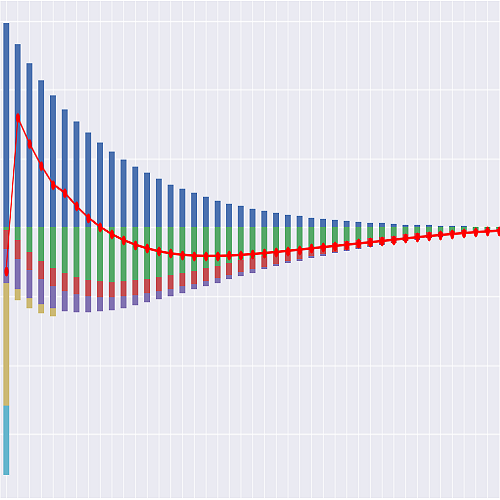
# modelx: pseudo-python
# This file is part of a modelx model.
# It can be imported as a Python module, but functions defined herein
# are model formulas and may not be executable as standard Python.
"""The by-policy projection of the :mod:`~.Annuity_JP_S` model.
The Space is parameterized by ``point_id``, so ``Projection[1]`` is an ItemSpace
projecting model point 1::
>>> Projection[1].result_cf() # the worked example's anchor cell
>>> Projection.point_id = 4 # or switch the default
.. rubric:: The time index
``t`` counts **policy months since issue** and is **0-based**: ``t = 0`` is the first
projected month, the month of issue, and month ``t`` runs from time ``t`` to time
``t + 1``. :func:`proj_len` is the **number** of projected months — the exclusive end of
the frame — so :func:`result_cf` covers ``t = 0 .. proj_len() - 1`` in ``proj_len()`` rows,
twelve to the policy year, and ``proj_len()`` is ``12 (n_y + k)`` on the 確定年金 form. The
attained 保険年齢 is ``age(t) = x + t // 12``, so ``age(0)`` is the 契約年齢 and holds for
the twelve months of policy year 1. A **contractual policy year is the 1-based label**
``policy_year(t) = 1 + t // 12``, and ``duration(t) = t // 12`` is the count of completed
policy years; both are derived where the prose needs them and never indexed by.
Premiums fall in the anniversary months ``t = 0, 12, …, 12(m - 1)``; the annuity is paid in
the months ``n, n + 12, …``. ``pols_if(t)`` is the in-force count at the **start** of month
``t``, so ``pols_if(0) = 1``, and it is the weight on that same ``result_cf()`` row.
.. rubric:: The second index, and why it stays in years
**Every contractual value in this product is defined at a 年単位の契約応当日**, so the value
family keeps an anniversary index ``s`` measured in **years**: :func:`av_pp`,
:func:`db_pp`, :func:`cv_pp`, :func:`surr_charge_pp`, :func:`apl_bal`, :func:`loan_pp` and
:func:`div_acc_pp` are time-point values at the ``s``-th anniversary, with ``s = 0`` at
issue, and **none of their numbers moved when ``t`` became a month**. The 保険料積立金 is an
annual net-level-premium recursion at the 予定利率 with an annual premium and an annual
survivorship release; re-deriving it monthly would replace a contractual quantity with a
modelling one, and would move the 年金原資 that the whole payout phase is bought out of.
A benefit falling **between** two anniversaries reads a monthly companion instead:
:func:`av_at_m` interpolates the fund linearly **[std]**, :func:`surr_charge_at_m` reads
the linear 解約控除 run-off finely, :func:`cv_at_m` applies the sourced cap to both month by
month, and :func:`db_at_m` is the contract's **own** 月払保険料 x 経過月数 wording — which
the annual grid could only approximate and this one can state. Each agrees with its annual
original at every anniversary.
.. rubric:: The monthly grid: what it buys on this product
**The premium and the annuity are both annual, and now look it.** A 年払 premium falls in
one month out of twelve and the 年金年額 instalment likewise, so the statement is a sawtooth
rather than a smooth line — one large inflow a year for thirty years, then one large outflow
a year for ten. Surrender, death and expense run every month against them. That shape is
the product, and the annual grid could not draw it.
**The 死亡給付金 is stated rather than approximated.** The contract pays 月払保険料 x 経過月数
[S2] [S4]; the annual grid carried ``rho P min(s, m)``, the same schedule read at
anniversaries, and said so. :func:`db_at_m` is the clause itself. The two agree at every
anniversary, so the fund, the 年金原資 and the calibration are untouched — what changes is
the benefit paid for a death part-way through a policy year.
**The sourced ceiling is asserted month by month.** ``解約返還金は…死亡給付金の額を限度とします``
[S2] is now checked at every month rather than at every anniversary, which is the stronger
statement: the death benefit steps once a month while the fund accumulates between
anniversaries, so a construction satisfying the cap at anniversaries could still breach it
in between. :func:`check_cv_cap` does not let it.
**Decrements convert, elections do not.** Mortality and 解約・失効 are rates per unit time
and are taken to the month on the effective convention ``r_m = 1 - (1 - r)^(1/12)``, so
twelve compound back to the annual rate exactly and survivorship at the anniversaries is
what the annual model produced. The 年金の一括払 election, by contrast, is a decision taken
on one date and falls in the single month ``t = n``.
.. rubric:: Input data
Inputs are **external files**: plain CSVs living in the model folder's parent directory,
``products/individual_annuity/``, read at run time rather than stored inside the model.
The model folder therefore holds nothing but formulas — no ``_data/``, no IOSpec, no
embedded values — so a diff of the model shows logic changes only, and an input can be
edited or swapped without rewriting the model. This follows ``annuallife.TradLife_A``;
contrast ``basiclife.BasicTerm_S``, which keeps its inputs *inside* the model.
The consequence worth knowing: **the model is not portable on its own.** Copying the
``Annuity_JP_S`` folder without its parent's CSVs produces a model that reads and then
fails on first evaluation.
Each table has a filename Reference and a reader Cells, both on
:mod:`~.Annuity_JP_S.Data`, reached here through the ``data`` Reference:
====================== ================================== ==========================
Reference Cells File
====================== ================================== ==========================
model_point_file data.model_point_table() model_point_table.csv
mort_table_file data.mort_table() mort_table.csv
mort_anchor_file data.mort_anchor_table() mort_anchor_table.csv
lapse_table_file data.lapse_table() lapse_table.csv
pricing_table_file data.pricing_table() pricing_table.csv
expense_table_file data.expense_table() expense_table.csv
commute_factor_file data.commute_factor_table() commute_factor_table.csv
====================== ================================== ==========================
.. rubric:: Naming
Cells names follow lifelib wherever it has an analogue — ``pols_*`` for policy counts,
plural nouns for cash flows, ``*_rate`` for rates, ``*_pp`` for per-policy amounts,
``claims(t, kind)`` with an uppercase ``kind`` string, ``pols_if_at(t, timing)`` for the
within-month reads and ``av_pp_at(s, timing)`` for the within-year ones, and the annual /
``*_mth`` pair for a rate quoted per annum and applied per month. The technical notes use
compact actuarial symbols instead. ``t`` below is a policy **month**, ``s`` an anniversary
in years and ``u`` an elapsed month:
================= ========================== =======================================
Notes symbol Cells Meaning
================= ========================== =======================================
(model point row) model_point() The selected model point
x issue_age() 契約年齢 (保険年齢) at issue
x + floor(t/12) age(t) Attained age in month t
floor(t/12) duration(t) Completed policy years
y(t) policy_year(t) Contractual policy year
(none) sex() Rating factor, M or F
m premium_term_y() 保険料払込期間 in years
d defer_gap_y() 据置期間 in years
n_y = m + d annuitisation_y() The anniversary of the 年金支払開始日
n = 12 n_y annuitisation_t() The **month** of the 年金支払開始日
(none) annuity_start_age() 保険年齢 at the 年金支払開始日
k payout_term_y() 確定年金 payment period in years
g guar_term_y() Guarantee period, life form only
(years) proj_years() Policy years, the span of s
t = 0..proj_len-1 proj_len() Number of projected months (row count)
P premium_pp() Level office annual premium
rho db_ratio() Death benefit / cumulative premiums
i_d int_rate_defer() 予定利率, deferral
i_p int_rate_payout() 予定利率, payout
beta expense_loading() 予定事業費率 on premium
theta annuitisation_charge() 年金支払開始時費用 on the 年金原資
NP(s) prem_to_av_pp(s) Net premium credited to the fund
q'(x+s) mort_rate_pricing(s) 予定死亡率, fund recursion only
q(t) mort_rate(t) Best-estimate rate, annual
q_m(t) mort_rate_mth(t) The same, per month
(table) mort_rate_base(t) Table rate before the [std] factor
q(x) by age mort_rate_at_age(table, x) Table lookup keyed by attained age
(0.85 / 1.10) mort_be_factor(t) Best-estimate factor, by phase
w(t) lapse_rate(t) 解約・失効 rate, annual
w_m(t) lapse_rate_mth(t) The same, per month
(table) lapse_rate_base(t) Table lapse rate, before dynamics
M(t) lapse_dyn_factor(t) Dynamic-lapse multiplier
V(s) av_pp(s) 保険料積立金 at anniversary s
V at month u av_at_m(u) The same, interpolated [std]
(within year) av_pp_at(s, timing) BEF_PREM / AFT_PREM / AFT_INT
SC(s) surr_charge_pp(s) 解約控除 at anniversary s
SC at month u surr_charge_at_m(u) The same, at elapsed month u
DB(s) db_pp(s) 死亡給付金 at anniversary s
DB at month u db_at_m(u) 月払保険料 x 経過月数, the clause itself
(net of loans) db_pp_net(s), db_net_at_m 死亡給付金 less any loan balance
CV(s) cv_pp(s) 解約返戻金 at anniversary s
CV at month u cv_at_m(u) The same, at elapsed month u
(net of loans) cv_pp_net(s), cv_net_at_m 解約返戻金 less any loan balance
F = V(n_y) annuity_fund_pp() 年金原資
adue(k, i_p) annuity_due_factor() Annuity-due factor, certain form
adue_life(g, i_p) annuity_due_life_factor() Guaranteed-plus-life factor
B annuity_amount_pp() 基本年金額, struck once at t = n
B x 1{payment} annuity_pp(t) Instalment payable at the start of t
(factor table) commute_factor(j) 年金の一括払 factor, j instalments left
(lump sum) commute_value_pp() Commuted value per contract
(dividend) div_credit_pp(s) 契約者配当 declared at anniversary s
(dividend) div_acc_pp(s) Accumulated 契約者配当 at anniversary s
l(t) pols_if(t) Contracts with an obligation open
(within month) pols_if_at(t, timing) BEF_DECR / BEF_LAPSE / AFT_DECR
L(t) lives_if(t) Probability the annuitant is alive
D(t) pols_death(t) Expected deaths in month t
W(t) pols_lapse(t) Expected lapses at the end of month t
(none) pols_commute(t) Contracts electing 年金の一括払
(none) pols_maturity(t) Contracts whose obligation ends
(APL) apl_bal(s) 自動振替貸付 balance per policy
(APL) apl_engaged(s) Whether the APL is carrying the premium
(loan) loan_pp(s) 契約者貸付 balance per policy
P x l(t) premiums(t) Premium income, once a year
DB, CV, B, lump claims(t, kind) Benefit outgo by kind
ec x D(t) claim_expenses(t) Claim expense, its own column
E0, e_m(t) expenses(t) Acquisition + maintenance
(none) inflation_factor(t) Expense inflation factor
c0, c_r commissions(t) Commission outgo
(loan advance) policy_loans(t) 契約者貸付 advanced, an outflow
CF(t) net_cf(t) Net cash flow, income positive
================= ========================== =======================================
Four names needed care.
``av_pp`` and ``cv_pp`` are **not** the same quantity and the difference is the product.
``av_pp`` is the 保険料積立金, which grows past cumulative premiums on the survivorship
release; ``cv_pp`` is the 解約返戻金, which is capped at the 死亡給付金 and therefore at
cumulative premiums. Clipping ``av_pp`` instead of ``cv_pp`` destroys the 年金原資, because
it is the un-clipped excess of the fund over the death benefit that buys the annuity. The
library's naming ruling puts the surrender quantity under ``cv_pp``, and this model keeps
both.
``pols_if`` and ``lives_if`` are two different in-force measures, following ``SPIA_US_S``.
``pols_if`` counts contracts with an obligation open; ``lives_if`` counts annuitants
alive. In the deferral phase they separate because lapse removes a contract without
removing a life. In the payout phase they separate for the opposite reason: on a 確定年金
the instalments are unconditional, so ``pols_if`` is flat through the certain period while
``lives_if`` runs down on the payout table. Collapsing the two is the single most likely
way to build this product wrongly.
Every ``*_at_m`` cells is the **monthly reading of an annual contractual quantity**, and
the suffix is the warning. ``cv_pp(s)`` is the 解約返戻金 the contract defines at an
anniversary; ``cv_at_m(u)`` is what this model pays someone who surrenders between two.
They agree at every anniversary by construction, and the annual cells are what the annual
checks — :func:`check_fund` above all — are asserted on.
``mort_rate_pricing`` is the 予定死亡率 used **only** inside the fund recursion, at 100% of
the death-cover table. ``mort_rate`` is the best-estimate decrement applied to the
in-force. They are different numbers in every year, because ``av_pp`` is a contractual
quantity and not an experience projection — and where actual mortality runs lighter than
``q'`` the insurer credits more survivorship than it earns and takes a 死差損, so the
mortality sensitivity is signed the opposite way round from a death-cover product.
.. rubric:: Two mortality tables, with the margin running opposite ways
The deferral phase reads 生保標準生命表2018(死亡保険用)and the payout phase
生保標準生命表2007(年金開始後用)— expressly not updated in 2018 — and :func:`mort_table_name`
switches between them at the month ``t = n``. Both are **valuation** tables, so neither is a
best-estimate basis, and the adjustment to them reverses sign at the same date: the
death-cover table carries a prudential margin against **death**, so a best-estimate basis
is 0.85 of it; the payout table carries a prudential margin against **longevity**, so a
best-estimate basis is 1.10 of it. :func:`mort_be_factor` is the one place that sign
lives. A model applying one factor to both tables has one of the two wrong.
Neither table is shipped. Both are [std] constructions anchored to quoted spot rates:
死亡保険用 is the canonical library-wide file, graduated log-linearly in ``ln q`` between its
sourced anchors, and 年金開始後用 is a Makeham law fitted to three of them. See the
:mod:`~.Annuity_JP_S.Data` docstring, and :func:`check_mort_graduation`, which asserts that
the shipped rates are still the ones the graduation produces.
.. rubric:: Modules that are off in the base run
Six of the notes' optional constructions are implemented and switched off at the anchor
cell, so that the base run reproduces the worked example while the machinery stays
visible and testable. Each is a model point column, so a non-anchor point exercises it:
- **保証期間付終身年金**, ``payout_form = "life_guar"``: instalments unconditional for ``g``
years and life-contingent after, priced on :func:`annuity_due_life_factor` at 100% of
the payout table, with :func:`proj_len` running to that table's terminal age. Held at
the issue basis **[std]** — the election is really priced on the 基礎率 in force at the
年金支払開始日, which no model can know, and that is why base-run take-up is zero. Model
points 4 and 9, the second being the anchor cell with nothing changed but the payout
form: the life form with ``g = 10`` gives ``B`` = ¥281,300 against ¥638,100 on the
certain form out of the same 年金原資, because the annuity-due factor is 22.032668 against
9.714338.
- **年金の一括払**, ``commute_rate``: the published factor table verbatim over 1-14
remaining instalments and an implied 0.40% p.a. outside it **[std]**. Model point 5.
Base take-up is zero for an arithmetic reason: at ``t = n`` the factor for ten remaining
instalments returns about 1.10% **more** than the gross 年金原資, because the factors come
from one carrier and the payout 予定利率 from another and the composite does not reconcile
them. Switching it on switches on a composite artefact, not a product feature.
- **自動振替貸付**, ``apl_on``: while the 解約返戻金 can carry the outstanding balance plus one
more premium, the lapse decrement is suppressed and the insurer lends the premium at the
contractual cap of 8% p.a.; the balance compounds and is deducted from the 死亡給付金 and
from the 年金原資. It is **not** a no-lapse rule — the moment principal and interest
outgrow the surrender value the contract lapses. Model point 7, where it engages at
``t = 2``, carries the contract for six years and then terminates it at ``t = 8``. One
carrier's product has no such facility at all. The engagement test and the balance are
annual, because the facility lends one annual premium at a time and compounds it at the
契約応当日; what the monthly grid changes is that the lapse it eventually triggers falls in
one month rather than being spread across a year.
- **契約者貸付**, ``loan_on``: a loan of half the 解約返戻金 drawn at the anniversary
``s = 20`` — the month ``t = 240`` — **[std]**,
compounding at 2.40% p.a. and capped at the 解約返戻金, deducted from the 死亡給付金 and from
the 年金原資. Model point 8.
- **契約者配当**, ``div_rate``: zero declared in the base run, machinery retained. A declared
rate credits :func:`div_credit_pp` on the fund each year, accumulates it at the 配当積立利率
and applies it at ``t = n`` as a single premium **increasing the 基本年金額**. Under the
税制適格特約 it may never be paid in cash before annuitisation. Model point 8.
- **Dynamic lapse**, ``rate_new``: ``M(t) = min(2, max(1, 1 + phi max(0, i_new - i_d)))``
with ``phi = 20`` **[std]**. Premiums and the 予定利率 are fixed at issue, so there is no
premium-shock lapse on this chassis; the driver runs the other way, a rise in
new-business 予定利率 making an in-force contract relatively unattractive. Model point 8.
減額, 払済 and 復活 are **not** implemented **[std scope]**. An unpaid premium terminates the
contract where the 自動振替貸付 cannot carry it, with no 払込猶予期間 state and no reinstatement
re-entry, so this model's ``lapse_rate`` is a net-of-復活 rate by construction and a user
substituting a gross experience rate will over-decrement. The monthly grid makes the 猶予期間
*representable* for the first time — it is about a month long, which was shorter than a step
and is now one — but modelling it would need a 復活 take-up assumption the sources do not
give, so the composite still carries one net rate.
.. rubric:: Sign convention
The notes' ``CF(t)`` is already **income positive**, which is the library-wide sign of
:func:`net_cf`, so there is no ``liability_cf`` companion to publish here — that absence
is a fact about which orientation the notes chose, not an omission. A reader comparing the
payout years with ``SPIA_US_S``, whose notes print outgo-positive, must flip the sign:
this model's payout rows are large negatives.
.. rubric:: The absences are product facts
There is no premium income after 払込満了 and none at all once the annuity is in payment;
there is no lapse decrement and no surrender value in the twelve months before the
年金支払開始日, because surrender is unavailable from that date; and there is no maturity benefit, because the contract
does not mature — it annuitises. Each of those is stated in a formula rather than left to
inference.
"""
from modelx.serialize.jsonvalues import *
_formula = lambda point_id: None
_bases = []
_allow_none = None
_spaces = []
# ---------------------------------------------------------------------------
# Cells
# --- Model point attributes ------------------------------------------------
[docs]
def model_point():
"""The selected model point as a Series."""
return data.model_point_table().loc[point_id] # noqa: F821
[docs]
def sex():
"""The annuitant's sex, ``M`` or ``F``; a rating factor on both mortality tables."""
v = model_point()["sex"]
if v not in ("M", "F"):
raise ValueError("invalid sex")
return v
[docs]
def issue_age():
"""x: the 契約年齢 at issue, on 保険年齢 (age nearest birthday) [REG-R20].
The basis 標準生命表2018 is built for. A model ageing its points on 満年齢 must say so
and say what it does about the half-year difference; this one does not.
"""
return int(model_point()["issue_age"])
[docs]
def premium_term_y():
"""m: the 保険料払込期間 in years; at least ten under the 税制適格特約 [R10]."""
return int(model_point()["premium_term_y"])
[docs]
def defer_gap_y():
"""d: the 据置期間 in years, between 払込満了 and the 年金支払開始日 [S6].
Zero is a valid model point and a different product; 払込満了 and 年金支払開始日 are
different dates and collapsing them moves the 年金原資 by several per cent.
"""
return int(model_point()["defer_gap_y"])
[docs]
def annuity_start_age():
"""The 保険年齢 at the 年金支払開始日; at least 60 under the 税制適格特約 [R10].
Derived rather than free: it must equal ``x + m + d``, and the model rejects a model
point where it does not, because two spellings of one date is how a projection
silently annuitises on the wrong year.
"""
v = int(model_point()["annuity_start_age"])
if v != issue_age() + premium_term_y() + defer_gap_y():
raise ValueError("annuity_start_age is not issue_age + m + d")
return v
[docs]
def premium_pp():
"""P: the level office annual premium, guaranteed for the whole 保険料払込期間.
There is no review right [S2] [S4] [S5] [S6], so the insurer has no unilateral
repricing lever and all ``m`` premiums are inside the contract boundary.
"""
return float(model_point()["premium_pp"])
[docs]
def payout_term_y():
"""k: the 確定年金 payment period in years; 10 or 15 under the 税制適格特約 [R10] [R16]."""
return int(model_point()["payout_term_y"])
[docs]
def guar_term_y():
"""g: the guarantee period of the 保証期間付終身年金 form, in years [S4] [R16]."""
return int(model_point()["guar_term_y"])
[docs]
def db_ratio():
"""rho: the 死亡給付金 as a multiple of cumulative premiums paid.
1.00 on the composite and 0.70 on both retrieved tontine designs [S3] [S10]. It sits
on the model point rather than in a code branch because a tontine is the same chassis
with a different death-benefit ratio under the same surrender ceiling.
"""
return float(model_point()["db_ratio"])
[docs]
def tax_rider():
"""Whether the 税制適格特約 is attached [S1] [R10].
It constrains the contract rather than the cash flows — ten years of premiums, a
start age of 60 or more, a payment period of ten years or more, no cash refund of a
減額 — so it validates the model point and then does nothing else here.
"""
v = bool(model_point()["tax_rider"])
if v and (premium_term_y() < 10 or annuity_start_age() < 60
or (payout_form() == "certain" and payout_term_y() < 10)
or (payout_form() == "life_guar" and guar_term_y() < 10)):
raise ValueError("model point does not satisfy the 税制適格特約 conditions")
return v
[docs]
def apl_on():
"""Whether the 自動振替貸付 module is switched on; false in the base run [S4] [REG-R14]."""
return bool(model_point()["apl_on"])
[docs]
def loan_on():
"""Whether the 契約者貸付 module is switched on; false in the base run [S4] [S11]."""
return bool(model_point()["loan_on"])
[docs]
def commute_rate():
"""The proportion electing 年金の一括払 at the 年金支払開始日 **[std]**; 0 in the base run.
Commutation is available from the 年金支払開始日 to the last 年金支払日 [S2] [S4]; the model
offers the election at ``t = n`` only **[std]**, which is where the published factor
table is richest and where the arithmetic against the 年金原資 is checkable.
"""
return float(model_point()["commute_rate"])
[docs]
def div_rate():
"""The declared 契約者配当 rate on the fund **[std]**; zero in the base run [S4] [S11].
Zero declared is a choice, not a product fact: the machinery is contractual, and under
the 税制適格特約 the accumulated dividend may never be withdrawn before annuitisation and
must be applied as a single premium increasing the 基本年金額 [S1] [S2] [R10].
"""
return float(model_point()["div_rate"])
[docs]
def rate_new():
"""i_new: the new-business 予定利率 the dynamic-lapse module compares against [S8].
Flat over the projection on the shipped points. Equal to :func:`int_rate_defer` in
the base run, which makes :func:`lapse_dyn_factor` exactly 1.
"""
return float(model_point()["rate_new"])
# --- Derived model point quantities ----------------------------------------
[docs]
def annuitisation_y():
"""n_y = m + d: the **anniversary** at which the 年金支払開始日 falls, in policy years.
The index of the contractual value family — :func:`av_pp`, :func:`db_pp`,
:func:`cv_pp`, :func:`surr_charge_pp`, :func:`loan_pp`, :func:`apl_bal` and
:func:`div_acc_pp` are all values *at* an anniversary and stay on this clock, because
the 保険料積立金 is an annual net-level-premium accumulation at the 予定利率 and the
年金支払開始日 is an anniversary by construction.
The join between the two contracts this product really is. Everything switches here:
the mortality table, the sign of the best-estimate factor, the availability of
surrender, and the direction of the cash flow.
Read off :func:`annuity_start_age` rather than summed from ``m`` and ``d`` directly,
which is the same number — that cells raises unless the model point's 年金支払開始日 equals
``x + m + d`` — but puts the consistency check on the path every projection takes.
Reached only through :func:`tax_rider`, it would validate the base form's model points
never, and two spellings of one date is how a projection silently annuitises on the
wrong year.
"""
return annuity_start_age() - issue_age()
[docs]
def annuitisation_t():
"""n = 12 n_y: the **month** at which the 年金支払開始日 falls, the first payout month.
An index, not a label: the 年金支払開始日 is at time ``n``, which opens the row ``t = n``,
and the first instalment is paid there. Every switch in the product happens at this
row — table, best-estimate factor, surrender availability, sign of the cash flow — and
on the monthly grid it happens at a month rather than over a year.
"""
return 12 * annuitisation_y()
[docs]
def proj_years():
"""The number of policy **years** the contract can run — the span of the anniversary index.
``n_y + k`` on the 確定年金 form and ``omega - x + 1`` on the 保証期間付終身年金 one. It is
what :func:`proj_len` is built from, and the range every annual check sweeps.
"""
if payout_form() == "certain":
return annuitisation_y() + payout_term_y()
return omega_age("annuity_payout_2007") - issue_age() + 1
[docs]
def proj_len():
"""The **number** of projected policy **months**, the exclusive end of the 0-based frame.
``result_cf()`` and ``result_pols()`` run ``t = 0 .. proj_len() - 1`` and have
``proj_len()`` rows each; every sweep here is ``for t in range(proj_len())``.
``12 (n_y + k)`` on the 確定年金 form: there are no tail states, because the 確定年金 pays
exactly ``k`` annual instalments and the contract ends [S2] [S4] — the last of them at
the month ``n + 12(k - 1)``, and the frame runs to the end of the policy year that
instalment opens. On the 保証期間付終身年金 form the horizon is instead the terminal age of
the 年金開始後用 table — 122 for a male and 126 for a female [R3] [REG-R19] — because a
life annuity has no other natural end, and the frame stops at the **first month** of the
year the annuitant attains it, where the table's ``q`` is 1 and so is its monthly
equivalent.
"""
if payout_form() == "certain":
return 12 * proj_years()
return 12 * (omega_age("annuity_payout_2007") - issue_age()) + 1
[docs]
def duration(t):
"""The number of **completed** policy years at the start of policy month t, ``t // 12``.
The bridge from the monthly projection index to the anniversary index the contractual
value family is defined on.
"""
return t // 12
[docs]
def policy_year(t):
"""y(t) = 1 + t // 12: the contractual policy year of month t, a 1-based label.
**Derived, never indexed by**: every cells here is indexed by the 0-based month ``t``
or by the anniversary.
"""
return 1 + duration(t)
[docs]
def age(t):
"""The attained 保険年齢 in policy month t: ``x + floor(t / 12)``.
``t`` is 0-based, so ``age(0)`` is the 契約年齢 itself and it holds for the twelve months
of policy year 1. This product is the library's one 保険年齢 (nearest-birthday) model
and the basis is unchanged by the grid: the age still steps once a 契約応当日.
"""
return issue_age() + duration(t)
# --- Assumption basis ------------------------------------------------------
[docs]
def pricing_basis(item):
"""One row of the pricing and module basis table, as a float.
A single lookup helper so that every basis item is read the same way and every one of
them carries a ``provenance`` tag in the CSV rather than sitting as an untagged
constant in a formula.
"""
return float(data.pricing_table().loc[item, "value"]) # noqa: F821
[docs]
def expense_basis(item):
"""One row of the best-estimate cash expense and commission table, as a float."""
return float(data.expense_table().loc[item, "value"]) # noqa: F821
[docs]
def int_rate_defer():
"""i_d: the deferral-phase 予定利率, 1.00% p.a., fixed at issue [S8]."""
return pricing_basis("int_rate_defer")
[docs]
def int_rate_payout():
"""i_p: the payout-phase 予定利率, 0.65% p.a., set separately from i_d [S5].
Since ``i_p < i_d``, each yen of 年金原資 buys **less** annuity than a single-rate model
would say. Using the deferral rate to buy the annuity overstates the 基本年金額 by about
1.55% at ``k = 10``.
"""
return pricing_basis("int_rate_payout")
[docs]
def expense_loading():
"""beta: the 予定事業費率 on each office premium, 6.5% **[std]**.
One loading, not a three-way 新契約費 / 維持費 / 集金費 split: no retrieved document
discloses one, the 算出方法書 is a 基礎書類 filed with the FSA and not published [REG-R2],
and inventing a split no source can confirm is worth less than one round number
calibrated against a published specimen [S6].
"""
return pricing_basis("expense_loading")
[docs]
def annuitisation_charge():
"""theta: the 年金支払開始時費用, 1.0% of the 年金原資, charged once **[std, new here]**."""
return pricing_basis("annuitisation_charge")
[docs]
def mort_table_name(t):
"""Which mortality table applies in year t.
``death_cover_2018`` in the deferral phase and ``annuity_payout_2007`` from the month
``t = n``.
For contracts concluded from 2018-04-01 the standard valuation basis is
生保標準生命表2018(死亡保険用)for death cover and 生保標準生命表2007(年金開始後用)for annuities in
payment [REG-R10] [REG-R11] [R4]. An annuity computed off the death-cover table is
wrong by construction and wrong in the expensive direction.
"""
return "death_cover_2018" if t < annuitisation_t() else "annuity_payout_2007"
[docs]
def mort_be_factor(t):
"""The best-estimate adjustment to the valuation table in policy month t.
0.85 in the deferral phase and 1.10 from ``t = n`` **[std, new here]**. Both tables
are valuation bases carrying a prudential margin, and the margin runs opposite ways:
against death before annuitisation, against **longevity** after it. 0.85 sits inside
the range the death-cover margin implies, from 1/1.30 where the 130% cap binds to 1.00
where no margin does [REG-R20]; the 作成概要 for the 2007 table was not retrieved, so the
size of 1.10 is [unverified] and only its direction is structural.
"""
if t < annuitisation_t():
return pricing_basis("mort_be_factor_defer")
return pricing_basis("mort_be_factor_payout")
[docs]
def omega_age(table):
"""The terminal age of a shipped mortality table: 109 / 113 and 122 / 126.
Read from ``data.mort_anchor_table()``, where it is a published fact about the real
table rather than a property of the construction [REG-R18] [R3] [REG-R19]. ``q`` is
truncated to 1 there.
"""
return int(data.mort_anchor_table().loc[ # noqa: F821
(table, sex()), "omega_age"].iloc[0])
[docs]
def mort_rate_at_age(table, x):
"""The shipped [std] rate of ``table`` at attained age ``x``, truncated to 1 at omega.
The single point at which the model touches its mortality input, so a licensed table
drops in by replacing ``mort_table.csv`` with a same-schema file.
"""
if x >= omega_age(table):
return 1.0
return float(data.mort_table().loc[(table, sex(), x), "mort_rate"]) # noqa: F821
[docs]
def mort_rate_base(t):
"""The **annual** table rate applying in month t, before the best-estimate factor."""
return mort_rate_at_age(mort_table_name(t), age(t))
[docs]
def mort_rate_pricing(s):
"""q'(x+s): the 予定死亡率 at anniversary s, 100% of the 死亡保険用 table.
Used **only** in the 保険料積立金 recursion, which is annual, so it is indexed by the
anniversary rather than by the month.
``av_pp`` is a contractual quantity and not an experience projection, so its
survivorship release is credited at the pricing rate whatever the best-estimate basis
says. Where actual mortality runs lighter than ``q'``, the insurer credits more
survivorship than it earns and takes a 死差損.
"""
return mort_rate_at_age("death_cover_2018", issue_age() + s)
[docs]
def mort_rate(t):
"""q(t): the **annual** best-estimate mortality rate in policy month t.
The table rate of the phase times :func:`mort_be_factor`, capped at 1. Two tables, two
factors, and the factors point opposite ways; see the Space docstring. This is the
annual rate the tables are stated on and the notes quote; :func:`mort_rate_mth` is the
decrement applied to the month.
"""
return min(1.0, mort_be_factor(t) * mort_rate_base(t))
[docs]
def mort_rate_mth(t):
"""q_m(t): the monthly mortality decrement, ``1 - (1 - q(t))^(1/12)`` **[std]**.
The **effective** convention, not a nominal ``q / 12``: twelve months compound back to
the annual rate exactly, so survivorship at the anniversaries is what the annual-grid
model produced and every difference between the two runs is one of timing. At the
terminal age of the 年金開始後用 table ``q`` is 1 and so is this, which is why the life
form's frame ends in the first month of that year.
"""
return 1.0 - (1.0 - mort_rate(t)) ** (1.0 / 12.0)
[docs]
def lapse_rate_base(t):
"""The [std] table 解約・失効 rate in year t, before any dynamic multiplier.
6.0 / 5.0 / 4.5 / 4.0 percent over the first ten policy years — completed durations
0, 1, 2 and 3 … 9, the CSV's ``from_year`` keys being 0-based completed **years**, so
the lookup goes through :func:`duration` — 3.0% for the rest of the 保険料払込期間, 1.0%
through the 据置期間 — no premium is due there, so the commonest lapse trigger is absent
— and **zero in the last twelve months before the 年金支払開始日**, where surrender is no
longer available [S2] [S4]. The rates are **annual** and are not restated per month.
The only public
calibration point is a market-wide 3.4% for FY2024 whose denominator is 契約高, not
policy count [R15] [REG-R31]; the duration shape is a standardization.
"""
tbl = data.lapse_table() # noqa: F821
d = duration(t)
if d >= annuitisation_y() - 1:
return float(tbl.loc[("pre_annuitisation", 0), "lapse_rate"])
if d >= premium_term_y():
return float(tbl.loc[("defer_gap", 0), "lapse_rate"])
seg = tbl.loc["premium_paying"]
return float(seg.loc[max(y for y in seg.index if y <= d), "lapse_rate"])
[docs]
def lapse_dyn_factor(t):
"""M(t): the dynamic-lapse multiplier **[std]**; 1 in the base run.
``min(cap, max(1, 1 + phi max(0, i_new(t) - i_d)))`` with ``phi`` = 20 and a cap of 2.
Premiums and the 予定利率 are both fixed at issue, so there is no premium-shock lapse and
no rate-driven surrender on this chassis. The economic driver runs the other way: when
new-business 予定利率 rise above the rate at issue — as they did in 2025, for the first
time in about forty years [S8] — an in-force contract becomes relatively unattractive
and lapse should rise.
"""
excess = max(0.0, rate_new() - int_rate_defer())
return min(pricing_basis("lapse_dyn_cap"),
max(1.0, 1.0 + pricing_basis("lapse_dyn_phi") * excess))
[docs]
def lapse_rate(t):
"""w(t): the **annual** 解約・失効 rate of the policy year containing month t.
The table rate times the dynamic multiplier, capped at 1 — except where the 自動振替貸付
module is carrying the contract, which suppresses the decrement entirely, and except in
the policy year that module can no longer carry it, where the whole in-force lapses
[S4] [REG-R14]. Zero in the last twelve months before the 年金支払開始日 in every case.
The 自動振替貸付 test is read at the **anniversary** opening the month's policy year,
because both sides of it are annual quantities: the facility lends one annual premium
at a time and its balance compounds once a year.
"""
d = duration(t)
if apl_on() and d < premium_term_y():
if apl_bal(d) > cv_pp(d):
return 1.0
if apl_engaged(d):
return 0.0
return min(1.0, lapse_rate_base(t) * lapse_dyn_factor(t))
[docs]
def lapse_rate_mth(t):
"""w_m(t): the monthly 解約・失効 rate, ``1 - (1 - w(t))^(1/12)`` **[std]**.
The same effective convention as :func:`mort_rate_mth`. Where :func:`lapse_rate` is 1
— the month the 自動振替貸付 can no longer carry the contract — this is 1 too, so the
whole in-force leaves in that month rather than over the year around it.
"""
return 1.0 - (1.0 - lapse_rate(t)) ** (1.0 / 12.0)
# --- The 保険料積立金 recursion ------------------------------------------------
[docs]
def prem_to_av_pp(s):
"""NP(s): the office premium net of the 予定事業費率, credited to the fund at anniversary s.
``P (1 - beta)`` while ``s < m`` and zero after. Credited whether or not the premium
arrives in cash: under the 自動振替貸付 module the insurer lends it, so the fund is fed
and the loan balance grows instead.
"""
return premium_pp() * (1.0 - expense_loading()) if s < premium_term_y() else 0.0
[docs]
def av_pp(s):
"""V(s): the 保険料積立金 per policy at anniversary s, before that year's premium.
A **time-point** value on the **anniversary** clock: ``av_pp(s)`` is the fund at the
``s``-th 年単位の契約応当日, with ``s = 0`` at issue, so ``av_pp(0) = 0`` and the policy
year opening at ``s`` closes on ``av_pp(s + 1)``.
**It stays annual on the monthly grid**, and deliberately: the 保険料積立金 is a
contractual accumulation defined by the 算出方法書 on an annual net-level-premium
recursion at the 予定利率, with an annual premium and an annual survivorship release.
Re-deriving it monthly would replace a contractual quantity with a modelling one. The
reading of it between anniversaries is :func:`av_at_m`, which interpolates **[std]**.
A net-level-premium accumulation carrying a **survivorship release**::
V(0) = 0
V(t+1) = [ (V(t) + NP(t)) (1 + i_d) - q'(x+t) DB(t+1) ] / (1 - q'(x+t))
The division by ``(1 - q')`` is the release: the premiums of those who die go to the
survivors net of the death benefit paid. Because ``DB`` is capped at cumulative
premiums while ``V`` is not, that release turns **positive from the duration at which V
first exceeds DB**, and that excess is precisely the survival benefit a
生存保障重視型 design buys. Lapse does not appear: the surrender release is the 解約控除,
which accrues to the insurer and not to the surviving fund. Zero after annuitisation,
where the fund has been converted into the annuity and the liability is the instalment
stream instead.
"""
if s <= 0 or s > annuitisation_y():
return 0.0
q = mort_rate_pricing(s - 1)
return (av_pp_at(s - 1, "AFT_INT") - q * db_pp(s)) / (1.0 - q)
[docs]
def av_pp_at(s, timing):
"""The 保険料積立金 per policy at a point inside the policy year opening at anniversary s.
``"BEF_PREM"``
V(s), the anniversary before the premium is credited; the same
number as :func:`av_pp`.
``"AFT_PREM"``
after the year's net premium is credited, before interest.
``"AFT_INT"``
after the 予定利率 is credited, before the survivorship release and the
death benefit are settled.
"""
if timing == "BEF_PREM":
return av_pp(s)
if timing == "AFT_PREM":
return av_pp(s) + prem_to_av_pp(s)
if timing == "AFT_INT":
return av_pp_at(s, "AFT_PREM") * (1.0 + int_rate_defer())
raise ValueError("invalid timing")
[docs]
def av_at_m(u):
"""V at **elapsed month u**: the 保険料積立金 between anniversaries **[std]**.
``V(s)`` at every anniversary — ``u = 12 s`` reproduces :func:`av_pp` exactly — and
linear in the elapsed months between two::
V(u) = (1 - f) V(s) + f V(s + 1), s = u // 12, f = (u mod 12) / 12
The within-year rule is the one thing the monthly grid needs and the contract does not
publish: the 算出方法書 is a 基礎書類 filed with the 金融庁 and is not disclosed [REG-R2].
Linear interpolation in elapsed months is the ordinary convention for a value quoted by
policy year, and it leaves every anniversary value — and therefore the 年金原資, the
calibration and every annual check — exactly where it was.
"""
s, r = u // 12, u % 12
if r == 0:
return av_pp(s)
f = r / 12.0
return (1.0 - f) * av_pp(s) + f * av_pp(s + 1)
# --- Deferral-phase benefit amounts ----------------------------------------
[docs]
def db_pp(s):
"""DB(s): the 死亡給付金 payable at anniversary s.
A **time-point** amount on the anniversary clock with ``s = 0`` at issue, so
``min(s, m)`` is the number of premiums paid by then and ``db_pp(0)`` is zero.
``rho P min(s, m)``, which 所令211①ロ requires to increase with duration or with
cumulative premiums [R10]. It **stops growing at 払込満了**, because no further premium
is paid: a model that keeps accruing it to ``n`` overstates deferral-phase claims by
``d`` years' worth of premium.
This is the limb the 保険料積立金 recursion and the 解約返戻金 ceiling read. The benefit
actually paid for a death **between** anniversaries is :func:`db_at_m`, which is the
contract's own 月払保険料 x 経過月数 form and agrees with this cells at every anniversary.
"""
return db_ratio() * premium_pp() * min(s, premium_term_y())
[docs]
def db_at_m(u):
"""DB at elapsed month u: the contractual 月払保険料 x 経過月数 form [S2] [S4].
``rho (P / 12) min(u, 12m)`` — a benefit that grows by one month's premium every month
and stops at 払込満了.
**This is the contract's own wording, not an interpolation of the annual form.** The
annual grid could only carry ``rho P min(s, m)``, the same schedule read at
anniversaries, and its own docstring called that "the annual-grid form of the
contractual 月払保険料 x 経過月数"; the monthly grid has no need of the approximation and
states the clause instead. The two agree at every anniversary, so the 保険料積立金 and
the 年金原資 are unchanged — what changes is the benefit paid for a death in, say, the
seventh month of a policy year, which the annual grid had to round to a whole year of
premiums.
"""
return (db_ratio() * premium_pp() / 12.0
* min(u, 12 * premium_term_y()))
[docs]
def db_pp_net(s):
"""The 死亡給付金 at anniversary s, less any loan principal and interest.
Unpaid premiums, 契約者貸付 and 自動振替貸付 balances are deducted from the benefit [S2]
[S4]. Equal to :func:`db_pp` in the base run, where both loan modules are off.
"""
return max(0.0, db_pp(s) - loan_pp(s) - apl_bal(s))
[docs]
def db_net_at_m(u):
"""The 死亡給付金 actually paid for a death settled at elapsed month u, net of loans.
The loan balances are annual — the 約款 compounds them at the 契約応当日 — so the
deduction is read at the anniversary that opened the month's policy year, which is the
balance actually outstanding when the claim is settled.
"""
return max(0.0, db_at_m(u) - loan_pp(u // 12) - apl_bal(u // 12))
[docs]
def surr_charge_pp(s):
"""SC(s): the 解約控除 at anniversary s **[std]**.
A **time-point** amount on the anniversary clock: full at ``s = 0``, the issue instant,
and exhausted at ``s = 10``, the end of the tenth policy year.
One annual premium running off linearly over ten policy years. Both 約款 state the
shape and not the parameters — 「ご契約後短期間で解約されたときには、解約返還金がない場合があります」 [S2] and
「まったくないか、あってもごくわずか」 [S4] — and the formula sits in the unpublished 算出方法書
[REG-R2]. The base amount of one annual premium is what makes the sourced invariant
hold: the first-year 解約返戻金 is nil-or-negligible against a full year's premium.
"""
yrs = pricing_basis("surr_charge_years")
base = premium_pp() * pricing_basis("surr_charge_prems")
return base * max(0.0, (yrs - s) / yrs)
[docs]
def surr_charge_at_m(u):
"""SC at elapsed month u: ``base (12 yrs - u) / 12 yrs``, floored at zero.
The 解約控除 runs off **linearly**, so the monthly reading is the same schedule stated
finely rather than a second one, and it agrees with :func:`surr_charge_pp` at every
anniversary.
"""
mm = 12.0 * pricing_basis("surr_charge_years")
base = premium_pp() * pricing_basis("surr_charge_prems")
return base * max(0.0, (mm - u) / mm)
[docs]
def cv_pp(s):
"""CV(s): the 解約返戻金 per policy at anniversary s.
``min(max(0, V(s) - SC(s)), DB(s))`` before annuitisation and **zero from the
年金支払開始日**,
because surrender is not available from the 年金支払開始日 [S2] [S4] [R16]. The upper cap
is the sourced ceiling 「解約返還金は…死亡給付金の額を限度とします」 [S2], and it is what the other
carrier means by 「一定期間経過後は死亡給付金と同額になります」 [S4]: beyond the crossover the surrender
value and the death benefit are literally the same number.
That cap also reverses the sign of the late-duration lapse sensitivity. From the
crossover a surrender returns exactly what was paid in and no interest, while the fund
behind it is worth more, so late-duration lapse is **profitable** to the insurer and a
prudent reserving basis loads it down, not up.
"""
if s >= annuitisation_y():
return 0.0
return min(max(0.0, av_pp(s) - surr_charge_pp(s)), db_pp(s))
[docs]
def cv_at_m(u):
"""CV at elapsed month u: the 解約返戻金 between anniversaries.
``min(max(0, V(u) - SC(u)), DB(u))`` on the monthly readings of all three limbs, and
zero from the 年金支払開始日. **The cap is applied month by month**, which is what keeps
the sourced ceiling 「解約返還金は…死亡給付金の額を限度とします」 [S2] true at every instant and
not merely at anniversaries — and it matters, because on the monthly grid the death
benefit grows by one month's premium at a time while the fund accumulates continuously,
so the crossover between the two is a month rather than a year.
"""
if u >= annuitisation_t():
return 0.0
return min(max(0.0, av_at_m(u) - surr_charge_at_m(u)), db_at_m(u))
[docs]
def cv_pp_net(s):
"""The 解約返戻金 at anniversary s, less any loan balance.
Equal to :func:`cv_pp` in the base run, where both loan modules are off.
"""
return max(0.0, cv_pp(s) - loan_pp(s) - apl_bal(s))
[docs]
def cv_net_at_m(u):
"""The 解約返戻金 actually paid on a surrender settled at elapsed month u, net of loans.
The loan balances are annual, so the deduction is read at the anniversary opening the
month's policy year — the balance actually outstanding at the settlement.
"""
return max(0.0, cv_at_m(u) - loan_pp(u // 12) - apl_bal(u // 12))
# --- The loan modules ------------------------------------------------------
[docs]
def apl_engaged(s):
"""Whether the 自動振替貸付 carries the premium falling at anniversary s; false in base.
Annual on the monthly grid, because the thing it carries is: one annual premium at a
time, lent at an anniversary and compounding once a year.
True while the module is on, a premium is still due, the 解約返戻金 is at least one
premium, and the outstanding balance has not yet outgrown the 解約返戻金 [S4]. That last
condition is the whole point: 自動振替貸付 is a policyholder election, not a no-lapse rule
[REG-R14], and one carrier's product does not offer it at all [S2].
"""
if not apl_on() or s >= premium_term_y():
return False
return cv_pp(s) >= premium_pp() and apl_bal(s) <= cv_pp(s)
[docs]
def apl_bal(s):
"""The 自動振替貸付 principal and interest per policy at anniversary s; zero in base.
A **time-point** balance on the anniversary clock, ``apl_bal(0) = 0`` at issue and
rolled forward from ``apl_bal(s - 1)``.
Each premium the module lends is added to the balance and the whole compounds at the
contractual cap of 8% p.a. [S4], adopted at the cap **[std]**. 8% against a surrender
value that is itself capped at cumulative premiums is why the facility carries a
contract for a few years and not for a term: the moment principal and interest outgrow
the 解約返戻金 the contract lapses [S4], which is what :func:`lapse_rate` does with it.
"""
if not apl_on() or s <= 0:
return 0.0
prev = apl_bal(s - 1)
if apl_engaged(s - 1):
prev = prev + premium_pp()
if prev <= 0.0:
return 0.0
return prev * (1.0 + pricing_basis("apl_rate"))
[docs]
def loan_pp(s):
"""The 契約者貸付 principal and interest per policy at anniversary s; zero in base.
A **time-point** balance on the anniversary clock: ``loan_draw_year`` in
``pricing_table.csv`` is a value of ``s``, so the drawdown is the anniversary
``s = 20``, which opens the twenty-first policy year, and ``loan_pp(19)`` is still
zero. The balance compounds once a year at the contractual 年利, so there is nothing
to roll between anniversaries.
A loan of half the 解約返戻金 drawn at ``t = 20`` **[std]**, compounding at 2.40%
p.a. on the current issue cohort [S11] [S8] and capped at the 解約返戻金 [S4] [REG-R14].
Deducted from the 死亡給付金 and from the 年金原資, so it does not touch :func:`av_pp`: the
fund is a contractual accumulation and the loan is a separate account against it.
"""
if not loan_on() or s < pricing_basis("loan_draw_year"):
return 0.0
if s == pricing_basis("loan_draw_year"):
return pricing_basis("loan_draw_frac") * cv_pp(s)
cap = cv_pp(s) if s < annuitisation_y() else av_pp(annuitisation_y())
return min(loan_pp(s - 1) * (1.0 + pricing_basis("loan_rate")), cap)
[docs]
def policy_loans(t):
"""The 契約者貸付 advanced in policy month t, an outflow; zero in the base run.
Drawn at the anniversary ``loan_draw_year``, which on the monthly frame is the single
month ``t = 12 loan_draw_year``. Only the drawdown is a cash flow: the balance is
recovered by deduction from the 死亡給付金, the 解約返戻金 or the 年金原資, which is where
:func:`db_net_at_m`, :func:`cv_net_at_m` and :func:`annuity_fund_pp` take it.
"""
if not loan_on() or t != 12 * int(pricing_basis("loan_draw_year")):
return 0.0
return loan_pp(duration(t)) * pols_if(t)
# --- 契約者配当 ---------------------------------------------------------------
[docs]
def div_credit_pp(s):
"""The 契約者配当 declared at anniversary s per policy **[std]**; zero in the base run.
``div_rate`` on the fund at that anniversary. The composite is a 5年ごと利差配当 design
[S4]; declaring annually on the fund is a **[std]** simplification of it, and the
declared rate rather than the frequency is what moves the answer — which is why the
declaration stays annual on a monthly grid.
The credit declared at ``s`` is carried to ``s + 1`` by :func:`div_acc_pp`, so the
declaration window is the anniversaries ``1 .. n_y - 1``: that last one is the final
credit that can reach the 年金原資, which is struck at ``n_y``.
"""
if s <= 0 or s >= annuitisation_y():
return 0.0
return div_rate() * av_pp(s)
[docs]
def div_acc_pp(s):
"""The accumulated 契約者配当 per policy at anniversary s; zero in the base run.
A **time-point** balance, zero at ``s = 0`` and carrying the credit declared at
``s - 1`` forward.
Accumulated at the 配当積立利率 of 0.60% p.a. [S11]. Under the 税制適格特約 it cannot be
withdrawn before annuitisation and must be applied as a single premium increasing the
基本年金額, never paid in cash [S1] [S2] [R10] — so it appears in
:func:`annuity_amount_pp` and nowhere in the cash flow before the 年金支払開始日.
"""
if s <= 0:
return 0.0
return ((div_acc_pp(s - 1) + div_credit_pp(s - 1))
* (1.0 + pricing_basis("div_int_rate")))
# --- The annuitisation transition ------------------------------------------
[docs]
def annuity_fund_pp():
"""F = V(n): the 年金原資, the fund out of which the annuity is bought.
Struck once, at ``t = n``, net of any outstanding loan balance [S2] [S4]. One carrier
pins the definition down by publishing both 一括受取率 (``F / Pm``) and 年金受取率
(``kB / Pm``) at one model point [S6], which is what makes the loading calibration
checkable rather than merely plausible.
"""
n = annuitisation_y()
return max(0.0, av_pp(n) - loan_pp(n) - apl_bal(n))
[docs]
def annuity_due_factor():
"""adue(k, i_p): the k-year annuity-due factor at the payout 予定利率.
``(1 - (1 + i)^-k) / i x (1 + i)``. The rate is ``i_p`` = 0.65%, **not** the deferral
rate: the payout phase is priced on its own 予定利率, published separately and left
unchanged when that carrier's deferral rates moved [S5].
"""
i = int_rate_payout()
k = payout_term_y()
if i == 0.0:
return float(k)
return (1.0 - (1.0 + i) ** (-k)) / i * (1.0 + i)
[docs]
def annuity_due_life_factor():
"""adue_life(g, i_p): the guaranteed-plus-life annuity-due factor at annuitisation.
``sum over j >= 0 of max(1{j < g}, jp_(x+n)) / (1 + i_p)**j`` on the 年金開始後用 table at
**100%** — a pricing basis, not the best-estimate factor. At the anchor cell's fund
and ``g = 10`` this is about 22.03 against 9.71 on the certain form, which is why the
same 年金原資 buys ¥281,300 a year as a life annuity and ¥638,100 a year as a ten-year
certain one. That ratio is the product fact the module exists to show.
"""
i = int_rate_payout()
g = guar_term_y()
a0 = annuity_start_age()
om = omega_age("annuity_payout_2007")
total = 0.0
surv = 1.0
j = 0
while a0 + j <= om:
total += max(1.0 if j < g else 0.0, surv) / (1.0 + i) ** j
surv = surv * (1.0 - mort_rate_at_age("annuity_payout_2007", a0 + j))
j = j + 1
return total
[docs]
def annuity_amount_pp():
"""B: the 基本年金額, the annual instalment, struck once at t = n and never recomputed.
``floor( (F (1 - theta) + accumulated dividend) / adue / 100 ) x 100``. The rounding
down to the nearest ¥100 is contractual rather than a display convention **[std, new
here]** — Japanese specimens are published at that granularity [S3] [S5] [S6] [S10] —
so it happens inside the model.
"""
step = pricing_basis("annuity_round_to")
factor = (annuity_due_factor() if payout_form() == "certain"
else annuity_due_life_factor())
gross = (annuity_fund_pp() * (1.0 - annuitisation_charge())
+ div_acc_pp(annuitisation_y()))
return float(int(gross / factor / step)) * step
[docs]
def annuity_pp(t):
"""B x 1{a payment falls in month t}: the instalment per contract payable at its start.
**Paid in advance, once a year**, from the 年金支払開始日 — so on the monthly frame it
falls in the months ``n, n + 12, n + 24, …`` and is zero in the eleven between each
pair. The composite is 年金年額, an annual instalment, and the monthly grid shows it as
the annual payment it is rather than as a twelfth a month; a 月額 design would be a
different product and a different model point column.
On the 確定年金 form there are exactly ``k`` of them and then the contract ends; on the
保証期間付終身年金 form the instalment is the same amount for as long as the contract is in
force, and it is :func:`pols_if` rather than the amount that carries the life
contingency.
"""
n = annuitisation_t()
if t < n or (t - n) % 12 != 0:
return 0.0
if payout_form() == "certain" and t >= n + 12 * payout_term_y():
return 0.0
return annuity_amount_pp()
[docs]
def commute_factor(j):
"""The 年金の一括払 factor for j remaining instalments [S2]; **[std]** outside 1-14.
The published table verbatim where it reaches, and an annuity-due at the 0.40% p.a. it
implies outside it. That rate is **not** the model's payout 予定利率 of 0.65%, and the
composite does not reconcile the two: the factors come from one carrier [S2] and the
payout rate from another [S5]. A production model must re-derive the factors on its
own payout basis.
"""
if j <= 0:
return 0.0
tbl = data.commute_factor_table() # noqa: F821
if j <= int(tbl.index.max()):
return float(tbl.loc[j, "factor"])
i = pricing_basis("commute_int_rate")
return (1.0 - (1.0 + i) ** (-j)) / i * (1.0 + i)
[docs]
def commute_value_pp():
"""The lump sum per contract electing 年金の一括払 at the 年金支払開始日 [S2] [S4].
``B`` times the factor for the whole certain or guaranteed period. At the anchor
cell's numbers this returns about 1.10% **more** than the gross 年金原資, which is why
base-run take-up is zero: switching commutation on switches on a composite artefact
rather than a product feature.
"""
j = (payout_term_y() if payout_form() == "certain" else guar_term_y())
return annuity_amount_pp() * commute_factor(j)
# --- In-force and decrements -----------------------------------------------
[docs]
def pols_if(t):
"""l(t): contracts with an obligation open at the **start** of policy month t.
1.0 at ``t = 0``, the frame's first row and the issue instant. Through the deferral
phase the notes' recursion on the **monthly** decrements,
``l(t+1) = l(t)(1 - q_m(t))(1 - w_m(t))``. From ``t = n`` the rules change with the
payout form: on the 確定年金 the instalments are unconditional, so ``l`` is **flat**
through the certain period and drops to zero once the last one has been paid for a
year; on the 保証期間付終身年金 it is flat through the guarantee period and then runs off on
the best-estimate payout basis, month by month.
This is the weight on every cash flow of the same ``result_cf()`` row. Do not
decrement it by mortality during a certain or guaranteed period: deaths there pay the
PV of the unpaid instalments, or the recipient elects continuation, and the base run
assumes continuation at 100% **[std]** so that the stream is unchanged [S2] [R16].
"""
n = annuitisation_t()
if t < 0 or t > proj_len():
return 0.0
if t == 0:
return 1.0
if t <= n:
return pols_if_at(t - 1, "AFT_DECR")
base = pols_if(n) - pols_commute(n)
if payout_form() == "certain":
return base if t < n + 12 * payout_term_y() else 0.0
guaranteed = 1.0 if t - n < 12 * guar_term_y() else 0.0
return base * max(guaranteed, lives_if(t) / lives_if(n))
[docs]
def pols_if_at(t, timing):
"""The number of contracts in force at a point inside policy month t.
``"BEF_DECR"``
l(t), the start of the month before any decrement; the same number as
:func:`pols_if` and the weight on that month's cash flows.
``"BEF_LAPSE"``
after deaths, before lapses — the notes' processing order is **death
before lapse** **[std order]**, so this is the population lapses are
taken from.
``"AFT_DECR"``
l(t+1), the end-of-month state.
"""
if timing == "BEF_DECR":
return pols_if(t)
if timing == "BEF_LAPSE":
return pols_if(t) - pols_death(t)
if timing == "AFT_DECR":
if t < annuitisation_t():
return pols_if_at(t, "BEF_LAPSE") * (1.0 - lapse_rate_mth(t))
return pols_if(t + 1)
raise ValueError("invalid timing")
[docs]
def lives_if(t):
"""L(t): the probability the annuitant is alive at the start of policy month t.
``L(t+1) = L(t)(1 - q_m(t))`` **throughout**, on whichever table the phase reads. It is
carried separately from :func:`pols_if` because the two measure different things: in
the deferral phase lapse removes a contract without removing a life, and in the payout
phase the 確定年金 obligation survives the annuitant. At the anchor cell ``lives_if``
falls from 0.91268274 to 0.77848987 over the ten payout years without moving a single
yen of projected cash flow, which is the clearest statement of why the two are not one
cells.
"""
if t <= 0:
return 1.0
return lives_if(t - 1) * (1.0 - mort_rate_mth(t - 1))
[docs]
def pols_death(t):
"""D(t): expected deaths in policy month t, taken at the **end** of the month.
``l(t) q_m(t)`` in the deferral phase. **Zero** inside a certain or guaranteed period,
where the obligation does not depend on survival; on the 保証期間付終身年金 form after the
guarantee it is the run-off of :func:`pols_if` itself.
"""
n = annuitisation_t()
if t < n:
return pols_if(t) * mort_rate_mth(t)
if payout_form() == "certain":
return 0.0
if t - n < 12 * guar_term_y() - 1:
return 0.0
return max(0.0, pols_if(t) - pols_if(t + 1))
[docs]
def pols_lapse(t):
"""W(t): expected lapses at the end of policy month t, from the survivors of mortality.
``l(t)(1 - q_m(t)) w_m(t)``, and zero in the twelve months before the 年金支払開始日, where
surrender is no longer available [S2] [S4]. A lapse applied at ``t = n - 1`` would
remove contracts at ``t = n``, where the surrender value is zero — in-force would
disappear with no payment and the annuity outgo would be understated.
"""
if t >= annuitisation_t():
return 0.0
return pols_if_at(t, "BEF_LAPSE") * lapse_rate_mth(t)
[docs]
def pols_commute(t):
"""Contracts electing 年金の一括払 at the 年金支払開始日; zero in the base run.
A decrement in the single month ``t = n`` **[std]**: the elector takes the lump sum in
place of the instalments and the contract terminates [S2] [S4].
"""
if t != annuitisation_t():
return 0.0
return pols_if(t) * commute_rate()
[docs]
def pols_maturity(t):
"""The count whose cover ends at the scheduled end of the contract, paid for or not.
The library-wide meaning of the name, as in ``BasicTerm_S`` and ``Term_UK_S``: the
contracts reaching the scheduled end, whether or not anything is paid for reaching it.
Here that end is the exhaustion of the 確定年金 — the year opened by the last instalment
running out — so this is non-zero only in the final month of the frame, and zero on the
保証期間付終身年金 form, which has no fixed end.
**There is no** ``claims(t, "MATURITY")`` **on this product**, and the absence is a
product fact rather than a gap: the 確定年金 pays exactly ``k`` instalments and then the
contract simply ends [S2] [S4], so the money attaching to this year is the ordinary
instalment in ``claims(t, "ANNUITY")`` and nothing further falls due. The count is
still needed for the in-force roll-forward to close, because the survivors of that year
neither die nor lapse; see :func:`check_pols_roll_fwd`.
"""
if payout_form() != "certain":
return 0.0
if t != proj_len() - 1:
return 0.0
return pols_if(t) - pols_commute(t)
# --- Cash flows ------------------------------------------------------------
[docs]
def premiums(t):
"""P l(t): premium income at the start of policy month t, an inflow.
**The premium is annual (年払), so it falls in one month out of twelve** — the
anniversary months ``t = 0, 12, …, 12(m - 1)`` — and is zero in the other eleven.
Level and guaranteed for the whole 保険料払込期間, and **nothing** after 払込満了 — the
据置期間 and the payout phase carry no premium at all. Zero as well once the 自動振替貸付
module has started carrying the contract, because there the insurer lends the premium
rather than receiving it, and a policyholder who has stopped paying does not resume in
the year the facility fails.
"""
if t % 12 != 0 or duration(t) >= premium_term_y():
return 0.0
d = duration(t)
if apl_on() and (apl_engaged(d) or apl_bal(d) > 0.0):
return 0.0
return premium_pp() * pols_if(t)
[docs]
def claims(t, kind=None):
"""Benefit outgo in policy month t, by kind; the total when kind is omitted.
``"ANNUITY"`` — published as ``claims_annuity`` — is a **living** benefit here: it is
paid on the annuitant *surviving* to a payment date, never on death. The same column
name carries a **death** benefit in ``IncomeTerm_JP_S``, where the survivor income runs
to the end of the term after the life assured dies, and a living benefit again in
``LTC_JP_S``. The name is the benefit's *form* — a stream rather than a lump sum — so
the contingency has to be read off the product, and this is where it is stated.
``"ANNUITY"``
the instalment paid in advance at the start of month t, to every contract with an
obligation open that has not commuted — non-zero only in the twelve-monthly
payment months from the 年金支払開始日. Past the guarantee period of the
保証期間付終身年金 form the instalment is payable only while the annuitant is alive;
over the 確定年金's certain period it is unconditional, which is prepaid
survival-contingent cover and still not a benefit death can trigger.
``"DEATH"``
the 死亡給付金 for deaths at the end of the month, ``DB(t+1) D(t)`` on the
contractual 月払保険料 x 経過月数 form, net of any loan balance. Zero inside
a certain or guaranteed period.
``"LAPSE"``
surrender payments at the end of the month, ``CV(t+1) W(t)``, net of any
loan balance. Zero in the twelve months before the 年金支払開始日.
``"COMMUTATION"``
the 年金の一括払 lump sums at the 年金支払開始日; zero in the base run.
"""
if kind is None:
return sum(claims(t, k) for k in ("ANNUITY", "DEATH", "LAPSE", "COMMUTATION"))
if kind == "ANNUITY":
return annuity_pp(t) * (pols_if(t) - pols_commute(t))
if kind == "DEATH":
return db_net_at_m(t + 1) * pols_death(t)
if kind == "LAPSE":
return cv_net_at_m(t + 1) * pols_lapse(t)
if kind == "COMMUTATION":
return commute_value_pp() * pols_commute(t)
raise ValueError("invalid kind")
[docs]
def inflation_factor(t):
"""The expense inflation factor in month t: ``(1 + pi)^(y(t) - 1)`` **[std]**, pi = 1%.
**Annual steps inside the monthly grid**: maintenance inflates once a policy year, at
the anniversary, and not once a month. A 1% p.a. assumption is an annual observation.
"""
return (1.0 + expense_basis("inflation_rate")) ** (policy_year(t) - 1)
[docs]
def claim_expenses(t):
"""ec D(t): the claim handling expense on the month's death claims **[std]**.
¥5,000 per death claim and none on surrender. A cells of its own, a ``claim_expenses``
column of its own in :func:`result_cf`, and a term of its own in :func:`net_cf` — the
library-wide meaning: :func:`expenses` is acquisition and maintenance, and the expense
that scales with claims rather than with in-force is never folded into it.
"""
return expense_basis("expense_claim") * pols_death(t)
[docs]
def expenses(t):
"""E0 and e_m(t): acquisition and maintenance expense in policy month t **[std]**.
¥30,000 per policy at ``t = 0``, then a twelfth of ¥4,000 a month in the deferral phase
and a twelfth of ¥2,000 once the annuity is in payment, both inflating at 1% p.a. **Acquisition and
maintenance only**: the claim handling expense is :func:`claim_expenses`, deducted
explicitly in :func:`net_cf` and published as its own ``claim_expenses`` column, which
is the library-wide meaning of the two names. These are best-estimate **cash** expenses
and are entirely separate from the 予定事業費率, which is a pricing loading living inside
:func:`av_pp`. Charging the loading against the cash flow, or projecting these into the
fund, double-counts expense in one direction and destroys the calibration in the other.
"""
acq = expense_basis("expense_acq") * pols_if(t) if t == 0 else 0.0
maint = (expense_basis("expense_maint_defer") if t < annuitisation_t()
else expense_basis("expense_maint_payout"))
return acq + maint / 12.0 * inflation_factor(t) * pols_if(t)
[docs]
def commissions(t):
"""Commission outgo in policy month t **[std]**.
40% of the annual premium at ``t = 0``, then 2% of premium income in policy years
2 .. m, and nothing after 払込満了. It follows the premium it is a percentage of, so it
falls in the anniversary month the premium does and is zero in the eleven between.
Against a ¥180,000 annual premium this is a small acquisition cost, which is why the
first month's net cash flow of this product is a large **positive** — the mirror image
of UK term assurance, where 150% of an annualized premium in upfront commission
produces a deep new business strain.
"""
init = (expense_basis("comm_init_rate") * premium_pp() * pols_if(t)
if t == 0 else 0.0)
renew = (expense_basis("comm_renewal_rate") * premiums(t)
if 12 <= t < 12 * premium_term_y() else 0.0)
return init + renew
[docs]
def net_cf(t):
"""CF(t): the net cash flow of policy month t, **income positive**.
Premiums less annuity instalments, death and surrender benefits, commutation lump
sums, acquisition and maintenance expense, claim expense, commission and any loan
advanced. :func:`claim_expenses` is deducted as its own term rather than through
:func:`expenses`. The notes print the stream this way round, so this model publishes no
``liability_cf`` companion — that absence is a fact about which orientation the notes
chose, not an omission.
The shape to expect is a large positive in the first month, then a sawtooth — one
premium a year against surrender and expense every month — with the positive margin
declining as surrender outgo grows against a shrinking premium base, and finally a
decade in which one large annuity instalment a year falls against eleven months of
nothing but expense.
"""
return (premiums(t) - claims(t) - expenses(t) - claim_expenses(t)
- commissions(t) - policy_loans(t))
# --- Roll-forward and ledger checks ----------------------------------------
[docs]
def check_pols_roll_fwd_resid(t):
"""The in-force roll-forward residual in policy month t; zero everywhere.
``l(t) - l(t+1) - deaths - lapses - commutations - expiries``. Expiries are non-zero
only in the final month of a 確定年金, where the survivors neither die nor lapse — the
contract simply ends — so without that term the last row appears to lose contracts with
no cause.
"""
return (pols_if(t) - pols_if(t + 1) - pols_death(t) - pols_lapse(t)
- pols_commute(t) - pols_maturity(t))
[docs]
def check_pols_roll_fwd():
"""True when the in-force roll-forward closes in every projected month.
The library-wide form of a roll-forward check: no argument, one bool over all t.
:func:`check_pols_roll_fwd_resid` gives the signed residual of the month that failed.
"""
return all(abs(check_pols_roll_fwd_resid(t)) <= roll_fwd_tol # noqa: F821
for t in range(0, proj_len()))
[docs]
def check_lives_roll_fwd_resid(t):
"""The survivorship roll-forward residual in policy month t; zero everywhere.
``L(t) - L(t+1) - L(t) q_m(t)``. Carried separately from the in-force check because
the two measures decrement differently, and a model that has quietly collapsed them
would still close one of the two.
"""
return lives_if(t) - lives_if(t + 1) - lives_if(t) * mort_rate_mth(t)
[docs]
def check_lives_roll_fwd():
"""True when the survivorship roll-forward closes in every projected month."""
return all(abs(check_lives_roll_fwd_resid(t)) <= roll_fwd_tol # noqa: F821
for t in range(0, proj_len()))
[docs]
def check_fund_resid(s):
"""The 保険料積立金 recursion residual over the policy year opening at anniversary s.
``(V(s) + NP(s))(1 + i_d) - q' DB(s+1) - (1 - q') V(s+1)``. Scaled by the fund, so
the tolerance means the same thing at every duration. Zero by definition from
``s = n_y``, where there is no fund left to roll forward.
**Annual, and it must stay annual.** The 保険料積立金 is a contractual accumulation
defined on an annual recursion; rolling it monthly would be checking
:func:`av_at_m`'s interpolation rather than the construction it interpolates.
"""
if s >= annuitisation_y():
return 0.0
q = mort_rate_pricing(s)
return (av_pp_at(s, "AFT_INT") - q * db_pp(s + 1)
- (1.0 - q) * av_pp(s + 1))
[docs]
def check_fund():
"""True when the 保険料積立金 recursion closes in every deferral year.
The identity that the survivorship release is exactly what is left after the death
benefit is paid out of the accumulated fund. A model that had put lapse into this
recursion, or that had used the best-estimate rate instead of the 予定死亡率, would fail
here rather than silently misstate the 年金原資.
"""
scale = max(1.0, annuity_fund_pp())
return all(abs(check_fund_resid(s)) <= roll_fwd_tol * scale # noqa: F821
for s in range(0, proj_years()))
[docs]
def check_cv_cap_resid(t):
"""The 解約返戻金 ceiling residual at policy month t; zero or negative is the breach.
``DB(t) - CV(t)`` on the **monthly** readings of both, which is non-negative at every
deferral month by the sourced ceiling [S2] [S4]. Asserting it month by month rather
than at anniversaries is the stronger statement and the one the monthly grid makes
available: the death benefit steps up once a month while the fund accumulates smoothly
between anniversaries, so a construction that satisfied the cap at every anniversary
could still breach it in between.
The residual is published unsigned rather than clipped so that the crossover — where it
reaches exactly zero and stays there — is readable off it.
"""
if t >= annuitisation_t():
return 0.0
return db_at_m(t) - cv_at_m(t)
[docs]
def check_cv_cap():
"""True when the 解約返戻金 never exceeds the 死亡給付金 at any deferral duration.
The product's sourced invariant [S2] [S4]. It is the fund, not the surrender value,
that is allowed past the ceiling: clipping :func:`av_pp` instead of :func:`cv_pp` would
pass this check and destroy the 年金原資.
"""
return all(check_cv_cap_resid(t) >= -roll_fwd_tol * max( # noqa: F821
1.0, db_pp(annuitisation_y())) for t in range(0, proj_len()))
[docs]
def check_annuity_total_resid(t):
"""The guaranteed-instalment residual in policy month t; zero everywhere.
The instalment actually payable per contract less ``B``, in each of the payment months
of the certain period of the 確定年金 or the guarantee period of the 保証期間付終身年金.
Zero in every month no instalment falls in, and zero outside that window.
"""
n = annuitisation_t()
guaranteed = (payout_term_y() if payout_form() == "certain" else guar_term_y())
if t < n or t >= n + 12 * guaranteed or (t - n) % 12 != 0:
return 0.0
return annuity_pp(t) - annuity_amount_pp()
[docs]
def check_annuity_total():
"""True when the undiscounted guaranteed instalments sum to k B (or g B).
The 確定年金 pays exactly ``k`` instalments of the same amount, regardless of survival
[S2] [R16], and the 保証期間付終身年金 pays at least ``g`` of them [S4] [R16]. A model that
had decremented the payout phase by mortality, or that had recomputed ``B`` after
annuitisation, would fail here.
"""
n = annuitisation_t()
guaranteed = (payout_term_y() if payout_form() == "certain" else guar_term_y())
total = sum(annuity_pp(t) for t in range(n, n + 12 * guaranteed))
scale = max(1.0, annuity_amount_pp())
return (all(abs(check_annuity_total_resid(t)) <= roll_fwd_tol * scale # noqa: F821
for t in range(0, proj_len()))
and abs(total - guaranteed * annuity_amount_pp())
<= roll_fwd_tol * scale)
[docs]
def check_net_cf_resid(t):
"""The cash flow ledger residual in policy month t; zero everywhere.
:func:`net_cf` less the sum of the columns ``result_cf()`` publishes. It is the check
that the published statement and the projected total are the same object, which is the
one identity a reader of the output cannot verify for themselves.
"""
return (net_cf(t) - premiums(t) + claims(t, "ANNUITY") + claims(t, "DEATH")
+ claims(t, "LAPSE") + claims(t, "COMMUTATION") + expenses(t)
+ claim_expenses(t) + commissions(t) + policy_loans(t))
[docs]
def check_net_cf():
"""True when the published cash flow columns add up to :func:`net_cf` in every month."""
scale = max(1.0, premium_pp())
return all(abs(check_net_cf_resid(t)) <= roll_fwd_tol * scale # noqa: F821
for t in range(0, proj_len()))
[docs]
def mort_anchor_ages(table):
"""The ages at which ``table`` is anchored to a quoted rate, ascending.
Read from ``data.mort_anchor_table()``. On 死亡保険用 these are the sourced ages of the
canonical library-wide table; on 年金開始後用 they are the three spot rates the Makeham
construction is fitted to.
"""
rows = data.mort_anchor_table().loc[(table, sex())] # noqa: F821
return [int(a) for a in sorted(rows["age"])]
[docs]
def makeham_coeff(table):
"""(A, B, c) of the [std] Makeham law fitted to the three anchors of ``table``.
Solved in closed form from equally spaced anchors: with ``mu = -ln(1 - q)`` and a
spacing of ``h`` years, ``c**h`` is the ratio of the two successive differences. The
anchors are therefore reproduced exactly by construction. Used for 年金開始後用 only —
死亡保険用 is graduated log-linearly instead; see :func:`mort_rate_graduated`.
"""
rows = data.mort_anchor_table().loc[(table, sex())] # noqa: F821
rows = rows.sort_values("age")
ages = [int(a) for a in rows["age"]]
mus = [-math.log(1.0 - float(q)) for q in rows["mort_rate"]] # noqa: F821
h = ages[1] - ages[0]
ch = (mus[2] - mus[1]) / (mus[1] - mus[0])
c = ch ** (1.0 / h)
b = (mus[1] - mus[0]) / (c ** ages[0] * (ch - 1.0))
return (mus[0] - b * c ** ages[0], b, c)
[docs]
def mort_rate_graduated(table, x):
"""The rate the shipped table's own stated graduation produces at age ``x``.
On ``death_cover_2018`` the graduation is **log-linear in age between the two
neighbouring anchors** — linear in ``ln q``, evaluated in full double precision and
rounded to five decimal places — which is the graduation the canonical library-wide
死亡保険用 file states in its ``provenance`` column. There is no extrapolation: every age
the model can reach lies between two sourced anchors.
On ``annuity_payout_2007`` it is the Makeham law of :func:`makeham_coeff`. Two tables,
two graduations, because the two anchor sets are different: the death-cover table is
anchored at every published age the library uses, the payout table at three spot rates.
"""
if table != "death_cover_2018":
a, b, c = makeham_coeff(table)
return 1.0 - math.exp(-(a + b * c ** x)) # noqa: F821
ages = mort_anchor_ages(table)
if x in ages:
return mort_rate_at_age(table, x)
lo = max(a for a in ages if a < x)
hi = min(a for a in ages if a > x)
q_lo = math.log(mort_rate_at_age(table, lo)) # noqa: F821
q_hi = math.log(mort_rate_at_age(table, hi)) # noqa: F821
return round(math.exp(q_lo + (x - lo) / (hi - lo) * (q_hi - q_lo)), 5) # noqa: F821
[docs]
def check_mort_graduation_resid(t):
"""The shipped-rate residual at the attained age of policy month t; zero everywhere.
``mort_table.csv`` rate less the graduation :func:`mort_rate_graduated` rebuilds from
the anchors in ``mort_anchor_table.csv``. Non-zero is not a defect once a licensed or
company table has been dropped in — it is the correct answer, and the reason this check
reports a residual rather than raising.
"""
tbl = mort_table_name(t)
x = age(t)
if x >= omega_age(tbl):
return 0.0
return mort_rate_at_age(tbl, x) - mort_rate_graduated(tbl, x)
[docs]
def check_mort_graduation():
"""True when the shipped rates are still the [std] graduation of the quoted anchors.
The library ships no copy of 標準生命表2018 or of the 2007 年金開始後用 table: what it ships
is a construction anchored to quoted rates, and this is the assertion that
``mort_table.csv`` and ``mort_anchor_table.csv`` still agree with each other — the
死亡保険用 rates log-linear between their anchors, the 年金開始後用 rates on the Makeham law.
"""
return all(abs(check_mort_graduation_resid(t)) <= 1e-15
for t in range(0, proj_len()))
# --- Results ---------------------------------------------------------------
[docs]
def result_cf():
"""Result table of cash flows, indexed by the 0-based policy **month** ``t``.
One row per projected month, ``t = 0 .. proj_len() - 1``, twelve to the policy year, so
the frame has ``proj_len()`` rows and opens on the month of issue;
``df.groupby(df.index // 12).sum()`` reads it back as the annual statement.
Two of its columns are non-zero in **one month out of twelve** and the rest in every
month, which is the shape of this product and the thing the annual grid could not
print: the 年払 premium and the annual 年金年額 instalment fall at anniversaries, while
surrender, death and expense run continuously.
``pols_if`` is the start-of-month count, which is the weight applied to every cash flow
on the same row. ``net_cf`` carries the notes' own income-positive sign, so the
deferral rows are positive and the payout rows are large negatives.
``claims_commutation`` and ``policy_loans`` are columns of zeros in the base run and are
published rather than dropped, because a zero states the module is off where a missing
column would only hide it.
``claims_annuity`` is a **living** benefit on this product — the instalments are paid on
the annuitant surviving to a payment date, never on death. The library uses the same
column name for the *form* of the benefit, a stream rather than a lump sum, so it names
a **death** benefit in ``IncomeTerm_JP_S`` and a living benefit in ``LTC_JP_S``; the
contingency is a product fact and is stated rather than inferred. The death
contingency has its own column here, ``claims_death``, carrying the 死亡給付金.
"""
ts = list(range(0, proj_len()))
return pd.DataFrame( # noqa: F821
{
"pols_if": [pols_if(t) for t in ts],
"premiums": [premiums(t) for t in ts],
"claims_annuity": [claims(t, "ANNUITY") for t in ts],
"claims_death": [claims(t, "DEATH") for t in ts],
"claims_lapse": [claims(t, "LAPSE") for t in ts],
"claims_commutation": [claims(t, "COMMUTATION") for t in ts],
"expenses": [expenses(t) for t in ts],
"claim_expenses": [claim_expenses(t) for t in ts],
"commissions": [commissions(t) for t in ts],
"policy_loans": [policy_loans(t) for t in ts],
"net_cf": [net_cf(t) for t in ts],
},
index=pd.Index(ts, name="t"), # noqa: F821
)
[docs]
def result_pols():
"""Result table of in-force, decrements and per-policy amounts, indexed by month t.
The same 0-based monthly frame as :func:`result_cf`, ``t = 0 .. proj_len() - 1``.
Its value columns are named ``av_at_m``, ``db_at_m`` and ``cv_at_m`` for the cells
that produce them, and **not** ``av_pp`` / ``db_pp`` / ``cv_pp``: those are the
contractual quantities at the **anniversaries**, in years, and a column holding a
monthly reading under an anniversary name would be wrong on eleven rows in twelve.
They are read at time ``t`` so that they sit on the same row as the decrements they
price, and they reproduce the anniversary cells wherever ``t`` is a multiple of twelve.
The companion to :func:`result_cf`: the two in-force measures side by side, the
decrements that move them, and the fund, death benefit and surrender value that price
them. Reading those three in one table is the quickest way to see the crossover,
where the fund passes the death benefit and the surrender value stops rising — which
on this grid happens at a **month**, the elapsed month 149 on the anchor cell, and not
merely somewhere inside a policy year.
"""
ts = list(range(0, proj_len()))
return pd.DataFrame( # noqa: F821
{
"pols_if": [pols_if(t) for t in ts],
"lives_if": [lives_if(t) for t in ts],
"pols_death": [pols_death(t) for t in ts],
"pols_lapse": [pols_lapse(t) for t in ts],
"pols_commute": [pols_commute(t) for t in ts],
"pols_maturity": [pols_maturity(t) for t in ts],
"mort_rate": [mort_rate(t) for t in ts],
"mort_rate_mth": [mort_rate_mth(t) for t in ts],
"lapse_rate": [lapse_rate(t) for t in ts],
"lapse_rate_mth": [lapse_rate_mth(t) for t in ts],
"av_at_m": [av_at_m(t) for t in ts],
"db_at_m": [db_at_m(t) for t in ts],
"cv_at_m": [cv_at_m(t) for t in ts],
},
index=pd.Index(ts, name="t"), # noqa: F821
)
[docs]
def lapse_rate_mean(weighting="count"):
"""The mean 解約・失効 rate over the deferral phase, on a stated weighting.
``"count"``
weighted by :func:`pols_if` at the anniversaries, ``sum l w / sum l`` over
the deferral years.
``"fund"``
weighted by :func:`av_pp` over the same range.
Both are read at the **anniversaries** of the deferral phase rather than at every
month, because what they summarize is the annual rate curve in ``lapse_table.csv`` and
the one public figure it is calibrated against is itself an annual rate.
Published as a cells because the two are not interchangeable and a calibration must say
which one it used. Lapse is front-loaded and the fund is back-loaded, so the fund
weighting comes out materially lower — and the one public figure this curve is anchored
to, a market-wide 3.4% for FY2024, is itself measured on 契約高 rather than on policy
count [R15] [REG-R31]. Calibrating a count model directly against the published number
without saying which weighting is meant mis-states the deferral decrement.
"""
ys = range(0, annuitisation_y())
if weighting == "count":
w = [pols_if(12 * y) for y in ys]
elif weighting == "fund":
w = [av_pp(y) for y in ys]
else:
raise ValueError("invalid weighting")
num = sum(wt * lapse_rate(12 * y) for wt, y in zip(w, ys))
den = sum(w)
return num / den if den else 0.0
# ---------------------------------------------------------------------------
# References
data = ("Interface", ("..", "Data"), "auto")
point_id = 1
roll_fwd_tol = 1e-10
math = ("Module", "math")
pd = ("Module", "pandas")