# modelx: pseudo-python
# This file is part of a modelx model.
# It can be imported as a Python module, but functions defined herein
# are model formulas and may not be executable as standard Python.
"""The by-policy projection of the :mod:`~.Pflege_DE_S` model.
The Space is parameterized by ``point_id``, so ``Projection[1]`` is an ItemSpace
projecting model point 1::
>>> Projection[1].result_cf() # the worked example's anchor cell
>>> Projection.point_id = 5 # or switch the default
``t`` counts **policy months**, 0-based: ``t = 0`` is the month of issue and
``age(t) = age_at_entry + t // 12``, so the attained age steps at the policy anniversary.
The frame **starts** at ``duration_mth_init()`` — ``0`` for new business, the elapsed
duration for an in-force model point — and runs to ``proj_len() - 1``, where
``proj_len() = 12 * (omega_age() - age_at_entry())`` is the **number of projected months**,
the exclusive end of ``range(duration_mth_init(), proj_len())``, and depends on the entry
age and the terminal age alone. There is no maturity, no survival benefit and no tail state:
the contract runs for life, and the closure is carried by the decrements.
.. rubric:: Input data
Inputs are **external files**: plain CSVs living in the model folder's parent directory,
``products/pflegerentenversicherung/``, read at run time rather than stored inside the
model. The model folder therefore holds nothing but formulas — no ``_data/``, no IOSpec,
no embedded values — so a diff of the model shows logic changes only, and an input can be
edited or swapped without rewriting the model. This follows ``annuallife.TradLife_A``;
contrast ``basiclife.BasicTerm_S``, which keeps its inputs *inside* the model through
modelx's IOSpec machinery.
The consequence worth knowing: **the model is not portable on its own.** Copying the
``Pflege_DE_S`` folder without its parent's CSVs produces a model that reads and then
fails on first evaluation.
Each table has a filename Reference and a reader Cells, both on
:mod:`~.Pflege_DE_S.Data`, reached here through the ``data`` Reference:
========================= =================================== =========================
Reference Cells File
========================= =================================== =========================
model_point_file data.model_point_table() model_point_table.csv
benefit_scale_file data.benefit_scale_table() benefit_scale_table.csv
mort_table_file data.mort_table() mort_table.csv
incidence_file data.incidence_table() incidence_table.csv
care_file data.care_table() care_table.csv
lapse_file data.lapse_table() lapse_table.csv
surrender_file data.surrender_table() surrender_table.csv
expense_file data.expense_table() expense_table.csv
basis_file data.basis_table() basis_table.csv
========================= =================================== =========================
.. rubric:: Naming
Cells names follow lifelib's ``basiclife.BasicTerm_S`` wherever that model has an
analogue — ``pols_*`` for policy counts, plural nouns for cash flows, ``*_rate`` for
annual rates and ``*_rate_mth`` for monthly ones, ``*_pp`` for per-policy amounts,
``claims(t, kind)`` with an uppercase ``kind`` string, ``pols_if_at(t, timing)`` for the
end-of-period read. The technical notes use compact actuarial symbols instead. The
mapping is:
========================== ============================== ==========================
Notes symbol Cells Meaning
========================== ============================== ==========================
(none) model_point() The selected model point row
n = 12(omega - entry) proj_len() Number of projected months
d0 duration_mth_init() Month the frame opens at
t duration_mth(t) Months since issue
y(t) = t // 12 + 1 policy_year(t) Versicherungsjahr
x(t) age(t) Attained age in month t
R rente_mth() Vereinbarte Pflegerente, PG5
pi_g benefit_pct(g) Leistungsstaffel percentage
(none) waiver_flag(g) Is an annuity payable at g?
P premium_mth_pp() Level monthly gross Beitrag
(none) prem_net_level_pp() Net level premium, A / U
m prem_mode_months() 1, 3, 6, 12, or 0 for single
q_A(x) mort_rate(t) Active annual death rate
(none) mort_rate_mth(t) The same rate, monthly
mu_A(t) mort_force(t) Active force of mortality
q_g(x) mort_rate_care(t, g) Annual death rate at grade g
mu_g(t) mort_force_care(t, g) mort_mult(g) x mu_A(t)
i(x) inc_rate(t) Annual incidence into care
iota(t) inc_force(t) Force of incidence, 0 in the
Wartezeit
s_g inc_share(g) Grade first entered, entry mix
(table) det_rate(g) Annual deterioration rate
delta_g(t) det_force(t, g) Force of deterioration
(table, damped) rec_rate(t, g) Annual recovery rate
rho_g(t) rec_force(t, g) Force of recovery
(table) lapse_rate(t) Annual lapse, active state
w(t) lapse_rate_mth(t) Monthly lapse probability
(allocation) p_act_stay/death/care(t) Active-state month transitions
(allocation) p_pg_stay/death/worse/better Grade-g month transitions
l_A(t) pols_act(t) Active at the start of month t
W_{g,z}(t) pols_karenz(t, g, z) In the Karenz ledger
l_g(t) pols_pg(t, g) In a paying Pflegegrad
E_g(t) esc_pg(t, g) Escalation-weighted l_g
(none) pols_care(t) Everyone in care
l(t) pols_if(t) In force at the start of t
l(t+1) pols_if_at(t, timing) BEG / END
(none) pols_in_term(t) In force inside the term
(none) pols_waived(t) Beitragsbefreiung population
(none) pols_prem(t) Units actually paying
(none) pols_entry(t, g) Entrants into grade g
(none) pols_grad(t, g) Karenz graduations into g
(none) pols_reactiv(t) Reaktivierung to the active
state
pols_death(t) pols_death(t) Deaths from every state
pols_lapse(t) pols_lapse(t) Surrenders, active state only
(none) pols_dead_cum(t) Cumulative deaths
(none) pols_lapse_cum(t) Cumulative surrenders
(none) premium_due(t) Is an instalment due?
(none) premium_pp(t) The instalment charged
(none) cum_prem_max_pp(t) Premium payable to date
(none) prem_units_at(t) The same, in units of P
premiums(t) premiums(t) Beitrag income
(none) rkw_pp(t) Rueckkaufswert per policy
(none) brg_pp(t) Beitragsrueckgewaehr per policy
claims_annuity, _lapse, claims(t, kind) Benefit outgo by kind
_death
alpha x Beitragssumme acq_expense_pp() Acquisition charge at t = 0
(none) beitragssumme() The Zillmerung base
(1 + f)^(t/12) expense_infl_factor(t) Expense inflation factor
expenses(t) expenses(t) Acquisition + administration
c x annuity payments claim_expenses(t) Per-annuity-payment cost
net_cf(t) net_cf(t) Net cash flow, income positive
-net_cf(t) liability_cf(t) The same stream, outgo positive
i rechnungszins() Technical rate, pricing only
v**t disc_factor(t) (1 + i)^(-t/12)
(first order) tar_mort_rate(t) Blended, margined active q
(first order) tar_mort_rate_care(t, g) Blended, margined in-care q
(first order) tar_inc_rate(t) Blended, margined incidence
(first order) tar_det_rate(t, g) Margined deterioration
(first order) tar_rec_rate(t, g) Margined recovery
(first order) tar_p_act(t), tar_p_pg(t, g) Tariff month transitions
(first order) tar_pols_act(t) Tariff active ledger
(first order) tar_pols_karenz(t, g, z) Tariff Karenz ledger
(first order) tar_pols_grad(t, g) Tariff Karenz graduations
(first order) tar_pols_pg(t, g) Tariff paying ledger
(first order) tar_esc_pg(t, g) Tariff escalation ledger
(first order) tar_pols_if(t) Tariff in force
(first order) tar_pols_prem(t) Tariff premium-paying units
(first order) tar_pols_death(t) Tariff deaths
A epv_benefits() EPV of the Pflegerente
U epv_prem_units() EPV of premium, in units of P
G epv_admin() EPV of per-policy admin
C epv_claim_expense() EPV of claims cost
========================== ============================== ==========================
Four names needed care.
``pols_if(t)`` is the count at the **start** of month ``t`` and is the weight on that same
``result_cf()`` row's cash flows, which is the library-wide convention; the end-of-period
count is :func:`pols_if_at` with ``"END"`` and never :func:`pols_if` at ``t + 1`` written
into a cash-flow row. Breaking that is silent: the exposure column becomes the correct
series shifted one period while every cash flow beside it stays right.
``pols_pg(t, g)`` and ``esc_pg(t, g)`` are the **same population** counted two ways. The
first is a head count; the second weights each life by its own escalation factor since its
annuity began. With ``leistungsdynamik = 0`` they are identical at every ``t`` and ``g``,
which :func:`check_esc_ledger` asserts. The annuity is weighted on ``esc_pg`` and never on
``pols_pg``, because using the head count would silently drop the escalation on the model
points that carry one.
``pols_waived(t)`` is the *Beitragsbefreiung* population, and it is **not** everyone in
care. A life in the *Karenz* ledger pays, because no annuity is yet payable and the waiver
runs with the annuity; a life at *Pflegegrad* 1 pays on the ``delib_std`` grid, where
``benefit_pct(1) = 0``, and is waived on the ``bahr`` grid, where it is 10 %. That is why
the split is driven by :func:`waiver_flag` rather than by membership of the care ledger,
and why ``pols_prem(t)`` is **not monotone**: a *Herabstufung* out of the insured grades
revives the premium.
``mort_rate(t)`` is the **active-life** rate. In-care mortality is not tabulated at all:
:func:`mort_force_care` is ``mort_mult(g)`` times the active *force*, so
:func:`mort_rate_care` is ``1 - exp(-mort_mult(g) mu_A)``. The multiple is on the force and
not on the rate, which matters at the oldest ages where the rate saturates.
.. rubric:: The monthly step: constant forces, proportional allocation
Every shipped rate is **annual** and every transition inside a month is computed from
**forces held constant over the month**, the competing transitions sharing one survival
probability in proportion to their forces. Writing ``q`` for an annual rate, the force is
``mu = -ln(1 - q)``; with forces ``mu_1 ... mu_k`` out of a state,
p_stay = exp(-(mu_1 + ... + mu_k) / 12) p_j = (mu_j / sum mu) (1 - p_stay)
so ``p_stay + sum p_j = 1`` exactly, by construction, which is what
:func:`p_act_stay` … :func:`p_pg_better` publish and what makes :func:`check_states` an
identity rather than an approximation. Adding monthly rates instead, or applying ``q/12``,
gives different answers wherever the forces are large — which on this product is exactly
where the money is.
The limiting-age convention needs one number. ``mort_rate`` is forced to 1.0 at
``omega_age() - 1``, whose force is infinite; it is capped at ``-ln(1e-12) = 27.63`` so
the proportional allocation stays finite, and the incidence, deterioration and recovery
forces are set to zero there so that every exit at the limiting age is death. What
survives to ``omega_age`` is then ``1e-12`` of the age-109 cohort, which on the anchor
cell is of the order of ``1e-17`` of the original policy.
.. rubric:: The pricing engine, and why it is a separate ledger
The library publishes **undiscounted** cash flows. The *Beitrag*, however, is a *priced*
quantity, so the model carries a second, self-contained actuarial-value engine — the
``tar_*`` cells — whose only output is :func:`premium_mth_pp`. **That engine discounts;
the projection does not.**
Where ``premium_mth`` is positive on the model point, that is the premium and the engine
is not consulted. Where it is ``0.0``, ``P`` is struck by equivalence on the
**first-order** (*erster Ordnung*) bases: every rate multiplied by its prudence margin,
the sexes blended at ``unisex_mix_male`` because sex may not enter a German premium, and
**no lapse at all**. The first-order basis carrying no lapse is both German practice and
what keeps the model acyclic — a pricing quantity must not depend on a behavioural
assumption that depends on the path that depends on the premium.
Everything on the benefit side that scales with ``P`` — the *Beitragsrückgewähr* and the
*Zillmerung* allowance — is linear in ``P``, so the equivalence
P U = A + P D1 + P a1 + beta P U + G + C
solves in closed form, ``P = (A + G + C) / (U (1 - beta) - D1 - a1)``, and
:func:`premium_mth_pp` multiplies that by the *Risikozuschlag*, which loads the **gross**
premium and never the benefit. :func:`check_prem_equiv` then re-assembles both legs month
by month from the tariff ledgers rather than from the closed form, so substituting a
best-estimate rate into one leg, or dropping the *Zillmerung* term, makes it fail.
.. rubric:: Modules that are off in the base run
Five constructions are implemented and switched off through the model point, so the base
run reproduces the worked example while the machinery stays visible and testable:
the *Wartezeit* (``wartezeit_months = 0``), the *Karenzzeit* (``karenz_months = 0``, in
which case the ledger is empty and a life graduates in the month it enters), the
*Leistungsdynamik* (``leistungsdynamik = 0``, in which case ``esc_pg == pols_pg``), the
*Beitragsrückgewähr* (``beitragsrueckgewaehr = False``, in which case ``claims_death`` is
structurally zero) and the *Stornoabzug* (``stornoabzug_rate = 0``). Model points 7, 8, 9 and
10 switch them on one at a time.
Four further constructions are described in the technical notes and **not** implemented,
each for a stated reason: no *Überschussbeteiligung* in any application form, the surplus
chassis belonging to ``products/kapitallebensversicherung/``; no *Beitragsdynamik*, whose
acceptance rate is a behavioural assumption with nothing behind it; no
*Beitragsfreistellung*, so every voluntary exit is a surrender; and no § 163 VVG re-rating,
which is a management action conditional on emerging experience rather than a projected
assumption.
.. rubric:: Sign convention
:func:`net_cf` is **income positive** — *Beitrag* in, annuity, surrender value, death
benefit and expenses out — which is the notes' own orientation and the library-wide sign.
:func:`liability_cf` publishes the same stream outgo-positive,
``liability_cf(t) = -net_cf(t)`` exactly, so a best-estimate liability is
``sum v(t) liability_cf(t)`` over whatever discount curve the valuation layer supplies.
Both are columns of :func:`result_cf`, so the identity is verifiable in the frame rather
than only in prose.
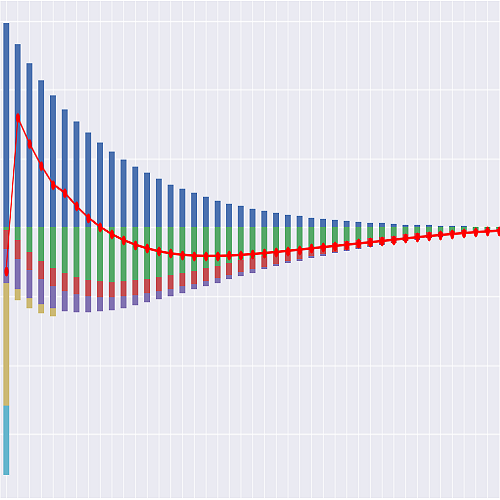
The shape to expect on the anchor cell is a large new-business strain at ``t = 0`` — the
25 ‰ *Zillmerung* allowance is charged in full there — then thirty-odd years of positive
monthly margins as the level *Beitrag* runs far above the risk premium, then a long
negative tail from the seventies onward as the incidence curve overtakes it. That crossing
is the *Deckungskapital*'s peak, and it is the whole economic content of an ageing reserve
carried on a life-assurance chassis.
"""
from modelx.serialize.jsonvalues import *
_formula = lambda point_id: None
_bases = []
_allow_none = None
_spaces = []
# ---------------------------------------------------------------------------
# Cells
[docs]
def model_point():
"""The selected model point as a Series."""
return data.model_point_table().loc[point_id] # noqa: F821
[docs]
def policy_id():
"""The policy identifier of the selected model point, ``PFL-0000NN``."""
return str(model_point()["policy_id"])
[docs]
def sex():
"""The insured's sex, M or F. **A projection input that must not reach the price.**
Sex may not enter the premium of a contract concluded from 21 December 2012, so
:func:`premium_mth_pp` blends the two bases at ``unisex_mix_male`` and never reads this
cells, while :func:`mort_rate` and :func:`inc_rate` read nothing else. The tension is
sharper on this product than on any other in the library: women have materially higher
incidence and materially longer care durations, so the unisex premium embeds a
cross-subsidy whose size depends on the sex mix actually written — and that mix is
endogenous to the price. Model points 1 and 2 are the same contract on the two sexes:
equal ``premium_mth_pp()``, unequal projected annuity.
"""
v = str(model_point()["sex"])
if v not in ("M", "F"):
raise ValueError("invalid sex")
return v
[docs]
def age_at_entry():
"""The age last birthday at issue.
It drives :func:`proj_len`, every rate lookup through :func:`age`, and the
*Beitragssumme* the *Zillmerung* allowance is struck on. The observed German entry
band is of the order of 18 to 65, and purchase clusters much later than the band
permits — predominantly between 45 and 60, when the buyer has seen a parent go into
care. Model points 13 and 14 sit at the two ends.
"""
return int(model_point()["age_at_entry"])
[docs]
def duration_mth_init():
"""Complete months elapsed at the projection start; ``0`` for new business.
The frame **opens** at this ``t``, which is a product fact rather than a house
convention: an in-force model point opens at the duration the policy has already run.
It does **not** change :func:`proj_len`, which is fixed by the entry age and the
terminal age alone, so a point opening at ``t = 240`` simply publishes a shorter frame
ending at the same index. Reading it as a shift of the horizon is a listed pitfall.
"""
return int(model_point()["duration_mth_init"])
[docs]
def status_init():
"""The state at the projection start: ``aktiv`` or ``pg1`` … ``pg5``.
An ``aktiv`` point seeds :func:`pols_act`; a point in claim seeds :func:`pols_pg` at
its grade with the *Karenzzeit* already served, because a life in payment at the
valuation date has served whatever deferral its contract carried. Model point 12 is
the in-claim case.
"""
v = str(model_point()["status"])
if v not in ("aktiv", "pg1", "pg2", "pg3", "pg4", "pg5"):
raise ValueError("invalid status")
return v
[docs]
def rente_mth():
"""R: the *vereinbarte Pflegerente* at *Pflegegrad* 5, in euro per month.
The scaling constant of the whole benefit schedule: every grade pays
``benefit_pct(g) x rente_mth()``. The market sells 1 000 € to 1 500 € a month, sized
against the residual a *Pflegeheim* resident funds from savings after the statutory
contribution and an average pension; the shipped 1 000 € is the round number at the
lower end of that band and is a **[std]** choice, not an observation.
"""
return float(model_point()["rente_mth"])
[docs]
def staffel_id():
"""The key into *benefit_scale_table.csv* naming this policy's *Leistungsstaffel*.
``delib_std`` is 0 / 30 / 50 / 75 / 100 %; ``bahr`` is the statutory
10 / 20 / 30 / 40 / 100 % minimum grid of § 127 SGB XI. The difference is not only a
level: on ``bahr`` *Pflegegrad* 1 is insured, so a grade-1 life is **waived** there and
**pays** on ``delib_std``.
"""
return str(model_point()["staffel_id"])
[docs]
def prem_end_age():
"""The attained age at which the *Beitrag* ceases; ``110`` means lifelong.
Three forms are sold: lifelong payment until death or claim, payment to a fixed age —
typically 65 or 85 — and a single *Einmalbeitrag*. A shortened
*Beitragszahlungsdauer* raises the level premium and the reserve and best matches the
buyer's earning life; model point 4 carries it. Once the term has ended the contract
is paid up: no premium, no lapse, and the cover runs on.
"""
return int(model_point()["prem_end_age"])
[docs]
def prem_mode():
"""The instalment frequency: monthly, quarterly, half_yearly, annual or single."""
v = str(model_point()["prem_mode"])
if v not in ("monthly", "quarterly", "half_yearly", "annual", "single"):
raise ValueError("invalid prem_mode")
return v
[docs]
def prem_mode_months():
"""m: the number of months one instalment covers; ``0`` for the *Einmalbeitrag*.
1, 3, 6 or 12, and ``0`` for ``single``, which is the sentinel the premium cells read
as "one payment at ``t = 0`` and nothing thereafter".
The model charges **no separate** *Ratenzahlungszuschlag*: the instalment loading is
folded into ``admin_prem_pct``, which is a percentage of the premium collected and so
is invariant to the mode. The consequence is worth stating because a user will read
it the wrong way round — in this model annual mode prices very slightly *below*
monthly, through the timing of the discounting alone, which is the opposite sign to a
real German tariff.
"""
return {"monthly": 1, "quarterly": 3, "half_yearly": 6,
"annual": 12, "single": 0}[prem_mode()]
[docs]
def premium_mth():
"""The contractual monthly *Beitrag* from the model point; ``0.0`` is a sentinel.
``0.0`` does not mean a free contract. It means **derive the premium by
equivalence**, and :func:`premium_mth_pp` then runs the first-order pricing engine.
A positive value is taken as the contractual premium and the engine is not consulted —
which is how an in-force model point carries the premium it was actually sold at.
"""
return float(model_point()["premium_mth"])
[docs]
def rating_factor():
"""The *Risikozuschlag* multiplier on the **gross** premium; 1.00 at standard rates.
A *Risikozuschlag* buys the same annuity at a higher price, so it scales the premium
and never the benefit, and :func:`claims` is invariant to it. No German
*Risikozuschlag* scale for this product was established; model point 13 carries 1.50
as a **[std]** illustration.
"""
return float(model_point()["rating_factor"])
[docs]
def wartezeit_months():
"""The *Wartezeit* from inception, in months; ``0`` in the base run.
Care beginning inside it is not covered, so :func:`inc_force` is zero while
``t < wartezeit_months()``. The underwritten mainstream product usually has none — the
*Gesundheitsprüfung* does the screening the *Wartezeit* does in the subsidised
*Pflege-Bahr* product, where the statutory maximum is five years. The pairing is near
deterministic: no underwriting implies a long *Wartezeit*, underwriting implies none.
Model point 7 carries 36 months.
"""
return int(model_point()["wartezeit_months"])
[docs]
def karenz_months():
"""K: the *Karenzzeit* from onset, in months; ``0`` in the base run.
A different device from the *Wartezeit* and routinely confused with it: the
*Wartezeit* runs from inception and denies cover, the *Karenzzeit* runs from **onset**
and defers an admitted claim. It is a clock **per onset**, not a gate on the
aggregate, which is why :func:`pols_karenz` carries a ledger dimension for it rather
than a shift on the benefit. Where it is positive, a material share of new claimants
die inside the deferral — mortality is highest immediately after onset — so it removes
disproportionately more claims than its length suggests. Model point 7 carries six
months.
"""
return int(model_point()["karenz_months"])
[docs]
def leistungsdynamik():
"""d: the annual escalation of the annuity **in payment**; ``0.0`` in the base run.
Not to be confused with a *Beitragsdynamik*, which raises premium and cover before
claim and is not modelled at all. The economic case for this one is that the
*Eigenanteil* a resident pays rises continuously while the statutory benefit is uprated
episodically, so a level annuity loses ground throughout a spell. Its cost is much
smaller than it looks — the annuity is paid to a population with heavily elevated
mortality, so the escalation compounds over three to five years, not fifteen. Model
point 8 carries 2 % a year.
"""
return float(model_point()["leistungsdynamik"])
[docs]
def beitragsrueckgewaehr():
"""Whether the *Beitragsrückgewähr* death benefit is on; ``False`` in the base run.
Switched on, the contract returns the premiums payable to date on death at any time,
which converts a pure biometric risk cover into a savings-bearing one: the reserve
needed to fund it is close to the accumulated premium itself, and the option roughly
doubles the premium for the same annuity. The base run leaves it off because the
savings roll-forward is demonstrated far better by
``products/kapitallebensversicherung/``; model point 9 turns it on to show how large
the effect is.
The implemented form is the **gross** one — no offset for annuity already paid. The
market's more common form nets the annuity off, but that netting is floored at zero
**per life**, and these ledgers are aggregates, so netting at the aggregate level would
let a life that received a large annuity subsidise one that received none. The
consequence — the option overstates the death benefit relative to the market-standard
form — is stated rather than hidden.
"""
return bool(model_point()["beitragsrueckgewaehr"])
[docs]
def stornoabzug_rate():
"""The deduction from the *Rückkaufswert*, as a fraction; ``0.0`` in the base run.
Admissible only if agreed, appropriate and **quantified in the contract**, and a
deduction for unamortised acquisition costs is expressly ineffective. No
*Stornoabzug* for any German *Pflegerenten* tariff was established, so the base run
ships zero — a non-zero deduction requires a contractual quantification this corpus
cannot supply — and model point 10 carries 5 % as a **[std]** illustration.
**Named ``stornoabzug_rate`` and not ``stornoabzug``.** It is a fraction, and the
library gives every rate the ``*_rate`` suffix; ``RV_DE_S``, ``FRV_DE_S`` and
``Riester_DE_S`` all spell this rate the same way. Bare ``stornoabzug`` is
``FRV_DE_S``'s *euro amount* retained from surrenders and one of its ``result_cf()``
columns — a different quantity, which is why the two do not share a name.
"""
return float(model_point()["stornoabzug_rate"])
[docs]
def pols_if_init():
"""The policy count at the frame's first ``t``; 1.0 on every shipped model point.
``result_cf()``'s first ``pols_if`` value equals this exactly, which is the
library-wide assertion that ``pols_if`` is a start-of-period count: no decrement has
been applied when a period opens.
"""
return float(model_point()["pols_if_init"])
[docs]
def omega_age():
"""The terminal age, 110, from *basis_table.csv*.
A **[std]** modelling choice rather than a table fact — the DAV tables run higher —
and it costs nothing material: an active female life aged 45 survives to 110 with
probability of the order of 1e-4 on the shipped basis. What it buys is a **closed**
system: :func:`mort_rate` is forced to 1.0 at ``omega_age() - 1``, so the decrements
account for the whole cohort and :func:`check_states` closes exactly instead of leaving
a truncation residue.
"""
return int(data.basis_table().at["omega_age", "value"]) # noqa: F821
[docs]
def rechnungszins():
"""i: the technical interest rate, 1,00 % a year, from *basis_table.csv*.
The *Höchstrechnungszins* of the DeckRV for new business from 1 January 2025, which
attaches to the cohort at issue and is then locked for the life of the contract.
**This is the one place a discount rate appears in the model**, and it is used only by
the pricing engine: the projection publishes undiscounted cash flows. It is also the
single most leveraged pricing assumption here, because a *Pflegerente*'s benefits fall
on average some thirty-five years after issue.
"""
return float(data.basis_table().at["rechnungszins", "value"]) # noqa: F821
[docs]
def proj_len():
"""n: the **number of projected months**, ``12 (omega_age - age_at_entry)``.
The **exclusive end** of the frame, counted from ``t = 0``: the frame is
``range(duration_mth_init(), proj_len())``, the last projected index is
``proj_len() - 1`` and ``result_cf().index[-1] == proj_len() - 1`` whether the frame
is 0-based or opens partway through, which is the library's reading and is asserted
for every model point. On the anchor cell — entry age 45, ``omega_age`` 110 — it is
780, so the frame runs ``t = 0 … 779``, 780 monthly rows, attained ages 45 to 109.
It depends on the entry age and the terminal age alone, **not** on
:func:`duration_mth_init`: a point opening at ``duration_mth_init() = d0`` publishes
``proj_len() - d0`` rows and still ends at its own ``proj_len() - 1``, because
``duration_mth_init`` shortens the frame at the front, never at the back. That last
index is the point's own — ``proj_len()`` varies with the entry age — not the anchor's
779.
"""
return 12 * (omega_age() - age_at_entry())
[docs]
def duration_mth(t):
"""Complete months elapsed since issue at the start of month ``t``, which is ``t``.
Published as its own cells because it is the quantity the *Wartezeit* is measured in,
and because ``t`` is an index while this is a duration: on a model point opening at
``duration_mth_init() = 240`` the frame's first row is already 240 months old.
"""
return t
[docs]
def policy_year(t):
"""y(t): the *Versicherungsjahr*, ``t // 12 + 1``, 1-based.
The key into *lapse_table.csv* and *surrender_table.csv*, both of which are tabulated
to year 40 with year 40's value applying to every later year.
"""
return t // 12 + 1
[docs]
def age(t):
"""x(t): the attained age, ``age_at_entry() + t // 12``.
The age steps at the **policy anniversary** rather than on a birthday, which is the
convention this monthly grid imposes; an implementation on real dates carries a
fractional offset of at most one year **[std]**.
"""
return age_at_entry() + t // 12
[docs]
def benefit_pct(g):
"""pi_g: the *Leistungsstaffel* percentage at *Pflegegrad* ``g``.
Read from *benefit_scale_table.csv* on this policy's ``staffel_id``. The annuity paid
at grade ``g`` is ``benefit_pct(g) x rente_mth()``, irrespective of the care setting:
the same amount is payable at home and in a *Pflegeheim*, which is what makes the
product a *Summenversicherung* and removes any need to prove where care is given.
The middle steps carry the cost. Time spent at each grade is very unequal — a person
entering at grade 2 and deteriorating spends most of the spell at grades 2 and 3 and
only the final months at grade 5 — so the time-weighted average percentage over a spell
is far below 100 %, and two tariffs with the same top step and different middle steps
differ by more than the headline suggests.
"""
return float(data.benefit_scale_table().at[ # noqa: F821
(staffel_id(), g), "benefit_pct"])
[docs]
def waiver_flag(g):
"""True when an annuity is payable at *Pflegegrad* ``g``, and so the *Beitrag* waived.
Waiver and benefit run on **one** trigger: the premium is waived from the first month
in which any annuity is payable and revives on exit from the paying grades. That is
the market-standard design, and it is what lets :func:`check_waiver` reconcile the
premium stream and the benefit stream against a single ledger.
The grade-1 case is the whole point of publishing this as its own cells. On
``delib_std`` ``benefit_pct(1)`` is zero, so a grade-1 life is in care, is counted in
:func:`pols_if`, generates no annuity and **keeps paying**; on ``bahr`` the same life
is waived. Wiring the waiver to membership of the care ledger instead gets both wrong.
"""
return benefit_pct(g) > 0.0
[docs]
def mort_rate(t):
"""q_A(x): the annual **active-life** death rate at the attained age, by sex.
Read from *mort_table.csv*, a **[std]** Gompertz proxy — not DAV 2008 T and not the
DAV 2008 P active-life table, neither of which is public or redistributed here. It is
forced to 1.0 at ``omega_age() - 1``, the limiting-age convention that closes the
system.
This is the rate of an **active** life. In-care mortality is a multiple of its force
and is :func:`mort_rate_care`.
"""
return float(data.mort_table().at[(sex(), age(t)), "mort_rate"]) # noqa: F821
[docs]
def mort_rate_mth(t):
"""The monthly active-life death rate, ``1 - (1 - mort_rate(t))**(1/12)``.
Published because it is the quantity a reader checks the monthly step against, and
because the error it guards is dividing an annual rate by twelve: ``mort_rate(t)/12``
is strictly **below** this rate wherever the annual rate is positive, so dividing by
twelve understates the monthly decrement. Twelve of these rates *compounded* return
the annual rate exactly, while twelve of them *added* overshoot it — the direction is
the opposite of the intuition, which is why the pair is published. The projection
itself does not use it — it works in forces, through :func:`mort_force` — but the two
agree by construction, ``1 - exp(-mort_force(t)/12)`` being this same number.
"""
return 1.0 - (1.0 - mort_rate(t)) ** (1.0 / 12.0)
[docs]
def mort_force(t):
"""mu_A(t): the force of active-life mortality, ``-ln(1 - mort_rate(t))``.
Held constant over the month. At the limiting age ``mort_rate`` is 1.0 and the force
is infinite; it is capped at ``-ln(1e-12) = 27.63`` so the proportional allocation of
the month's exits stays finite. What survives the year of age 109 is then ``1e-12`` of
the cohort that entered it — of the order of ``1e-17`` of the original policy on the
anchor cell — so the closure identity is exact to far beyond the tolerance.
"""
return -math.log(1.0 - min(mort_rate(t), 1.0 - 1e-12)) # noqa: F821
[docs]
def mort_rate_care(t, g):
"""q_g(x): the annual death rate of a life in *Pflegegrad* ``g``.
``1 - exp(-mort_force_care(t, g))``. Published so the single most load-bearing
biometric statement in this product is visible as a number: the mortality of a
*Pflegebedürftiger* is a large multiple of an active life's at the same age, rising
sharply with the grade.
Two consequences. **The annuity in payment is short** — three to five years, not the
fifteen to twenty of a healthy-life pension at the same age — so pricing it on an
annuity table built to be prudent about people living *longer* would be prudent in
exactly the wrong direction and would materially overprice the benefit. And **grade
and mortality are correlated**, so the highest-paying state is the shortest-lived: a
model applying an average benefit percentage to a survival curve computed at an average
mortality gets the wrong answer in a way no total will reveal.
"""
return 1.0 - math.exp(-mort_force_care(t, g)) # noqa: F821
[docs]
def mort_force_care(t, g):
"""mu_g(t): ``mort_mult(g)`` times the **force** of active mortality at the same age.
On the force and not on the rate, which is what makes the multiple mean the same thing
at every age: 1.5 at grade 1 rising to 9.0 at grade 5, carrying the research file's
order of magnitude — two to three times an active life at grade 2, five to ten times at
grade 5. On *rates* the ratio compresses towards 1 as ``mort_rate`` saturates at the
oldest ages, which is an artefact of the rate scale and not a change in the basis.
"""
mult = float(data.care_table().at[g, "mort_mult"]) # noqa: F821
return mult * mort_force(t)
[docs]
def inc_rate(t):
"""i(x): the annual rate at which an active life enters **any** *Pflegegrad*.
Read from *incidence_table.csv* by sex and attained age, a **[std]** exponential proxy
capped at ``inc_cap``. It is the rate of *leaving the active state for care*; the
grade actually entered is drawn from :func:`inc_share`, because entry is not uniformly
at the lowest grade — a stroke or a fracture enters directly at grade 3 or 4.
The *Wartezeit* is **not** applied here. It gates the force, in :func:`inc_force`, so
that this cells stays the tariff-comparable table rate at every age.
"""
return float(data.incidence_table().at[ # noqa: F821
(sex(), age(t)), "inc_rate"])
[docs]
def inc_force(t):
"""iota(t): the force of incidence into care, **zero inside the *Wartezeit***.
``-ln(1 - inc_rate(t))`` once ``t >= wartezeit_months()``, and exactly zero before
that: care beginning inside the *Wartezeit* is not covered at all. It is also zero at
the limiting age, so every exit there is death and the allocation stays well defined.
"""
if duration_mth(t) < wartezeit_months():
return 0.0
if age(t) >= omega_age() - 1:
return 0.0
return -math.log(1.0 - min(inc_rate(t), 1.0 - 1e-12)) # noqa: F821
[docs]
def inc_share(g):
"""s_g: the share of entrants into care whose first *Pflegegrad* is ``g``.
Read from *care_table.csv*; sums to 1.00 over the five grades. It is deliberately
**not** the stock distribution of *Pflegebedürftige*, which runs about
9 / 44 / 27 / 14 / 6 %: entrants skew lower than the stock, because deterioration moves
people up the grades over a spell. Using the stock as the entry mix is a listed
pitfall, and the model's own stock share at grades 4 and 5 over a whole projection
exceeds the entry share, which is the arithmetic statement of the same thing.
"""
return float(data.care_table().at[g, "entry_share"]) # noqa: F821
[docs]
def det_rate(g):
"""The annual rate of deterioration from *Pflegegrad* ``g`` to ``g + 1``.
Read from *care_table.csv*; zero at grade 5, which has nowhere to go. Deterioration
dominating recovery is one of the four properties a replacement table must preserve,
and it is what makes the benefit grow over a spell.
"""
return float(data.care_table().at[g, "det_rate"]) # noqa: F821
[docs]
def det_force(t, g):
"""delta_g(t): the force of deterioration out of grade ``g``; zero at grade 5.
Zero also at the limiting age, so every exit there is death.
"""
if age(t) >= omega_age() - 1:
return 0.0
q = det_rate(g)
if q <= 0.0:
return 0.0
return -math.log(1.0 - min(q, 1.0 - 1e-12)) # noqa: F821
[docs]
def rec_rate(t, g):
"""The annual rate of recovery from grade ``g``, damped above ``rec_age_ref``.
``rec_rate(g) x exp(-rec_age_decay x max(0, age(t) - rec_age_ref))`` with
``rec_age_ref = 75`` and ``rec_age_decay = 0.10`` **[std]**. The damping is what makes
deterioration dominate recovery above 75 — property (b) of a replacement table — and it
encodes the one thing about *Reaktivierung* that is not in doubt: it is real after
acute events at younger ages and small at the ages where most claims arise.
Recovery from grade 1 leads to the **active** state, and a life that recovers starts
paying its *Beitrag* again.
"""
base = float(data.care_table().at[g, "rec_rate"]) # noqa: F821
ref = float(data.basis_table().at["rec_age_ref", "value"]) # noqa: F821
decay = float(data.basis_table().at["rec_age_decay", "value"]) # noqa: F821
return base * math.exp(-decay * max(0.0, age(t) - ref)) # noqa: F821
[docs]
def rec_force(t, g):
"""rho_g(t): the force of recovery out of grade ``g``; zero at the limiting age."""
if age(t) >= omega_age() - 1:
return 0.0
q = rec_rate(t, g)
if q <= 0.0:
return 0.0
return -math.log(1.0 - min(q, 1.0 - 1e-12)) # noqa: F821
[docs]
def lapse_rate(t):
"""The **annual** lapse rate from the active state in policy year ``y(t)``.
Read from *lapse_table.csv*, tabulated to year 40 with year 40's rate applying to every
later year, and **zero once the premium term has ended**: a paid-up contract has no
premium-driven exit, and the model implements no *Beitragsfreistellung* election, so
every voluntary exit is a surrender.
Lapse here is *profitable* to the insurer — an early lapser paid for years and never
reached the risk period — which inverts the usual protection intuition and is why the
first-order pricing basis deliberately carries none.
"""
if age(t) >= prem_end_age():
return 0.0
return float(data.lapse_table().at[ # noqa: F821
min(policy_year(t), 40), "lapse_rate"])
[docs]
def lapse_rate_mth(t):
"""w(t): the monthly lapse probability, ``1 - (1 - lapse_rate(t))**(1/12)``.
Applied to the survivors of the insured decrements and of the reactivation inflow, so
that a life cannot both die and lapse in the same month. Nothing in care lapses: a
claimant with a waived premium has no premium to default on and a live annuity to
forfeit.
"""
return 1.0 - (1.0 - lapse_rate(t)) ** (1.0 / 12.0)
[docs]
def p_act_stay(t):
"""The probability that an active life is still active at the end of month ``t``.
``exp(-(mu_A + iota)/12)``, the constant-force survival of the two competing
decrements. With :func:`p_act_death` and :func:`p_act_care` it sums to exactly 1.
"""
return math.exp(-(mort_force(t) + inc_force(t)) / 12.0) # noqa: F821
[docs]
def p_act_death(t):
"""The probability that an active life dies during month ``t``.
The death force's share of the month's exits: ``(mu_A / (mu_A + iota)) (1 - p_stay)``.
Allocating the one survival probability in proportion to the forces is what makes the
three active-state probabilities sum to 1 exactly; adding monthly rates instead, or
dividing an annual rate by twelve, does not.
"""
total = mort_force(t) + inc_force(t)
return mort_force(t) / total * (1.0 - p_act_stay(t))
[docs]
def p_act_care(t):
"""The probability that an active life enters care during month ``t``.
``(iota / (mu_A + iota)) (1 - p_stay)``, and zero inside the *Wartezeit*, where the
incidence force is zero. The grade entered is then split by :func:`inc_share`.
"""
total = mort_force(t) + inc_force(t)
return inc_force(t) / total * (1.0 - p_act_stay(t))
[docs]
def p_pg_stay(t, g):
"""The probability that a life in *Pflegegrad* ``g`` is still there at month end.
``exp(-(mu_g + delta_g + rho_g)/12)``. Three forces compete out of a paying state, not
one — death, deterioration and recovery — which is the arithmetic form of the product's
central structural fact: **the paying state has three exits and only death is
absorbing**. A model that lets it be exited only by death overstates the liability; one
that treats every downgrade as a termination understates it.
"""
total = mort_force_care(t, g) + det_force(t, g) + rec_force(t, g)
return math.exp(-total / 12.0) # noqa: F821
[docs]
def p_pg_death(t, g):
"""The probability that a life in *Pflegegrad* ``g`` dies during month ``t``."""
total = mort_force_care(t, g) + det_force(t, g) + rec_force(t, g)
return mort_force_care(t, g) / total * (1.0 - p_pg_stay(t, g))
[docs]
def p_pg_worse(t, g):
"""The probability of a *Höherstufung* from grade ``g`` to ``g + 1`` in month ``t``.
Zero at grade 5. The insured does not elect this: a *Höherstufung* is applied for and
re-assessed by the *Medizinischer Dienst* or MEDICPROOF, so grade change is a biometric
transition here rather than a claims-management outcome.
"""
total = mort_force_care(t, g) + det_force(t, g) + rec_force(t, g)
return det_force(t, g) / total * (1.0 - p_pg_stay(t, g))
[docs]
def p_pg_better(t, g):
"""The probability of a *Herabstufung* from grade ``g`` to ``g - 1`` in month ``t``.
Out of grade 1 it leads to the **active** state — *Reaktivierung* — where the life
starts paying its *Beitrag* again and becomes exposed to lapse once more. Out of the
higher grades it moves the life down one step of the *Leistungsstaffel*, which reduces
the annuity without ending it, and out of the lowest **insured** grade it stops the
annuity and revives the premium. All three cases fall out of the same recursion; none
of them is a claim decision.
"""
total = mort_force_care(t, g) + det_force(t, g) + rec_force(t, g)
return rec_force(t, g) / total * (1.0 - p_pg_stay(t, g))
[docs]
def pols_act(t):
"""l_A(t): lives in the **active** state at the start of month ``t``.
Seeded at ``duration_mth_init()`` from :func:`status_init` and rolled forward as
l_A(t+1) = [ l_A(t) p_act_stay(t) + pols_reactiv(t) ] (1 - w(t))
— survivors of both insured decrements, plus the month's *Reaktivierungen*, then
exposed to lapse. **Lapse acts after the insured decrements and after the reactivation
inflow**; the alternatives give different answers and this ordering is the one the
notes' processing order states.
"""
if t <= duration_mth_init():
return pols_if_init() if status_init() == "aktiv" else 0.0
survivors = pols_act(t - 1) * p_act_stay(t - 1) + pols_reactiv(t - 1)
return survivors * (1.0 - lapse_rate_mth(t - 1))
[docs]
def pols_entry(t, g):
"""Lives entering *Pflegegrad* ``g`` from the active state during month ``t``.
``pols_act(t) x p_act_care(t) x inc_share(g)``. Entry is split across the grades
because it is not uniformly at the lowest one, and the split is one of the four
properties a replacement basis must preserve.
"""
return pols_act(t) * p_act_care(t) * inc_share(g)
[docs]
def pols_karenz(t, g, z):
"""W_{g,z}(t): lives in *Pflegegrad* ``g`` whose *Karenzzeit* clock stands at ``z``.
The ledger exists only when ``karenz_months() > 0``; otherwise it is empty and a life
graduates in the month it enters. Entrants join at ``z = 1`` and advance one month at
a time, subject to the **same** transitions as a served life — they die, deteriorate
and recover exactly as if the annuity were running, they simply are not paid.
The clock is **discarded on reactivation**: the *Karenzzeit* runs from onset, so a
recovered life who later relapses starts a new onset and a new clock. That is why
recovery out of ``g = 1`` leaves this ledger for the active state instead of moving to
a lower ``g``, and why :func:`pols_reactiv` reads across both ledgers.
A life in this ledger is in care, is counted in :func:`pols_if` and in
:func:`pols_care`, receives no annuity, and **pays its Beitrag**, because the waiver
runs with the annuity and not with the diagnosis.
"""
k = karenz_months()
if k <= 0 or z < 1 or z > k:
return 0.0
if t <= duration_mth_init():
return 0.0
if z == 1:
return pols_entry(t - 1, g)
total = 0.0
for h in range(max(1, g - 1), min(5, g + 1) + 1):
w = pols_karenz(t - 1, h, z - 1)
if w == 0.0:
continue
if h == g:
total += w * p_pg_stay(t - 1, h)
elif g == h + 1:
total += w * p_pg_worse(t - 1, h)
else:
total += w * p_pg_better(t - 1, h)
return total
[docs]
def pols_grad(t, g):
"""Lives graduating out of the *Karenz* ledger into *Pflegegrad* ``g`` in month ``t``.
Where ``karenz_months() == 0`` this is exactly :func:`pols_entry` — the degenerate case
the base run runs in — and where it is positive it is the ``z = K`` cohort carried one
more month through the same transitions.
The difference between the two is the whole cost of a *Karenzzeit*: summed over the
projection, graduations fall strictly short of entries, and the shortfall is the deaths
and recoveries recorded **inside** the deferral. Because mortality is highest
immediately after onset, that shortfall is larger than the length of the deferral
suggests — a deferred period on a population with elevated mortality removes
disproportionately more claims than the same period would on a healthy population.
"""
k = karenz_months()
if k <= 0:
return pols_entry(t, g)
total = 0.0
for h in range(max(1, g - 1), min(5, g + 1) + 1):
w = pols_karenz(t, h, k)
if w == 0.0:
continue
if h == g:
total += w * p_pg_stay(t, h)
elif g == h + 1:
total += w * p_pg_worse(t, h)
else:
total += w * p_pg_better(t, h)
return total
[docs]
def pols_reactiv(t):
"""Lives recovering out of *Pflegegrad* 1 to the **active** state during month ``t``.
Read across both care ledgers — the paying one and the *Karenz* one — because a life
still inside its deferred period can recover just as a paid one can. A reactivated
life rejoins :func:`pols_act`, resumes paying its *Beitrag* and becomes exposed to lapse
again in the same month, which is why the term appears inside :func:`pols_act`'s lapse
bracket rather than beside it.
"""
total = pols_pg(t, 1)
for z in range(1, karenz_months() + 1):
total += pols_karenz(t, 1, z)
return total * p_pg_better(t, 1)
[docs]
def pols_pg(t, g):
"""l_g(t): lives in *Pflegegrad* ``g`` at the start of month ``t``, *Karenz* served.
The ledger the annuity is paid on. Seeded at ``duration_mth_init()`` from
:func:`status_init` — an in-claim model point opens with its whole cohort here, at its
grade, with the deferral already served — and rolled forward as
l_g(t+1) = l_g(t) p_stay + l_{g-1}(t) p_worse + l_{g+1}(t) p_better + grad_g(t)
with the ``g = 1`` recovery term flowing to the active state instead and the ``g = 5``
deterioration term absent. Every one of those moves is **internal** to the in-force
population, which is why :func:`check_pols_roll_fwd` sees only deaths and lapses.
"""
if t <= duration_mth_init():
return pols_if_init() if status_init() == "pg%d" % g else 0.0
total = pols_pg(t - 1, g) * p_pg_stay(t - 1, g) + pols_grad(t - 1, g)
if g > 1:
total += pols_pg(t - 1, g - 1) * p_pg_worse(t - 1, g - 1)
if g < 5:
total += pols_pg(t - 1, g + 1) * p_pg_better(t - 1, g + 1)
return total
[docs]
def esc_pg(t, g):
"""E_g(t): the **escalation-weighted** counterpart of :func:`pols_pg`.
The same population, weighted by each life's own escalation factor since its annuity
began: the identical recursion with one extra factor of ``(1 + d)**(1/12)`` on the
surviving weights, entrants joining at weight 1.
Carrying the escalation as a **value ledger** rather than as a duration-since-onset
cohort dimension is what keeps the model O(n) instead of O(n squared); the price is
that it reports only the aggregate escalation, which is all the cash flow needs. With
``leistungsdynamik = 0`` the extra factor is 1 and this is the :func:`pols_pg`
recursion exactly, so the two ledgers agree at every ``t`` and ``g`` —
:func:`check_esc_ledger` asserts it.
The annuity is weighted on **this** ledger and never on :func:`pols_pg`. Using the
head count would silently drop the escalation on every model point that carries one,
and no total in the frame would look wrong.
"""
if t <= duration_mth_init():
return pols_pg(t, g)
factor = (1.0 + leistungsdynamik()) ** (1.0 / 12.0)
carried = esc_pg(t - 1, g) * p_pg_stay(t - 1, g)
if g > 1:
carried += esc_pg(t - 1, g - 1) * p_pg_worse(t - 1, g - 1)
if g < 5:
carried += esc_pg(t - 1, g + 1) * p_pg_better(t - 1, g + 1)
return factor * carried + pols_grad(t - 1, g)
[docs]
def pols_care(t):
"""Everyone in care at the start of month ``t``: the *Karenz* and paying ledgers.
``sum_g pols_pg(t, g) + sum_{g,z} pols_karenz(t, g, z)``. It is **not** the population
receiving an annuity and **not** the population whose premium is waived: a life inside
its *Karenzzeit* is here and is paid nothing, and a life at *Pflegegrad* 1 on the
``delib_std`` grid is here, is paid nothing and keeps paying.
"""
total = 0.0
for g in range(1, 6):
total += pols_pg(t, g)
for g in range(1, 6):
for z in range(1, karenz_months() + 1):
total += pols_karenz(t, g, z)
return total
[docs]
def pols_if(t):
"""l(t): policies in force at the **start** of month ``t``, active or in care.
The weight on that same ``result_cf()`` row's cash flows, which is the library-wide
convention; end-of-period state goes through :func:`pols_if_at` and never through this
cells read at ``t + 1``. ``result_cf()``'s first value equals :func:`pols_if_init`
exactly, because no decrement has been applied when a period opens.
Every *Pflegegrad* transition is internal to this count. Lives leave it only by death
or by surrender, which is what :func:`check_pols_roll_fwd` asserts.
"""
return pols_act(t) + pols_care(t)
[docs]
def pols_if_at(t, timing):
"""The in-force count at a point inside month ``t``: ``"BEG"`` or ``"END"``.
``"BEG"`` is :func:`pols_if` at ``t`` and ``"END"`` is :func:`pols_if` at ``t + 1``.
The cells exists so that end-of-period state has somewhere to live other than
:func:`pols_if`, whose meaning is fixed to the start of the period across the whole
library.
"""
if timing == "BEG":
return pols_if(t)
elif timing == "END":
return pols_if(t + 1)
else:
raise ValueError("invalid timing")
[docs]
def pols_in_term(t):
"""In-force units inside the premium-paying term: ``pols_if(t)`` while x(t) < prem_end_age.
Zero once the term has ended, at which point the contract is paid up: no premium, no
waiver population and no lapse, with the cover running on to the terminal age.
"""
if age(t) >= prem_end_age():
return 0.0
return pols_if(t)
[docs]
def pols_waived(t):
"""The *Beitragsbefreiung* population: in-term units in a **paying** *Pflegegrad*.
``sum_{g : waiver_flag(g)} pols_pg(t, g)``, restricted to the premium term. Three
consequences follow directly from the *Leistungsstaffel*, and each is a way to get the
waiver wrong: a life in a *Karenz* ledger is **not** here, because no annuity is yet
payable; a *Pflegegrad* 1 life is **not** here on ``delib_std`` and **is** here on
``bahr``; and a life downgraded out of the insured grades **leaves** here and starts
paying again.
"""
if age(t) >= prem_end_age():
return 0.0
total = 0.0
for g in range(1, 6):
if waiver_flag(g):
total += pols_pg(t, g)
return total
[docs]
def pols_prem(t):
"""The units that actually pay a *Beitrag*: ``pols_in_term(t) - pols_waived(t)``.
**Not monotone.** It falls as lives die, lapse and enter paying grades, and it *rises*
again whenever a *Herabstufung* takes a life out of the insured grades and revives its
premium obligation. A model whose premium-paying count only ever falls has wired the
waiver as an absorbing state, which is the single most common way to get this product's
premium stream wrong.
"""
return pols_in_term(t) - pols_waived(t)
[docs]
def pols_death(t):
"""Deaths during month ``t``, from **every** state.
The active state at ``p_act_death``, and each *Pflegegrad* — in the paying ledger and
in the *Karenz* ledger alike — at ``p_pg_death(t, g)``, which is grade-increasing
because the mortality multiple is. Aggregating the care ledgers into one average death
rate is the arithmetic form of forgetting that the highest-paying state is also the
shortest-lived.
"""
total = pols_act(t) * p_act_death(t)
for g in range(1, 6):
in_grade = pols_pg(t, g)
for z in range(1, karenz_months() + 1):
in_grade += pols_karenz(t, g, z)
total += in_grade * p_pg_death(t, g)
return total
[docs]
def pols_lapse(t):
"""Surrenders during month ``t``, from the **active state only**.
``[ pols_act(t) p_act_stay(t) + pols_reactiv(t) ] w(t)`` — the survivors of the insured
decrements together with the month's reactivations, exposed to lapse after both.
Nothing in care lapses: a claimant with a waived premium has no premium to default on
and a live annuity to forfeit. A *Pflegegrad* 1 life on ``delib_std`` does still pay
and could in principle surrender; the population is small and the model does not model
it, which is a stated simplification rather than an oversight.
"""
survivors = pols_act(t) * p_act_stay(t) + pols_reactiv(t)
return survivors * lapse_rate_mth(t)
[docs]
def pols_dead_cum(t):
"""Cumulative deaths before the start of month ``t``.
One of the two absorbing counts that, with the three live ledgers, partition the
initial cohort at every ``t``; see :func:`check_states`.
"""
if t <= duration_mth_init():
return 0.0
return pols_dead_cum(t - 1) + pols_death(t - 1)
[docs]
def pols_lapse_cum(t):
"""Cumulative surrenders before the start of month ``t``."""
if t <= duration_mth_init():
return 0.0
return pols_lapse_cum(t - 1) + pols_lapse(t - 1)
[docs]
def premium_due(t):
"""Whether an instalment falls due at the start of month ``t``.
``t % prem_mode_months() == 0`` inside the premium term, and for the *Einmalbeitrag*
only at ``t = 0``. The instalment months key off **issue**, not off the frame's first
row, so an in-force quarterly point opening at ``t = 240`` still pays in the months the
contract always paid in.
A waiver that begins between two due dates therefore takes effect **at the next due
date**, which is the German convention for a *Beitragsbefreiung* on a fractionated
contract; the alternative — refunding the unearned instalment — is a different and
equally arguable rule the model does not implement.
"""
if age(t) >= prem_end_age():
return False
m = prem_mode_months()
if m == 0:
return t == 0
return t % m == 0
[docs]
def premium_pp(t):
"""The instalment charged per paying policy at the start of month ``t``.
``premium_mth_pp() x prem_mode_months()`` on a due month and zero otherwise, so a
quarterly contract pays three months' worth three times a year rather than a twelfth of
the annual amount every month. For the *Einmalbeitrag* it is the whole
*Einmalbeitrag*, once, at ``t = 0``.
"""
if not premium_due(t):
return 0.0
m = prem_mode_months()
return premium_mth_pp() * (m if m > 0 else 1)
[docs]
def cum_prem_max_pp(t):
"""The *Beitrag* payable to date per policy on an **uninterrupted** path.
A deterministic quantity, not a ledger: it is what a policy that never claimed, never
lapsed and never died would have paid by the end of month ``t``, and it is the base of
both the *Rückkaufswert* and the *Beitragsrückgewähr*. It includes the instalment
collected at the start of month ``t``, because both benefits fall at the **end** of the
month.
Computing it in closed form rather than by accumulating :func:`premiums` is what lets an
in-force model point carry the right base at the frame's first row: the premiums paid
before the valuation date were paid, whether or not the model projected them.
"""
m = prem_mode_months()
if m == 0:
return premium_mth_pp() if t >= 0 else 0.0
last = min(t, 12 * (prem_end_age() - age_at_entry()) - 1)
if last < 0:
return 0.0
return premium_mth_pp() * m * (last // m + 1)
[docs]
def premiums(t):
"""*Beitrag* income in month ``t``: ``premium_pp(t) x pols_prem(t)``.
Collected **in advance**, at the start of the month, from the lives then inside the
term and not waived. Income-positive, like every other term of :func:`net_cf`.
"""
return premium_pp(t) * pols_prem(t)
[docs]
def rkw_pp(t):
"""The *Rückkaufswert* per surrendering policy at the end of month ``t``.
``rkw_prem_ratio(min(y(t), 40)) x cum_prem_max_pp(t) x (1 - stornoabzug_rate())`` — the
guaranteed surrender value as a fraction of premiums paid to date, which is the
scale-free form a German contract states, less any contractual *Stornoabzug*.
It is **near zero for the first several years** and stays well below premiums paid for
a long time, because the *Zillmerung* allowance is large and the risk premium in the
early years is small. That is the honest thing to tell a buyer, and it is the strongest
argument for the *Beitragsrückgewähr* option. Whether a **pure-risk** *Pflegerente*
falls inside § 169 VVG at all is an open question this library states rather than
assumes away; the table encodes the answer for a contract that does.
"""
ratio = float(data.surrender_table().at[ # noqa: F821
min(policy_year(t), 40), "rkw_prem_ratio"])
return ratio * cum_prem_max_pp(t) * (1.0 - stornoabzug_rate())
[docs]
def brg_pp(t):
"""The *Beitragsrückgewähr* per dying policy at the end of month ``t``.
``cum_prem_max_pp(t)`` where the option is on and ``0.0`` where it is not, so
``claims(t, "DEATH")`` is structurally zero in the base run. The **gross** form —
no offset for annuity already paid — for the reason given at
:func:`beitragsrueckgewaehr`.
"""
if not beitragsrueckgewaehr():
return 0.0
return cum_prem_max_pp(t)
[docs]
def claims(t, kind=None):
"""Benefit outgo in month ``t`` by ``kind``; the total when ``kind`` is omitted.
``"ANNUITY"`` is the *Pflegerente*, ``R sum_g pi_g E_g(t)``, paid **in advance** on the
escalation ledger. Two things about that weighting are load-bearing. It is
:func:`esc_pg` and not :func:`pols_pg`, so an escalation is never silently dropped. And
it is a **grade-by-grade** sum, never an average percentage on an average survival
curve: grade and mortality are correlated, so the highest-paying state is the
shortest-lived and the two are not interchangeable. The *Karenz* ledger contributes
nothing — a life inside its deferred period is in care, is counted in force, pays its
premium and receives no annuity.
``"LAPSE"`` is the *Rückkaufswert* and ``"DEATH"`` the *Beitragsrückgewähr*, both at the
**end** of the month on the lives that left during it.
"""
if kind is None:
return (claims(t, "ANNUITY") + claims(t, "LAPSE")
+ claims(t, "DEATH"))
elif kind == "ANNUITY":
total = 0.0
for g in range(1, 6):
pct = benefit_pct(g)
if pct > 0.0:
total += pct * esc_pg(t, g)
return rente_mth() * total
elif kind == "LAPSE":
return rkw_pp(t) * pols_lapse(t)
elif kind == "DEATH":
return brg_pp(t) * pols_death(t)
else:
raise ValueError("invalid kind")
[docs]
def beitragssumme():
"""The *Beitragssumme* the *Zillmerung* allowance is struck on.
``premium_mth_pp() x 12 x (min(prem_end_age(), beitragssumme_cap_age) - age_at_entry())``
and, for the *Einmalbeitrag*, the *Einmalbeitrag* itself.
A lifelong-premium contract has no finite *Beitragssumme* without a convention, and
``beitragssumme_cap_age = 85`` **[std]** is that convention. It is a parameter, not a
citation: what is cited is the 25 ‰ ceiling of DeckRV § 4 that the per-mille is set
exactly at, cut from 40 ‰ by the LVRG from 1 January 2015.
"""
m = prem_mode_months()
if m == 0:
return premium_mth_pp()
cap = int(data.basis_table().at[ # noqa: F821
"beitragssumme_cap_age", "value"])
years = max(0, min(prem_end_age(), cap) - age_at_entry())
return premium_mth_pp() * 12.0 * years
[docs]
def acq_expense_pp():
"""The acquisition and distribution charge per policy, incurred once at ``t = 0``.
``acq_permille / 1000 x beitragssumme()``, with the per-mille set **exactly at** the
§ 4 DeckRV *Höchstzillmersatz* so the ceiling binds visibly. The base is the
*Beitragssumme*, **not** the annual premium — charging the per-mille on an annual
premium understates it by a factor of the paying term and is a listed pitfall.
Because it falls at ``t = 0`` only, an in-force model point never incurs it: its frame
opens at ``duration_mth_init() > 0`` and the cost was incurred before the valuation
date. That is correct, and it is worth knowing before comparing an in-force point's
first row with a new-business point's.
"""
permille = float(data.expense_table().at[ # noqa: F821
"acq_permille", "value"])
return permille / 1000.0 * beitragssumme()
[docs]
def expense_infl_factor(t):
"""The expense inflation factor at month ``t``: ``(1 + expense_infl)**(t/12)``.
Applied to the per-policy administration cost and to the per-annuity-payment claims
cost, both of which are euro amounts quoted at ``t = 0`` prices. Over the anchor cell's
sixty-five years it is a factor of about 2.6, which is enough for the per-policy line to
decide the viability of a small contract on its own.
"""
infl = float(data.expense_table().at["expense_infl", "value"]) # noqa: F821
return (1.0 + infl) ** (t / 12.0)
[docs]
def expenses(t):
"""Acquisition and administration expense in month ``t``, at the start of the month.
Three components: the acquisition charge at ``t = 0`` only; a per-policy administration
cost on every policy in force, inflated; and a percentage of the *Beitrag* just
collected, which is where the instalment loading the model does not charge separately
lives. Claims-handling cost is **not** here — it is a per-event cost and is published
as its own column, :func:`claim_expenses`.
"""
admin_pp = float(data.expense_table().at[ # noqa: F821
"admin_mth_pp", "value"])
admin_pct = float(data.expense_table().at[ # noqa: F821
"admin_prem_pct", "value"])
total = admin_pp * expense_infl_factor(t) * pols_if(t)
total += admin_pct * premiums(t)
if t == 0:
total += acq_expense_pp()
return total
[docs]
def claim_expenses(t):
"""The claims-handling cost of month ``t``, per **annuity payment made**.
``claim_expense_pp x expense_infl_factor(t) x sum_{g : waiver_flag(g)} pols_pg(t, g)``,
so it is weighted on the paying grades only: a *Pflegegrad* 1 life on ``delib_std``
generates none, and neither does a life inside its *Karenzzeit*.
The level is set low, and that is a product fact rather than an optimistic assumption:
the *Pflegegrad* is determined by the *Medizinischer Dienst* or by MEDICPROOF and not
by the insurer, so the *Nachprüfung* is a documentation exercise rather than the
adversarial re-assessment that drives a *Berufsunfähigkeitsrente*'s claims cost.
"""
per_payment = float(data.expense_table().at[ # noqa: F821
"claim_expense_pp", "value"])
total = 0.0
for g in range(1, 6):
if waiver_flag(g):
total += pols_pg(t, g)
return per_payment * expense_infl_factor(t) * total
[docs]
def net_cf(t):
"""The net liability cash flow of month ``t``, **income positive**.
*Beitrag* less the *Pflegerente*, the *Rückkaufswert*, any *Beitragsrückgewähr*, the
acquisition and administration expense and the claims-handling cost. The notes' own
sign, and the library-wide one.
The shape to expect on the anchor cell is a large strain at ``t = 0``, where the 25 ‰
*Zillmerung* allowance is charged in full; then thirty-odd years of positive monthly
margins, the level *Beitrag* running far above the risk premium; then a long negative
tail from the seventies onward as the incidence curve overtakes it. That crossing is
where the *Deckungskapital* peaks, and it is the whole economic content of an ageing
reserve carried on a life-assurance chassis.
"""
return premiums(t) - claims(t) - expenses(t) - claim_expenses(t)
[docs]
def liability_cf(t):
"""The same stream as :func:`net_cf`, outgo positive: ``-net_cf(t)`` exactly.
The orientation a valuation layer consumes: a Solvency II best estimate is
``sum v(t) liability_cf(t)`` over the relevant risk-free term structure, plus a risk
margin. Published as a column beside :func:`net_cf` so the sign convention is
verifiable in the frame rather than only in prose.
"""
return -net_cf(t)
[docs]
def disc_factor(t):
"""v**t: ``(1 + rechnungszins())**(-t/12)``, the monthly discount factor.
**Used only by the pricing engine.** The projection publishes undiscounted cash flows
and this cells never touches them; it exists so that the equivalence the *Beitrag* is
struck by is visible in the model rather than only in the notes.
"""
return (1.0 + rechnungszins()) ** (-t / 12.0)
[docs]
def tar_mort_rate(t):
"""The first-order active-life death rate: blended across the sexes, margined.
``act_mort_margin x [ mix q_M(x) + (1 - mix) q_F(x) ]``, forced to 1.0 at the limiting
age. Two separate things are happening and both are deliberate.
The **blend** is the unisex constraint: sex may not enter the premium of a contract
concluded from 21 December 2012, so the price is struck on a mixed basis while the
projection runs on the model point's own sex. ``unisex_mix_male = 0.50`` is a
**[std]** assumption, and pricing a 50 / 50 mix while writing 60 / 40 is a named model
risk — the mismatch is the whole cross-subsidy, and the mix is endogenous to the price.
The **margin** is prudence, and its direction forks by risk. For an active life,
prudence means *lower* mortality — a life that survives is a life that can claim — so
the margin is 0.90 and not 1.10. Only the direction is cited; no German
*Sicherheitszuschlag* level for a *Pflegetafel* was established, and the responsible
actuary sets it in practice.
"""
if age(t) >= omega_age() - 1:
return 1.0
mix = float(data.basis_table().at["unisex_mix_male", "value"]) # noqa: F821
margin = float(data.basis_table().at[ # noqa: F821
"act_mort_margin", "value"])
q_m = float(data.mort_table().at[("M", age(t)), "mort_rate"]) # noqa: F821
q_f = float(data.mort_table().at[("F", age(t)), "mort_rate"]) # noqa: F821
return min(1.0 - 1e-12, margin * (mix * q_m + (1.0 - mix) * q_f))
[docs]
def tar_mort_rate_care(t, g):
"""The first-order in-care death rate at *Pflegegrad* ``g``.
``care_mort_margin x [ 1 - exp(-mort_mult(g) mu_blend) ]``, where ``mu_blend`` is the
force of the **unmargined** blended active rate. Taking the multiple on the unmargined
force is what keeps the two mortality margins from compounding: the active margin
lengthens the pre-claim period and the in-care margin lengthens the annuity, and they
are separate prudence statements about separate risks. ``care_mort_margin = 0.85``
lowers in-care mortality, which lengthens the annuity — prudent in the direction that
costs money here, and the opposite of what an annuity table would do.
"""
if age(t) >= omega_age() - 1:
return 1.0
mix = float(data.basis_table().at["unisex_mix_male", "value"]) # noqa: F821
margin = float(data.basis_table().at[ # noqa: F821
"care_mort_margin", "value"])
mult = float(data.care_table().at[g, "mort_mult"]) # noqa: F821
q_m = float(data.mort_table().at[("M", age(t)), "mort_rate"]) # noqa: F821
q_f = float(data.mort_table().at[("F", age(t)), "mort_rate"]) # noqa: F821
q = min(1.0 - 1e-12, mix * q_m + (1.0 - mix) * q_f)
mu = -math.log(1.0 - q) # noqa: F821
return min(1.0 - 1e-12, margin * (1.0 - math.exp(-mult * mu))) # noqa: F821
[docs]
def tar_inc_rate(t):
"""The first-order incidence rate: blended across the sexes, margined, capped.
``min(inc_margin x [ mix i_M(x) + (1 - mix) i_F(x) ], inc_cap)``. ``inc_margin = 1.25``
is prudence in the obvious direction — more claims — and it is the margin the whole
product's basis risk sits behind: DAV 2008 P was built on the superseded *Pflegestufen*
and the 2017 reform widened the insured population, and no margin is a substitute for
that. The cap binds only at the very oldest ages, where the exponential proxy would
otherwise exceed the survival it is applied to.
"""
mix = float(data.basis_table().at["unisex_mix_male", "value"]) # noqa: F821
margin = float(data.basis_table().at["inc_margin", "value"]) # noqa: F821
cap = float(data.basis_table().at["inc_cap", "value"]) # noqa: F821
i_m = float(data.incidence_table().at[ # noqa: F821
("M", age(t)), "inc_rate"])
i_f = float(data.incidence_table().at[ # noqa: F821
("F", age(t)), "inc_rate"])
return min(margin * (mix * i_m + (1.0 - mix) * i_f), cap)
[docs]
def tar_det_rate(t, g):
"""The first-order deterioration rate: ``det_margin x det_rate(g)``, capped below 1.
``det_margin = 1.15`` moves lives faster into the higher-paying grades, which is
prudence on a schedule whose top steps pay most.
"""
return min(1.0 - 1e-12, float(data.basis_table().at[ # noqa: F821
"det_margin", "value"]) * det_rate(g))
[docs]
def tar_rec_rate(t, g):
"""The first-order recovery rate: ``rec_margin x rec_rate(t, g)``.
``rec_margin = 0.80`` produces **fewer** recoveries and so longer spells in payment,
which is the prudent direction for a benefit that stops on recovery.
"""
return float(data.basis_table().at[ # noqa: F821
"rec_margin", "value"]) * rec_rate(t, g)
[docs]
def tar_p_act(t):
"""The first-order active-state month transitions, as ``(stay, death, care)``.
The same constant-force, proportional-allocation step as :func:`p_act_stay` and its
companions, on the first-order rates and with the *Wartezeit* gate applied to the
incidence force. Returned as one tuple rather than three cells because the tariff
ledgers are an internal engine: they have no reader outside :func:`premium_mth_pp` and
:func:`check_prem_equiv`, and splitting them would triple the pricing engine's surface
for no gain.
"""
mu_a = -math.log(1.0 - min(tar_mort_rate(t), 1.0 - 1e-12)) # noqa: F821
if duration_mth(t) < wartezeit_months() or age(t) >= omega_age() - 1:
mu_i = 0.0
else:
mu_i = -math.log(1.0 - min(tar_inc_rate(t), 1.0 - 1e-12)) # noqa: F821
total = mu_a + mu_i
stay = math.exp(-total / 12.0) # noqa: F821
return (stay, mu_a / total * (1.0 - stay), mu_i / total * (1.0 - stay))
[docs]
def tar_p_pg(t, g):
"""The first-order grade-``g`` month transitions, as ``(stay, death, worse, better)``.
The same allocation as :func:`p_pg_stay` and its companions, on the first-order rates.
The four components sum to exactly 1 by construction, which is what makes the tariff
ledgers a closed system and :func:`check_prem_equiv` a real identity.
"""
mu_g = -math.log(1.0 - min(tar_mort_rate_care(t, g), 1.0 - 1e-12)) # noqa: F821
if age(t) >= omega_age() - 1:
mu_d = 0.0
mu_r = 0.0
else:
q_d = tar_det_rate(t, g)
q_r = tar_rec_rate(t, g)
mu_d = -math.log(1.0 - q_d) if q_d > 0.0 else 0.0 # noqa: F821
mu_r = -math.log(1.0 - q_r) if q_r > 0.0 else 0.0 # noqa: F821
total = mu_g + mu_d + mu_r
stay = math.exp(-total / 12.0) # noqa: F821
rest = 1.0 - stay
return (stay, mu_g / total * rest, mu_d / total * rest, mu_r / total * rest)
[docs]
def tar_pols_act(t):
"""The first-order active ledger, from one policy at issue.
Seeded at ``t = 0`` with 1.0 whatever the model point's ``status`` is, because the
premium is struck **at issue on an active life** — an in-force point that supplies its
own premium never reaches this engine at all — and rolled forward with **no lapse**.
The absence of lapse is both German first-order practice and what keeps the model
acyclic: a pricing quantity must not depend on a behavioural assumption that depends on
the path that depends on the premium.
"""
if t <= 0:
return 1.0
stay = tar_p_act(t - 1)[0]
reactiv = tar_pols_pg(t - 1, 1)
for z in range(1, karenz_months() + 1):
reactiv += tar_pols_karenz(t - 1, 1, z)
return tar_pols_act(t - 1) * stay + reactiv * tar_p_pg(t - 1, 1)[3]
[docs]
def tar_pols_karenz(t, g, z):
"""The first-order *Karenz* ledger, empty unless ``karenz_months() > 0``.
Present so that the tariff basis prices the benefit the contract actually pays: a
*Karenzzeit* removes a material share of claims, more than its length suggests, and
omitting it from the pricing basis would load the premium with a benefit the contract
does not provide.
"""
k = karenz_months()
if k <= 0 or z < 1 or z > k or t <= 0:
return 0.0
if z == 1:
prev = tar_pols_act(t - 1) * tar_p_act(t - 1)[2] * inc_share(g)
return prev
total = 0.0
for h in range(max(1, g - 1), min(5, g + 1) + 1):
w = tar_pols_karenz(t - 1, h, z - 1)
if w == 0.0:
continue
p = tar_p_pg(t - 1, h)
if h == g:
total += w * p[0]
elif g == h + 1:
total += w * p[2]
else:
total += w * p[3]
return total
[docs]
def tar_pols_grad(t, g):
"""First-order graduations into *Pflegegrad* ``g``; the entrants themselves when K = 0."""
k = karenz_months()
if k <= 0:
return tar_pols_act(t) * tar_p_act(t)[2] * inc_share(g)
total = 0.0
for h in range(max(1, g - 1), min(5, g + 1) + 1):
w = tar_pols_karenz(t, h, k)
if w == 0.0:
continue
p = tar_p_pg(t, h)
if h == g:
total += w * p[0]
elif g == h + 1:
total += w * p[2]
else:
total += w * p[3]
return total
[docs]
def tar_pols_pg(t, g):
"""The first-order paying ledger at *Pflegegrad* ``g``."""
if t <= 0:
return 0.0
p_g = tar_p_pg(t - 1, g)
total = tar_pols_pg(t - 1, g) * p_g[0] + tar_pols_grad(t - 1, g)
if g > 1:
total += tar_pols_pg(t - 1, g - 1) * tar_p_pg(t - 1, g - 1)[2]
if g < 5:
total += tar_pols_pg(t - 1, g + 1) * tar_p_pg(t - 1, g + 1)[3]
return total
[docs]
def tar_esc_pg(t, g):
"""The first-order **escalation** ledger, the one the tariff annuity is valued on.
Identical in construction to :func:`esc_pg`, so a contract sold with a
*Leistungsdynamik* is priced with one. With the dynamic off it equals
:func:`tar_pols_pg` at every ``t`` and ``g``.
"""
if t <= 0:
return 0.0
factor = (1.0 + leistungsdynamik()) ** (1.0 / 12.0)
carried = tar_esc_pg(t - 1, g) * tar_p_pg(t - 1, g)[0]
if g > 1:
carried += tar_esc_pg(t - 1, g - 1) * tar_p_pg(t - 1, g - 1)[2]
if g < 5:
carried += tar_esc_pg(t - 1, g + 1) * tar_p_pg(t - 1, g + 1)[3]
return factor * carried + tar_pols_grad(t - 1, g)
[docs]
def tar_pols_if(t):
"""The first-order in-force count: active, deferred and paying together."""
total = tar_pols_act(t)
for g in range(1, 6):
total += tar_pols_pg(t, g)
for z in range(1, karenz_months() + 1):
total += tar_pols_karenz(t, g, z)
return total
[docs]
def tar_pols_prem(t):
"""The first-order premium-paying units: in-term, less the waived paying grades.
The waiver enters the **price**, not only the projection. On a level-premium contract
issued at 45 and claiming at 82 it removes the remaining premium stream for the whole
of the paying period — of the order of four years of premium, the same order as one
year of benefit — and that cost sits inside the level premium. It is one of the
reasons a *Pflegerente* is dearer than a *Pflegetagegeld* of nominally equal benefit.
"""
if age(t) >= prem_end_age():
return 0.0
total = tar_pols_if(t)
for g in range(1, 6):
if waiver_flag(g):
total -= tar_pols_pg(t, g)
return total
[docs]
def tar_pols_death(t):
"""First-order deaths in month ``t``, from every state.
Read only by the *Beitragsrückgewähr* leg of the equivalence: a death benefit written
into a *Pflegerente* is a death cover and has to be priced as one.
"""
total = tar_pols_act(t) * tar_p_act(t)[1]
for g in range(1, 6):
in_grade = tar_pols_pg(t, g)
for z in range(1, karenz_months() + 1):
in_grade += tar_pols_karenz(t, g, z)
total += in_grade * tar_p_pg(t, g)[1]
return total
[docs]
def epv_benefits():
"""A: the expected present value of the *Pflegerente* on the first-order basis.
``sum_t v**t R sum_g pi_g tar_esc_pg(t, g)``, discounted at the *Rechnungszins*. On
the anchor cell it is the whole of the benefit side: with no *Beitragsrückgewähr* and no
survival benefit, this annuity is the only thing the contract ever pays.
"""
total = 0.0
for t in range(proj_len()):
row = 0.0
for g in range(1, 6):
pct = benefit_pct(g)
if pct > 0.0:
row += pct * tar_esc_pg(t, g)
if row:
total += disc_factor(t) * rente_mth() * row
return total
[docs]
def epv_prem_units():
"""U: the expected present value of the premium stream **in units of P**.
``sum_{t : premium_due(t)} v**t m tar_pols_prem(t)``. Dividing the benefit and expense
values by this is what strikes the level premium, so it is the annuity factor of the
equivalence and the quantity a reader recomputes to check the premium by hand.
"""
m = prem_mode_months()
mult = m if m > 0 else 1
total = 0.0
for t in range(proj_len()):
if premium_due(t):
total += disc_factor(t) * mult * tar_pols_prem(t)
return total
[docs]
def epv_admin():
"""G: the expected present value of the per-policy administration cost, first order."""
admin_pp = float(data.expense_table().at[ # noqa: F821
"admin_mth_pp", "value"])
total = 0.0
for t in range(proj_len()):
total += disc_factor(t) * admin_pp * expense_infl_factor(t) * tar_pols_if(t)
return total
[docs]
def epv_claim_expense():
"""C: the expected present value of the per-annuity-payment claims cost, first order."""
per_payment = float(data.expense_table().at[ # noqa: F821
"claim_expense_pp", "value"])
total = 0.0
for t in range(proj_len()):
row = 0.0
for g in range(1, 6):
if waiver_flag(g):
row += tar_pols_pg(t, g)
if row:
total += disc_factor(t) * per_payment * expense_infl_factor(t) * row
return total
[docs]
def prem_net_level_pp():
"""The **net** level premium: ``epv_benefits() / epv_prem_units()``.
Benefits only — no expense loading, no *Zillmerung*, no *Risikozuschlag*. Published
beside :func:`premium_mth_pp` because the gap between the two is the whole of the
expense loading, and a reader who wants to know what the biometrics alone cost reads it
here.
"""
return epv_benefits() / epv_prem_units()
[docs]
def premium_mth_pp():
"""P: the level monthly gross *Beitrag* per policy.
Where ``premium_mth`` is positive on the model point, that is the premium and this
cells returns it unchanged. Where it is ``0.0``, the premium is struck by equivalence
on the **first-order** bases at the *Rechnungszins*:
P U = A + P D1 + P a1 + beta P U + G + C
where ``A`` is :func:`epv_benefits`, ``U`` :func:`epv_prem_units`, ``G``
:func:`epv_admin`, ``C`` :func:`epv_claim_expense`, ``beta`` the premium-related
administration percentage, ``a1`` the *Zillmerung* allowance in units of ``P`` and
``D1`` the *Beitragsrückgewähr* value in units of ``P``. Everything that scales with
``P`` is linear in it, so the equation solves in closed form,
P = (A + G + C) / [ U (1 - beta) - D1 - a1 ]
and for the *Einmalbeitrag* ``U = 1``, so the same expression gives the
*Einmalbeitrag* directly.
The *Risikozuschlag* multiplies the **gross** premium and never the benefit, so
:func:`claims` is invariant to it. It is applied here, after the equivalence, which
means the *Beitragssumme* an extra-risk contract's *Zillmerung* is charged on is the
rated premium's — the amount the policyholder actually contracts to pay.
There is **no published German rate card for this product to reproduce**, so this is a
computed quantity rather than a reproduced one, and the technical notes sanity-check its
level against an argued band rather than against a citation.
"""
if premium_mth() > 0.0:
return premium_mth()
permille = float(data.expense_table().at[ # noqa: F821
"acq_permille", "value"]) / 1000.0
admin_pct = float(data.expense_table().at[ # noqa: F821
"admin_prem_pct", "value"])
m = prem_mode_months()
if m == 0:
a1 = permille
else:
cap = int(data.basis_table().at[ # noqa: F821
"beitragssumme_cap_age", "value"])
years = max(0, min(prem_end_age(), cap) - age_at_entry())
a1 = permille * 12.0 * years
d1 = 0.0
if beitragsrueckgewaehr():
for t in range(proj_len()):
d1 += disc_factor(t) * prem_units_at(t) * tar_pols_death(t)
numerator = epv_benefits() + epv_admin() + epv_claim_expense()
denominator = epv_prem_units() * (1.0 - admin_pct) - d1 - a1
return rating_factor() * numerator / denominator
[docs]
def prem_units_at(t):
"""The number of premium **units of P** payable to date on an uninterrupted path.
``cum_prem_max_pp(t) / P`` written without ``P``, so the *Beitragsrückgewähr* leg of the
equivalence can be assembled before the premium it would otherwise depend on is known.
Breaking that circularity is the only reason this cells exists.
"""
m = prem_mode_months()
if m == 0:
return 1.0 if t >= 0 else 0.0
last = min(t, 12 * (prem_end_age() - age_at_entry()) - 1)
if last < 0:
return 0.0
return float(m * (last // m + 1))
[docs]
def check_net_cf_resid(t):
"""The cash flow statement's residual in month ``t`` — the library's first ruling.
``net_cf(t)`` less its reconstruction from the statement's own **published parts**:
``premiums - claims_annuity - claims_lapse - claims_death - expenses - claim_expenses``,
every one of them a column of :func:`result_cf`. Zero everywhere.
It is zero by construction while :func:`net_cf` subtracts ``claims(t)``, and that is the
point: the residual re-derives the headline number from the three ``claims`` **kinds**
separately rather than from their subtotal, so a benefit that stops being included in
``claims(t)``, or a column added to the frame without being subtracted, fails here
instead of silently changing the answer. Every model in this library publishes this
cells and its no-argument companion, so that no model's headline number is the one
quantity nothing checks.
"""
return net_cf(t) - (premiums(t)
- claims(t, "ANNUITY")
- claims(t, "LAPSE")
- claims(t, "DEATH")
- expenses(t)
- claim_expenses(t))
[docs]
def check_net_cf():
"""True when the cash flow statement reconciles in every projected month.
No argument, one bool over all ``t``, the library-wide shape;
:func:`check_net_cf_resid` gives the signed residual of the month that failed.
"""
tol = float(data.basis_table().at["roll_fwd_tol", "value"]) # noqa: F821
scale = max(pols_if_init() * max(rente_mth(), 1.0), 1.0)
return all(abs(check_net_cf_resid(t)) <= tol * scale
for t in range(duration_mth_init(), proj_len()))
[docs]
def check_pols_roll_fwd_resid(t):
"""The in-force roll-forward residual in month ``t``; zero everywhere.
``pols_if(t+1) - [ pols_if(t) - pols_death(t) - pols_lapse(t) ]``. It says that lives
leave the in-force population **only** by death or surrender, and that every
*Pflegegrad* transition — entry into care, deterioration, *Herabstufung*,
*Reaktivierung*, graduation out of the *Karenz* ledger — is internal to it.
That is a strong statement about a nine-state ledger and it is not trivially true: the
three ledgers are rolled forward independently, and a life double-counted between them,
or lost between the *Karenz* ledger and the paying one, or lapsed out of a paying grade,
leaves a residual here. What it does **not** catch is a life leaving the system
altogether, which is why :func:`check_states` is published beside it.
"""
return pols_if(t + 1) - (pols_if(t) - pols_death(t) - pols_lapse(t))
[docs]
def check_pols_roll_fwd():
"""True when the in-force roll-forward closes in every projected month."""
tol = float(data.basis_table().at["roll_fwd_tol", "value"]) # noqa: F821
scale = max(pols_if_init(), 1.0)
return all(abs(check_pols_roll_fwd_resid(t)) <= tol * scale
for t in range(duration_mth_init(), proj_len()))
[docs]
def check_states_resid(t):
"""The state-partition residual at the start of month ``t``; zero everywhere.
``pols_act + sum_{g,z} pols_karenz + sum_g pols_pg + pols_dead_cum + pols_lapse_cum``
less ``pols_if_init()``. The three live ledgers and the two absorbing counts partition
the initial cohort at **every** ``t``, and the identity is assembled by direct summation
over the ledgers, with no reference to the recursion that produced any of them.
That independence is what makes it more than the telescope of
:func:`check_pols_roll_fwd`. It catches a wrong seeding of an in-force model point, a
life counted in two grades at once, an entrant into care who never leaves the active
ledger, and a *Karenz* cohort that graduates twice. Because ``mort_rate`` is forced to
1 at the limiting age, it also closes at the far end: the decrements account for the
whole policy rather than leaving a truncation residue.
"""
total = pols_act(t) + pols_dead_cum(t) + pols_lapse_cum(t)
for g in range(1, 6):
total += pols_pg(t, g)
for z in range(1, karenz_months() + 1):
total += pols_karenz(t, g, z)
return total - pols_if_init()
[docs]
def check_states():
"""True when the ledgers and the absorbed counts partition the cohort at every month."""
tol = float(data.basis_table().at["roll_fwd_tol", "value"]) # noqa: F821
scale = max(pols_if_init(), 1.0)
return all(abs(check_states_resid(t)) <= tol * scale
for t in range(duration_mth_init(), proj_len()))
[docs]
def check_waiver_resid(t):
"""The *Beitragsbefreiung* split residual in month ``t``; zero everywhere.
``pols_prem(t) + pols_waived(t) - pols_in_term(t)``. The waiver **splits** the in-term
population: it neither loses a policy nor creates one, and a life that stops paying is a
life that started being paid.
It is arithmetically trivial while :func:`pols_prem` is a difference, and it is
published anyway because the failure it guards is not a slip in the subtraction but a
disagreement about who belongs on each side — a *Karenz* life counted as waived, a
grade-1 life waived on the ``delib_std`` grid, a waiver that never revives on a
*Herabstufung*. Each of those changes ``pols_waived`` and ``pols_prem`` in ways that
still sum correctly, so the check is read together with the tests that assert the
membership itself.
"""
return pols_prem(t) + pols_waived(t) - pols_in_term(t)
[docs]
def check_waiver():
"""True when the waiver splits the in-term population in every projected month."""
tol = float(data.basis_table().at["roll_fwd_tol", "value"]) # noqa: F821
scale = max(pols_if_init(), 1.0)
return all(abs(check_waiver_resid(t)) <= tol * scale
for t in range(duration_mth_init(), proj_len()))
[docs]
def check_esc_ledger_resid(t):
"""The escalation-ledger residual in month ``t``; zero everywhere.
With ``leistungsdynamik = 0`` it is ``sum_g [ esc_pg(t, g) - pols_pg(t, g) ]``, which
must be **exactly** zero: the two recursions are then identical and any difference is a
coding divergence between them. With a positive dynamic it is the sum of the *negative*
parts of the same differences, which must be zero because an escalated ledger can never
fall below the head count it escalates.
The invariant matters because the annuity is weighted on ``esc_pg``. If the escalation
ledger drifted below the population — an entrant added at the wrong weight, a survivor
escalated before rather than after the transition — the benefit would be understated and
no total in the frame would look wrong.
"""
if leistungsdynamik() == 0.0:
return sum(esc_pg(t, g) - pols_pg(t, g) for g in range(1, 6))
return sum(min(0.0, esc_pg(t, g) - pols_pg(t, g)) for g in range(1, 6))
[docs]
def check_esc_ledger():
"""True when the escalation ledger dominates the head count in every projected month."""
tol = float(data.basis_table().at["roll_fwd_tol", "value"]) # noqa: F821
scale = max(pols_if_init(), 1.0)
return all(abs(check_esc_ledger_resid(t)) <= tol * scale
for t in range(duration_mth_init(), proj_len()))
[docs]
def check_prem_equiv_resid(t):
"""The discounted first-order imbalance of month ``t``; its **sum** over ``t`` is zero.
``v**t [ premium - benefit - expense ]`` on the tariff ledgers: the premium leg is
``P m tar_pols_prem(t)`` on due months, the benefit leg the *Pflegerente* valued on
``tar_esc_pg`` plus the *Beitragsrückgewähr* where the option is on, and the expense leg
the *Zillmerung* allowance at ``t = 0``, the per-policy administration, the
premium-related administration and the claims cost.
It is **not** a tautology. The premium level comes from the closed form in
:func:`premium_mth_pp`, but both legs here are re-assembled month by month from the
ledgers, so substituting a best-estimate rate into one leg, dropping the *Zillmerung*
term, forgetting the waiver in ``tar_pols_prem`` or valuing the annuity on
``tar_pols_pg`` instead of ``tar_esc_pg`` all make the sum miss zero.
Individual months are large and of both signs — the early ones strongly positive, the
late ones strongly negative — so only the **sum** is an identity. Where the model point
supplies its own *Beitrag* no equivalence was struck, and the residual is zero by
construction: an equivalence that was never struck cannot be checked.
"""
if premium_mth() > 0.0:
return 0.0
p0 = premium_mth_pp() / rating_factor()
m = prem_mode_months()
mult = m if m > 0 else 1
admin_pct = float(data.expense_table().at[ # noqa: F821
"admin_prem_pct", "value"])
admin_pp = float(data.expense_table().at[ # noqa: F821
"admin_mth_pp", "value"])
per_payment = float(data.expense_table().at[ # noqa: F821
"claim_expense_pp", "value"])
permille = float(data.expense_table().at[ # noqa: F821
"acq_permille", "value"]) / 1000.0
prem_leg = p0 * mult * tar_pols_prem(t) if premium_due(t) else 0.0
ben_leg = 0.0
paying = 0.0
for g in range(1, 6):
pct = benefit_pct(g)
if pct > 0.0:
ben_leg += pct * tar_esc_pg(t, g)
paying += tar_pols_pg(t, g)
ben_leg = rente_mth() * ben_leg
if beitragsrueckgewaehr():
ben_leg += p0 * prem_units_at(t) * tar_pols_death(t)
exp_leg = (admin_pp * expense_infl_factor(t) * tar_pols_if(t)
+ per_payment * expense_infl_factor(t) * paying
+ admin_pct * prem_leg)
if t == 0:
if m == 0:
exp_leg += p0 * permille
else:
cap = int(data.basis_table().at[ # noqa: F821
"beitragssumme_cap_age", "value"])
years = max(0, min(prem_end_age(), cap) - age_at_entry())
exp_leg += p0 * permille * 12.0 * years
return disc_factor(t) * (prem_leg - ben_leg - exp_leg)
[docs]
def check_prem_equiv():
"""True when the gross premium closes the first-order equivalence.
The sum of :func:`check_prem_equiv_resid` over the whole tariff horizon, against a
tolerance scaled by ``P U`` — the size of the premium leg — because the residual is a
difference of two large discounted values and an absolute tolerance on it would be a
statement about the contract's size rather than about the equivalence.
"""
tol = float(data.basis_table().at["roll_fwd_tol", "value"]) # noqa: F821
if premium_mth() > 0.0:
return True
scale = max(premium_mth_pp() / rating_factor() * epv_prem_units(), 1.0)
total = sum(check_prem_equiv_resid(t) for t in range(proj_len()))
return abs(total) <= tol * scale
[docs]
def result_cf():
"""Result table of cash flows, indexed by policy month ``t``.
Contiguous from :func:`duration_mth_init` to ``proj_len() - 1``. ``pols_if`` is the
**start**-of-month count, which is the weight applied to every cash flow on the same
row, and its first value equals ``pols_if_init()`` exactly. ``pols_act``,
``pols_care`` and ``pols_prem`` split it three ways for a reader following the
projection: active, in care — deferred and paying together — and actually paying a
*Beitrag*.
``claims_death`` is structurally zero unless ``beitragsrueckgewaehr`` is on, and
``claims_lapse`` is zero once the premium term has ended, both published rather than
dropped so the product facts are stated instead of inferred. ``net_cf`` is
``premiums`` less the three ``claims`` columns, ``expenses`` and ``claim_expenses``;
``liability_cf`` is its negative.
"""
ts = list(range(duration_mth_init(), proj_len()))
return pd.DataFrame( # noqa: F821
{
"pols_if": [pols_if(t) for t in ts],
"pols_act": [pols_act(t) for t in ts],
"pols_care": [pols_care(t) for t in ts],
"pols_prem": [pols_prem(t) for t in ts],
"premiums": [premiums(t) for t in ts],
"claims_annuity": [claims(t, "ANNUITY") for t in ts],
"claims_lapse": [claims(t, "LAPSE") for t in ts],
"claims_death": [claims(t, "DEATH") for t in ts],
"expenses": [expenses(t) for t in ts],
"claim_expenses": [claim_expenses(t) for t in ts],
"net_cf": [net_cf(t) for t in ts],
"liability_cf": [liability_cf(t) for t in ts],
},
index=pd.Index(ts, name="t"), # noqa: F821
)
[docs]
def result_states():
"""Result table of the state ledgers, flows and rates, indexed by policy month ``t``.
The frame a reader needs to follow the multi-state machinery behind
:func:`result_cf`: the five paying grades, the *Karenz* ledger and the three flows
between them, the two decrements out of the system, and the four annual rates the whole
projection is built from. It is not part of the house contract and carries no
``check_*``; ``mort_rate_care_pg5`` is published in preference to all five grades'
because the grade-5 rate is the one that carries the product's central biometric fact.
"""
ts = list(range(duration_mth_init(), proj_len()))
return pd.DataFrame( # noqa: F821
{
"pols_pg1": [pols_pg(t, 1) for t in ts],
"pols_pg2": [pols_pg(t, 2) for t in ts],
"pols_pg3": [pols_pg(t, 3) for t in ts],
"pols_pg4": [pols_pg(t, 4) for t in ts],
"pols_pg5": [pols_pg(t, 5) for t in ts],
"pols_karenz": [sum(pols_karenz(t, g, z)
for g in range(1, 6)
for z in range(1, karenz_months() + 1)) for t in ts],
"pols_entry": [sum(pols_entry(t, g) for g in range(1, 6)) for t in ts],
"pols_grad": [sum(pols_grad(t, g) for g in range(1, 6)) for t in ts],
"pols_reactiv": [pols_reactiv(t) for t in ts],
"pols_death": [pols_death(t) for t in ts],
"pols_lapse": [pols_lapse(t) for t in ts],
"mort_rate": [mort_rate(t) for t in ts],
"mort_rate_care_pg5": [mort_rate_care(t, 5) for t in ts],
"inc_rate": [inc_rate(t) for t in ts],
"lapse_rate": [lapse_rate(t) for t in ts],
"premium_pp": [premium_pp(t) for t in ts],
},
index=pd.Index(ts, name="t"), # noqa: F821
)
# ---------------------------------------------------------------------------
# References
data = ("Interface", ("..", "Data"), "auto")
point_id = 1
math = ("Module", "math")
pd = ("Module", "pandas")