# modelx: pseudo-python
# This file is part of a modelx model.
# It can be imported as a Python module, but functions defined herein
# are model formulas and may not be executable as standard Python.
"""The by-policy projection of the :mod:`~.KLV_DE_S` model.
The Space is parameterized by ``point_id``, so ``Projection[1]`` is an ItemSpace
projecting model point 1::
>>> Projection[1].result_cf() # the worked example's anchor cell
>>> Projection.point_id = 8 # or switch the default
``t`` counts **policy months, 0-based and measured from issue**: month ``t`` runs from time
``t`` to time ``t + 1``, so ``t = 0`` is the first policy month and the frame runs
``t = t_start() ... proj_len() - 1`` contiguously, with ``t_start() = 12 * duration_init()``
and ``proj_len() = 12 * policy_term()`` — 300 on the anchor cell — the frame's **exclusive**
end. The *Ablauf* falls at the end of the last month. **There is no ``t = proj_len()`` row.**
.. rubric:: Two clocks, and which cells carries which
**A monthly grid is not a monthly product, and on this one almost nothing is monthly.** The
whole *Überschussbeteiligung* is an annual statement — the *laufende Verzinsung* is declared
for a *Versicherungsjahr*, the *Schlussüberschussanteilsatz* accrues on that year's closing
*Deckungskapital*, the *Ansammlungszins* is an annual rate — and so is everything the tariff
defines: an annual *Rechnungszins*, an annual first-order table, a Fackler roll-forward from
one anniversary to the next, the § 169 Abs. 3 five-year spreading, the *Beitragsfreistellung*
election at the end of a *Versicherungsperiode*. None of that becomes monthly. What the finer
grid resolves is everything that is **not** contractually annual: the *Beitrag* the contract
bills in instalments, the insurer's running expense, and the decrements, which now fall in
the month they happen and are paid the balances standing at the last anniversary.
So the argument of a cells says which clock it is on:
* cells that state an **annual account** take ``k``, the 0-based policy year — the whole
pricing block, :func:`res_net_pp`, :func:`res_zill_pp`, :func:`res_min_pp`, :func:`res_pp`,
:func:`res_pp_at`, :func:`res_guar_pp`, :func:`pu_single_prem`, :func:`is_paid_up`,
:func:`bfz_uplift_pp`, :func:`decl_rate`, :func:`term_rate`, :func:`ans_rate`,
:func:`surplus_base_pp`, :func:`surplus_credit_pp`, :func:`av_sur_pp`, :func:`term_bonus_pp`,
:func:`bonus_si_pp`, :func:`prem_offset_pp`, :func:`prem_charged_pp`, :func:`prem_paid_pp`,
:func:`storno_rate` and :func:`inflation_factor`;
* cells that state a **month** take ``t`` — the in force, the claims, the instalments, every
``result_cf()`` column, and the ``*_close_pp`` cells that say what a mid-month exit is paid;
* the **decrement rates take ``t`` and return the year's annual rate**, which is the
library-wide convention and is not the same thing as an annual statement.
``duration(t) = t // 12`` is the bridge: it is the completed policy years at the start of
month ``t``, and it is what a month resolves to when it reaches an annual cells.
``policy_year(t) = duration(t) + 1`` is the contractual 1-based label the input tables are
keyed on, ``age(t) = age_y(duration(t))`` steps on the anniversary, and
``is_anniv(t) = (t % 12 == 11)`` marks the month the annual machinery acts in. The frame is
indexed by ``t``; the policy year is derived and never indexed by.
The two-speed structure that follows is the library's convention: :func:`mort_rate` and
:func:`lapse_rate` are the **annual** rates of the policy year containing month ``t`` — the
vectors the technical notes tabulate — and :func:`mort_rate_mth` and :func:`lapse_rate_mth`
are the monthly rates actually applied, each ``1 - (1 - r)^(1/12)``, so that twelve of them
compound back to exactly the year's rate. That is what leaves the annual layer untouched:
``pols_if(12k)`` here is the annual-step model's own ``pols_if(k)``, so every reserve, every
declared credit and every ledger balance is the same number on the two grids.
.. rubric:: Input data
Inputs are **external files**: plain CSVs living in the model folder's parent directory,
``products/kapitallebensversicherung/``, read at run time rather than stored inside the
model. The model folder therefore holds nothing but formulas — no ``_data/``, no IOSpec, no
embedded values — so a diff of the model shows logic changes only, and an input can be
edited or swapped without rewriting the model. This follows ``annuallife.TradLife_A``;
contrast ``basiclife.BasicTerm_S``, which keeps its inputs *inside* the model through
modelx's IOSpec machinery.
The consequence worth knowing: **the model is not portable on its own.** Copying the
``KLV_DE_S`` folder without its parent's CSVs produces a model that reads and then fails on
first evaluation.
Each table has a filename Reference and a reader Cells, both on :mod:`~.KLV_DE_S.Data`,
reached here through the ``data`` Reference:
======================== ================================= ==========================
Reference Cells File
======================== ================================= ==========================
model_point_file data.model_point_table() model_point_table.csv
mort_table_file data.mort_table() mort_table.csv
lapse_file data.lapse_table() lapse_table.csv
surplus_rate_file data.surplus_rate_table() surplus_rate_table.csv
cost_file data.cost_table() cost_table.csv
freq_loading_file data.freq_loading_table() freq_loading_table.csv
deckrv_file data.deckrv_table() deckrv_table.csv
======================== ================================= ==========================
.. rubric:: Naming
Cells names follow lifelib's ``basiclife.BasicTerm_S`` and ``savings.CashValue_SE``
wherever those models have an analogue — ``pols_*`` for policy counts, plural nouns for
cash flows, ``*_rate`` for rates, ``*_pp`` for per-policy amounts, ``claims(t, kind)`` with
an uppercase ``kind`` string, ``*_at(t, timing)`` for the within-year reads. The technical
notes use compact actuarial symbols instead. The mapping is:
================== ===================================== ====================================
Notes symbol Cells Meaning
================== ===================================== ====================================
(none) model_point() The selected model point row
n proj_len_y() Policy years = policy_term
12 n proj_len() Projected months; frame end
(none) t_start() First projected month index
(none) k_start() First projected policy year
m prem_term() Beitragszahlungsdauer
(none) duration_mth(t) Completed policy months, = t
k duration(t) Completed policy years, t // 12
(none) is_anniv(t) Last month of a policy year
x(t), x(k) age(t), age_y(k) Attained age, on each clock
y(t) = k + 1 policy_year(t) Contractual 1-based policy year
SE sum_assured() Guaranteed Erlebensfallleistung
SD sum_death() Guaranteed Todesfallleistung
i1 rechnungszins() First-order interest rate
v1^k disc_factor_1st(k) First-order discount factor
kpx tpx_1st(k) First-order survival from issue
q1(x) mort_rate_at_age(x) First-order tariff rate at age
x - the unisex blend, which
prices and reserves
(table) mort_rate_base(t) Sex-specific annual table rate
q(t) mort_rate(t) Best-estimate annual mortality
qm(t) mort_rate_mth(t) The same, applied in month t
f rating_factor() Risikozuschlag on the death leg
alpha, beta, gamma alpha_rate(), beta_rate(), Zillmersatz; premium loading;
gamma_rate() sum-insured loading
phi prem_freq_load() Ratenzahlungszuschlag
(none) instalments() Payments a year
(pricing) pv_death_1st(), pv_maturity_1st(), The equivalence's parts
pv_benefit_1st(), ann_due_prem_1st(),
ann_due_term_1st()
B prem_gross_pp() Annual Bruttobeitrag before phi
BS beitragssumme() Beitragssumme = B x m
A alpha_cost() Zillmered acquisition cost
P^n prem_net_level_pp() Net level premium
P^Z prem_zill_pp() Zillmer premium
(prospective) pv_benefit_fut(k), The reserve's parts
ann_due_prem_fut(k)
V^n, V^Z, V^min res_net_pp(k), res_zill_pp(k), The three constructions
res_min_pp(k)
V(k) res_pp(k) Deckungskapital at start of year k
(within year) res_pp_at(k, timing) BEF_PREM / AFT_PREM / AFT_INT
G(k) res_guar_pp(k) Section 169 value at end of year k
(closing) res_guar_close_pp(t) The same, standing at end of month t
RK(t) surr_value_pp(t) Rueckkaufswert payable in month t
(unit paid-up) pu_single_prem(k) Single premium for one unit
(none) bfz_si_pp() Beitragsfreie Versicherungssumme
(none) bfz_uplift_pp(k) Section 169 uplift on election
(none) is_paid_up(k) Whether the contract is beitragsfrei
(none) bfz_fails() Whether the election became a surrender
d(k) decl_rate(k) Declared laufende Verzinsung
z(k) zins_ueberschuss_rate(k) Interest surplus rate
s(k) term_rate(k) Schlussueberschussanteilsatz
a(k) ans_rate(k) Ansammlungszinssatz
(base) surplus_base_pp(k) Deckungskapital at allocation
C(k) surplus_credit_pp(k) Surplus allocated for year k
S(k) term_bonus_pp(k) Accrued Schlussueberschussanteil
(closing) term_bonus_close_pp(t) The same, standing at end of month t
U(k) av_sur_pp(k) Ueberschussguthaben per policy
(within year) av_sur_pp_at(k, timing) BEF_INT / AFT_INT / AFT_CREDIT
(closing) av_sur_close_pp(t) The same, standing at end of month t
(aggregate) av_sur(k), av_sur_at(k, timing) The same, times pols_if(12k)
Z(k) bonus_si_pp(k) Bonus sum insured
(closing) bonus_si_close_pp(t) The same, standing at end of month t
(offset) prem_offset_pp(k) Beitragsverrechnung offset
B phi prem_charged_pp(k) Annual Zahlbeitrag before the offset
(none) prem_paid_pp(k) Annual Zahlbeitrag after it
(none) prem_cycle(), prem_due(t) The instalment cycle
(none) prem_charged_inst_pp(t) Instalment charged in month t
(none) prem_inst_pp(t) Instalment collected in month t
(none) premiums(t) Premium income in month t
w(t) lapse_rate(t) Annual surrender rate of the year
wm(t) lapse_rate_mth(t) The same, applied in month t
sigma(k) storno_rate(k) Stornoabzug rate
l(t) pols_if(t) In force at the start of month t
(within month) pols_if_at(t, timing) BEF_DECR / AFT_MORT / AFT_LAPSE
(exits) pols_death(t), pols_lapse(t), Expected exits in month t
pols_maturity(t)
(none) benefit_full_pp(t) Full death benefit before 161
(none) benefit_death_pp(t) What a death claim pays
(none) benefit_maturity_pp(t) What the Ablauf pays
claims_* claims(t, kind) DEATH / MATURITY / LAPSE
(none) inflation_factor(k) Expense inflation factor
(none) claim_expenses(t) Claim handling expense
(none) expenses_pp(t) Per-policy expense in month t
E(t) expenses(t) Expense outgo, no commission
(none) commissions(t) Commission outgo
net_cf(t) net_cf(t) Net cash flow, income positive
liability_cf(t) liability_cf(t) The same stream, outgo positive
(the notes' table) result_cf_annual() result_cf() summed by policy year
================== ===================================== ====================================
.. rubric:: The declared rate is a total, not an add-on
The single most common way to get this product wrong. The *laufende Verzinsung* **is** the
*Garantieverzinsung* plus the *laufende Zinsüberschussbeteiligung*, so
zins_ueberschuss_rate(k) = max(0, decl_rate(k) - rechnungszins())
is 1,70 pp on the anchor cell's 2,70 % declaration against a 1,00 % guarantee, and never
2,70 pp on top of 1,00 pp. The interest-surplus rate is **derived and never an input**. The
outer ``max`` is what keeps the ``nil`` scenario honest: the declared rate is then below the
guarantee, which the reserve roll-forward still meets in full, so the surplus is zero rather
than negative.
The base it multiplies is the ***Deckungskapital* at the allocation date** —
``max(res_pp_at(k, "AFT_INT"), 0)`` — not the sum insured and not the premium. That inner
``max`` is equally load-bearing: a *gezillmerte Deckungskapital* is **negative** for the
first several years, and a positive rate on a negative base credits a negative surplus. It
follows that a *gezillmert* contract earns **no** interest surplus in its early years even
though the § 153 VVG entitlement runs from inception — economically right, because there is
no fund to earn on, and worth saying because it looks like a bug.
.. rubric:: Three reserves, and the one the customer gets
:func:`res_zill_pp` is the *gezillmerte Deckungskapital*: it is exactly ``-alpha_cost()`` at
issue and stays negative for several years. :func:`res_min_pp` is the § 169 Abs. 3 VVG floor,
the same net reserve with the acquisition cost amortised **straight-line over the first five
contract years** rather than over the whole premium term. Because
``ann_due_prem_fut(k) / ann_due_prem_1st()`` falls roughly linearly over ``m`` years while
``max(0, 1 - k/5)`` reaches zero after five, the floor **normally binds** on a long
*gezillmert* contract, with equality only at durations 0 and ``m``. :func:`res_guar_pp` is
their maximum, floored at zero, struck at the **end** of policy year ``k`` because that is
what "zum Schluss der laufenden Versicherungsperiode" requires — so it reads the reserves at
``k + 1``. What a surrender in a *non*-anniversary month is paid is
:func:`res_guar_close_pp`, the value struck at the **last** anniversary.
With ``zillmer_on = 0`` (model point 13) ``alpha_cost()`` is zero, all three coincide and the
floor is slack — a useful invariance test. With ``prem_term = 1`` (model point 2) the 25 ‰
*Zillmersatz* buys almost nothing and the floor is slack from the first anniversary. Both are
the correct answer rather than a degenerate case.
Note that the acquisition cost is in the **premium** whether or not the contract is
zillmered: ``zillmer_on`` enters :func:`alpha_cost`, which is a *reserving* quantity, and not
the pricing equation, which always charges ``alpha_rate() * beitragssumme()``. That is why one
insurer can publish a *gezillmerte* and a non-*gezillmerte* edition of the same tariff at the
same price.
.. rubric:: Paid-up is not lapse, and it can fail
§ 165 VVG lets the policyholder demand conversion to a *prämienfreie Versicherung* at the end
of the current *Versicherungsperiode*, **provided the agreed *Mindestversicherungsleistung* is
reached**. The paid-up sum is bought with the § 169 value, so, writing ``e = bfz_year() - 1``
for the 0-based index of the election year, ``bfz_si_pp() = res_guar_pp(e) /
pu_single_prem(e + 1)``, and the contract
stays in ``pols_if`` with that reduced sum in place of ``sum_assured()``. Where the sum falls
short of ``bfz_min_si``, the statute obliges the insurer to pay the § 169 value instead and
**the election becomes a surrender**: :func:`lapse_rate` returns 1.0 for that year and
:func:`lapse_rate_mth` places the whole of it in the year's **last month**, where the election
falls. The cohort leaves there as ``claims(t, "LAPSE")`` and every later row is zero. Model
point 11 takes the first branch and model point 12 the second.
Placing that 1.0 is the one decrement decision the monthly grid forced. Spreading an annual
rate of 1.0 geometrically would put the whole cohort out in the election year's **first**
month, eleven months before the election it models; the election is an act at the end of a
*Versicherungsperiode*, so it is a month-specific event and :func:`lapse_rate_mth` says so.
Because the § 169 floor generally exceeds the Zillmer reserve, the paid-up sum bought is worth
more than the Zillmer reserve released. :func:`bfz_uplift_pp` is that difference, discounted
to the start of the election year, and it enters :func:`res_pp_at` so that
:func:`check_res_roll_fwd` still closes in the election year rather than being switched off
there.
.. rubric:: What surrender pays, and what it does not
A surrender at the end of month ``t``, in the policy year ``k = duration(t)``, pays::
surr_value_pp(t) = res_guar_close_pp(t) x (1 - storno_rate(k))
+ av_sur_close_pp(t)
+ term_surr_share x term_bonus_close_pp(t)
where the ``*_close_pp`` cells return the balance **standing at the end of that month**: the
year's own closing figure in an anniversary month, and the one struck at the **last**
anniversary in the other eleven. On a *gezillmert* contract that makes the guaranteed leg
exactly **zero through the whole first policy year** — the consumer fact this product is best
known for, and one the annual grid could not express, having paid a month-0 surrender the
value the coming anniversary would close at.
Four rules ride on that line. The ***Stornoabzug* bites on the guaranteed value only** — the
published deduction is a percentage of the *Deckungskapital* — so the accumulated
*Überschussguthaben* passes through undeducted. ``term_surr_share = 0`` in the base run: the
accrued *Schlussüberschussanteil* is paid at the *Ablauf* and on death and **not** on
surrender, which is the choice that does not invent an entitlement the sources do not
describe; the parameter is exposed rather than hard-coded. And the surrender value is what a
suicide inside three years is paid: § 161 VVG makes the insurer *leistungsfrei* **and**
obliges it to pay the *Rückkaufswert* including *Überschussanteile*, so the German rule is a
benefit **substitution** and not a forfeiture. And the *Stornoabzug* band is a **policy-year**
band: it steps on the anniversary, not monthly.
.. rubric:: The two mortality bases must not be crossed
:func:`mort_rate_at_age` is the first-order **tariff** rate: it prices and it reserves, and
it is a fixed unisex blend of the two table rows, because German new business has been unisex
since 21 December 2012. :func:`mort_rate_base` is this policy's own **sex-specific** table
rate, and :func:`mort_rate` is ``mort_rate_base(t) * mort_be_factor`` with
``mort_be_factor = 0.75``: it projects. The 33 % wedge is the *Sicherheitszuschlag*, whose systematic release **is** the
*Risikoüberschuss* — which this model does not compute, and which a model that reserves on
the best estimate has thrown away. ``rating_factor`` is a third thing again: it is the
*Risikozuschlag*, and it multiplies the first-order rate **in the death leg of the pricing and
the prospective reserve only** — never the survivorship factors, never the benefit, and never
a best-estimate rate. ``sex`` reaches :func:`mort_rate_base`, and therefore the
**decrement**, and it reaches nothing else: ``prem_gross_pp()`` is identical for two model
points differing only in it, which is what model points 1 and 7 exist to make visible. The
unisex blend behind the tariff is **[std]** - no German insurer publishes the portfolio mix
behind its own.
.. rubric:: The three Überschussverwendung systems
``ansammlung`` accumulates the credit at ``ans_rate`` in :func:`av_sur_pp` and raises the maturity
benefit; ``bonus`` buys paid-up sum insured at first-order rates in :func:`bonus_si_pp`,
raising the **death** benefit immediately by the full bonus sum but accumulating only at
``rechnungszins``; ``beitragsverrechnung`` carries last year's credit forward as this year's
premium offset in :func:`prem_offset_pp` and neither balance grows. Because
``ans_rate > rechnungszins`` the first gives a higher maturity benefit and the second a higher
death benefit — exactly the asymmetry the sources record, and the test that distinguishes
them. A model that sets the two rates equal destroys it.
Under ``beitragsverrechnung`` the **renewal commission is charged on
:func:`prem_charged_pp`, not on :func:`prem_paid_pp`**: the intermediary is paid on the tariff
premium, the surplus offset being a policyholder rebate.
.. rubric:: Modules that are off in the base run
Two dynamic lapse constructions ship switched off, so the base run reproduces the worked
example while the machinery stays visible. **Premium-shock lapse**, ``beta_shock = 0``:
``1 + beta_shock * max(0, prem_paid_pp(k)/prem_paid_pp(k-1) - 1 - 0.05)`` on the **annual**
*Zahlbeitrag* of consecutive policy years, inert on a level *Bruttobeitrag* but live under
*Beitragsverrechnung*, where a fall in the declared rate raises the *Zahlbeitrag*.
**Rate-gap lapse**, ``lapse_gap_a = 0``:
``lapse_gap_a * max(0, ref_rate - decl_rate(k) - 0.005)``, keyed on the gap between the
declared rate and what is available elsewhere. Both compare **annual** declarations, which is
what they are about; neither becomes a monthly comparison. **No German calibration of any of these numbers
exists**, which is why both ship off. ``bwr_rate = 0`` likewise switches off the
*Beteiligung an den Bewertungsreserven*, on the reasoning that the *Sicherungsbedarf* has
routinely exhausted the half share.
.. rubric:: Sign convention
:func:`net_cf` is **income positive** — *Beiträge* in, claims, expenses and commission out —
which is the notes' own orientation and the library-wide sign. :func:`liability_cf` publishes
the same stream outgo-positive, ``liability_cf(t) = -net_cf(t)`` exactly. Both are columns of
:func:`result_cf`, so the identity is verifiable in the frame rather than only in prose.
:func:`expenses` **excludes** commission — the deliberate difference from the frlib chassis,
where commission sits inside the expense column — so the six flow columns of
:func:`result_cf` sum to :func:`net_cf` without a double count. That sum is what
:func:`check_net_cf` asserts, and it is this library's first ruling.
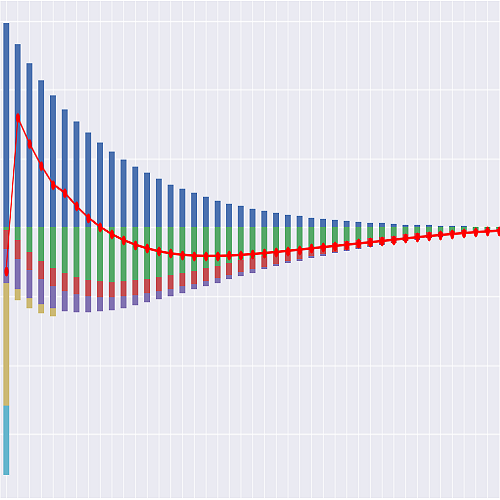
The shape to expect on the anchor cell, read on :func:`result_cf_annual`, is a first year that
very nearly washes - the *Beitrag* of 2 004,04 € almost exactly meeting the initial commission
of 2,5 % of the *Beitragssumme* plus the 300 € acquisition expense - then annual margins of
the order of a thousand euros that decay as the cohort lapses, and a single very large
negative year at the *Ablauf* when the *Erlebensfallleistung* and the whole accumulated
*Überschussguthaben* fall due together. The new-business strain of a *gezillmert* German
endowment sits in the **reserve**, which opens at ``-alpha_cost()``, and not in the cash flow.
.. rubric:: What the monthly grid changes, and what it does not
**Nothing annual moved, and that is checkable rather than asserted.** Because the monthly
decrement rates compound back to their policy year's annual values,
``[(1 - qm)(1 - wm)]^12 = (1 - q)(1 - w)``, the in force at every anniversary is the
annual-step recursion term for term. So ``prem_gross_pp()`` is **bit-identical**, and so is
every one of the three reserves at every duration, the § 169 value, the *Beitragssumme*, the
Zillmer cost, the declared credit, the *Ansammlung* balance, the bonus sum, the accrued
terminal share and the paid-up sum the § 169 value buys. The equivalence, the Fackler
roll-forward and the surplus ledgers are all **policy-year identities** and are checked as
such.
What the finer grid changes is the **cash flows**, and each change is a decision:
- a *Beitrag* is collected in instalments on the *Zahlweise*'s own cycle
(:func:`prem_cycle`, :func:`prem_due`, :func:`prem_inst_pp`), so the four fractionated model
points collect less than the annual grid charged them — and the ``echt`` / ``unecht``
distinction of :func:`unterjaehrig_form`, which on an annual grid lived entirely in a
multiplier, is now a difference in the frame;
- a death, surrender or *Ablauf* falls at the end of the **month** of exit and is paid the
balances standing **then** (:func:`av_sur_close_pp` and the three cells beside it), so on a
*gezillmert* contract a surrender in the first policy year is paid the *Überschussguthaben*
and nothing guaranteed. The annual grid had to pay it the value the coming anniversary would
close at, which is a forward-looking payment at a date it is not yet due;
- a twelfth of the maintenance expense accrues each month on that month's in-force rather than
on the anniversary's, so a decrementing block costs less;
- the renewal commission follows the instalment it is charged on.
On the anchor cell that is death claims 2 506,85 → 2 446,09 €, surrender claims
10 104,99 → 9 112,99 €, expenses 1 327,88 → 1 314,12 € and ``net_cf`` −11 048,31 →
−9 981,79 €, with ``premiums`` and the *Ablauf* payment unchanged.
:func:`result_cf_annual` sums the frame into policy years so the two can be laid side by side,
and :func:`result_surplus` stays annual because what it publishes moves once a year.
"""
from modelx.serialize.jsonvalues import *
_formula = lambda point_id: None
_bases = []
_allow_none = None
_spaces = []
# ---------------------------------------------------------------------------
# Cells
# --- the model point -------------------------------------------------------
[docs]
def model_point():
"""The selected model point as a Series, indexed by ``point_id``."""
return data.model_point_table().loc[point_id] # noqa: F821
[docs]
def policy_id():
"""The policy identifier of the selected model point, e.g. ``DE-KLV-0001``."""
return model_point()["policy_id"]
[docs]
def sex():
"""The insured's sex, M or F. **Decrement lookup only - never a pricing input.**
§ 20 Abs. 2 Satz 1 AGG was repealed and German new business has been unisex since
21 December 2012, so :func:`prem_gross_pp` must be identical for two model points
differing only here. The first-order table is nevertheless sex-specific, because that
is the raw material a unisex tariff blends; the blend itself is **[std]** and this model
prices every point on its own ``sex`` row only through the *decrements*, which is what
model points 1 and 7 exist to make visible.
"""
v = model_point()["sex"]
if v not in ("M", "F"):
raise ValueError("invalid sex")
return v
[docs]
def smoker():
"""The insured's smoker status, N or S.
Carried because the *Gesundheitsprüfung* asks, and because it is what a *Risikozuschlag*
would be struck on. It feeds :func:`rating_factor` through the model point rather than
through a formula: DAV 2008 T R / NR exist for smoker-differentiated pricing but are not
public, and no German insurer publishes a loading scale.
"""
v = model_point()["smoker"]
if v not in ("N", "S"):
raise ValueError("invalid smoker")
return v
[docs]
def issue_year():
"""The calendar year of conclusion: the contract's **cohort identity**.
It fixes the two DeckRV ceilings through :func:`hrz_max` and :func:`zillmer_max`, both of
which stay with the contract for its whole term, and it fixes the income-tax cohort. A
4,00 % guarantee on a 2026 issue year is not a stress, it is a data error - which is why
:func:`check_rechnungszins_cap` is a model invariant rather than a build script.
"""
return int(model_point()["issue_year"])
[docs]
def issue_age():
"""The age last birthday at issue, stepping at the policy anniversary **[std]**.
No located German endowment wording states an age basis, so the convention is a
standardization. On this annual grid an implementation on real dates carries a
fractional offset of at most one year.
"""
return int(model_point()["issue_age"])
[docs]
def duration_init():
"""The completed policy years at the valuation date; 0 for new business.
An **elapsed count**, so it is 0-based by nature and is already on the frame's scale: it
fixes where the frame opens - ``t_start() = duration_init()`` - and it is what suppresses
the acquisition expense and the initial commission on an in-force point, which incurred
both long ago. Model point 10 carries 14, and its frame therefore opens at ``t = 14``,
the fifteenth policy year.
"""
return int(model_point()["duration_init"])
[docs]
def pols_if_init():
"""The number of policies represented at ``t_start()``: 1.0, a single-policy model point.
The library's projections are per policy, so this is 1 everywhere; it is named rather than
written as a literal because it is the scale of the roll-forward tolerances and because
``result_cf()``'s first ``pols_if`` must equal it exactly.
"""
return float(model_point()["pols_if_init"])
[docs]
def policy_term():
"""n: the *Versicherungsdauer* in years. Equals :func:`proj_len`.
The *Ablauf* falls at the end of the last policy year, index ``n - 1`` on the frame, and
the *Erlebensfallleistung* is paid there to the survivors of that year's mortality.
"""
return int(model_point()["policy_term"])
[docs]
def prem_term():
"""m: the *Beitragszahlungsdauer* in years, at most :func:`policy_term`.
``m = 1`` is the *Einmalbeitrag* - the other premium form, and the case in which
``ann_due_prem_1st()`` collapses to 1, the *Beitragssumme* to the single premium itself
and the 25 ‰ *Zillmersatz* to almost nothing. ``m < n`` is the *abgekürzte
Beitragszahlungsdauer*: premiums stop while cover runs on, and the reserve then rolls
forward with no premium at all.
"""
return int(model_point()["prem_term"])
[docs]
def sum_assured():
"""SE: the guaranteed *Erlebensfallleistung*, in euros - the *Versicherungssumme*.
Paid at the *Ablauf* to a survivor, plus the accumulated *Überschussguthaben*, any bonus
sum insured and the accrued *Schlussüberschussanteil*. It is **not** what a paid-up
contract receives; see :func:`bfz_si_pp`.
"""
return float(model_point()["sum_assured"])
[docs]
def death_ratio():
"""The *Todesfallleistung* as a multiple of the *Erlebensfallleistung*.
1.00 is the *gemischte Versicherung auf den Todes- und Erlebensfall* proper, where the two
guaranteed sums are equal. Below 1 the contract is the same chassis with an unequal death
sum, subject to the *Mindesttodesfallschutz*: for a contract concluded from 1 April 2009
the death sum must be at least 50 % of the *Beitragssumme*, which is a **model point
design constraint** checked when the table is built and not a model formula.
"""
return float(model_point()["death_ratio"])
[docs]
def prem_freq():
"""The payment frequency, a key into *freq_loading_table.csv*.
``annual``, ``half_yearly``, ``quarterly`` or ``monthly``. The frequency buys a
*Ratenzahlungszuschlag* only where :func:`unterjaehrig_form` is ``unecht``.
"""
v = model_point()["prem_freq"]
if v not in data.freq_loading_table().index: # noqa: F821
raise ValueError("no frequency loading for prem_freq " + str(v))
return v
[docs]
def rechnungszins():
"""i1: the contract's own guaranteed technical rate, fixed at conclusion.
A **contract term, not a market rate**: it is set once, at conclusion, and carried for the
whole term, which is why a German in-force book is a stack of cohorts and why the in-force
model point carries 1,75 % while new business carries 1,00 %. It must not exceed the
cohort's :func:`hrz_max`; :func:`check_rechnungszins_cap` asserts it.
"""
return float(model_point()["rechnungszins"])
[docs]
def zillmer_on():
"""1 where the *Deckungskapital* is *gezillmert*, 0 where it is not.
A **per-tariff design choice a German insurer makes and publishes** - one carrier
maintains a *gezillmerte* and a non-*gezillmerte* edition of the same tariff - and not an
invariant of German practice. It enters :func:`alpha_cost` and therefore the *reserve*;
it does **not** enter the pricing equation, so the two editions cost the same.
"""
return int(model_point()["zillmer_on"])
[docs]
def cost_id():
"""The key into *cost_table.csv* naming this policy's loadings and expense basis."""
return model_point()["cost_id"]
[docs]
def surplus_use():
"""The *Überschussverwendung*: ``ansammlung``, ``bonus`` or ``beitragsverrechnung``.
*Verzinsliche Ansammlung* accumulates the credit in :func:`av_sur_pp` at ``ans_rate``; the
*Bonussystem* buys paid-up sum insured in :func:`bonus_si_pp` at first-order rates; the
*Beitragsverrechnung* carries the credit forward as next year's premium offset. Because
``ans_rate > rechnungszins``, the first pays more at maturity and the second more on an
early death - the asymmetry the corpus records and pitfall 15 asserts.
"""
v = model_point()["surplus_use"]
if v not in ("ansammlung", "bonus", "beitragsverrechnung"):
raise ValueError("invalid surplus_use")
return v
[docs]
def scenario_id():
"""The key into *surplus_rate_table.csv* naming this policy's declared-rate path.
``base``, ``low`` or ``nil``. The declared rate is **insurer-discretionary, revisable
annually and capable of being zero**, so it is a scenario rather than an assumption; the
``nil`` path is the sourced statement that the surplus may be zero euros, made runnable.
"""
return model_point()["scenario_id"]
[docs]
def rating_factor():
"""f: the *Risikozuschlag* multiplier; 1.00 at standard rates.
It scales the **first-order mortality in the death leg** of :func:`pv_death_1st` and
:func:`pv_benefit_fut`, so it raises :func:`prem_gross_pp`. It must not reach the
survivorship factors, the benefit or the best-estimate rate: :func:`benefit_death_pp` and
:func:`mort_rate` are both invariant to it. No German scale is public; model point 14
carries 1.50 **[std]**.
"""
return float(model_point()["rating_factor"])
[docs]
def av_sur_pp_init():
"""The *Überschussguthaben* per policy carried at ``t_start()``, in euros.
Zero for new business; model point 10 opens at duration 14 with 6 000 € already
accumulated. It is **not** part of the *Deckungsrückstellung*: § 341f HGB forms that
provision *excluding verzinslich angesammelte Überschussanteile*, and the separation is
the reason this balance is a cells of its own rather than part of :func:`res_pp`.
"""
return float(model_point()["av_sur_pp_init"])
[docs]
def bonus_si_init():
"""The bonus sum insured already bought at ``t_start()``, in euros.
Zero on every shipped model point: the *Bonussystem* point starts at issue with nothing
bought. The column exists so that an in-force contract on that system can be projected
without a formula change.
"""
return float(model_point()["bonus_si_init"])
[docs]
def bfz_year():
"""The **contractual, 1-based policy year** at whose end *Beitragsfreistellung* is
elected; 0 means never.
It is a policy-year *label* and not a frame index, which is why the column is left
1-based: 0 has to stay free to mean "never". The election falls at the end of policy
year ``bfz_year()``, which is the end of period ``bfz_year() - 1`` and the start of
period ``bfz_year()``, so :func:`is_paid_up` tests ``t >= bfz_year()`` while
:func:`lapse_rate`, :func:`bfz_uplift_pp` and :func:`bfz_si_pp` read the election year
itself as ``bfz_year() - 1``. A value at or below :func:`duration_init` means the
contract was already *beitragsfrei* when the frame opened.
A **deterministic model point column, not a decrement**. The corpus establishes the § 165
VVG right in full and gives **no take-up rate at all**, and the one market aggregate that
would bear on it mixes the paid-up route in with surrenders and cannot be split - so
modelling the election as a schedule keeps an unsourced number out of the base run. What
that costs is stated rather than hidden: a real German book converts a material,
duration-dependent share to *beitragsfrei*, and this model shows that path only where a
model point elects it.
"""
return int(model_point()["bfz_year"])
# --- the projection frame --------------------------------------------------
[docs]
def proj_len_y():
"""n: the **number of policy years counted from year 0**, equal to :func:`policy_term`.
The unit every **annual** construction in this model is written against: the equivalence,
the three reserves, the § 169 value, the *Überschussdeklaration* and the paid-up purchase
all run over policy years and are indexed by ``k = 0 ... n``. :func:`proj_len` is twelve
times this and is the frame.
"""
return policy_term()
[docs]
def proj_len():
"""The **number of projected policy months**, ``12 x proj_len_y()``.
300 on the anchor cell. The **exclusive** end of the frame, which is 0-based:
``result_cf()`` covers ``t = t_start() ... proj_len() - 1``, so
``result_cf().index[-1] == proj_len() - 1`` on every model point and
``len(result_cf()) == proj_len() - t_start()``. This is lifelib's own
``for t in range(proj_len())``. The *Ablauf* falls at the end of the last month, where
the survivors take the *Erlebensfallleistung*. **There is no ``t = proj_len()`` row**;
``pols_if(proj_len())`` is defined because the closure identities need it, and it weights
no cash flow.
"""
return 12 * proj_len_y()
[docs]
def t_start():
"""The first projected **month**: ``12 x duration_init()``.
A new-business point opens at ``t = 0`` and an in-force point at the month its completed
duration reaches - an elapsed count of policy **years**, so the conversion is a
multiplication and not an offset. Where the frame *starts* is a product fact and the
conventions suite does not assert it; contiguity from here to ``proj_len() - 1`` is what
it asserts instead.
"""
return 12 * duration_init()
[docs]
def k_start():
"""The first projected **policy year**: ``duration_init()``.
The annual clock's counterpart of :func:`t_start`, and the two are the same statement in
two units: ``t_start() == 12 * k_start()``. Every annual cells that has to know where
the frame opens reads this one, so the two clocks cannot drift apart.
"""
return duration_init()
[docs]
def duration_mth(t):
"""Completed policy months at the start of month t; equal to ``t``.
``t`` is 0-based and counted from **issue** on every model point, the in-force one
included - its frame opens at ``t = t_start()`` rather than re-basing the clock - so the
identity is trivial and the cells exists to name the unit. It is what the premium
instalment cycle is counted in, and the vocabulary ``Sofort_DE_S``, ``BU_DE_S``,
``Pflege_DE_S`` and ``RLV_DE_S`` already use.
"""
return t
[docs]
def duration(t):
"""k: the completed policy **years** at the start of month t, ``duration_mth(t) // 12``.
0-based, as lifelib's ``duration`` is: it is 0 through the whole first policy year. It is
the **bridge between the two clocks** — every annual cells in this model takes a policy
year ``k``, and this is what a month resolves to. It is what every duration-keyed
schedule is indexed on: the § 169 Abs. 3 five-year spreading in :func:`res_min_pp`, the
*Stornoabzug* band, the *Beitragszahlungsdauer*, the § 161 window.
"""
return duration_mth(t) // 12
[docs]
def is_anniv(t):
"""Whether month t is the **last month of a policy year**, ``t % 12 == 11``.
The policy anniversary falls at the end of it, and that is the instant the contract's
annual machinery acts: the *Überschussdeklaration* is credited, the *Deckungskapital*
rolls forward by Fackler, the § 169 value is struck, the *Beitragsfreistellung* election
takes effect and the *Ablauf* falls. A claim in any **other** month is paid the balances
that were standing at the last anniversary; see :func:`av_sur_close_pp`.
"""
return t % 12 == 11
[docs]
def age(t):
"""x(t): the attained age in the policy year containing month t.
``age_y(duration(t))``. The age steps on the **policy anniversary** — at ``t = 12, 24,
...`` — and not monthly: the age basis is the attained age at the anniversary and the
finer grid does not make it finer.
"""
return age_y(duration(t))
[docs]
def age_y(k):
"""x(k): the attained age at the start of **policy year** k, ``issue_age() + k``.
The annual face of :func:`age`, and the one every pricing and reserving cells reads:
those all take a policy year, so they must not go through a month to reach an age.
"""
return issue_age() + k
[docs]
def policy_year(t):
"""y(t): the **contractual, 1-based** policy year containing month t, ``duration(t) + 1``.
Derived, never indexed by: ``t`` is the model's clock and this is the label the contract
and the input tables use. It is the key into the ``policy_year`` column of
*lapse_table.csv* (:func:`lapse_rate`, :func:`storno_rate`) and of
*surplus_rate_table.csv* (:func:`decl_rate`, :func:`term_rate`, :func:`ans_rate`), which
are 1-based schedules and are left that way rather than being re-keyed to the frame.
"""
return duration(t) + 1
[docs]
def policy_year_y(k):
"""The contractual, 1-based label of **policy year** k: ``k + 1``.
The annual face of :func:`policy_year`, for the annual cells that key a 1-based schedule.
"""
return k + 1
# --- the bases -------------------------------------------------------------
[docs]
def mort_rate_at_age(x):
"""q1(x): the **first-order tariff** death rate at attained age x - the unisex blend.
``unisex_share`` of the male table row plus the rest of the female one, at 0.5 / 0.5
**[std]**. This is the *Rechnungsgrundlage erster Ordnung* of the tariff, and **every
pricing and reserving formula in the model reads it**: :func:`tpx_1st`,
:func:`pv_death_1st`, :func:`pv_benefit_fut`, :func:`ann_due_prem_fut` and the Fackler
roll-forward in :func:`res_pp_at`.
It is blended rather than read off the policy's own ``sex`` row because **German new
business has been unisex since 21 December 2012**: § 20 Abs. 2 Satz 1 AGG was repealed,
and a tariff that charged a woman less than a man for the same endowment would be
unlawful. The first-order *table* is nevertheless sex-specific, because that is the raw
material a unisex tariff blends - which is exactly why this cells and
:func:`mort_rate_base` are two different quantities and **not two indexings of one**.
The blend itself is a fixed portfolio mix and is **[std]**: no German insurer publishes
the mix behind its unisex tariff.
The table is a **[std]** Makeham-form proxy anchored at
``mort_rate_1st(M, 37) = 0.001200`` exactly, standing in for DAV 2008 T, which is the
property of the Deutsche Aktuarvereinigung, is not public and is not redistributed here;
see the ``Data`` docstring for what a replacement must preserve.
"""
tbl = data.mort_table() # noqa: F821
return (unisex_share * float(tbl.loc[("M", int(x)), "mort_rate_1st"]) # noqa: F821
+ (1.0 - unisex_share) # noqa: F821
* float(tbl.loc[("F", int(x)), "mort_rate_1st"]))
[docs]
def mort_rate_base(t):
"""The **sex-specific annual** first-order table rate of month t's policy year.
A lookup into *mort_table.csv* on this policy's own ``sex`` row at :func:`age`, and the
parent of the best-estimate decrement: ``mort_rate(t) = mort_rate_base(t) *
mort_be_factor``. Flat across a policy year's twelve months, the attained age stepping
on the anniversary.
It is **not** the rate the contract is priced or reserved on - that is
:func:`mort_rate_at_age`, the unisex blend - and the two are deliberately different
quantities. A German tariff may not price on sex; a best-estimate projection of a
particular life must. ``sex`` therefore reaches the **decrement** and nothing else, and
``prem_gross_pp()`` is identical for two model points differing only in it.
"""
return float(data.mort_table().loc[ # noqa: F821
(sex(), int(age(t))), "mort_rate_1st"])
[docs]
def mort_rate(t):
"""q(t): the **best-estimate annual** death rate of the policy year containing month t.
``mort_rate_base(t) * mort_be_factor`` with ``mort_be_factor = 0.75`` **[std]**, so the
first-order table carries a 33 % safety loading. **Annual**, as the library-wide
convention requires: this is the vector the technical notes tabulate, and
:func:`mort_rate_mth` is what the recursion applies. Invariant to
:func:`rating_factor`, which is a *first-order* loading and has no business in a best
estimate.
It is the only place ``sex`` reaches a cash flow.
"""
return min(1.0, mort_rate_base(t) * mort_be_factor) # noqa: F821
[docs]
def mort_rate_mth(t):
"""qm(t): the **monthly** best-estimate death rate applied at the end of month t **[std]**.
``1 - (1 - q(t))^(1/12)``, the constant-force conversion of the policy year's annual
rate — derived geometrically and **not** by dividing by twelve, so that twelve months of
it compound back to exactly ``q(t)``, which is the factor the annual-step model this
replaced applied at the anniversary. That is what makes the in-force at every policy
anniversary identical to the annual model's, and with it every annual quantity the
reserve and the *Überschussbeteiligung* are built on.
No German instrument states a conversion convention for any decrement, so the choice is a
standardization; what is not optional is that it reproduce the annual factor.
"""
return 1.0 - (1.0 - mort_rate(t)) ** (1.0 / 12.0)
[docs]
def disc_factor_1st(k):
"""v1^k: the first-order discount factor over k years, at :func:`rechnungszins`.
Used **only** by the pricing and reserving formulas. The published cash flows are
undiscounted; discounting a liability is a valuation layer's job and this library does not
do it.
"""
return (1.0 + rechnungszins()) ** (-k)
[docs]
def tpx_1st(k):
"""kpx: first-order survival from the issue age to ``issue_age() + k``.
``tpx_1st(0) = 1`` and ``tpx_1st(k) = tpx_1st(k-1) * (1 - q1(issue_age + k - 1))``, on the
**unrated** first-order table: :func:`rating_factor` loads the death *claim* rate, not the
survivorship, so a *Risikozuschlag* raises the price without shortening the life the
survival benefit is priced on.
"""
if k <= 0:
return 1.0
return tpx_1st(k - 1) * (1.0 - mort_rate_at_age(issue_age() + k - 1))
[docs]
def hrz_max():
"""The § 2 DeckRV *Höchstrechnungszins* for this contract's ``issue_year``.
A **cohort fact**: the ceiling in force at conclusion applies for the whole term. The
published history splits 1994 and 2000 mid-year and a year-keyed table cannot, so both
split years carry the **higher** of the two rates - which makes
:func:`check_rechnungszins_cap` permissive rather than strict in exactly the two years
where the model cannot know which half of the year a contract was written in **[std]**.
"""
tbl = data.deckrv_table() # noqa: F821
y = min(max(issue_year(), int(tbl.index.min())), int(tbl.index.max()))
return float(tbl.loc[y, "hoechstrechnungszins"])
[docs]
def zillmer_max():
"""The § 4 DeckRV *Höchstzillmersatz* for this contract's ``issue_year``.
40 ‰ of the *Beitragssumme* to 2014 and **25 ‰ from 1 January 2015**, the LVRG cut. A cap
on the **charge**, and not to be confused with § 169 Abs. 3 VVG's five-year spreading,
which is a floor on the **value**: :func:`check_zillmer_cap` and :func:`check_surr_floor`
assert the two separately for that reason.
"""
tbl = data.deckrv_table() # noqa: F821
y = min(max(issue_year(), int(tbl.index.min())), int(tbl.index.max()))
return float(tbl.loc[y, "hoechstzillmersatz"])
[docs]
def instalments():
"""The number of premium instalments a year for this policy's :func:`prem_freq`.
1, 2, 4 or 12. Reported rather than used: the projection runs on an annual grid and
collects the year's *Beitrag* in advance, so the instalment count enters only the
*Ratenzahlungszuschlag* it justifies.
"""
return int(data.freq_loading_table().loc[ # noqa: F821
prem_freq(), "instalments"])
[docs]
def prem_freq_load():
"""phi: the *Ratenzahlungszuschlag* multiplier on the annual *Bruttobeitrag*.
The table value where :func:`unterjaehrig_form` is ``unecht`` - 1.000 annual, 1.020
half-yearly, 1.030 quarterly, 1.050 monthly **[std]** - and **exactly 1.000 where it is
``echt``**, because a genuine sub-annual *Versicherungsperiode* is not an instalment of an
annual one and carries no loading. Model points 4 and 5 are the same monthly contract
under the two readings.
"""
if unterjaehrig_form() == "echt":
return 1.0
return float(data.freq_loading_table().loc[ # noqa: F821
prem_freq(), "prem_freq_load"])
[docs]
def alpha_rate():
"""alpha: the *Zillmersatz*, a fraction of the *Beitragssumme*.
25 ‰, sitting **at** the § 4 DeckRV ceiling for a contract written from 2015 - the ceiling
is cited, the level is **[std]**, and no German carrier's actual acquisition cost is
public. It is charged in the premium whether or not the contract is zillmered; only
:func:`alpha_cost` carries ``zillmer_on``.
"""
return float(data.cost_table().loc[cost_id(), "alpha_rate"]) # noqa: F821
[docs]
def beta_rate():
"""beta: the collection loading, a fraction of the *Bruttobeitrag* over ``prem_term``.
3,0 % **[std]**. The *form* - a percentage of the gross premium over the premium-paying
period - is what the corpus establishes; the level is not.
"""
return float(data.cost_table().loc[cost_id(), "beta_rate"]) # noqa: F821
[docs]
def gamma_rate():
"""gamma: the administration loading, a fraction of the *Versicherungssumme* p.a.
1,5 ‰ over the whole *Versicherungsdauer* **[std]**. Neither the form nor the level is
established anywhere in the corpus, which is why the reserve carries no separate
*Verwaltungskostenrückstellung* for the years after the *Beitragszahlungsdauer*: the
pricing equation funds the running cost and the classical reserve convention assumes the
ongoing loadings meet it.
"""
return float(data.cost_table().loc[cost_id(), "gamma_rate"]) # noqa: F821
# --- pricing on the first-order basis --------------------------------------
[docs]
def sum_death():
"""SD: the guaranteed *Todesfallleistung*, ``sum_assured() * death_ratio()``.
The **tariff** death sum, which is what the pricing and the reserve are struck on. What a
death claim actually pays is :func:`benefit_death_pp`, which adds the surplus balances and
substitutes the *Rückkaufswert* on the § 161 VVG suicide share; and a paid-up contract's
guaranteed death sum is ``bfz_si_pp() * death_ratio()`` instead.
"""
return sum_assured() * death_ratio()
[docs]
def pv_death_1st():
"""The first-order present value at issue of the death benefit, per policy.
``SD * sum over k of v1^(k+1) * kpx * f * q1(x0 + k)`` over the whole *Versicherungsdauer*,
with the *Risikozuschlag* ``f`` on the **claim rate in this leg only**. Claims fall at the
end of the policy year of death, which is why the discount exponent is ``k + 1``.
"""
n = policy_term()
x0 = issue_age()
return sum_death() * sum(
disc_factor_1st(k + 1) * tpx_1st(k) * rating_factor()
* mort_rate_at_age(x0 + k) for k in range(n))
[docs]
def pv_maturity_1st():
"""The first-order present value at issue of the *Erlebensfallleistung*, per policy.
``SE * v1^n * npx``. No *Risikozuschlag*: an extra-mortality loading may not make the
survival benefit cheaper, so it stays out of both the discount and the survivorship.
"""
return sum_assured() * disc_factor_1st(policy_term()) * tpx_1st(policy_term())
[docs]
def pv_benefit_1st():
"""The first-order present value at issue of both guaranteed benefits, per policy.
On the *gemischte Versicherung* proper, where ``death_ratio = 1``, this is very nearly the
endowment factor times the sum insured, and the price is only weakly sensitive to the
mortality basis - the survival leg dominating a twenty-five-year contract's reserve.
"""
return pv_death_1st() + pv_maturity_1st()
[docs]
def ann_due_prem_1st():
"""The first-order annuity-due factor over the *Beitragszahlungsdauer*, per policy.
``sum over k = 0 .. m-1 of v1^k * kpx``. Exactly 1.0 on an *Einmalbeitrag*, which is why
the single-premium branch needs no special case anywhere.
"""
return sum(disc_factor_1st(k) * tpx_1st(k) for k in range(prem_term()))
[docs]
def ann_due_term_1st():
"""The first-order annuity-due factor over the *Versicherungsdauer*, per policy.
``sum over k = 0 .. n-1 of v1^k * kpx``. It is the base of the ``gamma`` administration
loading, which runs for the whole term rather than for the premium-paying period - the
asymmetry that makes an *abgekürzte Beitragszahlungsdauer* dearer per premium.
"""
return sum(disc_factor_1st(k) * tpx_1st(k) for k in range(policy_term()))
[docs]
def prem_gross_pp():
"""B: the annual *Bruttobeitrag* per policy before the *Ratenzahlungszuschlag*.
Struck by the first-order equivalence principle, which is linear in ``B`` because the
*Beitragssumme* is ``B * m``::
B (1 - beta) a_m - alpha B m = pv_benefit_1st + gamma SE a_n
so ``B = (pv_benefit_1st + gamma SE a_n) / ((1 - beta) a_m - alpha m)``.
:func:`check_equivalence` asserts that the identity closes.
The *Bruttobeitrag* is **not** a model point column: no German endowment premium rate
table is public for any carrier, so a shipped rate would be an invention. It is derived,
reported, and it rises with :func:`rating_factor` while being identical for two points
differing only in :func:`sex`.
"""
return ((pv_benefit_1st() + gamma_rate() * sum_assured() * ann_due_term_1st())
/ ((1.0 - beta_rate()) * ann_due_prem_1st()
- alpha_rate() * prem_term()))
[docs]
def beitragssumme():
"""BS: the *Beitragssumme*, ``prem_gross_pp() * prem_term()``.
The total of all premiums payable over the agreed term, **before** the
*Ratenzahlungszuschlag*, and the reference base for the § 4 DeckRV acquisition-cost cap,
for the initial commission and for the *Mindesttodesfallschutz* test.
"""
return prem_gross_pp() * prem_term()
[docs]
def alpha_cost():
"""A: the zillmered acquisition cost written into the reserve, in euros.
``zillmer_on() * alpha_rate() * beitragssumme()``. **Zero on a non-gezillmert tariff**,
where the three reserve constructions then coincide - but the cost is charged in the
premium either way, because ``zillmer_on`` decides where it sits in the *reserve* and not
whether it is charged. It is capped by :func:`zillmer_max` times the *Beitragssumme*;
:func:`check_zillmer_cap` asserts it.
"""
return zillmer_on() * alpha_rate() * beitragssumme()
[docs]
def prem_net_level_pp():
"""P^n: the net level premium, ``pv_benefit_1st() / ann_due_prem_1st()``.
The pure benefit premium with no loading of any kind. It is a **pricing quantity that
never becomes a cash flow**: what is collected is :func:`prem_paid_pp`. It is the premium
the net reserve :func:`res_net_pp` is struck on.
"""
return pv_benefit_1st() / ann_due_prem_1st()
[docs]
def prem_zill_pp():
"""P^Z: the Zillmer premium, ``prem_net_level_pp() + alpha_cost() / ann_due_prem_1st()``.
The net premium plus the level annual charge that amortises the zillmered acquisition cost
over the *Beitragszahlungsdauer*. It is the premium the Zillmer reserve rolls forward on,
which is why :func:`check_res_roll_fwd` reads it and not :func:`prem_charged_pp`: one is a
first-order reserving quantity and the other is a cash flow.
"""
return prem_net_level_pp() + alpha_cost() / ann_due_prem_1st()
# --- the Deckungskapital ---------------------------------------------------
[docs]
def pv_benefit_fut(k):
"""The first-order present value of the remaining guaranteed benefits at the start of k.
Prospective, over the remaining term ``n - k`` for the 0-based **policy year** ``k``, on
the attained age ``age_y(k)``, with the *Risikozuschlag* on the death leg only. At
``k = n`` the remaining term is zero and the value is ``SE``, the maturity payment then
due; beyond that it is zero.
The argument is a policy year and not a month, like every pricing and reserving cells
here: a first-order reserve is struck on the tariff's annual bases against an annual
*Rechnungszins*, so it stays on the annual clock whatever the projection grid is.
"""
rem = policy_term() - k
if rem < 0:
return 0.0
if rem == 0:
return sum_assured()
x = age_y(k)
death = 0.0
p = 1.0
for j in range(rem):
q = mort_rate_at_age(x + j)
death += disc_factor_1st(j + 1) * p * rating_factor() * q
p *= (1.0 - q)
return sum_death() * death + sum_assured() * disc_factor_1st(rem) * p
[docs]
def ann_due_prem_fut(k):
"""The first-order annuity-due factor over the **remaining** premium-paying period.
``sum over j = 0 .. max(0, m - k) - 1 of v1^j * jp(x(k))`` for the 0-based **policy
year** ``k``. Zero once the *Beitragszahlungsdauer* has run out, which is what makes the
reserve of an *abgekürzte Beitragszahlungsdauer* roll forward on interest and mortality
alone.
"""
rem = max(0, prem_term() - k)
if rem <= 0:
return 0.0
x = age_y(k)
s = 0.0
p = 1.0
for j in range(rem):
s += disc_factor_1st(j) * p
p *= (1.0 - mort_rate_at_age(x + j))
return s
[docs]
def res_net_pp(k):
"""V^n: the **net** prospective reserve at the start of policy year k, per policy.
``pv_benefit_fut(k) - prem_net_level_pp() * ann_due_prem_fut(k)``, and therefore exactly
zero at ``k = 0`` on a new-business point - which is the equivalence principle stated as a
reserve. It carries no acquisition cost at all, so it is neither what the insurer holds
nor what the customer gets; it is the construction the other two are built from.
This and the two below are the **premium-paying constructions**, computed on the full
:func:`sum_assured` for the whole remaining term, whether or not the contract has been
made paid-up. What the contract actually holds is :func:`res_pp`.
"""
return pv_benefit_fut(k) - prem_net_level_pp() * ann_due_prem_fut(k)
[docs]
def res_zill_pp(k):
"""V^Z: the *gezillmerte Deckungskapital* at the start of policy year k, per policy.
``res_net_pp(k) - alpha_cost() * ann_due_prem_fut(k) / ann_due_prem_1st()``: the net
reserve less the part of the acquisition cost the future premiums have yet to repay.
**It is exactly ``-alpha_cost()`` at ``k = 0``**, which on the anchor cell is
-1 252,53 €. That is not a defect: it is the arithmetic of *Zillmerung*, and it is the
reason § 169 Abs. 3 VVG needs a floor at all. **How long it stays negative is a parameter
question.** At the post-2015 25 ‰ ceiling over a twenty-five-year *Beitragszahlungsdauer*
the zillmered cost is 0,625 of one annual premium, so the first Zillmer premium more than
repays it and the reserve is positive from the first anniversary; at the pre-2015 40 ‰
ceiling, or over a long term with a short premium period, it is negative for longer. With
``zillmer_on = 0`` it coincides with :func:`res_net_pp`.
"""
return (res_net_pp(k)
- alpha_cost() * ann_due_prem_fut(k) / ann_due_prem_1st())
[docs]
def res_min_pp(k):
"""V^min: the § 169 Abs. 3 VVG floor reserve at the start of policy year k, per policy.
``res_net_pp(k) - alpha_cost() * max(0, 1 - k/5)`` for the 0-based **policy year** ``k``:
the same net reserve with the *angesetzte Abschluss- und Vertriebskosten* spread **evenly over the
first five contract years** rather than over the whole premium term. The straight-line
reading is **[std]**; the alternative - a five-year *Zillmerung* - gives a slightly lower
floor at durations 1 to 4 and the same value from duration 5.
On a long *gezillmert* contract this floor **normally binds**, with equality to
:func:`res_zill_pp` only at durations 0 and ``m``. A model publishing only the Zillmer
reserve as the surrender value understates it at essentially every duration.
"""
return res_net_pp(k) - alpha_cost() * max(0.0, 1.0 - k / 5.0)
[docs]
def is_paid_up(k):
"""Whether the contract is *beitragsfrei* at the start of policy year k.
True only where a *Beitragsfreistellung* was elected (``bfz_year > 0``), the election
year has passed **and the election succeeded** - that is, the
*beitragsfreie Versicherungssumme* it bought reached the agreed
*Mindestversicherungsleistung* ``bfz_min_si``. Where it did not, § 165 VVG obliges the
insurer to pay the § 169 value instead and the election **becomes a surrender**; see
:func:`lapse_rate`.
``bfz_year()`` is the **contractual, 1-based** policy year at whose end the election
falls, so the election year is period ``bfz_year() - 1`` and the contract is paid-up from
period ``bfz_year()`` onwards: hence ``k >= bfz_year()`` here.
The clause order matters and is not cosmetic: testing the year **before** calling
:func:`bfz_si_pp` is what keeps the election year itself off the paid-up basis, so that
:func:`res_guar_pp` can price the purchase without depending on its own result.
"""
return (bfz_year() > 0 and k >= bfz_year()
and bfz_si_pp() >= bfz_min_si) # noqa: F821
[docs]
def res_pp(k):
"""V(k): the guaranteed *Deckungskapital* per policy at the **start** of policy year k.
The *gezillmerte* construction :func:`res_zill_pp` while the contract is premium-paying,
and ``bfz_si_pp() * pu_single_prem(k)`` once it is *beitragsfrei* - the reserve of the
reduced paid-up endowment the § 169 value bought.
Defined at ``k = proj_len_y()``, where it is :func:`sum_assured` (or the paid-up sum):
the closing reserve of the last policy year is the maturity payment itself. That value
weights no cash flow and exists for :func:`check_res_roll_fwd`.
This is the model's contribution to the § 341f HGB *Deckungsrückstellung* line and is
**not** floored at zero as the balance sheet would floor it, so the negative early
*gezillmert* values stay visible. ``av_sur_pp(k)`` is explicitly not part of it.
"""
if is_paid_up(k):
return bfz_si_pp() * pu_single_prem(k)
return res_zill_pp(k)
[docs]
def res_pp_at(k, timing):
"""The guaranteed *Deckungskapital* per policy at a point inside policy year k.
``"BEF_PREM"``
``res_pp(k)``, the opening reserve before the year's *Beitrag*.
``"AFT_PREM"``
after the first-order Zillmer premium has been credited, and after any
:func:`bfz_uplift_pp`. The premium credited here is ``prem_zill_pp()`` - a
**first-order reserving quantity**, not the *Zahlbeitrag* of
:func:`prem_charged_pp` - and it is credited only while the contract is
premium-paying.
``"AFT_INT"``
the **closing** guaranteed reserve of policy year k: the Fackler roll-forward of
``AFT_PREM`` at :func:`rechnungszins` with the first-order mortality released
over the survivors,
(V + P^Z) (1 + i1) = f q1 SD + (1 - q1) V(k+1)
This is the ***Deckungskapital* at the allocation date** that the declared surplus
rate multiplies, and it is computed **retrospectively** here while
:func:`res_pp` computes the same quantity prospectively - which is what gives
:func:`check_res_roll_fwd` its teeth.
"""
if timing == "BEF_PREM":
return res_pp(k)
if timing == "AFT_PREM":
prem = (prem_zill_pp()
if (k < prem_term() and not is_paid_up(k)) else 0.0)
return res_pp(k) + prem + bfz_uplift_pp(k)
if timing == "AFT_INT":
q = mort_rate_at_age(age_y(k))
si = bfz_si_pp() if is_paid_up(k) else sum_assured()
return ((res_pp_at(k, "AFT_PREM") * (1.0 + rechnungszins())
- rating_factor() * q * si * death_ratio()) / (1.0 - q))
raise ValueError("invalid timing")
[docs]
def pu_single_prem(k):
"""The first-order single premium at the start of year k for **one unit** of paid-up cover.
``pv_benefit_fut(k) / sum_assured()``: the present value of one euro of
*Erlebensfallleistung* with ``death_ratio`` euros of *Todesfallleistung* over the
remaining term, on the contract's own *Rechnungsgrundlagen der Prämienkalkulation*
including the *Risikozuschlag*.
It is the price at which the § 169 value buys the *beitragsfreie Versicherungssumme*
(:func:`bfz_si_pp`), and the price at which the *Bonussystem* buys bonus sum insured
(:func:`bonus_si_pp`). At ``k = proj_len_y()`` it is exactly 1.
"""
return pv_benefit_fut(k) / sum_assured()
[docs]
def bfz_si_pp():
"""The *beitragsfreie Versicherungssumme* the § 169 value buys, in euros; 0 if never.
``res_guar_pp(e) / pu_single_prem(e + 1)`` with ``e = bfz_year() - 1``, the 0-based index
of the election year - exactly what § 165 VVG
prescribes, the paid-up benefit being calculated by recognised actuarial rules on the
*Rechnungsgrundlagen der Prämienkalkulation* **on the basis of the *Rückkaufswert* under
§ 169 Abs. 3 bis 5**. Two structural consequences follow: the paid-up sum inherits the
five-year spreading floor, and because that floor generally exceeds the Zillmer reserve
the sum bought is worth more than the reserve released - the difference being
:func:`bfz_uplift_pp`.
Where the result falls below ``bfz_min_si`` (2 500 € **[std]**) the election is **not** a
*Beitragsfreistellung* at all; see :func:`is_paid_up` and :func:`lapse_rate`.
"""
if bfz_year() <= 0:
return 0.0
e = bfz_year() - 1
return res_guar_pp(e) / pu_single_prem(e + 1)
[docs]
def bfz_uplift_pp(k):
"""The § 169 uplift credited to the reserve in the *Beitragsfreistellung* year; else 0.
``(res_guar_pp(k) - res_zill_pp(k+1)) * (1 - q1(k)) / (1 + i1)`` at ``k = bfz_year() - 1``
- the 0-based index of the election year -
where the election succeeds, and zero everywhere else. It is the § 169 Abs. 3 floor
uplift - the amount by which the value the paid-up sum is bought with exceeds the Zillmer
reserve released - discounted back to the start of the election year so that it can enter
:func:`res_pp_at` as a credit.
It exists so that :func:`check_res_roll_fwd` **still closes in the election year** rather
than being switched off there, and the identity it then asserts is a real one: that
``bfz_si_pp() * pu_single_prem(bfz_year())`` really is ``res_guar_pp(bfz_year() - 1)``,
i.e. that the paid-up purchase was made at the right price.
"""
if bfz_year() <= 0 or k != bfz_year() - 1 or not is_paid_up(k + 1):
return 0.0
return ((res_guar_pp(k) - res_zill_pp(k + 1))
* (1.0 - mort_rate_at_age(age_y(k))) / (1.0 + rechnungszins()))
[docs]
def res_guar_pp(k):
"""G(k): the § 169 VVG guaranteed value at the **end** of policy year k, per policy.
``max(res_zill_pp(k+1), res_min_pp(k+1), 0)`` while the contract is premium-paying, and
``max(res_pp(k+1), 0)`` once it is *beitragsfrei*, where the floor is already inside the
paid-up sum that was bought.
It reads the reserves at ``k + 1`` because § 169 Abs. 3 VVG strikes the value **zum
Schluss der laufenden Versicherungsperiode** and not at the cancellation date, and it
takes the maximum because the *Mindestrückkaufswert* is a **floor on the value**: the
customer gets whichever construction is higher. It is the base of the *Stornoabzug*, the
base of the paid-up purchase and the base of the *Bewertungsreserven* share.
"""
if is_paid_up(k):
return max(res_pp(k + 1), 0.0)
return max(res_zill_pp(k + 1), res_min_pp(k + 1), 0.0)
# --- the Ueberschussbeteiligung --------------------------------------------
[docs]
def decl_rate(k):
"""d(k): the declared *laufende Verzinsung* in policy year k, from the scenario table.
The **total** declared rate - the *Garantieverzinsung* plus the *laufende
Zinsüberschussbeteiligung* - and not an increment over the guarantee. 2,70 % on the
``base`` path, one carrier's 2026 rate for its classic endowment book held level for the
whole projection **[std]**; 1,20 % on ``low``; 0 on ``nil``. It is
insurer-discretionary, revisable annually and **may be zero euros**, which is why it is a
scenario rather than an assumption.
The table is keyed by the **contractual, 1-based** ``policy_year``, so the lookup goes
through :func:`policy_year`, clamped at the table's last row.
"""
tbl = data.surplus_rate_table() # noqa: F821
y = min(policy_year_y(k), int(tbl.loc[scenario_id()].index.max()))
return float(tbl.loc[(scenario_id(), y), "decl_rate"])
[docs]
def zins_ueberschuss_rate(k):
"""z(k): the interest-surplus rate in policy year k, ``max(0, d(k) - i1)``.
**Derived and never an input.** A declared 2,70 % on a 1,00 % guarantee is a 1,70 pp
credit, not 2,70 pp on top of 1,00 pp - the single most common way to get this product
wrong. The ``max`` matters on the ``nil`` scenario, where the declared rate falls below
the guarantee: the reserve still rolls forward at the full :func:`rechnungszins`, so the
surplus is zero and never negative.
"""
return max(0.0, decl_rate(k) - rechnungszins())
[docs]
def term_rate(k):
"""s(k): the *Schlussüberschussanteilsatz* in policy year k, from the scenario table.
0,40 % p.a. of the *Deckungskapital* on the ``base`` path **[std]** - **nothing in the
corpus fixes a terminal-bonus level, for any insurer, in any year**. It accrues on the
same base as the interest surplus and is paid at the *Ablauf* and on death, and not on
surrender unless ``term_surr_share`` is raised. Keyed by the contractual, 1-based
``policy_year``, so the lookup goes through :func:`policy_year`.
"""
tbl = data.surplus_rate_table() # noqa: F821
y = min(policy_year_y(k), int(tbl.loc[scenario_id()].index.max()))
return float(tbl.loc[(scenario_id(), y), "term_rate"])
[docs]
def ans_rate(k):
"""a(k): the *Ansammlungszinssatz* in policy year k, from the scenario table.
2,70 % on the ``base`` path, set equal to the declared rate **[std]**. That equality
matters for one reason: because ``ans_rate > rechnungszins``, the *verzinsliche
Ansammlung* out-accumulates the *Bonussystem* at maturity while the *Bonussystem* pays
more on an early death. Setting it equal to the guarantee would destroy that asymmetry.
Keyed by the contractual, 1-based ``policy_year``, so the lookup goes through
:func:`policy_year`.
"""
tbl = data.surplus_rate_table() # noqa: F821
y = min(policy_year_y(k), int(tbl.loc[scenario_id()].index.max()))
return float(tbl.loc[(scenario_id(), y), "ans_rate"])
[docs]
def surplus_base_pp(k):
"""The *Deckungskapital* the year-k surplus rates are applied to, per policy.
``max(res_pp_at(k, "AFT_INT"), 0)``: the **closing** guaranteed reserve of the year,
after that year's interest and mortality and before this year's surplus - the reserve
"calculated at the allocation date", which the sources put at the *Bilanzstichtag*.
The ``max`` is load-bearing wherever the base is negative, and a *gezillmerte
Deckungskapital* is negative at issue. A positive rate on a negative base credits a
**negative** surplus - so a contract whose *Zillmerung* is not yet recovered earns no
interest surplus at all, even though the § 153 VVG entitlement runs from inception:
economically right, because there is no fund to earn on, and worth saying because it looks
like a bug.
On the shipped parameters the guard is **inert**: the base here is the *closing* reserve,
and at a 25 ‰ *Zillmersatz* over a twenty-five-year premium term that is already positive
in the first policy year, ``k = 0`` (570,75 € on the anchor cell against an opening
-1 252,53 €). It is not
inert at the pre-2015 40 ‰ ceiling, and it is the kind of guard whose absence is invisible
until the parameter that needs it arrives.
"""
return max(res_pp_at(k, "AFT_INT"), 0.0)
[docs]
def surplus_credit_pp(k):
"""C(k): the surplus allocated to the contract for policy year k, per policy.
``zins_ueberschuss_rate(k) * surplus_base_pp(k)``. Zero before the frame opens - a
defensive floor only: no cells reads it there, because :func:`prem_offset_pp` returns zero
in the first projected year instead of reaching for a predecessor outside the frame.
What it is applied *to* is decided by :func:`surplus_use`, not here: this cells is the
amount declared, and the three systems differ in what they do with it.
"""
if k < k_start():
return 0.0
return zins_ueberschuss_rate(k) * surplus_base_pp(k)
[docs]
def term_bonus_pp(k):
"""S(k): the accrued *Schlussüberschussanteil* at the start of policy year k, per policy.
``S(k+1) = S(k) + term_rate(k) * surplus_base_pp(k)``, opening at zero. It is paid at the
*Ablauf* and on death and **not** on surrender in the base run, ``term_surr_share`` being
zero - the choice that does not invent an entitlement the sources do not describe. It
accrues but never compounds: no source describes interest on an accrued terminal share.
"""
if k <= k_start():
return 0.0
return term_bonus_pp(k - 1) + term_rate(k - 1) * surplus_base_pp(k - 1)
[docs]
def av_sur_pp(k):
"""U(k): the *Überschussguthaben* per policy at the start of policy year k, in euros.
The *verzinsliche Ansammlung* balance: it receives declared surplus and **never premium**.
There is no unit fund and no policyholder account fed by contributions in this product, so
the house vocabulary's ``prem_to_av_pp`` has no counterpart here and is not published.
**Named ``av_sur_*`` and not ``av_*``.** Across delib ``av_pp`` / ``av_pp_at`` / ``av`` /
``av_at`` is the *principal* account balance — the *Deckungskapital* on ``RV_DE_S``,
``Index_DE_S`` and ``Basis_DE_S``, the *Fondsguthaben* on ``FRV_DE_S`` — and ``av_sur_*``
is the *verzinsliche Ansammlung* side account beside it, which is ``RV_DE_S``'s spelling
on the one model that carries both. This product's principal balance is a **reserve**
rather than an account and is published as ``res_pp`` / ``res_zill_pp``, so ``KLV_DE_S``
publishes the ``av_sur_*`` half of the pair and no ``av_pp``.
It is explicitly **not** part of the *Deckungsrückstellung*: § 341f HGB forms that
provision *excluding verzinslich angesammelte Überschussanteile*.
"""
if k <= k_start():
return av_sur_pp_init()
return av_sur_pp_at(k - 1, "AFT_CREDIT")
[docs]
def av_sur_pp_at(k, timing):
"""The *Überschussguthaben* per policy at a point inside policy year k.
``"BEF_INT"``
the opening balance, ``av_sur_pp(k)``.
``"AFT_INT"``
after the year's *Ansammlungszins*, ``av_sur_pp(k) * (1 + ans_rate(k))``. The
balance earns its own interest whatever the current *Überschussverwendung* is.
``"AFT_CREDIT"``
after this year's declared surplus has been added, which happens **only** under
``ansammlung``. This is the closing balance ``av_sur_pp(k + 1)``, and it is what a
death, maturity or surrender at the end of year k is paid on top of the
guaranteed benefit.
"""
if timing == "BEF_INT":
return av_sur_pp(k)
if timing == "AFT_INT":
return av_sur_pp(k) * (1.0 + ans_rate(k))
if timing == "AFT_CREDIT":
credit = (surplus_credit_pp(k)
if surplus_use() == "ansammlung" else 0.0)
return av_sur_pp_at(k, "AFT_INT") + credit
raise ValueError("invalid timing")
[docs]
def av_sur(k):
"""The *Überschussguthaben* of the whole model point at the start of year k, in euros.
``av_sur_pp(k) * pols_if(12 * k)``: the per-policy balance weighted by the in-force count
**at the anniversary opening policy year k**, which is the quantity a portfolio roll-up
consumes. The balance is an annual one and so is the weight; a mid-year in-force count
would pair a start-of-year balance with a population that has already decremented.
"""
return av_sur_pp(k) * pols_if(12 * k)
[docs]
def av_sur_at(k, timing):
"""The aggregate *Überschussguthaben* at a point inside policy year k.
``av_sur_pp_at(k, timing) * pols_if(12 * k)``, on the in-force at the anniversary opening
policy year k. The timings are :func:`av_sur_pp_at`'s.
"""
return av_sur_pp_at(k, timing) * pols_if(12 * k)
[docs]
def bonus_si_pp(k):
"""Z(k): the bonus sum insured bought out of surplus, per policy, at the start of year k.
``Z(k+1) = Z(k) + surplus_credit_pp(k) / pu_single_prem(k+1)`` under the *Bonussystem*,
and frozen at :func:`bonus_si_init` under the other two systems.
The bonus sum is **paid-up insurance**: it raises the death benefit immediately by its
full face amount, which is why the *Bonussystem* pays more on an early death - but it
accumulates only at :func:`rechnungszins`, which is why the *verzinsliche Ansammlung*
pays more at the *Ablauf*.
"""
if k <= k_start():
return bonus_si_init()
add = (surplus_credit_pp(k - 1) / pu_single_prem(k)
if surplus_use() == "bonus" else 0.0)
return bonus_si_pp(k - 1) + add
[docs]
def prem_offset_pp(k):
"""The *Beitragsverrechnung* offset applied to the year-k *Zahlbeitrag*, per policy.
``min(prem_charged_pp(k), surplus_credit_pp(k - 1))`` under ``beitragsverrechnung`` and
zero otherwise: **last** year's declared surplus reduces **this** year's premium, floored
at zero so that a surplus larger than the premium never becomes a payment to the
policyholder. In the first projected year there is no last year, so the offset is zero
outright rather than reaching for a predecessor outside the frame.
What it reduces is a *Zahlbeitrag*, not a *Bruttobeitrag*: the tariff premium is unchanged
and the offset is a **discretionary** rebate the insurer may withdraw without invoking
§ 163 VVG at all. That is why the renewal commission is charged on
:func:`prem_charged_pp` and not on :func:`prem_paid_pp`.
"""
if surplus_use() != "beitragsverrechnung":
return 0.0
if k <= k_start():
return 0.0
return min(prem_charged_pp(k), surplus_credit_pp(k - 1))
# --- premium ---------------------------------------------------------------
[docs]
def prem_charged_pp(k):
"""The **annual** *Zahlbeitrag* charged per policy in policy year k, before any offset.
``prem_gross_pp() * prem_freq_load()`` while ``k < prem_term()`` **and** the contract is
not *beitragsfrei*; zero otherwise. ``m`` premiums fall in years ``k = 0 ... m - 1``,
which is the 0-based reading of "payable over the *Beitragszahlungsdauer*". An annual
amount: ``phi`` loads the year's *Bruttobeitrag* once, and what is collected in a month is
:func:`prem_charged_inst_pp`.
"""
if k < prem_term() and not is_paid_up(k):
return prem_gross_pp() * prem_freq_load()
return 0.0
[docs]
def prem_paid_pp(k):
"""The **annual** *Zahlbeitrag* actually paid per policy in year k, after the offset.
``prem_charged_pp(k) - prem_offset_pp(k)``. It differs from :func:`prem_charged_pp` only
under ``beitragsverrechnung``, and the difference is a policyholder rebate rather than a
price change - which is why the two are separate cells and why the commission reads the
first of them.
"""
return prem_charged_pp(k) - prem_offset_pp(k)
[docs]
def prem_cycle():
"""Months between premium instalments: 12 annual, 6 half-yearly, 3 quarterly, 1 monthly.
``12 // instalments()`` — arithmetic of the elected *Zahlweise* rather than an assumption.
"""
return 12 // instalments()
[docs]
def prem_due(t):
"""Whether a premium instalment falls due at the **beginning** of month t.
``duration_mth(t) % prem_cycle() == 0``. An annual payer is due in the first month of
every policy year and nowhere else; a *monthly* payer is due in every month.
**This is what the ``echt`` / ``unecht`` distinction was always about.** Under ``unecht``
the *Versicherungsperiode* remains the year and the twelve payments are instalments of an
annual premium, which is exactly what the *Ratenzahlungszuschlag* compensates; under
``echt`` the period is genuinely monthly and no loading applies. On the annual grid this
model ran on, both readings collected the same amount at the same instant and the whole
distinction lived in a multiplier. Here they differ in the frame: model points 4 and 5
are the same monthly contract, and only the *Ratenzahlungszuschlag* separates them.
"""
return duration_mth(t) % prem_cycle() == 0
[docs]
def prem_charged_inst_pp(t):
"""The *Zahlbeitrag* instalment **charged** in month t before any offset, or zero.
``prem_charged_pp(duration(t)) / instalments()`` where :func:`prem_due` makes one due.
The instalments of a policy year therefore sum to exactly that year's annual charge, the
loading included: ``phi`` multiplies the annual amount once and the division into
instalments is what it pays for. Loading each instalment again charges it twice.
This, and not :func:`prem_inst_pp`, is the base of the renewal commission: under
*Beitragsverrechnung* the intermediary is paid on the tariff premium, the surplus offset
being a policyholder rebate.
"""
return (prem_charged_pp(duration(t)) / instalments()
if prem_due(t) else 0.0)
[docs]
def prem_inst_pp(t):
"""The *Zahlbeitrag* instalment actually **collected** in month t, or zero.
``prem_paid_pp(duration(t)) / instalments()`` where :func:`prem_due` makes one due — the
year's premium net of the *Beitragsverrechnung* offset, divided into the elected number of
instalments. Formed from the annual amount so that the offset is spread over the year's
instalments exactly as the charge is, and the two cannot fall on different cycles.
"""
return (prem_paid_pp(duration(t)) / instalments()
if prem_due(t) else 0.0)
[docs]
def premiums(t):
"""*Beitrag* income at the **beginning** of month t, an inflow.
``prem_inst_pp(t) * pols_if(t)``: the instalment the elected *Zahlweise* makes due this
month, weighted by the in-force entering it. An annual payer contributes the whole
year's *Beitrag* in the first month of the policy year and nothing in the other eleven; a
monthly payer contributes a twelfth each month on a block that has already lost lives,
which is where the premium-cessation rule finally bites.
**Not** further multiplied by ``(1 - qm)``: decrements fall at the end of the month, so a
life that dies or surrenders in it has already paid that month's instalment, and applying
the premium-cessation rule again here charges it twice.
"""
return prem_inst_pp(t) * pols_if(t)
# --- decrements ------------------------------------------------------------
[docs]
def lapse_rate(t):
"""w(t): the annual surrender rate applied at the **end** of policy year t.
From *lapse_table.csv* by the contractual, 1-based ``policy_year`` - so the lookup goes
through :func:`policy_year` - and **[std]** throughout: 5,0 % in policy years 1-2,
3,5 % in 3-8, 2,0 % in 9-11, **6,0 % in policy year 12** and 2,5 % from 13. The *shape* is the
one thing the evidence supports - the income-tax half-income rule needs twelve years and
age 60 or 62, so surrenders are suppressed approaching duration 12 and spike at it. The
**levels are not sourced**: the only German data are market aggregates that are neither
endowment-specific nor by duration, and the headline one counts conversions to
*beitragsfrei* as well as surrenders, so calibrating a surrender decrement to it
double-counts.
Two overrides. **Zero through the whole final policy year**,
``duration(t) >= proj_len_y() - 1``: its end is the *Ablauf*, so the survivors leave as a
maturity - and unlike a term cover this is a real payment decision, a surrender paying the
§ 169 value while a maturity pays the sum insured plus surplus. The zero covers the year
and not merely its last month, because that is what the annual-step model this replaced
said of it. **1.0 in the year a *Beitragsfreistellung* election fails the
*Mindestversicherungsleistung* test**, where § 165 VVG turns the election into a
surrender and the whole cohort leaves; that override is a statutory consequence and not a
behavioural rate, and it is the only place the shipped table is departed from.
This is the **annual** rate of the policy year containing month ``t``;
:func:`lapse_rate_mth` is what the recursion applies, and it is where the election year's
1.0 is placed on the anniversary rather than spread.
"""
if duration(t) >= proj_len_y() - 1:
return 0.0
if bfz_fails() and duration(t) == bfz_year() - 1:
return 1.0
tbl = data.lapse_table() # noqa: F821
return float(tbl.loc[min(policy_year(t), int(tbl.index.max())),
"lapse_rate"])
[docs]
def bfz_fails():
"""Whether a *Beitragsfreistellung* was elected and **failed** the minimum-sum test.
``bfz_year() > 0 and not is_paid_up(bfz_year())``: the election was made and the
*beitragsfreie Versicherungssumme* it bought fell short of ``bfz_min_si``, so § 165 VVG
obliges the insurer to pay the § 169 value instead and the election **becomes a
surrender**. Named because two cells need the same test and a monthly grid makes them
read it at different arguments — :func:`lapse_rate` at a month, :func:`is_paid_up` at a
policy year. Model point 12 is the failing cell.
"""
return bfz_year() > 0 and not is_paid_up(bfz_year())
[docs]
def lapse_rate_mth(t):
"""wm(t): the surrender rate applied at the **end** of month t, after the mortality one.
``1 - (1 - w(t))^(1/12)`` on the policy year's annual rate **[std]**, derived
geometrically and not by dividing by twelve, so that twelve months of it compound back to
exactly that rate.
**One month is excepted, and it is a statutory event rather than a rate.** Where a
*Beitragsfreistellung* election fails the *Mindestversicherungsleistung* test, § 165 VVG
turns it into a surrender — and the election falls at the **end** of the election policy
year, not spread across it. So the whole cohort leaves in that year's last month and
nowhere else, which is what ``1.0 if is_anniv(t) else 0.0`` says. Spreading an annual
rate of 1.0 geometrically would put the entire cohort out in the year's **first** month,
eleven months before the election it models.
"""
if bfz_fails() and duration(t) == bfz_year() - 1:
return 1.0 if is_anniv(t) else 0.0
return 1.0 - (1.0 - lapse_rate(t)) ** (1.0 / 12.0)
[docs]
def storno_rate(k):
"""sigma(k): the *Stornoabzug* rate on a surrender at the end of policy year k.
10 % of the guaranteed value in policy years 1-5, 7,5 % in 6-10, 5 % in 11-15 and 2,5 %
from 16 **[std]** - contractual, 1-based policy years, so the lookup goes through
:func:`policy_year` - against an observed range of 5 % to 20 % of the *Deckungskapital* from
**one carrier**, under collective action and a BGH remittal.
§ 169 Abs. 5 VVG permits a deduction only where it is *vereinbart*, *beziffert* and
*angemessen*, and a deduction for *noch nicht getilgte Abschluss- und Vertriebskosten* is
unwirksam - which is what stops an insurer recovering through the deduction what the
five-year spreading denies it. It bites on the **guaranteed value only**; see
:func:`surr_value_pp`.
"""
tbl = data.lapse_table() # noqa: F821
return float(tbl.loc[min(policy_year_y(k), int(tbl.index.max())),
"storno_rate"])
[docs]
def pols_if(t):
"""l(t): the number of policies in force at the **start** of month t.
``pols_if_init()`` at ``t_start()``, then ``l(t+1) = l(t) (1 - qm(t)) (1 - wm(t))`` on the
**best-estimate** monthly rates. This is the weight on every cash flow of the same
:func:`result_cf` row.
Because both monthly rates compound back to their policy year's annual rate, twelve months
of this recursion collapse to ``l(t+12) = l(t) (1 - q(t)) (1 - w(t))`` — the annual-step
recursion this replaced, term for term — so the in-force **at every policy anniversary**
is the annual model's own figure, ``pols_if(12k)`` here equalling its ``pols_if(k)`` to
floating point. That is what leaves the whole annual layer of this product — the three
reserves, the § 169 value, the surplus ledgers, the paid-up purchase — unmoved by the
conversion.
A contract made *beitragsfrei* stays here: § 165 VVG keeps it in force with a reduced sum
insured, and only a *Kündigung* removes it. ``pols_if(proj_len())`` is defined and is
the maturing cohort; it is read by :func:`check_pols_roll_fwd` and
:func:`check_decrement_closure` and weights no cash flow.
"""
if t < t_start() or t > proj_len():
return 0.0
if t == t_start():
return pols_if_init()
return pols_if_at(t - 1, "AFT_LAPSE")
[docs]
def pols_if_at(t, timing):
"""The number of policies in force at a point inside policy year t.
``"BEF_DECR"``
l(t), the start of the year before any decrement - the same number as
:func:`pols_if` and the weight on that year's cash flows.
``"AFT_MORT"``
after the mortality decrement, ``l(t) (1 - qm(t))``. This is the population the
surrender rate is taken from **and** the population that matures at
``t = proj_len() - 1``, which is why the two exits cannot both be applied to it in
the last month.
``"AFT_LAPSE"``
l(t+1), the end-of-month state. Through the final policy year :func:`lapse_rate` is
zero, so in the last month this equals :func:`pols_maturity`.
"""
if timing == "BEF_DECR":
return pols_if(t)
if timing == "AFT_MORT":
return pols_if(t) * (1.0 - mort_rate_mth(t))
if timing == "AFT_LAPSE":
if t < t_start() or t > proj_len() - 1:
return 0.0
return pols_if_at(t, "AFT_MORT") * (1.0 - lapse_rate_mth(t))
raise ValueError("invalid timing")
[docs]
def pols_death(t):
"""l(t) qm(t): expected deaths in month t, claimed at the **end** of the month.
On the **best-estimate monthly** mortality, not the first-order one, so a claim now falls
in the month it happens rather than at the anniversary. The decedent has already paid
whatever instalment fell due in advance at the start of that month - which is what
"premiums cease on death" means on a grid with premiums in advance.
"""
return pols_if(t) * mort_rate_mth(t)
[docs]
def pols_lapse(t):
"""Expected surrenders at the end of month t, from the survivors of that month's mortality.
``pols_if_at(t, "AFT_MORT") * lapse_rate_mth(t)``. They are paid :func:`surr_value_pp`,
which on this product is a real and often large amount - unlike a term cover, where a
lapse pays nothing. Zero through the final policy year, where the survivors leave as a
maturity instead.
"""
return pols_if_at(t, "AFT_MORT") * lapse_rate_mth(t)
[docs]
def pols_maturity(t):
"""Policies reaching the *Ablauf* at the end of the last projected month; zero before it.
``pols_if(N) * (1 - mort_rate_mth(N))`` at ``N = proj_len() - 1`` - the survivors of that
month's mortality, all of them, because :func:`lapse_rate` is zero through the whole final
policy year. They take the *Erlebensfallleistung*.
"""
if t != proj_len() - 1:
return 0.0
return pols_if_at(t, "AFT_MORT")
# --- benefits --------------------------------------------------------------
[docs]
def av_sur_close_pp(t):
"""The *Überschussguthaben* per policy **standing at the end of month t**, in euros.
``av_sur_pp(duration(t) + 1)`` in an anniversary month and ``av_sur_pp(duration(t))`` in
every other — the balance a claim leaving at the end of that month is actually paid.
**This is the rule for every time-varying benefit leg on this model, and it is what the
monthly grid is for.** The *Überschussdeklaration* is an annual act: § 153 VVG's
entitlement is settled once a year, the rates are declared for a *Versicherungsjahr* and
the credit lands at the anniversary. A death or surrender in March is therefore paid the
balance that was standing at the last anniversary, not the one the coming anniversary will
produce. The annual-step model this replaced could only pay a March exit the December
balance, which is a forward-looking payment at a date it is not yet due; it did so because
on that grid the exit and the crediting were the same instant.
The documented alternative — a *pro rata temporis* accrual, crediting a twelfth of the
year's declared surplus in each month — is a **variant and not the base**: no retrieved
German wording describes one, and adopting it would put an unsourced accrual rule inside
the benefit. It would reconcile at the anniversary just as exactly, the year's credit
still summing to ``C(k)``, so only the sources decide between them.
"""
k = duration(t)
return av_sur_pp(k + 1) if is_anniv(t) else av_sur_pp(k)
[docs]
def bonus_si_close_pp(t):
"""The bonus sum insured per policy standing at the end of month t, in euros.
``bonus_si_pp(duration(t) + 1)`` in an anniversary month and ``bonus_si_pp(duration(t))``
otherwise, on :func:`av_sur_close_pp`'s rule: the *Bonussystem* buys its paid-up cover out
of the year's declared surplus, so the purchase falls at the anniversary too.
"""
k = duration(t)
return bonus_si_pp(k + 1) if is_anniv(t) else bonus_si_pp(k)
[docs]
def term_bonus_close_pp(t):
"""The accrued *Schlussüberschussanteil* per policy at the end of month t, in euros.
``term_bonus_pp(duration(t) + 1)`` in an anniversary month and
``term_bonus_pp(duration(t))`` otherwise. The *Schlussüberschussanteilsatz* is declared
for a *Versicherungsjahr* and accrues on that year's closing *Deckungskapital*, so it
lands at the anniversary like the rest.
"""
k = duration(t)
return term_bonus_pp(k + 1) if is_anniv(t) else term_bonus_pp(k)
[docs]
def res_guar_close_pp(t):
"""G(t): the § 169 VVG guaranteed value **standing at the end of month t**, per policy.
``res_guar_pp(duration(t))`` in an anniversary month and ``res_guar_pp(duration(t) - 1)``
in every other — the value struck at the **last** anniversary, which is what an
administration system holds and what a mid-year surrender is quoted.
§ 169 Abs. 3 VVG strikes the value "zum Schluss der laufenden Versicherungsperiode", and
§ 12 VVG makes that period follow the *Zahlweise*, so on a monthly-paying contract the
statute would strike it monthly. **The model does not, and says so rather than
interpolating**: a monthly § 169 value needs a monthly *Deckungskapital*, and the tariff
defines the *Rechnungsgrundlagen der Prämienkalkulation* on an annual *Rechnungszins* and
an annual first-order table. What the monthly grid does remove is the opposite and worse
error, which the annual grid had to make — paying a surrender in the first month of a
policy year the value that year will close at.
In the first eleven months of the contract ``res_guar_pp(-1)`` is the § 169 value at issue,
which on a *gezillmert* contract is exactly zero: a surrender inside the first policy year
is paid the accumulated *Überschussguthaben* and nothing guaranteed, which is the
consumer fact this product is best known for.
"""
k = duration(t)
return res_guar_pp(k) if is_anniv(t) else res_guar_pp(k - 1)
[docs]
def benefit_full_pp(t):
"""The full death benefit per claim in month t, before the § 161 VVG substitution.
The guaranteed *Todesfallleistung* plus **the three surplus balances standing at the end
of the month**: the *Überschussguthaben*, the bonus sum insured and the accrued
*Schlussüberschussanteil*, each through the closing rule of :func:`av_sur_close_pp`. The
surplus is added to the death benefit whole - the two benefits of a *gemischte
Versicherung* differ only in their guaranteed leg.
The guaranteed leg carries no timing question at all: it is a **sum**, not a balance. A
*beitragsfrei* contract's is ``bfz_si_pp() * death_ratio()`` instead of ``sum_death()``.
"""
si = bfz_si_pp() if is_paid_up(duration(t)) else sum_assured()
return (si * death_ratio() + av_sur_close_pp(t)
+ bonus_si_close_pp(t) + term_bonus_close_pp(t))
[docs]
def benefit_death_pp(t):
"""What a death claim in month t actually pays, per claim, in euros.
:func:`benefit_full_pp` from policy year 4 (``duration(t) >= 3``) onwards. In policy
years 1 to 3 — the **first thirty-six months** — the § 161 VVG
*Selbsttötung* rule applies to a share ``suicide_share`` of deaths: the insurer is
*leistungsfrei* **and must nevertheless pay the *Rückkaufswert* including
*Überschussanteile* under § 169**. The German rule is a benefit **substitution**, not a
forfeiture - materially unlike art. L. 132-7 of the French code, where the cover is of no
effect in the first year and there is no surrender value to fall back on.
The window is measured in whole years from conclusion, so its boundary falls on an
anniversary and ``duration(t) < 3`` is the same statement as ``t < 36``: the monthly grid
resolves it exactly rather than approximately.
``suicide_share = 0.02`` **[std]** stands for "about one death in fifty inside the window
is an excluded suicide"; no source gives a suicide share of deaths at any age. Setting it
to zero is a defensible variant. Paying **nil** on the excluded share is not.
"""
if duration(t) < 3:
return ((1.0 - suicide_share) * benefit_full_pp(t) # noqa: F821
+ suicide_share * surr_value_pp(t)) # noqa: F821
return benefit_full_pp(t)
[docs]
def benefit_maturity_pp(t):
"""What the *Ablauf* pays per surviving policy at the end of the last projected month
``t = proj_len() - 1``; zero before it.
The guaranteed *Erlebensfallleistung* plus the three surplus balances, plus the
*Beteiligung an den Bewertungsreserven* at ``bwr_rate`` on the guaranteed value. The last
projected month **is** an anniversary month, so every closing balance here is the year's
closing one and the *Ablauf* is unchanged by the conversion.
``bwr_rate = 0`` in the base run **[std]**: § 153 Abs. 3 VVG allocates half the
*Bewertungsreserven* determined on termination, but § 139 VAG permits participation only
to the extent they exceed the *Sicherungsbedarf* arising from contracts with an interest
guarantee, and that need has routinely exhausted them. The parameter exists so the
reasoning is visible and reversible.
A *beitragsfrei* contract matures on ``bfz_si_pp()`` in place of :func:`sum_assured`.
"""
if t != proj_len() - 1:
return 0.0
si = bfz_si_pp() if is_paid_up(duration(t)) else sum_assured()
return (si + av_sur_close_pp(t) + bonus_si_close_pp(t)
+ term_bonus_close_pp(t)
+ bwr_rate * res_guar_close_pp(t)) # noqa: F821
[docs]
def surr_value_pp(t):
"""RK(t): the *Rückkaufswert* payable per policy on a surrender at the end of month t.
``res_guar_close_pp(t) * (1 - storno_rate(duration(t))) + av_sur_close_pp(t)
+ term_surr_share * term_bonus_close_pp(t)`` — every leg struck on the balance standing at
the end of the month of exit, which is the rule :func:`av_sur_close_pp` states.
The ***Stornoabzug* bites on the guaranteed value alone**: the published deduction is a
percentage of the *Deckungskapital*, so the accumulated *Überschussguthaben* passes
through undeducted. Its band is a **policy-year** band and steps on the anniversary.
``term_surr_share = 0`` in the base run, the accrued
*Schlussüberschussanteil* being payable at the *Ablauf* and on death and not on surrender;
the parameter is exposed rather than hard-coded because that choice would move surrender
values most.
This is also what a § 161 VVG suicide inside three years is paid, and what a failed
*Beitragsfreistellung* election is paid under § 165 VVG — the latter falling in the
election year's last month, where the closing rule makes it the year's own § 169 value.
"""
return (res_guar_close_pp(t) * (1.0 - storno_rate(duration(t)))
+ av_sur_close_pp(t)
+ term_surr_share * term_bonus_close_pp(t)) # noqa: F821
[docs]
def claims(t, kind=None):
"""Benefit outgo in month t, by kind; the total when kind is omitted.
``"DEATH"``
``pols_death(t) * benefit_death_pp(t)``: the guaranteed *Todesfallleistung*
plus the surplus balances standing at the end of the month, with the § 161 VVG
substitution of the *Rückkaufswert* on the suicide share in the first
thirty-six months.
``"MATURITY"``
``pols_maturity(t) * benefit_maturity_pp(t)``, nil except at
``t = proj_len() - 1``: the *Erlebensfallleistung* plus the surplus balances.
``"LAPSE"``
``pols_lapse(t) * surr_value_pp(t)``: the *Rückkaufswert*. Unlike a
*Risikolebensversicherung*, where a lapse pays nothing, this is a real and
often large outflow, and in the last month the distinction between it and a
maturity decides a payment rather than only a label.
"""
if kind is None:
return sum(claims(t, k) for k in ("DEATH", "MATURITY", "LAPSE"))
if kind == "DEATH":
return pols_death(t) * benefit_death_pp(t)
if kind == "MATURITY":
return pols_maturity(t) * benefit_maturity_pp(t)
if kind == "LAPSE":
return pols_lapse(t) * surr_value_pp(t)
raise ValueError("invalid kind")
# --- expenses and commission -----------------------------------------------
[docs]
def inflation_factor(k):
"""The expense inflation factor in policy year k: ``(1 + expense_infl)^k`` **[std]**.
Measured from **issue**, not from the valuation date, so an in-force model point opens on
the inflation its duration has already accumulated - and because ``k`` is the 0-based
year from issue, the exponent is ``k`` itself and is 1.0 in the first policy year.
1,8 % p.a. is a placeholder.
"""
infl = float(data.cost_table().loc[cost_id(), "expense_infl"]) # noqa: F821
return (1.0 + infl) ** k
[docs]
def claim_expenses(t):
"""The claim handling expense on the month's exits **[std]**.
120 € per death, maturity or surrender claim, uninflated. Named separately because it is
the only expense line that scales with **claims** rather than with policies, and it is
inside :func:`expenses`.
"""
ce = float(data.cost_table().loc[cost_id(), "claim_expense"]) # noqa: F821
return ce * (pols_death(t) + pols_lapse(t) + pols_maturity(t))
[docs]
def expenses_pp(t):
"""The per-policy expense in **month** t, in euros, excluding claim handling **[std]**.
The 300 € acquisition expense at issue - **only** in month ``t_start()`` and **only** for a
new-business point, an in-force point having incurred it long ago, and a single amount
rather than a twelfth of one - plus **one twelfth** of the 45 € annual maintenance
expense, inflated to the policy year the month falls in. A policy that runs a full year
therefore carries the same annual maintenance charge it did on the annual grid, but it is
borne by the in-force of **each month** rather than of the anniversary, which is what makes
a decrementing block cost less.
All levels are placeholders: **no charge level of any kind was established for any German
carrier**, and the levels shipped are sized so that the first-year acquisition outgo
modestly exceeds what the *Zillmerung* recovers, so that the anchor cell carries the
new-business strain a real German endowment carries.
"""
cost = data.cost_table().loc[cost_id()] # noqa: F821
acq = (float(cost["acq_expense"])
if (t == t_start() and duration_init() == 0) else 0.0)
return (acq + float(cost["maint_expense"]) / 12.0
* inflation_factor(duration(t)))
[docs]
def expenses(t):
"""Total insurer expense outgo in month t, **excluding commission** **[std]**.
``expenses_pp(t) * pols_if(t) + claim_expenses(t)``.
The deliberate difference from the frlib chassis, where commission sits *inside* the
expense column and is published beside it: here :func:`commissions` is a separate line, so
the six flow columns of :func:`result_cf` sum to :func:`net_cf` rather than double-counting
the commission. Whichever convention a model takes, taking both at once is the error.
This is the rule on **every delib model that has a commission to publish** —
``Basis_DE_S``, ``Riester_DE_S``, ``RLV_DE_S`` and ``FRV_DE_S`` — so ``expenses`` means
the same quantity across the library. ``BU_DE_S`` is the one model that names no
commission at all: its acquisition cost is a single **[std]** ``acq_rate`` with nothing
inside it to separate, and its docstring says so rather than implying a split.
"""
return expenses_pp(t) * pols_if(t) + claim_expenses(t)
[docs]
def commissions(t):
"""Commission outgo in month t **[std]**, excluded from :func:`expenses`.
2,5 % of the *Beitragssumme* at conclusion - anchored to the 25 ‰ § 4 DeckRV ceiling and
to one carrier's reported 25 ‰, a single amount in month ``t_start()`` - plus a 1,5 %
*Bestandsprovision* on each *Bruttobeitrag* **instalment** from the second projected
policy year. Neither term applies at ``t_start()`` on an in-force point: it was paid at
conclusion, long before the frame opens.
The **rate** is a policy-year rate and steps on the anniversary; the **base** is the
instalment actually charged, so a fractionated payer earns the renewal commission in
instalments too. It is charged on :func:`prem_charged_inst_pp` and **not** on
:func:`prem_inst_pp`: under *Beitragsverrechnung* the intermediary is paid on the tariff
premium, the surplus offset being a policyholder rebate rather than a price reduction.
"""
cost = data.cost_table().loc[cost_id()] # noqa: F821
init = (float(cost["comm_init_rate"]) * beitragssumme() * pols_if(t)
if (t == t_start() and duration_init() == 0) else 0.0)
renew = (float(cost["comm_renew_rate"]) * prem_charged_inst_pp(t) * pols_if(t)
if duration(t) > k_start() else 0.0)
return init + renew
# --- output ----------------------------------------------------------------
[docs]
def net_cf(t):
"""The net liability cash flow of month t, **income positive**.
*Beiträge* less death, maturity and surrender claims, less expenses, less commission -
each subtracted exactly once, :func:`expenses` excluding commission by construction. The
notes' own sign and the library-wide one.
The shape to expect on the anchor cell is a **first year that very nearly washes** -
+320,89 €, the year's *Beitrag* of 2 004,04 € almost exactly meeting the 1 252,53 € initial
commission plus the 300 € acquisition expense - then margins of the order of a thousand
euros a year that decay as the cohort lapses, then a single very large negative year at the
*Ablauf*, -28 172,76 €. The new-business strain of this product sits in the **reserve**,
which opens at -1 252,53 €, and not in the cash flow.
"""
return (premiums(t) - claims(t, "DEATH") - claims(t, "MATURITY")
- claims(t, "LAPSE") - expenses(t) - commissions(t))
[docs]
def liability_cf(t):
"""The same stream as :func:`net_cf`, outgo positive: ``-net_cf(t)`` exactly.
The orientation a valuation layer consumes: a Solvency II best estimate is
``sum v(t) * liability_cf(t)`` over the relevant risk-free term structure, plus a risk
margin. Published as a column of :func:`result_cf` so the sign convention is verifiable
in the frame rather than only in prose.
"""
return -net_cf(t)
[docs]
def check_net_cf_resid(t):
"""The cash flow statement residual in policy year t; zero everywhere.
``net_cf - (premiums - claims_death - claims_maturity - claims_lapse - expenses
- commissions)``, rebuilt **from :func:`result_cf`'s own published columns** rather than
from the cells behind them. Reading the frame is the point: the identity then holds of
what the model actually publishes, so a column dropped, renamed or mis-signed on the way
into the frame fails here.
The commission is subtracted **once**: :func:`expenses` excludes it. A model on the frlib
convention, where the expense column carries the commission, must not subtract both.
"""
row = result_cf().loc[t]
rebuilt = (row["premiums"] - row["claims_death"] - row["claims_maturity"]
- row["claims_lapse"] - row["expenses"] - row["commissions"])
return float(row["net_cf"] - rebuilt)
[docs]
def check_net_cf():
"""True when the cash flow statement reconciles in every projected policy year.
**This library's first ruling**: every model publishes the identity that reconstructs
``net_cf(t)`` from its own cash flow statement's published parts, so that the headline
number of a cash flow model is not the one quantity nothing checks. No argument, one bool
over all ``t``; :func:`check_net_cf_resid` gives the signed residual of the year that
failed.
"""
tol = roll_fwd_tol * max(sum_assured(), 1.0) # noqa: F821
return all(abs(check_net_cf_resid(t)) <= tol
for t in range(t_start(), proj_len()))
[docs]
def check_pols_roll_fwd_resid(t):
"""The in-force roll-forward residual in policy year t; zero everywhere.
``pols_if(t) - pols_if(t+1) - pols_death(t) - pols_lapse(t)``, plus in the final policy
year the difference between :func:`pols_maturity` and the survivors of that year's
mortality. The recursion multiplies ``(1 - q)(1 - w)`` while the exits are formed
separately, so the two agree by algebra when - and only when - every one of them is read
at the same ``t``. What it catches is a **misindexed recursion**, and in the last year a
maturity count that is not exactly the cohort that survived to it.
"""
r = (pols_if(t) - pols_if(t + 1) - pols_death(t) - pols_lapse(t))
if t == proj_len() - 1:
r += pols_maturity(t) - pols_if_at(t, "AFT_MORT")
return r
[docs]
def check_pols_roll_fwd():
"""True when the in-force roll-forward closes in every projected policy year.
No argument, one bool over all ``t``; :func:`check_pols_roll_fwd_resid` gives the signed
residual of the year that failed.
"""
tol = roll_fwd_tol * max(pols_if_init(), 1.0) # noqa: F821
return all(abs(check_pols_roll_fwd_resid(t)) <= tol
for t in range(t_start(), proj_len()))
[docs]
def check_decrement_closure_resid(t):
"""The cumulative decrement-closure residual at the end of policy year t; zero.
Deaths plus surrenders plus maturities up to ``t``, plus the survivors carried into
``t + 1`` before the *Ablauf*, less the original cohort. It is built by **direct
summation over the exit cells**, with no reference to the recursion that produced
:func:`pols_if`, which is what makes it more than the telescope of
:func:`check_pols_roll_fwd`: it catches a wrong starting cohort, an exit counted in two
places, and a maturity that double-counts the final year's surrenders.
"""
exits = sum(pols_death(s) + pols_lapse(s) + pols_maturity(s)
for s in range(t_start(), t + 1))
carried = pols_if(t + 1) if t < proj_len() - 1 else 0.0
return exits + carried - pols_if_init()
[docs]
def check_decrement_closure():
"""True when deaths, surrenders, maturities and survivors account for the whole cohort.
No argument, one bool over all ``t``; :func:`check_decrement_closure_resid` gives the
signed residual of the year that failed. At ``t = proj_len() - 1`` it is the notes'
closure identity: the three exit streams sum to :func:`pols_if_init` exactly.
"""
tol = roll_fwd_tol * max(pols_if_init(), 1.0) # noqa: F821
return all(abs(check_decrement_closure_resid(t)) <= tol
for t in range(t_start(), proj_len()))
[docs]
def check_res_roll_fwd_resid(k):
"""The *Deckungskapital* roll-forward residual in **policy year** k; zero everywhere.
``res_pp_at(k, "AFT_INT") - res_pp(k + 1)``: the Fackler recursion
(V(k) + P^Z + uplift) (1 + i1) = f q1(k) SD + (1 - q1(k)) V(k+1)
computed **retrospectively** on the left and **prospectively** on the right. This is the
strongest single check in the model: it proves that the premium, the first-order
mortality, the interest rate and the prospective reserve formula are mutually consistent,
and it fails on a *Risikozuschlag* applied to the survivorship, a Zillmer premium
amortised over the wrong annuity, a reserve read at the wrong duration, and an
*abgekürzte Beitragszahlungsdauer* that keeps crediting a premium after it has stopped.
In the *Beitragsfreistellung* year the identity it asserts is a different one -
:func:`bfz_uplift_pp` is defined to close it - and there it says that the paid-up sum was
bought at exactly the § 169 value.
It is a **policy-year** identity and stays one on the monthly grid: an annual Fackler
recursion at an annual *Rechnungszins*, which is what the tariff defines.
"""
return res_pp_at(k, "AFT_INT") - res_pp(k + 1)
[docs]
def check_res_roll_fwd():
"""True when the guaranteed reserve rolls forward in every projected policy year.
No argument, one bool over all policy years ``k``; :func:`check_res_roll_fwd_resid` gives
the signed residual of the year that failed.
"""
tol = roll_fwd_tol * max(sum_assured(), 1.0) # noqa: F821
return all(abs(check_res_roll_fwd_resid(k)) <= tol
for k in range(k_start(), proj_len_y()))
[docs]
def check_surplus_roll_fwd_resid(k):
"""The active *Überschussverwendung* ledger's residual in **policy year** k; zero.
Under ``ansammlung``, ``av_sur_pp(k+1) - [av_sur_pp(k) (1 + a(k)) + C(k)]``; under
``bonus``, ``bonus_si_pp(k+1) - [bonus_si_pp(k) + C(k) / pu_single_prem(k+1)]``; under
``beitragsverrechnung``, ``prem_offset_pp(k) - min(prem_charged_pp(k), C(k-1))``.
One check for three ledgers, because exactly one of them is live on any model point - and
a model that credits the same surplus to two of them fails here rather than quietly
paying it twice. All three are **policy-year** ledgers and stay so: the declaration is an
annual act and the finer grid does not subdivide it.
"""
if surplus_use() == "ansammlung":
return (av_sur_pp(k + 1)
- (av_sur_pp(k) * (1.0 + ans_rate(k)) + surplus_credit_pp(k)))
if surplus_use() == "bonus":
return (bonus_si_pp(k + 1)
- (bonus_si_pp(k)
+ surplus_credit_pp(k) / pu_single_prem(k + 1)))
return prem_offset_pp(k) - min(
prem_charged_pp(k),
surplus_credit_pp(k - 1) if k > k_start() else 0.0)
[docs]
def check_surplus_roll_fwd():
"""True when the live surplus ledger closes in every projected policy year.
No argument, one bool over all policy years ``k``; :func:`check_surplus_roll_fwd_resid`
gives the signed residual of the year that failed.
"""
tol = roll_fwd_tol * max(sum_assured(), 1.0) # noqa: F821
return all(abs(check_surplus_roll_fwd_resid(k)) <= tol
for k in range(k_start(), proj_len_y()))
[docs]
def check_surr_floor_resid(k):
"""The § 169 Abs. 3 VVG surrender-floor residual in **policy year** k; zero everywhere.
The sum of four one-sided violations, each of which can only be negative:
``res_guar_pp(k)`` below :func:`res_zill_pp` at ``k + 1``, below :func:`res_min_pp` at
``k + 1``, below zero, and the *Rückkaufswert* payable at that year's anniversary —
``surr_value_pp(12k + 11)`` — below zero. The two reserve comparisons
are made only while the contract is premium-paying: once it is *beitragsfrei* the
premium-paying constructions describe a contract that no longer exists, and the floor is
already inside the paid-up sum that was bought.
Near-trivial by construction, since :func:`res_guar_pp` is that maximum - and published
for the same reason frlib publishes its gate checks: the rule is written twice, so the two
disagree if either is edited. What it guards against is the specific and tempting error
of publishing the Zillmer reserve alone as the surrender value, which understates it at
essentially every duration on a *gezillmert* contract.
"""
r = min(0.0, res_guar_pp(k)) + min(0.0, surr_value_pp(12 * k + 11))
if not is_paid_up(k):
r += min(0.0, res_guar_pp(k) - res_zill_pp(k + 1))
r += min(0.0, res_guar_pp(k) - res_min_pp(k + 1))
return r
[docs]
def check_surr_floor():
"""True when the § 169 Abs. 3 floor holds in every projected policy year.
No argument, one bool over all policy years ``k``; :func:`check_surr_floor_resid` gives
the signed residual of the year that failed. The *Rückkaufswert* is also checked
non-negative in **every month** by :func:`check_surr_nonneg`, because the monthly grid
quotes one in eleven months the annual grid never priced.
"""
tol = roll_fwd_tol * max(sum_assured(), 1.0) # noqa: F821
return all(abs(check_surr_floor_resid(k)) <= tol
for k in range(k_start(), proj_len_y()))
[docs]
def check_surr_nonneg_resid(t):
"""``min(0, surr_value_pp(t))``: the *Rückkaufswert* payable in month t, one-sided.
Zero everywhere, and it exists because the monthly grid quotes a surrender value in the
eleven months of each policy year the annual grid never priced. Those months are paid on
the **last** anniversary's § 169 value (:func:`res_guar_close_pp`), which is a different
and smaller number than the one the annual model used — and in the first eleven months of
a *gezillmert* contract it is exactly zero. A model that reached for the coming
anniversary's value instead would pay a forward-looking amount; a model that subtracted a
*Stornoabzug* from a zero guaranteed value and forgot the *Überschussguthaben* could go
negative. This says it does not.
"""
return min(0.0, surr_value_pp(t))
[docs]
def check_surr_nonneg():
"""True when the *Rückkaufswert* is non-negative in every projected month."""
tol = roll_fwd_tol * max(sum_assured(), 1.0) # noqa: F821
return all(abs(check_surr_nonneg_resid(t)) <= tol
for t in range(t_start(), proj_len()))
[docs]
def check_equivalence_resid(t):
"""The first-order pricing equivalence residual; the same value at every month t.
``B (1 - beta) a_m - alpha BS - pv_benefit_1st - gamma SE a_n``. It does not depend on
``t`` - the equivalence is struck once, at issue - and it carries the argument only so
that every ``check_*`` in this library has the same shape.
Note that it charges ``alpha_rate() * beitragssumme()`` and **not** :func:`alpha_cost`:
the acquisition cost is in the premium whether or not the contract is zillmered, which is
why a *gezillmerte* and a non-*gezillmerte* edition of one tariff cost the same.
"""
return (prem_gross_pp() * (1.0 - beta_rate()) * ann_due_prem_1st()
- alpha_rate() * beitragssumme()
- pv_benefit_1st()
- gamma_rate() * sum_assured() * ann_due_term_1st())
[docs]
def check_equivalence():
"""True when the first-order pricing equivalence closes.
No argument, one bool; :func:`check_equivalence_resid` gives the signed residual. It is
what makes :func:`prem_gross_pp` a derived quantity rather than an asserted one, and it is
the only check that would fail if the *Beitragssumme* were formed on the loaded
*Zahlbeitrag* instead of on the *Bruttobeitrag*.
"""
tol = roll_fwd_tol * max(sum_assured(), 1.0) # noqa: F821
return all(abs(check_equivalence_resid(t)) <= tol
for t in range(t_start(), proj_len()))
[docs]
def check_rechnungszins_cap_resid(t):
"""The § 2 DeckRV ceiling residual; zero unless the guarantee exceeds the cohort's cap.
``min(0, hrz_max() - rechnungszins())``, the same value at every ``t``. A **parameter
invariant rather than a roll-forward identity**, and it lives in the model rather than in
a build script because a German model point's cohort *is* an assumption: a 4,00 %
guarantee on a 2026 issue year is not a stress, it is a data error.
"""
return min(0.0, hrz_max() - rechnungszins())
[docs]
def check_rechnungszins_cap():
"""True when the contract's *Rechnungszins* is within its cohort's *Höchstrechnungszins*.
No argument, one bool; :func:`check_rechnungszins_cap_resid` gives the signed shortfall.
"""
return all(abs(check_rechnungszins_cap_resid(t)) <= roll_fwd_tol # noqa: F821
for t in range(t_start(), proj_len()))
[docs]
def check_zillmer_cap_resid(t):
"""The § 4 DeckRV ceiling residual; zero unless the *Zillmersatz* exceeds the cohort's cap.
``min(0, zillmer_max() - alpha_rate()) + min(0, zillmer_max() * beitragssumme()
- alpha_cost())``, the same value at every ``t``: the rate against the ceiling and the
zillmered amount against the ceiling applied to the *Beitragssumme*.
It is asserted **separately** from :func:`check_surr_floor` on purpose. § 4 DeckRV caps
**how much** may be zillmered at all - a cap on the *charge* - while § 169 Abs. 3 VVG
fixes **how** the acquisition cost is spread for the surrender floor - a floor on the
*value*. Conflating the two is a documented failure mode, and one search summary in the
research corpus does exactly that.
"""
return (min(0.0, zillmer_max() - alpha_rate())
+ min(0.0, zillmer_max() * beitragssumme() - alpha_cost()))
[docs]
def check_zillmer_cap():
"""True when the *Zillmersatz* is within its cohort's *Höchstzillmersatz*.
No argument, one bool; :func:`check_zillmer_cap_resid` gives the signed shortfall.
"""
tol = roll_fwd_tol * max(sum_assured(), 1.0) # noqa: F821
return all(abs(check_zillmer_cap_resid(t)) <= tol
for t in range(t_start(), proj_len()))
[docs]
def result_cf():
"""Result table of cash flows, indexed by the 0-based **policy month** t.
``pols_if`` is the **start-of-month** count, which is the weight applied to every cash flow
on the same row, and its first value is :func:`pols_if_init` exactly. ``expenses``
**excludes** commission, so the six flow columns
premiums, claims_death, claims_maturity, claims_lapse, expenses, commissions
sum to ``net_cf`` with no double count - which is what :func:`check_net_cf` asserts.
``liability_cf`` is ``net_cf`` outgo-positive and is published as the last column so that
the sign convention is verifiable in the frame.
``premiums`` is the instalment **collected in the month**, so on an annual *Zahlweise*
eleven rows in twelve carry a zero there; :func:`result_cf_annual` sums the frame into
policy years, which is the view the technical notes' worked example is stated on.
The frame runs ``t = t_start() ... proj_len() - 1`` contiguously and stops: the *Ablauf*
falls at the end of the last month and **there is no ``t = proj_len()`` row**.
"""
ts = list(range(t_start(), proj_len()))
return pd.DataFrame( # noqa: F821
{
"pols_if": [pols_if(t) for t in ts],
"premiums": [premiums(t) for t in ts],
"claims_death": [claims(t, "DEATH") for t in ts],
"claims_maturity": [claims(t, "MATURITY") for t in ts],
"claims_lapse": [claims(t, "LAPSE") for t in ts],
"expenses": [expenses(t) for t in ts],
"commissions": [commissions(t) for t in ts],
"net_cf": [net_cf(t) for t in ts],
"liability_cf": [liability_cf(t) for t in ts],
},
index=pd.Index(ts, name="t"), # noqa: F821
)
[docs]
def result_cf_annual():
""":func:`result_cf` summed into policy years, indexed by the 1-based ``policy_year``.
Every cash flow column is the total of that policy year's twelve months; ``pols_if`` is
the count at the **start** of the policy year, ``pols_if(12 k)``, which is the number the
annual-step model this replaced carried on the same row and is unchanged by the
conversion. It is the monthly frame **regrouped and never a second projection**, which is
what lets the notes' annual worked example stay annual and still be asserted cell by cell.
``pols_if`` and the whole annual layer beside it — the three reserves, the § 169 value,
the surplus ledgers, the paid-up purchase, the equivalence — are the annual model's own
numbers. The cash flow columns are not, and are not meant to be: claims fall in the month
of exit and are paid the balances standing at the **last** anniversary, maintenance
accrues a twelfth a month on that month's in-force, and a fractionated *Beitrag* is
collected on a block that has already lost lives.
"""
df = result_cf()
years = pd.Index([duration(t) + 1 for t in df.index], # noqa: F821
name="policy_year")
out = df.drop(columns="pols_if").groupby(years).sum()
out.insert(0, "pols_if", df["pols_if"].groupby(years).first())
return out
[docs]
def result_surplus():
"""Result table of the surplus machinery and the reserves, indexed by ``policy_year``.
**The annual frame, and deliberately so.** ``decl_rate``, ``zins_ueberschuss_rate``,
``surplus_base_pp``, ``surplus_credit_pp``, ``res_pp``, ``av_sur_pp`` and
``term_bonus_pp`` are annual **state** and move once a year; publishing them monthly would
repeat each value twelve times and invite a reader to think a *Deckungskapital* accrues
through the year. ``surr_value_pp`` is the *Rückkaufswert* payable at that policy year's
**anniversary**, ``surr_value_pp(12k + 11)``; what a mid-year surrender is paid is in
:func:`result_cf` through :func:`res_guar_close_pp`, and is smaller.
They are state, not cash flow, which is why they are published here rather than in
:func:`result_cf`: a cash flow statement whose columns do not all sum to its bottom line
is a statement a reader has to know which columns to skip.
Read the first rows of this frame beside the first rows of :func:`result_cf_annual` and
the product is visible in two numbers. ``res_pp`` opens at ``-alpha_cost()`` - the whole
of the *Zillmerung*, unrecovered - while ``surplus_credit_pp`` is struck on the year's
*closing* reserve and is therefore small but positive from the first year. The gap
between the two columns in the early durations is the entire economics of a German
endowment's first years.
"""
ks = list(range(k_start(), proj_len_y()))
return pd.DataFrame( # noqa: F821
{
"decl_rate": [decl_rate(k) for k in ks],
"zins_ueberschuss_rate": [zins_ueberschuss_rate(k) for k in ks],
"surplus_base_pp": [surplus_base_pp(k) for k in ks],
"surplus_credit_pp": [surplus_credit_pp(k) for k in ks],
"res_pp": [res_pp(k) for k in ks],
"av_sur_pp": [av_sur_pp(k) for k in ks],
"term_bonus_pp": [term_bonus_pp(k) for k in ks],
"surr_value_pp": [surr_value_pp(12 * k + 11) for k in ks],
},
index=pd.Index([k + 1 for k in ks], name="policy_year"), # noqa: F821
)
# ---------------------------------------------------------------------------
# References
data = ("Interface", ("..", "Data"), "auto")
point_id = 1
mort_be_factor = 0.75
suicide_share = 0.02
bfz_min_si = 2500.0
term_surr_share = 0.0
bwr_rate = 0.0
beta_shock = 0.0
lapse_gap_a = 0.0
ref_rate = 0.03
unisex_share = 0.5
roll_fwd_tol = 1e-10
pd = ("Module", "pandas")